

What is Maslow’s Hierarchy of Needs?
Abraham Maslow in 1943 proposed the psychological theory of Maslow’s Hierarchy of Needs in his paper “A Theory of Human Motivation,” which talks about a five-tier model of human needs depicting different hierarchical levels in a pyramid. The theory says that the needs at lower levels must be fulfilled before one can attain to the needs at the higher levels in the pyramid.
The various needs explained by Maslow starting from the bottom of the hierarchy are; Physiological, Safety, Love and Belonging, Esteem, and Self-Actualization.
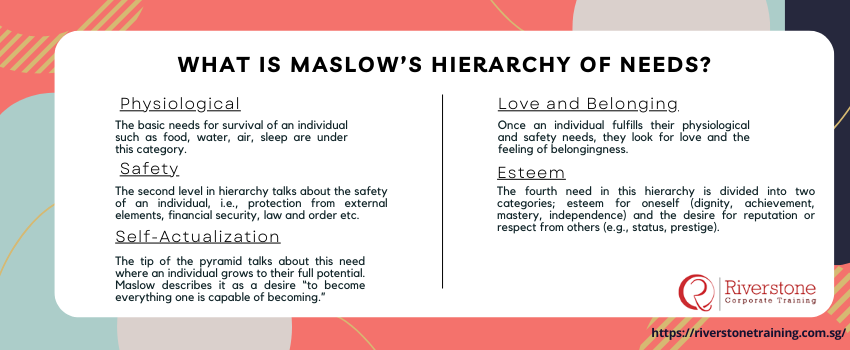
- Physiological: The basic needs for survival of an individual such as food, water, air, sleep are under this category. In case of failure in satisfying these needs, a human body cannot function and therefore, Maslow considered them to be the most critical needs.
- Safety: The second level in hierarchy talks about the safety of an individual, i.e., protection from external elements, financial security, law and order etc.
- Love and Belonging: Once an individual fulfills their physiological and safety needs, they look for love and the feeling of belongingness. Factors such as friendship, romance, family, social groups satisfy this need.
- Esteem: The fourth need in this Maslow’s Hierarchy is divided into two categories; esteem for oneself (dignity, achievement, mastery, independence) and the desire for reputation or respect from others (e.g., status, prestige). Maslow explained that individuals who satisfy their needs for esteem tend to feel confident about them.
- Self-Actualization: The tip of the pyramid talks about this need where an individual grows to their full potential. Maslow describes it as a desire “to become everything one is capable of becoming.”
In his research, Maslow talks about how an individual can satisfy the needs at the top of Maslow’s Hierarchy only after accomplishing the requirements at the bottom. For example, one cannot look for safety or love if they don’t have basic physiological needs such as food and water. According to Maslow’s theory, it is tough to skip the basic needs at the bottom of the hierarchy and reach the top; however, the order of satisfying one’s needs is not rigid. The progress through the hierarchy is just like climbing a ladder step by step and there are no shortcuts available for it.
Maslow noted that there is no standard progression for satisfying the needs as it can vary from one individual to other. It is very much possible that a person can choose self-esteem over love and look to fulfill that first.
Even after so many years and researches on this topic, Maslow’s theory of Maslow’s Hierarchy of needs is still the most well-known and recognized theory to date within the social science field.