Structuring Communication and Collaboration Workshops for Industry Professionals
Introduction to Certified Advanced Communication Skills Program
In the globalized work environment, organizations in any field will find it very crucial that they have high performing teams that possess good teamwork, effective communication skills, and interpersonal relationship skills among others. With the work environment progressing towards being more cross-functional and international, practitioners have to work with varying communication styles, cultural variations, internet-based collaborative tools and more complicated team dynamics.
Teamwork has ceased to be a soft skill; it becomes an important efficiency, innovativeness, and a key factor of long-term competitiveness in the organization. Loss of the communication process leads to decreasing productivity, inability of the teams to achieve deadlines, fragmentation of strategic performance, and this fact may eventually translate into reputation of the organization and trust to it by stakeholders.
To address the expectation of the contemporary workplaces, organizations are engaging in organized communication and teamwork training sessions to enhance interpersonal effectiveness and team coordination, as well as developing cultures of trust and collective responsibility. These workshops provide the industry professionals with the tools to express themselves clearly, effectively solve conflicts, develop team-work attitudes, and assist in the process of decision-making.
Introduced as either a holistic professional communication and team working skills training regimen or an intensive workplace collaborative and interpersonal effectiveness training curriculum, the following structured programs assist organization to neutralize the phenomenon of communication gaps, minimize the operational inefficiencies, as well as enhance team performances at every level.
Organized workshops are also a way to deal with common issues within a team, which could be the clash in expectations, lack of understanding, misinterpretation of culture, ineffective communication through mutual understanding and usage of a common language. Through the professional communication and team collaboration skills workshop use of interactive activities, simulation analyses and reflective discussions, such workshops enable professionals to be equipped to deal with routine as well as high stakes communication situations with calmness and ability. As time goes by, organizations incorporating such programs in their professional development approach have developed harmonious teams that can power innovation and enhance productivity and make the organization successful in the long run.
Why Organizations Need Communication and Collaboration Workshops
Enhancing Skills for Effective Cross-Functional Engagement
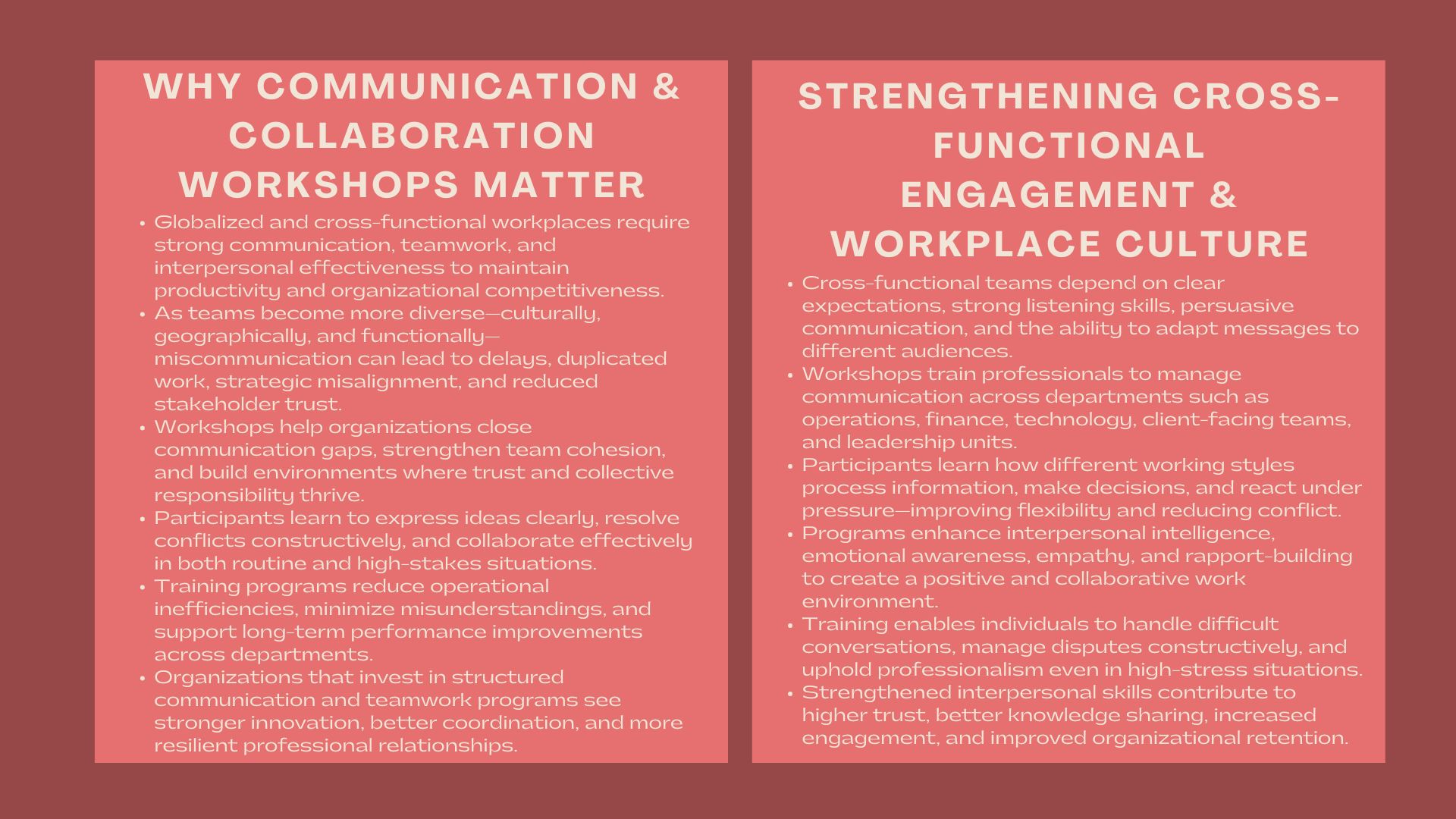
The current organizations are functioning using cross-functional teams, which combine talent of various departments, disciplines and geographical locations/ areas. Projects need smooth coordination among technical professional participants, operation executives, teams and interacting teams with clients as well as the management units with strategic leadership. Poor communication in such an environment results in misunderstandings, redundancy of work, expectations inconsistency and divergent goals. These problems have the effect of creating deadlines that can be missed, poor output, and escalated cost of running a business.
Formal workshops equip practitioners with models and effective skills that they require to overcome such hurdles. The participants are taught strategies which make them clear, understand how to listen effectively, be able to be persuasive during communication, and be able to adjust messages to fit various audiences. Programs will be focused to guide the participants in workplace collaboration and interpersonal effectiveness training, clarity of expression, sufficient feedback and participation in team discussions with certainty and exactness. Formal professional communication and team collaboration workshop is designed knowing that the participants study the importance of proper communication in affecting the success of an organization with proper values.
The power to cooperate within the working styles is also enhanced in workshops. Through learning the way the team members process information, make decisions and reactions to difficult situations, participants know how to adjust their communication to suit the needs of others. Such flexibility improves co-ordination, reduces conflict and it allows teams to act more efficiently, aligned and cohesive. It is also practised that the participants learn to solve misunderstandings, compromise, and build consensus which is important in high-stress processes and cross-functioning projects.
Fostering Positive Workplace Culture Through Interpersonal Development
Interpersonal effectiveness is also key to defining the culture of an organization and determining the way that a team operates in their day to day activities. Good interpersonal relations help in development of trust, knowledge sharing, enhance cooperation, and healthy working places. On the other hand, ineffective interpersonal relationships may impede any development, demoralize employees, and cause impediments that can slack down any organizational development, more so where team work is a key requirement.
Formal communication classes focus on interpersonal intelligence, as they teach professionals to be aware of emotional triggers, how to react to such triggers with empathy and how to establish rapport in different teams. Respondents are taught to contain awkward discussions and solve disputes in constructive ways, as well as be professional even when faced with adverse situations. Guided practice enables them to acquire skills that allow them to have a collaborative attitude and facilitate a healthy work culture.
Organizational development as a result of these workshops is based on the ability of the professionals to know the significance of empathy, respect, and emotional awareness in daily engagements. An effective workplace teamwork and interpersonal effectiveness training program enhances individual strength as well as group working environment by enhancing their own values and behaviour that leads to the establishment of teams, trusts and works over the long term. In the long term, it will be converted into more involvement, better retention of employees, and better organizational performance.
Essential Components for Designing Communication and Collaboration Workshops
Developing Core Communication Competencies
A well-organized communication workshop commences with basic skills training that will afford accurate, effective, and unambiguous communication. Respondents are exposed to the principles of good verbal, non-verbal, and written communication. They get to know the effect of tone, clarity, structure and delivery on the reception and understanding of messages. With the help of instructions, people learn to say complicated things in a compact form, adapt the methods of messages to achieve the desired effect with various people, and be clear even under stressful conditions or emotion appeals.
Listening is also a factor of communication effectiveness covered in workshops. The participants get to learn how to listen with purposefulness, find out the main points, explain the misconception and act wisely. They also employ reflective listening skills whereby members of the team are allowed to confirm what the other member of the team contributes and learn to understand one another. The achievement of such core skills will help the professionals be more efficient members of their teams and enhance effective communication channels through open and productive communication.
Besides skills that are the basics, skills that deal with the importance of communication in leadership are taught in workshops. The respondents discuss the way in which leaders communicate to motivate teams, offer guidance, craft vision and negotiate difficult discussions. During the process of developing these capabilities individuals can develop the power to impact others, create a consensus and promote organizational decisions which is specifically helpful in a matrixed or project oriented work set up.
Practical Exercises for Enhancing Team Collaboration
Cooperation will involve the professionals to effectively coordinate themselves across the various working styles, disciplines, and views. Workshops as a learning setting offer systematic learning processes which enable participants to train to be collaborative to solve problems, generate ideas and make decisions jointly. With supported scenarios, people know how to have good communication, negotiate the differences in opinions, and create a consensus that helps an organization achieve its goals.
Another area of training is the knowledge of the team dynamics and aspects of behavior that can affect collaboration. The participants look into the ways of building trust, the way of role definition, the way of responsibility assignment, and communication within successful teams. They are taught how to identify barriers to collaboration and work out the ways to overcome the barrier, which may be connected with the lack of miscommunication, incompatible priorities, or cultural peculiarities.
Through applying the skills in organized workshop models, the professionals develop confidence with regards to their capacity to work in teams. Not only do they acquire exposure in real life situations but they are also able to bring on the board something positive to the group realm. In the long run, such competencies assist a team to remain very efficient, creative and resilient even to deal with complex or high stress situations.
Adapting Workshops to Industry-Specific Needs
Customizing for Sector-Specific Collaboration Challenges
The communication place, workplace, and team work requirements in different sectors are different. The finance, healthcare, technology, manufacturing, retail, and energy industry need identity-specific communication approaches, based on their operational sets of reality. As an illustration, technology teams can be more dependent on digital collaboration, whereas healthcare teams will always require fast and accurate communication in times of crisis. The business world needs high cross-departmental cooperation, whereas the industry subject to customer interactions needs interpersonal effectiveness to effectively respond to the expectations of clients and uphold the quality of services.
Structured workshops have these factors of the industry in mind and set up content and method of delivery. Training programs provide insight that can be applied by practitioners in their professions by dealing with real-life situations, industry-specific issues and communication models. This personalization will increase the efficacy in the workshop as well as allow the participants to implement recently learned skills as soon as they could do it in their working fields.
Organizational communication practices are also supported by customized workshops that help organizations to fit in overall strategic goals. Whether it is to increase the efficiency of operations or assure a digital transformation, better the customer service or in internal governance, workshops are very instrumental in ensuring that organizations can be strategically aligned on a team and departmental level.
Promoting Cross-Departmental Collaboration and Integration
To work efficiently in a similar direction, there must be co-ordination between various departments and business units. Workshops give a participant a chance to learn how information circulates throughout the organization and how teamwork facilitates the implementation of the strategy. The participants are taught to overcome silos, information sharing, and integrate actions across the various functional units.
Training programs are pointed to the need to understand how individual functions relate. Through the processes of being educated on how various departments work and in what ways their input helps to provide the organization with its goals, individuals are able to have a clearer understanding of how interconnected their work is. This knowledge will help increase cooperation and lessen the tension among teams.
Also, workshops assist professionals in gaining the necessary confidence in order to have cross functional discussions and coordinate projects. They are taught how to clearly express their needs, allocate duties, handle divergent views and also make decisions of the team professionally and with dignity. With the improved cross-functional teamwork through this fortification, organizations become more efficient, more understanding, and establish a situation in which teams work in unison to accomplish similar objectives.
Developing Critical Thinking and Communication Judgment
Strategic Thinking for Complex Workplace Interactions
The communication at the modern workplace means that professionals are expected to think through situations and predict responses and look around the implications their message has. The workshops foster critical thinking ability which is strategic and they enable the participants to maneuver the intricate interactions when it comes to the skill of communication of a leader, handling of clients, resolving conflicts, and management of change.
The participants discuss the effects of communication on the decision-making, perceptions of messages in an organizational hierarchy, and how the situation affects interpersonal relations. Knowing the dimensions, the professionals gain knowledge on how to communicate more responsibly and frame their messages in accordance with the priorities of the organization. They also acquire the ability to know how to make early predictions on what may be misconstrued, how to prepare to handle difficult conversation, and how to strike a balance between being assertive and diplomatic.
Mastering Expressive and Interpretive Communication
Communication at work usually entails stakes that are very high making it more professional, sensitive and precise. Workshops build up interpretive skills of the participants enabling them to identify current concerns, emotional indicators, and unofficial expectations. The participants also acquire expression skills that will help in communication of messages and leading a conversation in a way that makes deliveries and explaining difficult questions in a clear manner.
The smoother the participants become in their skills of being able to interpret and expound ideas in a sophisticated manner, the more effective members of the operations and strategic discussion they will be. The better capabilities help to uplift the morale of the team, it assists in robust leadership and in conditions where communication is clear and respectful and oriented towards the organizational values.
Conclusion
In both industries, communication and collaboration workshops are very important in enhancing the performance of the teams. In well-organized learning, the professionals will acquire the skills on communication foundation, interpersonal intelligence, and collaborative competence shaping them to communicate in complex workplace settings. In-depth professional communication/team collaboration skill training course prepares one with the instrument to make contacts with coworkers, customers as well as stakeholders.
In the meantime, the properly designed workplace collaboration and interpersonal effectiveness training program will not only improve the relations between the team members but also reinforce the organizational culture and make collaboration a force to drive professional communication and collaboration training for cross-functional teams long-term success.
Through such investments, organizations end up having teams that perform excellently, and can work with sanity, oneness and professionalism in a world that is becoming so dynamic. In the long-term, such workshops lead to long time productivity, innovation and corporate strength making businesses to be in positions to compete effectively in rapidly changing industries.