Build your career with our industry-related courses. call us now at +65 9730 4250

Customer Service Training Programs for Retail, Banking, and Hospitality Sectors

Introduction to Certified Customer Experience Improvement Program

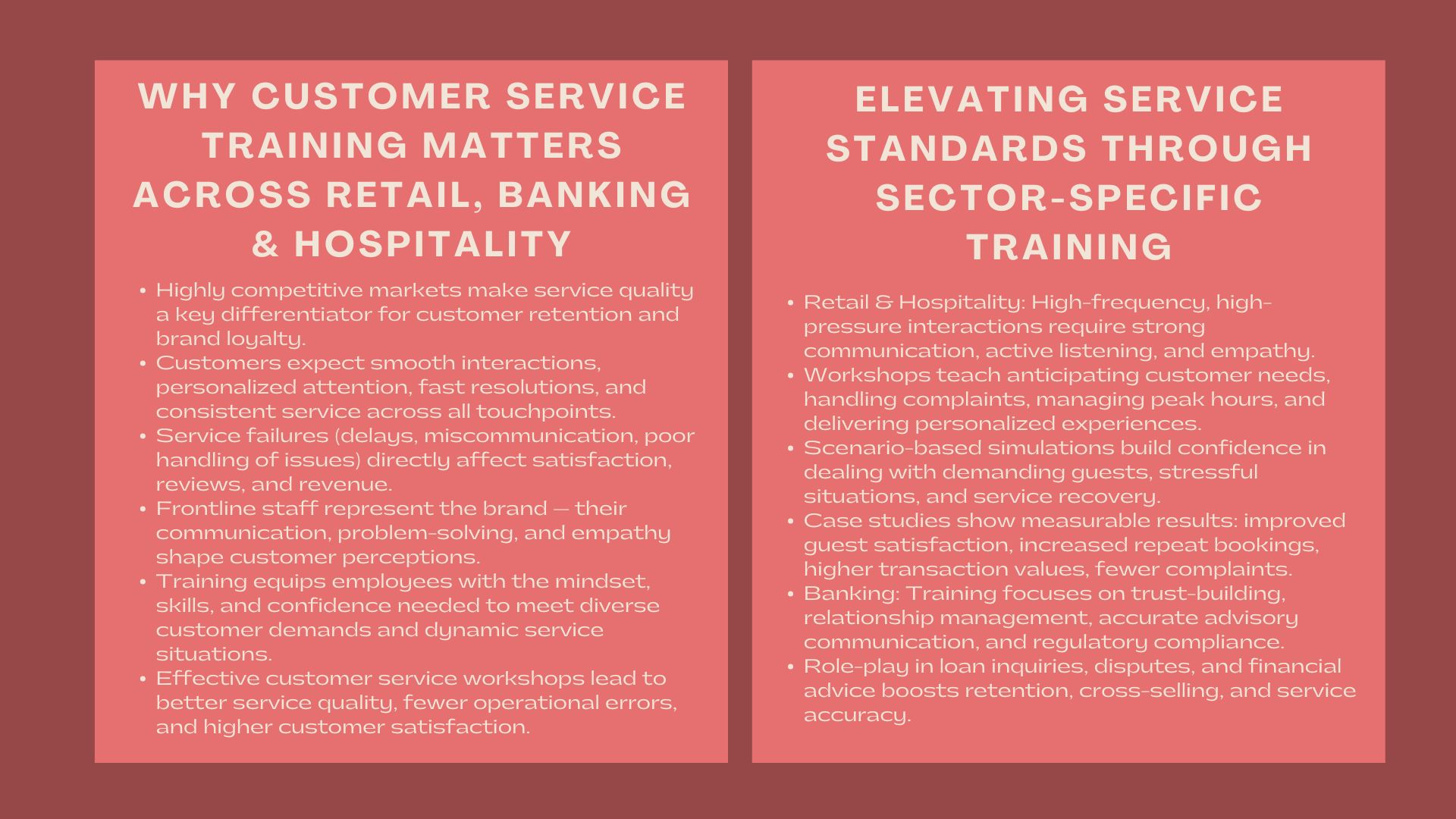
In the current highly competitive business environment, excellent customer service has been one of the key competitive points of the organizations that conduct their business in the retail, banking and hospitality businesses. Customers would demand smooth and convenient interactions, personal attention, and quality of services at various touchpoints. Any disruption in the service may lead to reduced brand loyalty, poor reviews, and failure to get revenue. It is thus the responsibility of the organizations to be able to provide their employees with knowledge, skills, and mindsets that enable them to persistently deliver excellent customer experiences.

Customer service specialists become the brand image and have a direct impact on the perceptions of the clients, brand image, and the retention of customers. The way they are able to interact, solve problems and develop positive relationships is what not only ensures instant satisfaction but also the capability of the organization to encourage long-term loyalty and support. The staff needs to be equipped sufficiently through comprehensive training programs to achieve the demands amidst the various customer demands, the dynamic service situations, and new industry requirements.

Formal courses like customer service excellence workshops in retail and hospitality industry or customer service and relationship management in the banking industry give employees the retail and hospitality customer service excellence workshop necessary practical skills, behavioral strategies and actionable models. Engaging in interactive learning, role-playing, and real-life simulations, the participants learn to be confident in their ability to cope with a challenging situation and surpass the expectations of the customers as well as become a part of the overall organizational success. Such programs have quantifiable returns, like the increased quality of service rendered, fewer mistakes in the functioning, and general client satisfaction.

Moreover, good customer service training generates an improvement culture in organizations. It motivates the employees to be proactive in seeking methods of improving the customer experiences, using feedback to guide improvement of the processes, and work together across the department to provide uniformity in service delivery. Investment in structured training programs lets organizations improve the competencies of individuals and at the same time increase the overall effect of operations and resiliency of business.

Certified Customer Experience Improvement Program

Elevating Service Standards Across Key Industries

Maximizing Retail and Hospitality Customer Experiences

Retail and hospitality industries have a very dynamic environment, since the customer interactions with them are empathic, immediate and high in frequency. The personnel has to deal with various types of customers, be able to cope with stressful events, and provide personalized services leaving positive feedback.

One method of tackling the challenges is a retail and hospitality customer service excellence workshop that facilitates the participants with skills that are necessary in communication, problem solving and relating with other people. The employees get to learn to expect the needs of the customers, complaints are addressed efficiently and service delivery is beyond expectation. Emphasis is also laid in workshops that focus on active listening, empathy and ability to make adjustments to various customer behaviors.

Training incorporates scenario based practice like dealing with demanding guests, dealing with periods of high service and dealing with complaints and providing customized advice. Through training these competencies within a simulation learning environment, employees become confident in the ability to be able to deal with real-life challenges. In the long term this will equate to an improvement in customer satisfaction rating, re-business and brand reputation.

Case Study: The example of a large hospitality chain which introduced a customer service excellence workshop in all their properties. The employees were engaged in a rigorous role-play of stressful scenarios like calls made by two separate customers who wanted to be at the identical hotel at the same time, and waited at the service desk. After half a year, the survey indicators of guest satisfaction rose by 18 percent. The company rated and reported a significant improvement in online reviews and a quantifiable effect on the increase in repeat bookings, proving the practical effect of systematic training of service providers.

Another case study is a chain of retailers that held industry workshops that dealt with addressing high-season traffic. The strategies encouraged among the participants involved how to solve problems fast, upselling without sacrificing the quality of the services as well as balancing between customer interaction and operational efficiency. The following improvements resulted in 12 percent growth in the average value of transaction, as well as, reduction in the number of customer complaints that were experienced during periods of high traffic.

Enhancing Banking Client Engagement and Relationship Management

Customer Service in the banking sector is not just about the essential interaction lies in the relationship management and financial advisory services as well as the building of trust. Bankers are required to find their way through the complicated product lines, regulatory needs and multi-stakeholder client interactions.

Training in bank customer service and relationship management also provides the employees with equipment that help them deal with client expectations, efficiently and efficiently address their inquiries and enable them to have long-term loyalty. The participants acquire competences in consultative dialogues, being proactive in solving problems and individual interaction. Workshops are oriented to the knowledge of customer financial objectives, prospects of cross-selling and upselling, professionally presenting and accurate service.

Case Study-Example: A regional bank has introduced relationship management training to its banking customer service and relationship management training front line employees, playing some scenario exercises that mimic an account dispute, loan question and investment consulting. Six months after the training, the retention of the clients increased by 12 percent and cross sell possibilities grew by 20 percent. According to the staff, there was greater confidence in handling complicated accounts and improved response times and individual treatment among clients, which is a positive indicator of the benefits of implementing specific service training programs in practice.

Core Skill Development in Customer Service Programs

Developing Effective Communication and Empathetic Interaction

Customer service can only be effective when there is effective communication and empathy. The training exercises focus more on verbal and non-verbal communication, toning as well as listening capabilities and expressing understanding and reassurance. Members are also taught how to customize their message concerning the context of the customer and respond in a way that is clear and understandable as well as help the client engage in a meaningful conversation.

Learning to be empathetic allows the staff to instead look at the customer and see the situation through their eyes as well as perceptions of what is to come and how to address any issues related to it to leave an impression or lasting impact on the customer. Such competencies will lead to better customer relations, enhanced level of ratings regarding customer service, and a rise in the number of business returns.

Active listening skills, empathy mapping exercises, facilitated reflections are some of the high-order techniques that are usually applied in workshops. Simulated role reversal and customer perspective helps the participants to internalize the significance of attentive listening to the emotional cues and responding adequately to improve the quality of interactions greatly.

Building Problem-Solving and Conflict Resolution Expertise

Customer service personnel are always faced with tough decisions such as complaints, lack of understanding and service failure. The training programs are based on systematic problem solving models, which aim at instructing the participants on how to pinpoint the underlying causes, consider alternatives, and execute the solutions in an effective manner.

Conflict resolution exercises will enable the participants to train de-escalation, professionalism in the pressure environment, and mutually beneficial conflict resolutions. High stress situations like dealing with angry clients, fixing billing mistakes, or service failures are simulated by realistic real-life situations. Such abilities do not just solve short-term problems but also help avoid the repetitions of the problems and build credibility with the clients.

Fostering Relationship Management and Customer Loyalty

In the retail, banking and hospitality sectors customer loyalty leads to long term success. The training is based on proactive interaction, personal treatment, and follow-up procedures which strengthen the relationship not only after one exchange. The participants will be taught how to monitor the interactions, identify areas of value addition, and how to execute strategies that will lead to a repeat business.

Applied learning enables the employees to know how to make a simple gesture, communicate at the right time and how a problem can be resolved in a manner that will make the customer satisfied and loyal. The workshops frequently have case studies, where the participants test the real-life interaction with customers and come up with solutions to ensure better retention and advocacy. In the long run, the practices work to uphold positive organizational image, retention and achieve sustainable growth.

Customizing Training for Sector-Specific Needs

Adapting Programs for Retail and Hospitality Contexts

Work-based situations (similar to peak-time service, dealing with multiple guests, high-stress situations, etc.) are included in retirement and hospitality training. The participants learn how to balance intensity, efficiency, and individual attitude so that the quality of the service should not be compromised under a difficult situation.

Another aspect drawn in workshops is upselling and cross-selling methods which are specific to retail goods or hospitality facilities. Through the combination of the practical practices with the customer experience strategy, the staff acquire skills that are reflected directly in the increase in sales, customer satisfaction, and memorable guest experiences.

The lengthy regimes can incorporate subjects concerning the management of luxury clients, event management, and cross-cultural communication with international customers so that the participants can be made ready to provide service excellence in a variety of settings.

Tailoring Banking Training for Relationship Excellence

The banking customer service training incorporates the industry-specific details such as compliance with regulations and financial products, as well as the multi-level interactions with the clients. The participants participate in simulations associated with managing accounts, advisory discussions, and solving complicated questions.

The curriculum focuses on the efficiency at operations and also relationship building that will ensure that employees are able to provide the correct, compliant and personalized service and that trust, and confidence amongst the clients are developed. Digital banking platforms, fraud detection, and ethical advisory matters could be another area of professional competency that should be included in longer workshops.

Leveraging Technology, Analytics, and Continuous Development

Integrating Technology for Enhanced Customer Service

Contemporary customer service has become extremely dependent on technology, such as CRM systems, online communication tools, and service analytics. It is achieved through training programs that teach the participants to make good use of these tools, monitor customer contacts, and tailor their service delivery in relation to actionable insights.

The participants are trained on digital interaction thus the uniform and optimal service delivery through physical, virtual, and cellular interfaces. Through a combination of both the knowledge and interpersonal techniques, the employees are able to deliver good and smooth services to cater to the changing customer requirements. Simulations of virtual interactions with customers and strategies to execute on the omnichannel service may also be included in workshops to make the participants ready to operate in the new services environment.

Tracking Performance and Encouraging Continuous Improvement

Some of the structured customer service programs have the mechanisms of continued assessment of performance. Customer satisfaction rates, time taken in resolution of complaints as well as repeat rates of interactions are measured to be in the skill retention and application. Self-feedback, coaching, and refresher courses would ensure the service standards remain high in the long run.

When this approach is followed, a spirit of excellence takes root in the organization since the employees are eager to advance every time, embrace new challenges and give their customers outstanding experiences every time. Performance analytics integration enables the managers to track the gaps in the skills and their accomplishments, and establish the interventions to use, strengthening the accountability, and stimulating the constant development.

Conclusion

Customer service training programs of total retailing, banking and hospitality sectors would go a long way in imparting professionals with the competence, expertise and confidence to thrive in very competitive and challenging markets. The investment into the retail and hospitality customer service excellence workshops and banking customer service and relationship management training will result in the creation of teams of employees who can consistently provide excellent experience, generate customer loyalty, and contribute to the business’s sustained growth.

Such programs develop an integration of communication skills, empathy, problem solving, relationship management, expertise in technologies and analytical wisdom. Scenario-based exercises, role-playing, and applied learning enable the participants to have practical experience that can be converted into the measurable achievement of the improved service quality, client satisfaction, and organizational performance.

Also, companies are able to be relevant and easily applicable by designing programs to the needs of a particular sector because the employees can learn to navigate the intricate interactions, follow the industry rules, and offer personalized solutions. These are further enhanced by continuous performance monitoring, coaching and technological integration, which develops the culture of excellence and continuous improvement.

Finally, customer service training is well planned and focused and will enable organizations to establish a stronger reputation in the market, increase their customer base and base, maintain their competitive advantage on the long term basis in retail, banking as well as hospitality industries. Through the development of very skilled, confident and customer-oriented professionals, such programs make sure that the organizations are kept responsive, flexible and successful in the current business world that is retail and hospitality customer service excellence workshops characterized by ever changing patterns and trends.

Not only does the long-term implementation of these training programs improve the capabilities of the frontline, but also influences the organizational culture with the establishment of the customer-centric approach to thinking as a part of the everyday routine. Those companies that invest in service excellence in the long run realize tangible returns on operational productivity, participation in teams, brand image, and customer sales, which become a vicious cycle, increases employee satisfaction and loyalty to the customers.

customer/certified-customer-experience-improvement-program