Case Study: Leadership In-House Training Services Strengthening Management Capability and Organisational Alignment
Background on Case Study Leadership In-House Training
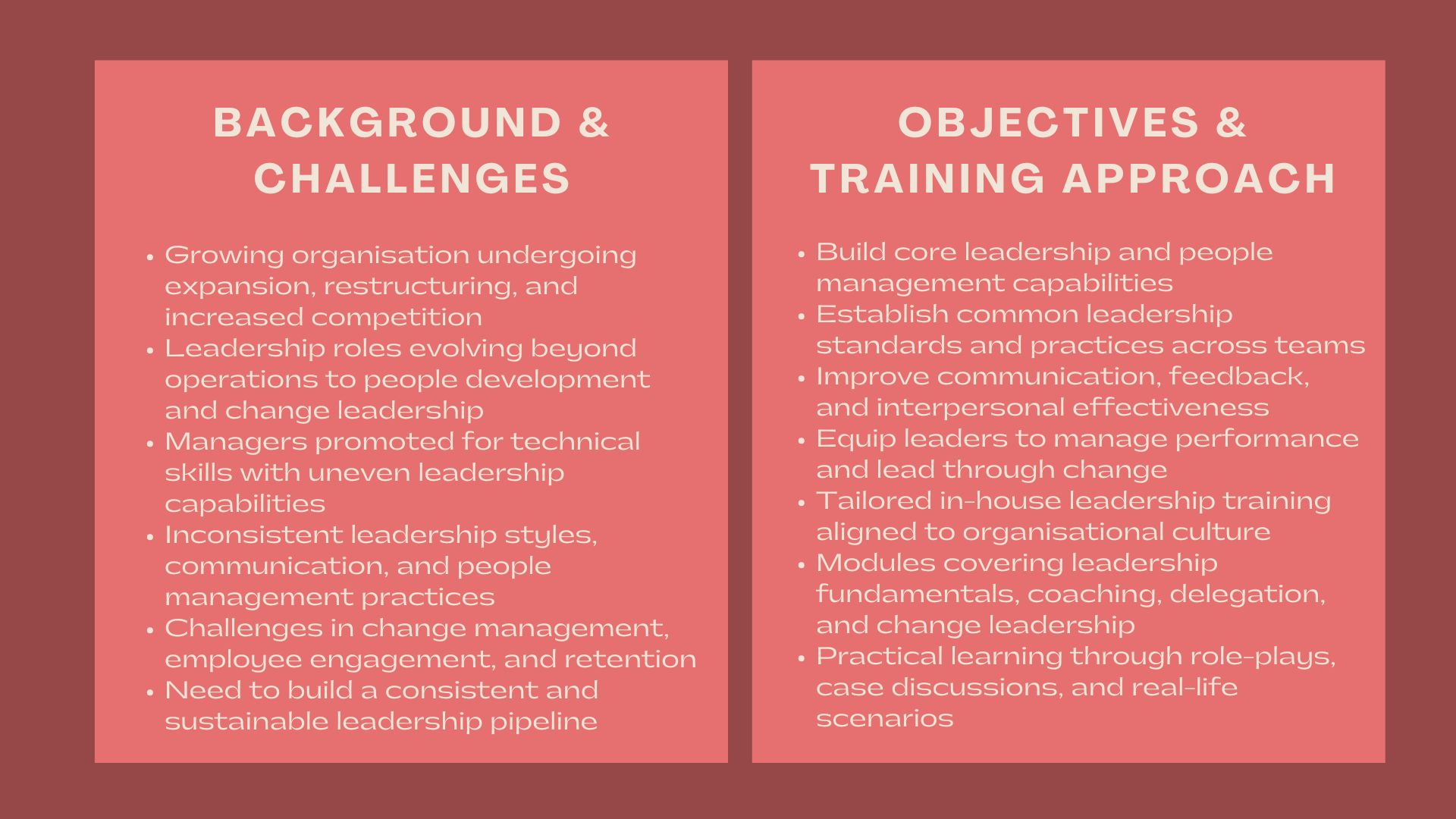
An organisation that was growing and had many business units was going through a strategic change. The company was also venturing into markets that had not been served before, reorganizing teams and also transferring high performers to managerial and supervisory positions. With the growth in the level and complexity of leadership roles, the top management realised that they needed to enhance leadership capacity within the organisation.
Although several managers had high technical or functional knowledge, their skills in leadership had emerged in an informal and haphazard fashion. Disagreements in management style, method of communication and decision making were starting to have an impact on team alignment and effectiveness in work.
As a measure to develop consistent and able leaders, the organisation contracted our Leadership In-House Training Services to develop and implement a structured leadership development programme that is in line with its culture, values, and business goals.
Issues and Challenges
Formal leadership development was necessary because the organisation encountered several challenges that underscored formal leadership.
Lack of an equitable leadership capacity was one of the challenges. The new managers were also not technically trained in people management, delegation, performance management and conflict management.
The other issue was the lack of consistency in the leadership practices. The lack of a common system of leadership made managers use various criteria in communication, feedback and decision-making, which caused the misalignment of teams.
There were also problems in change management. The organisation was being transformed and the leaders should have had the ability to lead the team through insecurity, keep the team involved and be able to handle resisting change.
Other issues were employee engagement and retention. Managers were very instrumental in creating employee experience, and not all the leaders were well prepared to inspire teams, manage development requirements, and resolve performance issues in constructive ways.
Lastly, the top management wanted to develop a leadership pipeline. Leadership development was required to assist the current managers and potential employees who were on their way to leadership positions.
Objectives
The main goal of the engagement was to enhance the leadership potential with the help of tailored in-house training in leadership.
In particular, the organisation was striving to:
- Establish basic leadership and people management competencies.
- introduce the uniform leadership norms and behaviours.
- Improve communication, feedback and decision-making skills.
- Assist leaders in change management and supervise the team performance.
- Establish a leadership development system that is sustainable.
The training programme should have been realistic, interactive and in line with actual leadership problems that those involved would be experiencing.
How We Helped
In-house training of our leaders was practiced in a structured and a collaborative manner, and aligned with the organisational culture, structure, and strategic priorities.
We started our interaction with a leadership needs assessment. We collaborated with top management and HR executives to gain insights into the leadership issues, demands and gaps in competencies in the organisation. This guided the creation of an oriented and pertinent training programme.
Now on this evaluation, we have designed tailor-made leadership training modules with major issues like leadership basics, communication and influence, performance management, delegation, coaching, conflict management and leading change. The content was in line with organisational values and management philosophy.
There was a strongly focused practical practice. Real life situations, role plays, group discussion and reflective exercises were included in the training sessions which made the participants apply to their teams and challenges.
The programme was designed in such a way that it could fit in with the various levels of leadership such as the first-time managers and more experienced leaders. This facilitated applicability and enhanced common language and expectations of leadership throughout the organisation.
The delivery of training was interactive. Workshops were held both in person and virtually with an option of making them flexible and still having meaningful participation.
In order to strengthen learning, we used supporting resources and practical aids, including leadership models, communication, and action planning templates. The participants were asked to practice learning intersessionally and to introspect.
During the interaction we were in close contact with participants and organisational leaders to promote free discussion, solve challenges and modify content when necessary. Debriefing has been included to make it more relevant and effective.
Value Delivered
This case study explains how the Leadership In-House Training Services by professionals can empower management talent and organisational harmony.
Engagement achieved via organized and applied leadership training was beneficial in creating more stable and self-assured leaders, enhancing communication and teamwork, and assisting employees in navigating change. Better involvement and more understanding of leadership expectations within the organisation were also a result of the training.
The leadership training model that was formulated in the course of this interaction offered a framework of scalability to future leadership development, talent development and organisational success over the long term.