
Case Study: Valuation In-House Training Services Enhancing Valuation Capability and Decision Support
Background on Case Study Valuation In-House
The organisation was a professional services business and investment-driven organisation operating in an industry that was highly competitive. The demand was growing around valuation-related information. A broad array of uses was required of valuation inputs, such as investment analysis, financial reporting, supporting transactions, fundraising discussions and internal planning, regulatory or audit-related reviews.
Although the organisation has been utilizing external advisors in complex valuation-related engagements, the management realised that it needed to enhance internal management knowledge in finance, strategy, investment and corporate development teams. The internal stakeholders were becoming more likely to make sense of valuation reports, question assumptions and apply valuation to business decisions.
Nonetheless, the knowledge of valuation was not even in the organisation. Part of the team members had good financial modelling knowledge, whereas others were not well exposed to the valuation procedures and standards. In an attempt to bridge these loopholes and enhance its internal capacity, the organisation used our Valuation In-House Training Services to design and provide structured and practical training programmes.
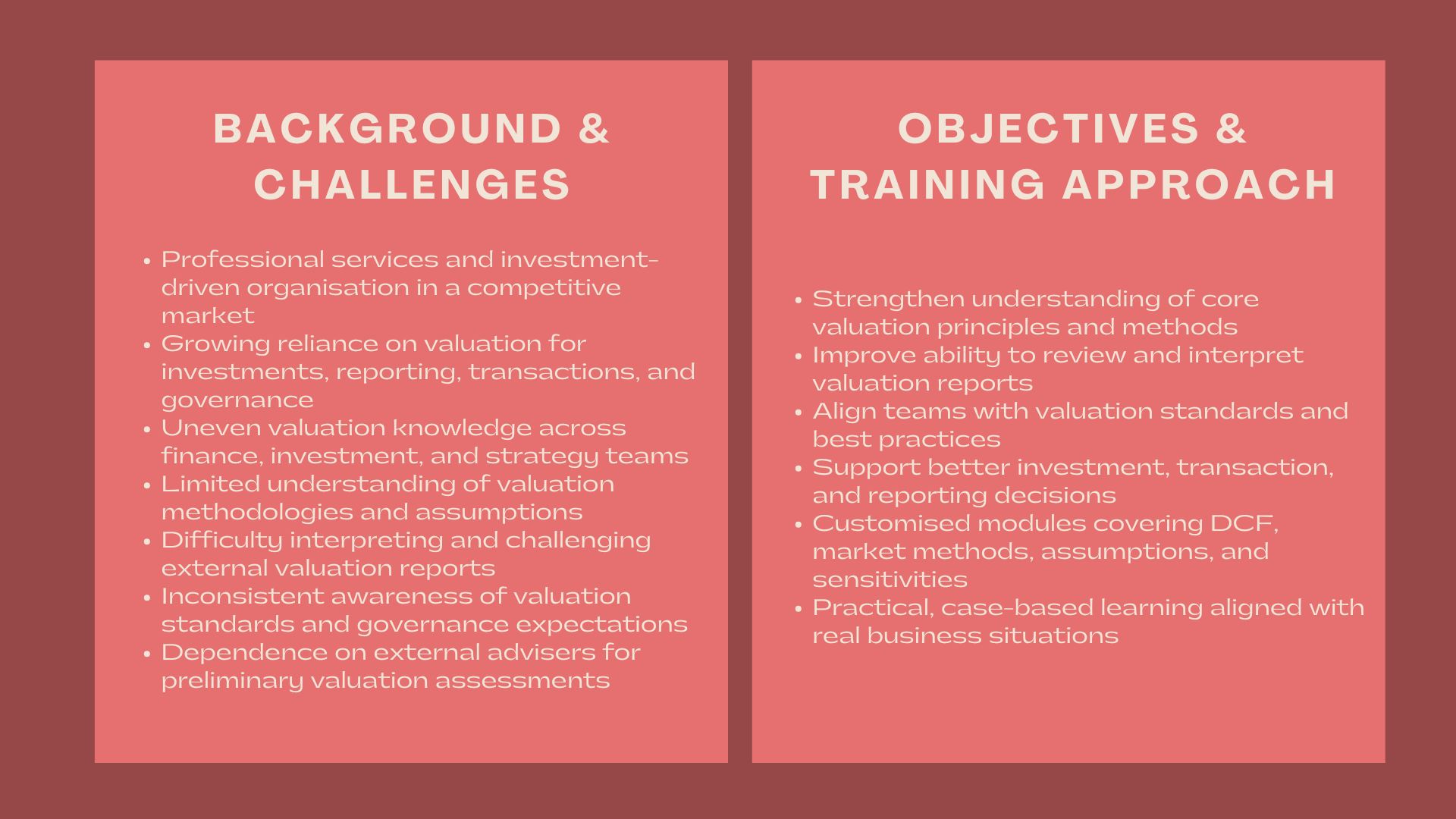
Issues and Challenges
The organisation was experiencing a number of challenges that pointed at specialised training on valuation.
Poor understanding of valuation methodologies was one of the challenges. Those in the team knew the upper-level principles of discounted cash flow and market multiples, but they were not clear about the methodology choice, the development of assumptions, and the disadvantages of each method.
The other issue was to interpret valuation reports. It was not easy to internally evaluate valuation inputs, sensitivity analysis and conclusions made by external consultants and this diminished the ability of the internal stakeholders to participate actively in discussions with the auditors, investors as well as regulators.
Valuation standards and reporting considerations were also not known well. Since the valuation outputs were utilised in the reporting of financial, transactions, and governance activities, management acknowledged the need to harmonise the internal knowledge and the accepted valuation frameworks and professional practices.
Practical application was also another challenge. The generic valuation training was not sufficient to capture the situation in the industry, the structure of the transactions, and the decision-making requirements of the organisation.
Lastly, the organisation aimed at decreasing the use of external advisers to make preliminary valuation assessment and enhance the efficiency of the internal review and decision making.
Objectives
The main rationale of the engagement was to create internal valuation capacity by way of valuation training in-house.
In particular, the organisation was aimed at:
- Enhance the knowledge of basic valuation principles and approaches.
- Enhance the skills of reading and reviewing valuation reports.
- Improve the knowledge of best practices and valuation standards.
- Enhance investment, transaction and reporting decisions.
- Create a common value system between teams.
The training had to be deep in technical aspects and yet practical; it had to be affordable to a wide range of valuation-experienced participants.
How We Helped
Our valuation strategy involved a systematic and concerted effort to in-house training using the business model, industry focus, and needs of the organisation.
We started by carrying out a valuation training needs assessment. We had interacted with the senior management and other key stakeholders to learn how valuation was utilised in the organisation, what some of the challenges encountered by teams, and what degree of technical knowledge each role demanded.
This evaluation enabled us to prepare tailor-made training modules on the basis of basic and practical valuation issues. These involved valuation principles, choice of methodology, discounted cash flow analysis, market-based valuation methods, development of assumptions, sensitivity analysis and interpretation of valuation findings.
We also included education about valuation standards, governance issues and typical pitfalls of valuation. This gave the participants insight into the manner in which the participants of the audit review valuation outputs by the auditors, regulators, and investors.
There was a high focus on practical application. Case-based discussions as well as simplified valuation models and examples of actual transactions and reporting situations were included in training sessions. The participants were taken through the reasoning of the assumptions and the outputs of valuation, as opposed to paying attention to the technical computation only.
The programme was designed in such a way that it would suit the participants of various functions as finance, investment, corporate development and management functions. This was relevant and it contributed to development of consistent valuation understanding among teams.
The delivery of training was dynamic and integrated both face-to-face training and online courses. There was engagement and analysis through interactive discussions, questions and answers, and analysis of a situation.
In order to enhance continuous learning, we gave reference materials, valuation frameworks, and practical guides, which participants could make use of after training. These materials contributed to strengthening ideas and internal debates that were related to the issue of valuation.
During the engagement, we collaborated with the participants in asking questions, explaining complicated issues, and adjusting the explanations to the business setting of a particular company.
Value Delivered
This case study illustrates that professional Valuation In-House Training Services help enhance the internal valuation capability and decision support.
The engagement was useful in increasing confidence in valuation-related discussions, beneficial to the quality of internal review and challenge of valuation reports, and facilitating more informed decision-making in investment and transaction decisions with the aid of customised and practical training.
The in-house training model that emerged as a result of this engagement offered a platform of scalability to continue building capabilities, enhance better governance and increased utilisation of the valuation insights within the entire organisation.