Case Study: Soft Skills In-House Training Services Enhancing Communication, Collaboration, and Workplace Effectiveness
Background on Case Study Soft Skills In-House
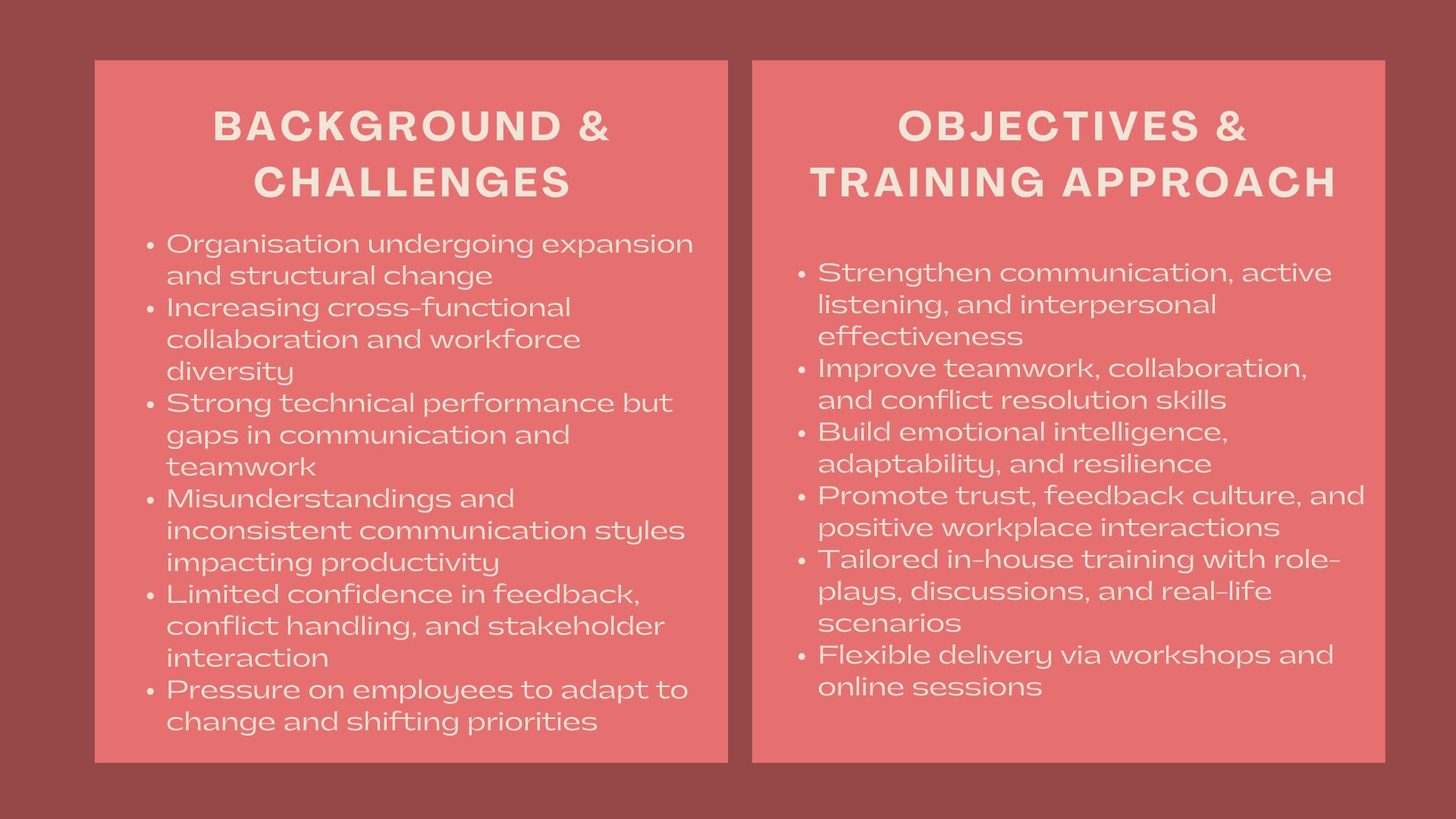
It was an organisation in full operational expansion and change of structure; a growing organisation that had various functions and teams. With the growing diversity of the workforce and the rise in cross-functional collaboration, the management realised that technical expertise was not enough to enable effective performance and sustainable growth any longer.
Although the employees were showing excellent technical and professional performance, there were developing gaps in the domains of communication, teamwork, interpersonal effectiveness and adaptability. Managers found that the productivity, collaboration and employee engagement were being impacted by misunderstandings, mismatched expectations, and differences in communication styles.
In a bid to deal with these issues and achieve better performance in the workplace, the organisation has contracted our Soft Skills In-House Training Services to develop and conduct an organised and practical training programme that suits its culture, operating environment and people development goals.
Issues and Challenges
There are various issues that the organisation encountered thus showing the necessity of the formal development of soft skills.
Lack of coherent communication between teams was one of the challenges. Communication differences, expectations, and cultural differences created some misunderstanding, delays and inefficiencies during day-to-day work at times.
One more challenge was collaboration and teamwork. With the growing input of cross-functional input to projects, there were teams that lacked effective collaboration, conflict resolution and shared goal orientation.
There was also an issue of interpersonal effectiveness. The employees did not always feel secure in providing or receiving feedback, handling challenging discussions, and shaping stakeholders in a positive way.
Flexibility and capacity to withstand were other problems. Development of new priorities, processes and organisational structure continued to place pressure on employees to be flexible, adaptable, and be able to perform in the dynamic environment.
Lastly, the management aimed to enhance the overall employee engagement and workplace culture by investing in the interpersonal skills of the employees to enable them to work well with their colleagues, clients and stakeholders.
Objectives
The main aim of the engagement was to enhance interpersonal capability within the organisation by training soft skills customised in-house.
In particular, the objectives of the organisation were:
- Communication and active listening.
- Improve functional teamwork and collaboration.
- Develop trust in person to person interactions and feedback.
- Enhance flexibility, emotional and emotional intelligence.
- Promote a good and healthy working environment.
The training had to be relevant, practical and inclusive to participants in various levels and roles of the organisation.
How We Helped
Our in-house training of soft skills was done in a systematic and participatory way, depending on the culture of the organisation, workforce composition as well as the developmental priorities within the organisation.
We have commenced with a soft skills training needs assessment. In collaboration with the HR and the management, we found out that we shared similar challenges in interpersonal relationships, desired behaviours, and areas of priority skills across teams.
On the basis of this analysis we developed tailored training modules to address some of the important soft skills areas that include effective communication, active listening, teamwork, emotional intelligence, and conflict management, time management, and flexibility.
An intense focus was put on practice. Role-plays, group discussion and interactive activities and real-life workplace situations were used in the training to ensure that the participants were allowed to practice their skills in a safe and constructive environment.
The training programme was made to accommodate members of various functions, seniority and styles of communication. The contents were in a clear and accessible format and this enabled participation and engagement.
The forms of delivery could be flexible such as face-to-face workshops and online where necessary based on the operations. This was facilitated through interactive methods to ensure that people stayed engaged and reflected and discussed.
In order to enhance learning, we had supporting resources and aids, including frameworks of communication, feedback models, and self-reflection guides that the participants have access to post-training.
During the engagement, we collaborated with the participants by closely answering questions, having a free-flowing discussion, and adjusting the discussion to the actual problems in the workplace.
Value Delivered
The case study shows that professional Soft Skills In-House Training Services can lead to an increase in communication, teamwork, and performance at work.
The engagement contributed to the enhancement of the overall performance of the working environment as the improved interpersonal skills, enhanced team dynamics, and a more positive and efficient working environment were built with the help of customised and interactive training.
The in-house training system of soft skills that were created through this engagement offered a scalable basis of continuous people development, greater employee engagement and enhanced organisational culture.