
Case Study: Rating In-House Training Services Strengthening Credit Rating Understanding and Risk Communication
Background on Case Study Rating In-House
An organisation that is financially services based and is exposed to capital markets, lending and investments became more of a necessity to interact with external credit rating agencies, investors and regulators. The credit ratings were critical to the cost of financing the organisation, capital plan, counterparty relationships and risk profile of the organisation as a whole.
With the increased integration of rating consideration into learn strategic and day-to-day decision making, the management realised that internal knowledge on credit rating frameworks and methods would have to be enhanced. Although some members of select individuals had experience of dealing with rating agencies, greater teams did not have a systematic appreciation of how ratings are made, monitored, and disseminated.
To develop internal capacity and guarantee a regular involvement to the issues of ratings, the organisation contracted our Rating In-House Training Services to develop and implement an appropriate training programme based on its business model, risk profile and the regulatory environment.
Issues and Challenges
There were a number of challenges that the organisation encountered that made specialised training that was rating-oriented.
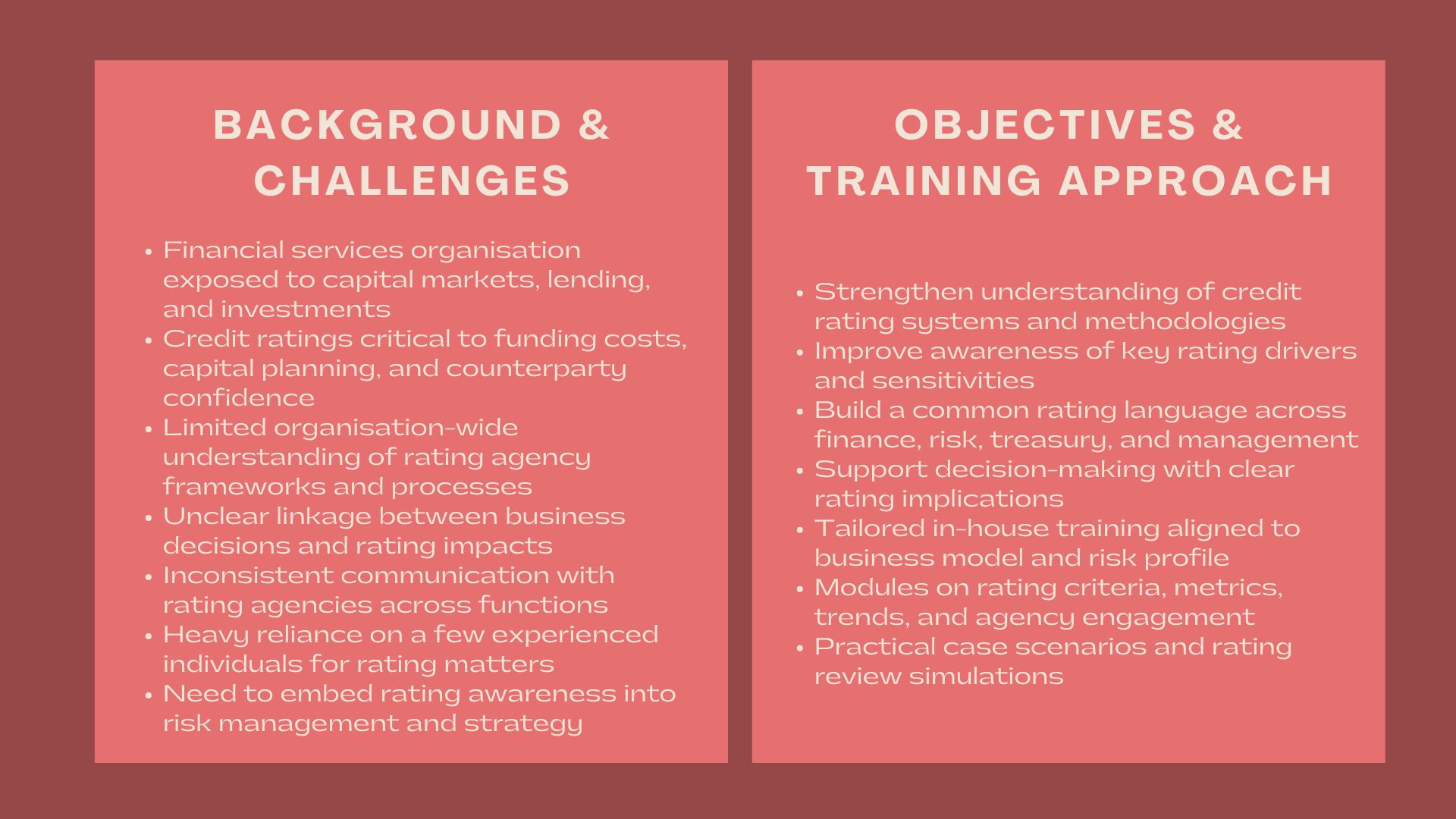
One of the problems was the lack of knowledge on rating agency procedures. Although ratings were constantly mentioned, a lot of stakeholders were not sure how qualitative and quantitative considerations were evaluated and rated by rating agencies.
The other difficulty was interpreting business decisions in terms of rating impacts. Leverage changes in capital structure, financial performance, risk appetite, or strategy had not always been understood how they might change credit ratings over time by teams.
It was also difficult in communication with rating agencies. And the coordination among functions was necessary to prepare rating reviews, information requests, and presentations; however, not every participant could be sure how to tell the credit story of the organisation in a systematic and productive way.
It also depended on a few experienced people to rate issues relating to ratings, which augmented the risk of key-person and restricted organisational stability.
Lastly, the management aimed to incorporate rating consciousness, to more global risk management and strategic planning efforts, as opposed to ratings being conducted as a single or responsive activity.
Objectives
The main goal of the engagement was the enhancement of the rating-related competence by tailored rating in-house training.
Particularly, the organisation wanted to:
- Enhance knowledge in credit rating systems and process.
- Improve the consciousness of rating drivers and sensitivities.
- Enhance internal synergies to rate agency participation.
- Support Authorized decision making with rating implications.
- Develop the common rating language between teams.

The training had to be pragmatic, non-specialist and consistent with the credit profile and strategic focus of the organisation.
How We Helped
Our rating strategy was a structured and collaborative method of rating in-house training, based on the industry of the organisation, exposure to rating and internal governance structure.
The interaction started with a rating training needs assessment. We interacted with the finance, risk, treasury, and senior management teams to find out the present rating profile of the organisation, the history of interaction with the rating agencies, and the internal issues concerning rating management.
On this evaluation, we developed tailored training kits on main areas of rating. These encompassed the description of credit rating agencies, rating scale, criteria of qualitative and quantitative assessment, and standard rating techniques.
We also discussed driver rating and sensitivities whereby the participants got to know how financial metrics, business risk, governance, and strategic decisions affect the rating results. It has focused its attention on the knowledge about trends and future consideration as adopted by rating agencies.
The training involved communication and engagement with rating agencies. The participants were advised on the best practices to prepare rating materials, answer information requests and present an understandable and plausible credit story.
Much importance was given to practical application. The training sessions were based on realistic scenarios, simple discussion of rating cases, and the illustration of the usual rating review processes. The participants were advised to take into consideration the implications of rating when they are analysing business decisions.
The programme was designed in a way that it could house members of various functions such as finance, treasury, risk, strategy and senior management. This guaranteed relevancy and generated a consistent understanding of rating in the organisation.
The delivery of training was adaptable with both physical and online workshops to be used as needed. There were interactive discussions, question and answers, and scenario analysis to stimulate interest and more insight.
In order to strengthen the learning process, we gave out the supporting materials, rating frameworks and reference guides which the participants could use at the end of the training process so as to assist in the continuous rating activities.
During the engagement, we collaborated with the participants to demystify concepts, answer questions, and modify discussions to a specific rating situation of the organisation.
Value Delivered
This case study illustrates how professional Rating In-House Training Services can enhance the internal knowledge on credit rating and also enhance the risk communication.
The engagement assisted in raising confidence in discussions on ratings, gaining better coordination between teams, and making more informed strategic and financial decisions with rating factors in mind, through customised and practical training.
The rating in-house training structure was created on the basis of this engagement and this established a scalable basis of future capability building, enhanced governance, and enhanced engagement with rating agencies, and stakeholders.
