Case Study: Leadership In-House Training Services Developing Confident and Effective Organisational Leaders
Background on Case Study Leadership In-House Training
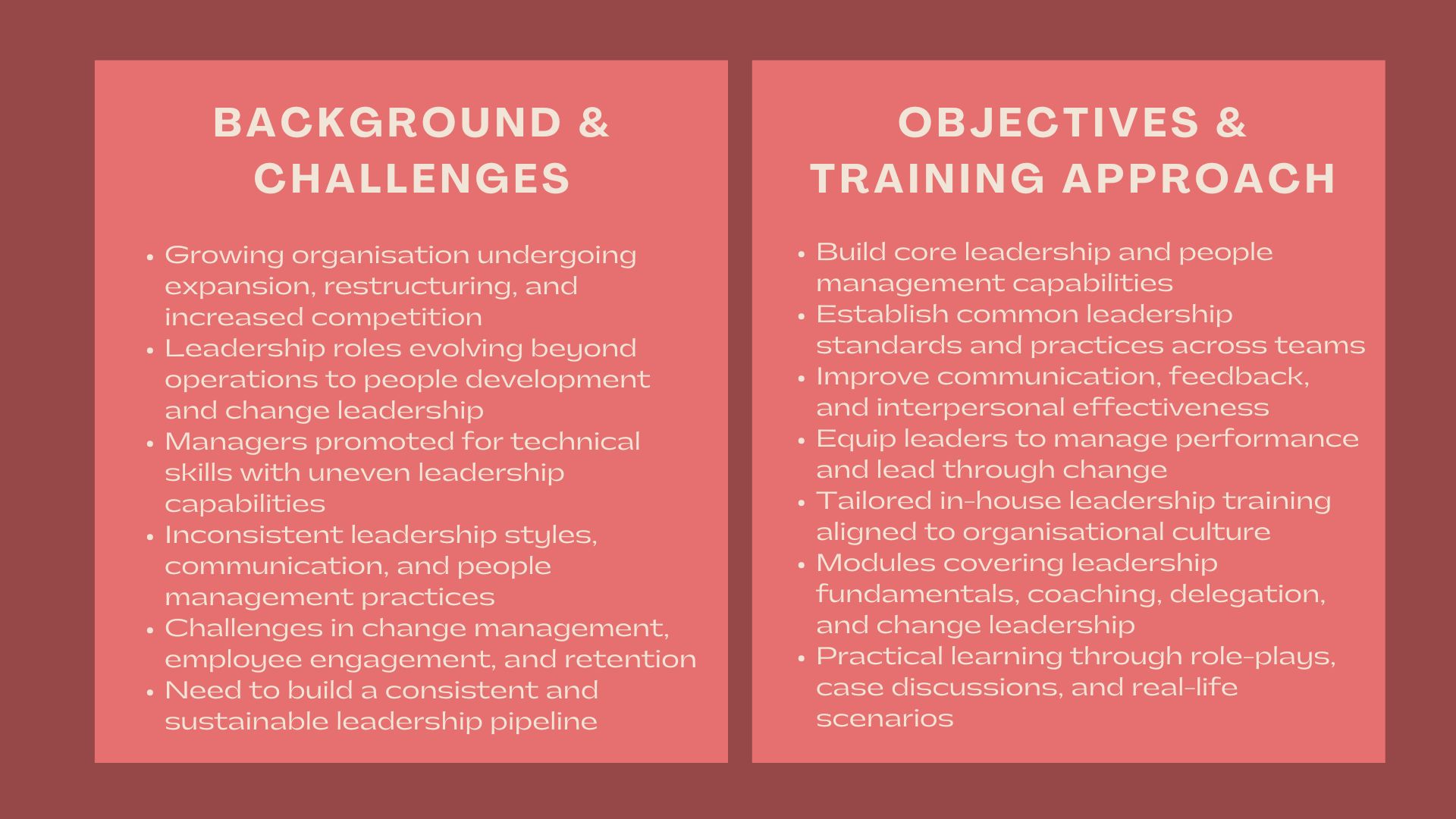
An organisation that was in its developing phase and had several business units was experiencing a transitional phase due to the expansions, organisational reorganisation, and the growth in competition. As the company grew, the role of leadership shifted to cover not only the supervision of the operations but also people building, multi-functional teamwork, and strategic implementation.
Most of the team leaders and managers promoted had been on the basis of good technical or functional expertise. But the leadership competencies had grown in an organic and uneven manner throughout the organisation. The distinction in leadership style, communication strategy, and people management practices were starting to have an impact on the team alignment, consistency of performance and employee engagement.
The top management realised that a good leadership was essential in the continuation of growth and good organisational culture. In order to deal with these issues and establish a stable leadership base, the organisation has sought the services of our Leadership In-House Training Services to help in developing and implementing a systematic, hands-on, and organisation-specific leadership development programme.
Issues and Challenges
The company experienced a number of difficulties which pinpointed the importance of institutional training on leadership.
Inequalities in leadership abilities was one of the challenges. The new managers did not have well-structured training on people management, delegation, coaching and performance management. Although technically qualified, most leaders were still lacking confidence in how to lead teams.
The other problem was uneven leadership practices in the departments. In the absence of a shared leadership structure, managers used varying standards when conveying expectations, giving feedback and correcting performance problems. This paradox at times caused misunderstanding and lack of interest in the team members.
Change management was also a major problem. The organisation was introducing new processes and strategic initiatives that necessitated leaders to lead teams through uncertainty, stay motivated and withstand resistance in a constructive manner.
Other issues included employee engagement and retention. It was noted that leadership quality directly affected employee experience, but not every manager was prepared to motivate, support, and develop his or her team.
Lastly, the organisation aimed at enhancing its leadership pipeline. The need to train high potential employees and current managers was evident to occupy future leadership positions organized and in a sustainable way.
Objectives
The first aim of the engagement was to enhance the organisational leadership capacity via bespoke leadership in-house training.
In particular, the organisation was going to achieve:
- Learn fundamental leadership and people management.
- Each develops uniform leadership guidelines and practices.
- Improve interaction, feedback, and interpersonal effectiveness.
- Prepare leaders to handle change and performance.
- Establish a long term leadership development system.
The training programme should have been realistic, involving and in line with the culture, values and business objectives of the organisation.
How We Helped
Our leadership in-house training strategy was structured and collaborative based on leadership issues facing the organisation, workforce profile, and organisational strategic priorities.
Our interaction started with a leadership needs evaluation. We collaborated with the senior management and HR managers in order to gain insight on leadership requirements, competency deficiencies and the general issues that managers in the organisation may encounter.
In this evaluation, we developed a tailored leadership training module on major areas of leadership fundamentals, communication and influence, delegation, performance management, coaching skills, conflict management, and leading through change.
Overemphasis was made on practice. Real-life leadership situations, role-plays, group discussions and reflective processes were used in the training activities to enable participants to apply the concepts in real-life situations within their teams.
The programme was designed to suit the members of various levels of leadership (first-time managers and experienced leaders). This guaranteed relevance coupled with the following of standard leadership language as well as coherence in expectations throughout the organisation.
It was interactive and engaging in the delivery of training. The sessions were held in combination with both in-person workshops and virtual ones in order to meet the operational needs. Facilitated discussions helped the participants to learn through sharing experiences and learning together.
We also gave effective learning aids and resources, including leadership models, communication strategies, feedback systems, and action planning templates, to support the learning process. The participants were encouraged to practice learning in between the sessions and consider their leadership practices.
During the engagement, we collaborated directly with the participants to resolve problems, explain ideas, and customize the conversations as it related to the particular context of the organisation. The inclusion of feedback was done to make everything relevant and effective.
Value Delivered
This case study proves the way that Professional Leadership In-House Training Services might enhance the capability and alignment of management.
The engagement allowed building more competent and confident leaders, enhancing the effectiveness of communication and teamwork, and assisting employees in changing times through the organized and practical leadership training.
The in-house training model, established due to the given engagement, offered a platform of continuous leadership development, talent advancement and long term organisational prosperity.