Case Study: Investment Banking In-House Training Services Enhancing Deal Execution and Advisory Excellence
Background on Case Study Investment Banking In-House
A growing investment banking practice was a financial advisory firm where there was mounting demand on the complex corporate finance and capital markets transactions. The company consulted customers in terms of mergers and takeovers, capital fundraising, valuation, and strategic financial plan in various sectors. Through the volume of deals and complexity of transactions that were being made, the management realised that it was necessary to empower the internal technical capacity and uniformity of execution standards throughout the investment banking team. Whereas the senior bankers had decent transaction experience, junior and mid-level professionals needed formal training that would enhance their knowledge on the fundamentals of investment banking and deal mechanics. Besides this, the company was also recruiting new employees with varying professional backgrounds such as accounting, consulting and corporate finance. It also became a strategic imperative to secure a shared technical base and a similarity in the way deals are being done. The firm used our Investment Banking In-House Training (IHT) Services to meet these demands.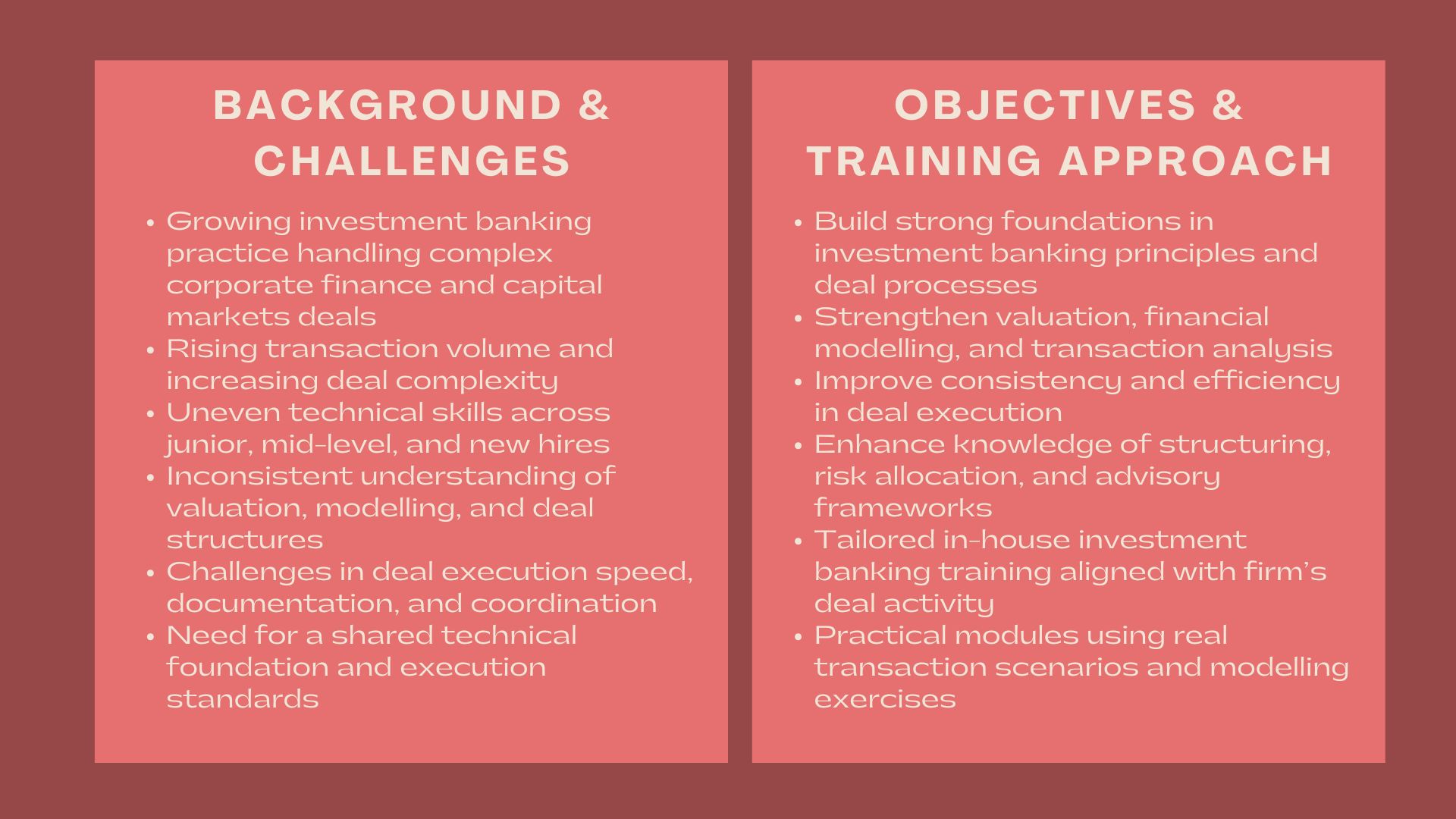
Issues and Challenges
The company experienced various problems which indicated the necessity of the organized investment banking training. The problem of inaccurate technical skills among team members was one of them. The variation of previous experience led to the uneven perception of valuation techniques, financial modelling, and structure of transactions. The other issue was on the effectiveness of deal execution. With the growth of the transactions and strict time schedules, the junior employees needed to be equipped with more knowledge in financial analysis, due diligence assistance, and presentation. It also had difficulties in structuring and documenting transactions. The team members should have had a better comprehension of the effect of deal terms, financing structure and risk allocation mechanisms in the outcomes of the transactions. Inter-deal team communication and coordination were other issues. Technical language and knowledge of deal processes were necessary to work closely with analysts, associates and senior bankers. Lastly, the management tried to reinforce internal talent development and retention through clear learning channels of junior professionals to further develop in the investment banking capability.Objectives
The main aim of the engagement was to enhance the internal investment banking capacity by undertaking tailor-made investment banking in-house training. Particularly, the company wanted to:- Establish a solid background in investment banking principles and processes of a deal.
- Enhance valuation, financial modelling and transaction analysis.
- Enhance the consistency and efficiency of deals.
- Increase the knowledge of the transaction structuring and advisory considerations.
- Benefit talent advancement and career growth in the company.