
Case Study: Private Equity In-House Training Services Strengthening Investment Discipline and Value Creation Capability
Background on Case Study Private Equity In-House
The company is a private equity firm with a growing portfolio of mid-market investments that was intended to enhance its internal investment capacity as the number of deals rose. The company had concentrated on the acquisition of controlling and significant minority equity in firms within various industries and the strategy has been based on enhancing operations, accelerating growth and creating long term value.
As the company expanded, the management realised that performance remained discipline-based and execution standards were required as the company expanded. Although the experienced professionals were able to provide a good transaction experience, juniors and support functions needed systematic training to build in a holistic knowledge of the principles, process and best practice of the private equity.
Moreover, the company aimed at improving cross-investment, portfolio management and cross-operational teamwork. In order to implement these goals, the company decided to hire the services of our Private Equity In-House Training Services to develop and implement a tailor-made and hands-on training programme.
Issues and Challenges
The company encountered various obstacles which showed how structured private equity training was necessary in the company.
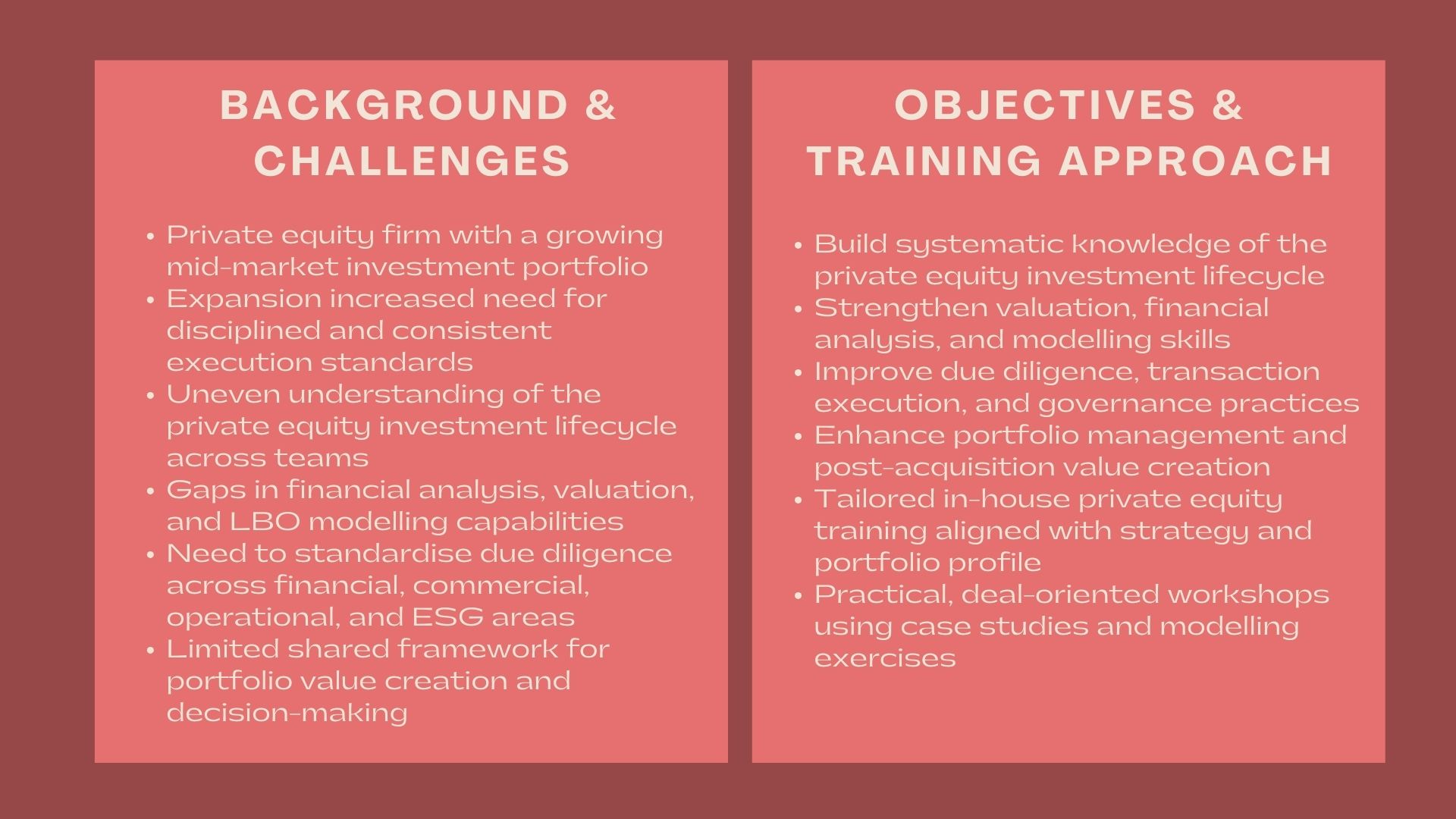
Poor comprehension of the lifecycle of the investment in private equity was one of the main problems. There was a difference in the exposure of team members to deal sourcing, due diligence, transaction execution, portfolio management and exit planning.
Financial analysis and valuation was another issue. Assessing private firms meant strong financial modelling, cash flow analysis and scenario testing, and not every one of the team members was sure of the use of the tools on a regular basis.
There was also the focus on due diligence processes. Although the company did due diligence properly, the management aimed to standardise the strategies on the financial, commercial, operational, and ESG levels.
There were further problems in creating portfolio values. The team members should have had more detailed structures on how to work with the portfolio company management teams, performance monitoring and post acquisition strategic implementation.
Lastly, the company wanted to enhance internal communication and decision-making by creating a common language of the private equity and standardized evaluation criteria.
Objectives
The main prerequisite of the engagement was to build the capability of private equity via bespoke training in private equity in-house.
In particular, the company was to:
- Develop systematic knowledge of the lifecycle of the private equity investment.
- Enhance financial analysis, valuation and modelling capabilities.
- Improve due diligence and practices of executing the transactions.
- Enhance value-creating and portfolio management strategies.
- Implement uniform criteria on investments between teams.

The training programme had to be operational, deal oriented, and pertinent to the investment strategy and portfolio profile of the firm.
How We Helped
Our strategy for in-house training in the field of private equity was structured and collaborative; it was designed as per the deal activity of the firm, the sector it was in, and the internal capabilities.
We started with training needs assessment. As a team, we collaborated with partners, investment team, and operating teams to learn about the investment strategy of the firm, the composition of its portfolio, and its gaps in skills.
On this analysis, we developed tailor-made training courses on the basics of private equity. Some of the topics covered the lifecycle in the private equity investment, the structure of funds, and the roles played by various stakeholders.
The programme was based on financial analysis and valuation. The training covered the methodologies of the personal valuation of a company, leveraged buyout (LBO) modelling principles, cash flows forecasting, and sensitivity analysis.
We, also, discussed due diligence and execution of transactions. They were also taken through financial, commercial, operational, and ESG due diligence considerations, transaction structuring and governance arrangements.
Value creation and portfolio management were prioritised to help in the success of the post-acquisition. Among the subjects were performance monitoring, working with management teams, and using strategic and operational improvements.
Much attention was focused on practice. Deal-based training, simplified case-based discussions on cases, and real-life modelling exercises were all included in training in order to make the participants apply concepts to a real-life situation in the world of private equity.
The programme was designed to include all participants regardless of their roles in the investment such as investment analysts, associates, portfolio managers, and operational specialists. This made it relevant, as well as ensuring portability of understanding throughout the firm.
The delivery of the training was done in the form of interactive workshops and a mix of both in-person and virtual training was used where necessary. Guided dialogues were used to promote the sharing of experiences and coming to a common ground in investment practices.
To support learning, we were offering realistic templates, frameworks, and reference resources which respondents could utilize in live transactions and portfolio management exercises.
During the engagement, we collaborated intimately with the firm to revise training material to suit the changing market trends and areas of investment.
Value Delivered
The case study shows how investment discipline and value addition ability can be enhanced using professional Private Equity In-House Training Services. The engagement allowed to increase consistency in investment analysis, better due diligence practices, and contribute to effective portfolio management through customised and practicable training.
The in-house training model created as a result of this engagement offered a scalable platform, to continue building the capacity, to be disciplined in making investment decisions, and to create long-term value in its portfolio.
