
Build your career with our industry-related courses. call us now at +65 9730 4250

Case Study: Construction E-Learning Services Enhancing Project Delivery, Safety, and Operational Capability Through Digital Learning

Background on Case Study Construction E-Learning Services

Construction business is a risk-prone and very complicated business. The coordination amongst project managers, engineers, site supervisors, contractors and the support teams is essential in achieving a successful project delivery. Meanwhile, construction organisations have to deal with high safety standards, laws and regulations, budget constraints, and strict time management of the project.

Due to the increased size and technical complexity of construction projects, the ability to work in a particular manner has become a vital distinction. Nevertheless, the conventional classroom training designs do not usually cope with the demands of the industries. These sites of work, rotating teams of projects, and operations that are located in different geographical locations render it hard to provide consistent training without interfering with the running projects.

In order to overcome these challenges, there was a construction-based organisation that hired our firm to design and implement a holistic Construction E-Learning programme. These were to create an effective, scalable and adaptable digital learning platform that would enhance the technical expertise, safety consciousness and project management skills within the organisation.
Case Study Construction E-Learning Services

Issues and Challenges

Before the engagement, the organisation experienced a number of workforce development issues that are usually experienced in the construction industry.

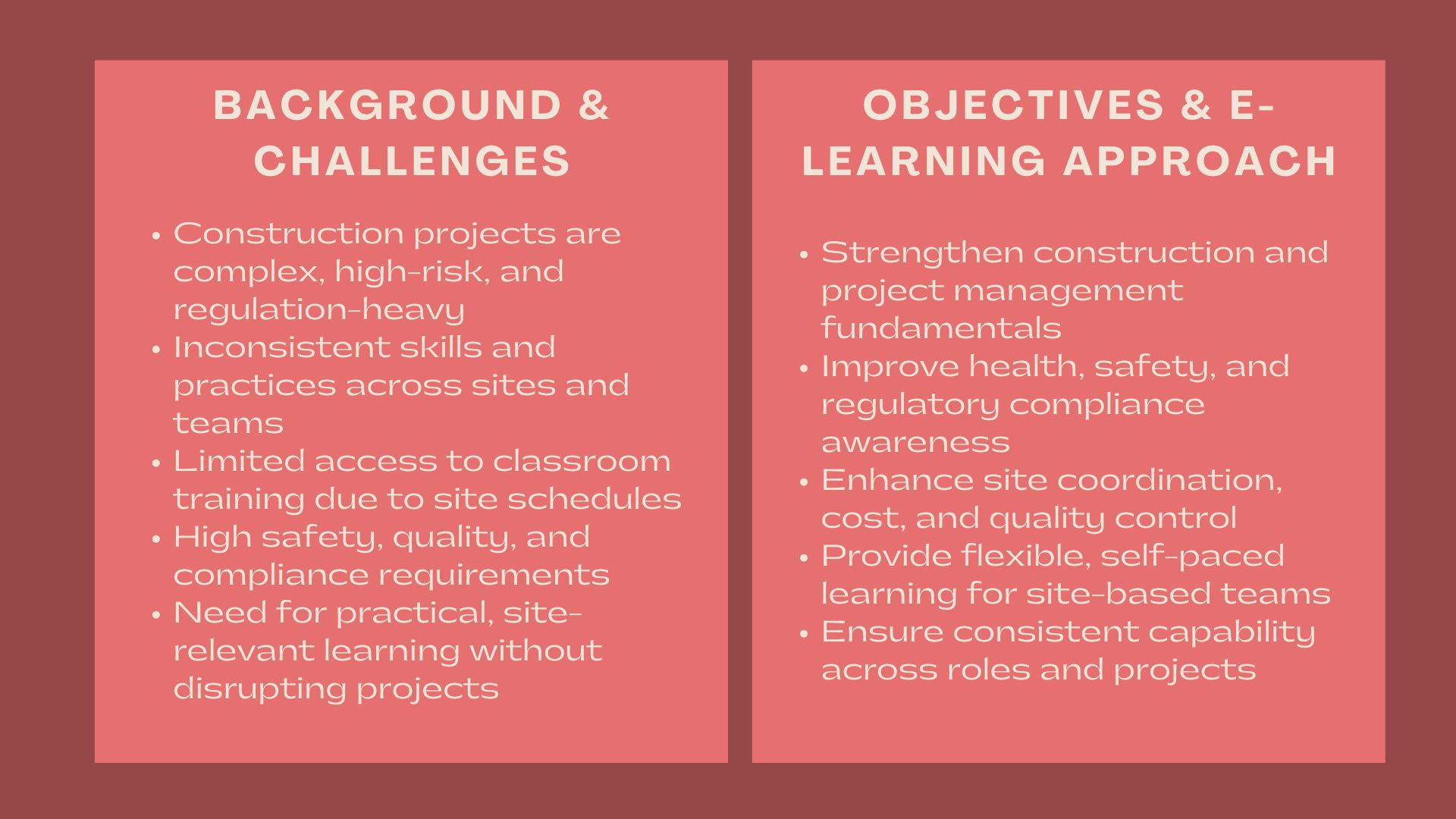
Poor knowledge and practices at different project sites was one of the main challenges. The difference in the level of experience and exposure to training also resulted in variation in the practices of safety, quality standards and method of executing the project.

Lack of access to training was another problem. Personnel at the site had to work long hours and on strict schedules and it was hard to manage to attend the classroom sessions without derailing the project.

Much concern was given to health and safety compliance. Construction environments are associated with high risk of safety and frequent training was needed to enhance the awareness of hazard, mitigation of risk and compliance with regulations.

The need to have more practical and applied learning was also increasing. The available training resources were mostly biased towards regulations and procedures rather than the real life construction issues like site coordination, management of subcontractors or cost control.

Objectives

The engagement sought to come up with a Construction E-Learning solution that would not only improve the capability of the workforce but also make operations run smoothly.

Key objectives included:

  • Enhancing basics of construction and project knowledge.
  • Enhancing compliance awareness, health awareness, and safety awareness.
  • Increasing project management and site coordination capabilities.
  • Favouring the regular quality and cost control practices.
  • Providing adaptable learners at a self-paced learning that fits site-based teams.

The programme was required to apply to a large variety of work positions, such as site supervisors, engineers, project managers, and support staff, and to have similar standards of learning across projects.

How We Helped

We developed a Construction E-Learning programme that is modular and which is based on the practical realities of construction operations.

The programme commenced with the basic construction principles that helped the learners to be introduced to the construction project lifecycle, stakeholders, roles and responsibilities in delivering the project. This provided a common understanding of the role of individuals in the general project success.

Later modules dealt with project management concepts in construction such as planning, scheduling and cost control and progress monitoring. Students were able to understand how well coordination and communication help to facilitate the execution of the project on time and at the right cost.

The training was a part of the programme that entailed health and safety. Four modules dealt with hazard identification, risk assessment, safe work practice, and regulatory requirements, as the culture of safety promoted the significance of safety culture on the construction sites.

The issues of quality management and compliance were introduced during the learning process. Students discussed the quality assurance procedures, documentation and inspection procedures necessary to implement the contractual and regulatory standards.

To make the programme practical, realistic construction scenarios and case-based learning were incorporated in the programme. Examples of instances that learners used concepts were control of risks on the site, delay resolution in projects and communication with subcontractors.

Learning Design and Delivery

The Construction E-Learning programme was geared towards being practical, interactive, and available to the site-based and office-based teams.

Learning took place in small and focused modules that could be undertaken within short sessions, meaning that learners could incorporate training into project-related schedules.

Complex construction concepts and processes also were simplified by explaining them with visuals, diagrams, and real-world examples.

The quizzes, questions in the form of a scenario, and practical activities were used as interactive learning tools that helped to support learning and promote active engagement.

The digital format of training was self-paced, which allowed the training to be conducted at one site and ensured that the training did not interfere with the current construction processes. The structure of modules also facilitated easy updates with the changing regulations, standards or project needs.

Outcomes and Value Delivered

In this case study, the usefulness of Construction E-Learning Services in developing scalable, consistent, and practical construction capacity is illustrated.

The employees acquired a better comprehension of the construction practices, safety practices, and principles of project management, which supported the delivery of projects in a safer and more efficient manner.

On the organisational level, the e-learning solution offered an affordable and scaled way of workforce development. The same learning standards across projects facilitated less variance in practices and enhanced more quality and compliance results.

The programme also developed a structured learning base which can be developed in the long run and sustained capability building and organisational resilience.

services/case-study-construction-e-learning-services