Build your career with our industry-related courses. call us now at +65 9730 4250

Case Study: Social E-Learning Services Building Social Awareness, Responsible Behaviour, and Inclusive Capability Through Digital Learning

Background on Case Study Social E-Learning Services

Social consideration has become a significant concern to organisations in all industries. The matters of diversity and inclusion, conduct in the workplace, community involvement, employee welfare, and social responsibility are now the core of organisational culture, reputation, and sustainability in the long run. All employees are supposed to be aware of social standards, be responsible, and make a difference to the workplace and community settings.

Meanwhile, organisations experience obstacles in provision of effective and consistent social training. They can consist of workforces that are diverse, geographically spread and working in various cultural and regulatory environments. Face-to-face training in a traditional classroom may be hard to scale and might not offer continuous reinforcement of socially responsible behaviours.

In order to solve these issues, a socially oriented organisation has approached our firm to plan and implement a holistic Social E-Learning programme. This was aimed at developing a structured, available, and practical digital learning solution that would enhance social awareness, inclusive behaviour, and positive organisational culture.
Case Study Social E-Learning Services

Issues and Challenges

Before the engagement, the organisation has had a few challenges that are normally identified with social learning and training behaviour.

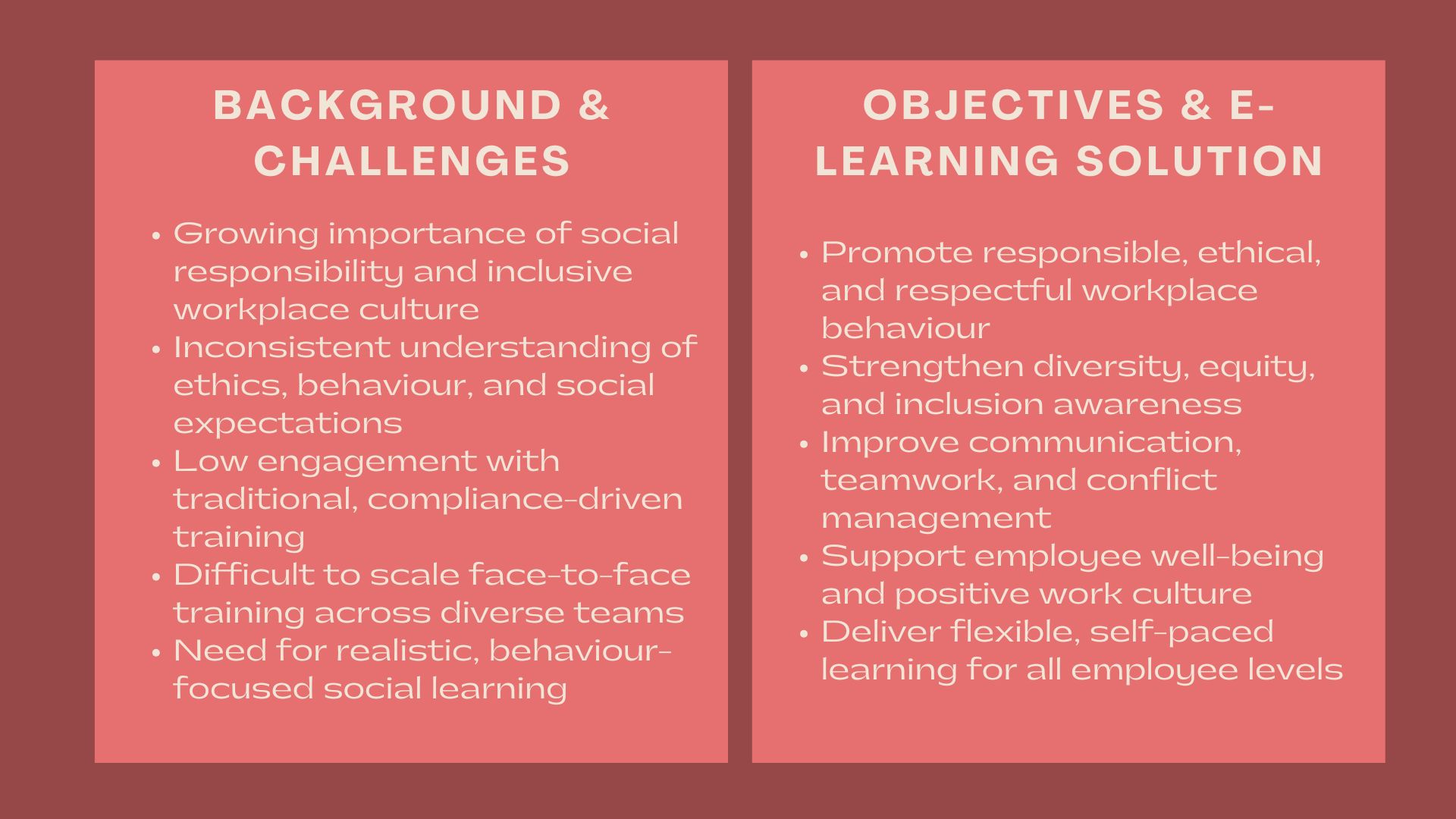
Poor cross-team comprehension of social expectations was one of the problems. Workplace behaviour, integration, and ethical practices were perceived in different ways by the employees resulting in discrepancies in how they were carried out and at times misunderstood.

The other issue was lack of involvement in the social training programs available. The conventional training models were usually viewed as being compliance-based or theoretical, which minimized their ability to affect the day-to-day behaviour.

There were also challenges in the delivery of training of the organisation at different locations and positions. The work time and access to face-to-face training varied among the employees, and they needed to make certain that all of them had an equivalent learning experience.

Moreover, more realistic and situation-based learning was required. The available materials were not comprehensive enough to cover real social life scenarios like bias management, conflict management at work-life or actions to counter undesirable behaviour.

Objectives

The interaction was to come up with a Social E-Learning solution that would facilitate behavioural change and yet be scalable and accessible.

Key objectives included:

  • Enhancing social responsibility and conduct in the workplace.
  • Fostering diversity, equity, and inclusion.
  • Improving inter-personal communication and teamwork.
  • Standing by the welfare of employees and respectful work ethics.
  • Introducing flexible learning, which is self-paced throughout the organisation.

The programme should have been applicable to all levels of employees without undermining a uniform group of social values and expectations.

How We Helped

We developed a flexible Social E-Learning programme based upon major social themes and applications.

The programme was initiated with basic social concepts where the learners were introduced to organisational values, ethical behaviour and the value of respectful and inclusive workplaces. This formed common knowledge of social expectations in the organisation.

Other modules were based on inclusion and diversity. Students studied the three issues of unconscious bias, inclusive communication, and cultural awareness with the help of familiar examples and useful advice.

There was also an issue over the conduct and ethics in the workplace. Professional behaviour, respectful communication and responsiveness to challenging situations were also discussed as modules and this supported accountability and responsibility.

Another aspect of the programme was employee well-being and mental health awareness. Students were exposed to stress coping, resiliency and positive work environment strategies.

Social scenarios and case-based learning were introduced in order to make this programme more practical. Students used the concepts in real-life scenarios of teamwork, conflict management and decision making.

Learning Design and Delivery

A Social E-Learning programme was adopted to facilitate reflection, engagement and change of behaviour.

The content covered was presented in brief and intensive modules that involved instructional videos, visual templates, and practical examples. Sensitive issues were discussed in a brilliant and approachable manner, in order to make them easily accessible and comprehensible.

Interactive activities like scenario based queries, reflections, and quizzes helped to reinforce learning and made the learners think critically about their personal behaviours and choices.

The digital self-paced format enabled the employees to undergo training at their free time and liberty without the pressure of time, which favored openness and engagement.

The modular structure helped the organisation to modify content readily according to the changing social expectation, regulations, or organisational priorities.

Outcomes and Value Delivered

The current case study confirms how useful Social E-Learning Services could be in creating a steady social consciousness and promoting a healthy workplace environment.

The staff came to have better knowledge on social responsibility, inclusive behaviour and respectful communication. Increased awareness helped to make the collaboration more effective, minimise the number of workplace problems, and improve organisational culture.

Organisation wise, e-learning solution offered a scalable and cost effective method of social training. Unified learning standardized helped to strengthen common values and expectations between teams and places.

The programme also established a viable base in continuous social development, which favoured the long run alignment of culture and sustenance of the organisations.

services/case-study-social-e-learning-services