
Operational Risk Management Framework
Introduction to Operational Risk Management Framework
The meaning of operational risk management meaning has become an important field of concern to any organization working in a more complex, regulated, and technology-driven business environment. With the increase in the size of firms, their presence in different markets, and increased regulatory attention on the business, the failure of operations can result in financial losses, a tarnished image, and regulatory fines. Knowing the meaning behind operational risk management meaning is hence no longer a preserve of risk professionals but rather a necessity among executives, managers and compliance teams.
In addition to the conceptual knowledge, companies should use systematic methods with the help of a clear operational risk management methodology and backed by a practical tool like an operational risk management worksheet. The combination of these aspects allows the firms to recognize, evaluate, reduce, and track operational risks in a systematic and justifiable framework. This paper gives an extensive discussion of the meaning of operational risk management meaning, the popular methodologies and the importance of worksheets in facilitating good implementation in all industries.
The Operational Risk Management Meaning
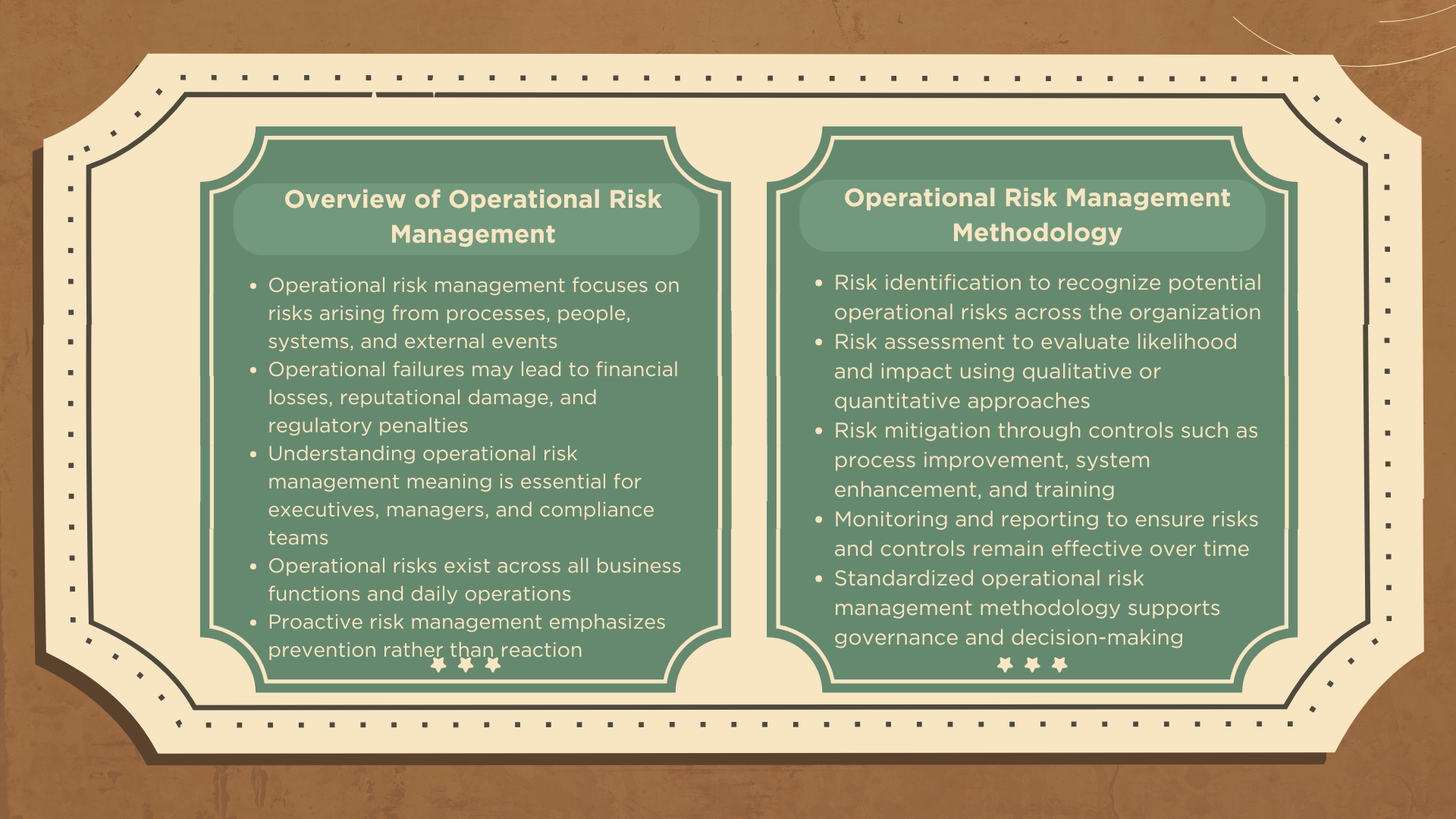
The operational risk management meaning is that of risk identification, assessment, control, and monitoring; operational risks are those caused by internal processes, people, systems, or other external events. Operational risks unlike financial or market risks are integrated in the normal operations of a business and may touch any area of operation within an organization.
Regulatory and rule of meaning, the operational risk management meaning includes failures in processes, human error, system unavailability, evidence of fraud, cybercrimes, and violations of rules. These risks tend to be interwoven that is why it is very hard to isolate them unless one has an orderly risk structure. The higher the complexity of the organization, the higher the operational risk exposure, which supports the formalization of risk management practices.
Notably, the meaning of operational risk management meaning also encompasses the proactive risk prevention. Instead of reacting to the events at the point of their occurrence, proactive management of operational risks focuses on the early identification and control design in order to minimize the probability and consequences of negative occurrences. It is a proactive strategy that facilitates organizational resilience and sustainability in the long run.
Operational Risk Management Strategic Importance
The operational risk management meaning is closely associated with the organizational performance and stability, which is evident in the clear understanding of the meaning. Disruption in operations may stop the production, ruin customer confidence, and loss of shareholder value. In the regulated sectors like banking, energy, health care, and production, failure in operations can also lead to dire effects in legal and regulation.
Developing trends in the management of operational risks through structured operational risk management methodology are increasingly being relied on by the senior management to support decision-making and governance. Organizational risk aversion can ensure a balanced approach in growth and risk tolerance by inculcating risk-related factors in strategic planning and operational implementation. This fit helps companies to be innovative and at the same time have effective internal controls.
Furthermore, robust operational risk systems are considered by investors and regulators as signs of good management. Companies that are mature in their application of operational risk management methodology and tools including an operational risk management worksheet are usually viewed as more stable and reliable of counterparts in the competitive markets.
Basic Building Blocks of a Risk Management Approach to Operations
A good operational risk management process gives the organization a unified approach to risk management. Although the methodologies can depend on the industry and regulatory regime, they are normally of the same type in terms of their underlying elements.
The initial element is the risk identification. The organizations should be systematic in identifying the risks that may occur in terms of processes, systems, and functions. The step is important to make sure that the risks are documented and realized in terms of business operations. This information is usually captured and standardized on a structured operational risk management worksheet.
The second element is on risk assessment. After being identified, the risks are rated according to their probability and the impact it may cause. An effective operational risk management process uses either a qualitative or quantitative approach to rank risks and distribute resources effectively.
The third component is the risk mitigation and control design. Organizations establish and institute controls to minimize the exposure of risks to acceptable levels. Such controls can be process enhancement, system enhancement, training, or updating of policies. The operations risk management is a well-constructed operational risk management worksheet that assists in recording the controls present and the gaps.
Lastly, monitoring and reporting will keep risks and controls in efficient operation in the long term. The constant review aspect of any operational risk management process is an essential aspect of any operational risk management process because it allows organisations to adjust to the dynamic internal and external environments.
Governance Role in the Operational Risk Management
The operational risk management meaning is central to governance structures that strengthen the meaning throughout the organization. Clear accountability also makes sure that the risk ownership is allocated at the right levels, both operational teams and the top management.
Standardized operational risk management methodology is what boards and executive committees use to get uniform and consistent risk information. Consistent reporting with documented format such as an operational risk management worksheet enables the leadership to keep track of risk trends to make sound strategic decisions.
Good governance also fosters the culture of risk awareness. By making employees aware of operational risk management meaning and their contribution towards risk management, there is enhanced operational discipline within the organization.
Real-Life Implementation of the Worksheets on Operational Risk Management
Worksheet to manage operational risk is a handy tool that can be used to implement theoretical work. It offers a common format of risk data to be captured thus being consistent across departments and business units.
Generally, an operational risk management worksheet incorporates such sections as risk description, underlying cause of the risk, possible impact of the risk, controls in place, rating of risk and mitigation measures. This framework facilitates the methodological use of the operational risk management methodology and enhances the quality of documentation.
Operatively, worksheets allow teams to perform risk assessment effectively whilst remaining at par with organizational requirements. The long term trend analysis and continuous improvement activities are supported by aggregated worksheets data over time.
Noteworthy, the operational risk management worksheet provides communication, as well. It supports continuity in the mutual meaning of operational risk management meaning by providing the risk information in a clear and structured form to bridge the gap between the operational teams and the top management.
Enterprise Risk Management Integration
Operational risk management is not a stand-alone process. It is an essential part of more comprehensive enterprise risk management (ERM). The operational risk management meaning in an ERM context allows organizations to balance the operational risk with the strategic, financial, and compliance risks.
An operational risk management methodology standard approach would provide the leadership with a possibility to prioritize the risks, as the operational risks would be assessed based on similar criteria. This integration is facilitated by worksheets and standardized reporting which deliver viable data inputs to enterprise wide risk assessment.
Operational Risk Processing through the ERM alignment helps organizations to be more resilient and respond to new risks in a coordinated way.
Advantages of Structured Operational Risk Management Approach
Companies that align the meaning of operational risk management meaning and adopt an effective operational risk management methodology have quantifiable returns. These are minimized occurrence rate, increased regulatory adherence and greater operational efficiency.
Audit Readiness and transparency is also enhanced with the disciplined implementation of an operational risk management worksheet. Effective control is evident through clear documentation and it promotes regulatory examinations or internal audits.
Also, structured operations risk management helps in improved decision-making. The leaders become more visible on the risk exposures and are able to distribute resources to the areas that have the most impact more effectively.
Difficulties in the Operational Risk Management Implementation
Although it is important, the operational risk management implementation is challenging. Companies can have a problem of interdepartmental and irregular interpretation of the meaning of operational risk management meaning. Risk assessment can be of different quality and completeness without proper direction.
The other difficulty is that of choosing and implementing a suitable operational risk management methodology. Excessively complicated structures can deter adoption and overly simplistic frameworks can be insufficient to model material risks.
The user engagement is also critical towards the effectiveness of an operational risk management worksheet. Unless well trained and governed, worksheets will be seen to be compliance programs instead of powerful risk management instruments.
These issues can be dealt with through the leadership dedication, effective communication, and continuous training to enforce the risk management principles.
Operational Risk Management Trends in the Future
The meaning of operational risk management meaning is still changing as organizations embrace new superior technologies. Digital transformation provides new risks of cybersecurity, data privacy, and system dependencies, which leads to the need to update the operational risk management methodology adopted by the organization before.
Risk management processes are more and more being incorporated with data analytics and automation. The operational risk management worksheet available in digital format offers real time monitoring of the risks and a better reporting quality.
These changes demonstrate the significance of continual enhancement and flexibility in operational risk systems.
Conclusion
The operational risk management meaning is a concept that should be known well by any organization that aims at resiliency and sustainable growth in the current dynamic business world. Through the application of a systematic operational risk management methodology and complemented with useful tools like an operational risk management worksheet, companies office bearers can successfully determine, evaluate, and avert operational risks.
Operational risk management, when incorporated in governance structures and enterprise risk, has the effect of improving decision-making, improving compliance, and aiding the creation of long-term value. Instead of considering operational risk management as a mandatory element of regulations, organizations must realize that it is a strategic strength that helps to achieve stability, accountability and competitive edge.