
Business Capability Growth
Organizations with a distinct focus on developing the intellectual capital of their people are the ones that exist in this day and age of rapid economic shifts, razor-thin margins, and ever-more complicated financial landscapes. From being a side project in HR, corporate capability building has now become a Boardroom priority – it’s a structured way of developing people’s skills, knowledge and performance.
The stakes are higher for the finance sector, business leaders and corporate decision makers. The regulatory landscape is becoming more complex. There’s a need for more accuracy in the capital allocation decision. With businesses now operating internationally, the need for employees who can analyze, model, forecast, and evaluate with confidence becomes an essential and not a desirable trait.
This article casts light on the increasing significance of structured corporate learning, especially in the fields of finance, valuation, project investment and digital education, and why companies that consider capability development as an investment — rather than a cost — are always outperforming those that do not.
The Shifting Landscape of Corporate Learning
Ten years ago, many companies would send a team to a weekend seminar or give out PDF manuals for corporate training. These days it’s a different story. Staff is looking for relevance, flexibility, and depth. Organizations are hoping for results that they can measure. These expectations are bringing a shift in the way training is designed, delivered and evaluated.
Finance education has been revolutionized, especially in terms of finance education. Finance education has literally been revolutionized, especially with regard to finance education. With the growing importance of the financial data-driven business and financial analytics, the need for professionals with finance fundamentals training has grown in many sectors, not only in the banking and investment management sector, but also in the healthcare, manufacturing, logistics, and technology sectors. Reading a balance sheet, creating a cash flow, or assessing a capital project isn’t the sole preserve of CFOs and financial controllers anymore. It is becoming a more and more demanded capacity of middle management and even of operational leaders.
The organizations reacting to this change are developing and implementing learning pathways, not just workshops here and there. They are collaborating with specialist training providers, focusing on scalable digital platforms and integrating learning outcomes into business strategy.
Why Finance Literacy Sits at the Core of Capability Building
The importance of financial literacy in an organization is beyond doubt. Non-finance managers can participate in the budget process, understand the costs of their choices, and assess ROI on various competing priorities, which boosts decision-making quality throughout the business.
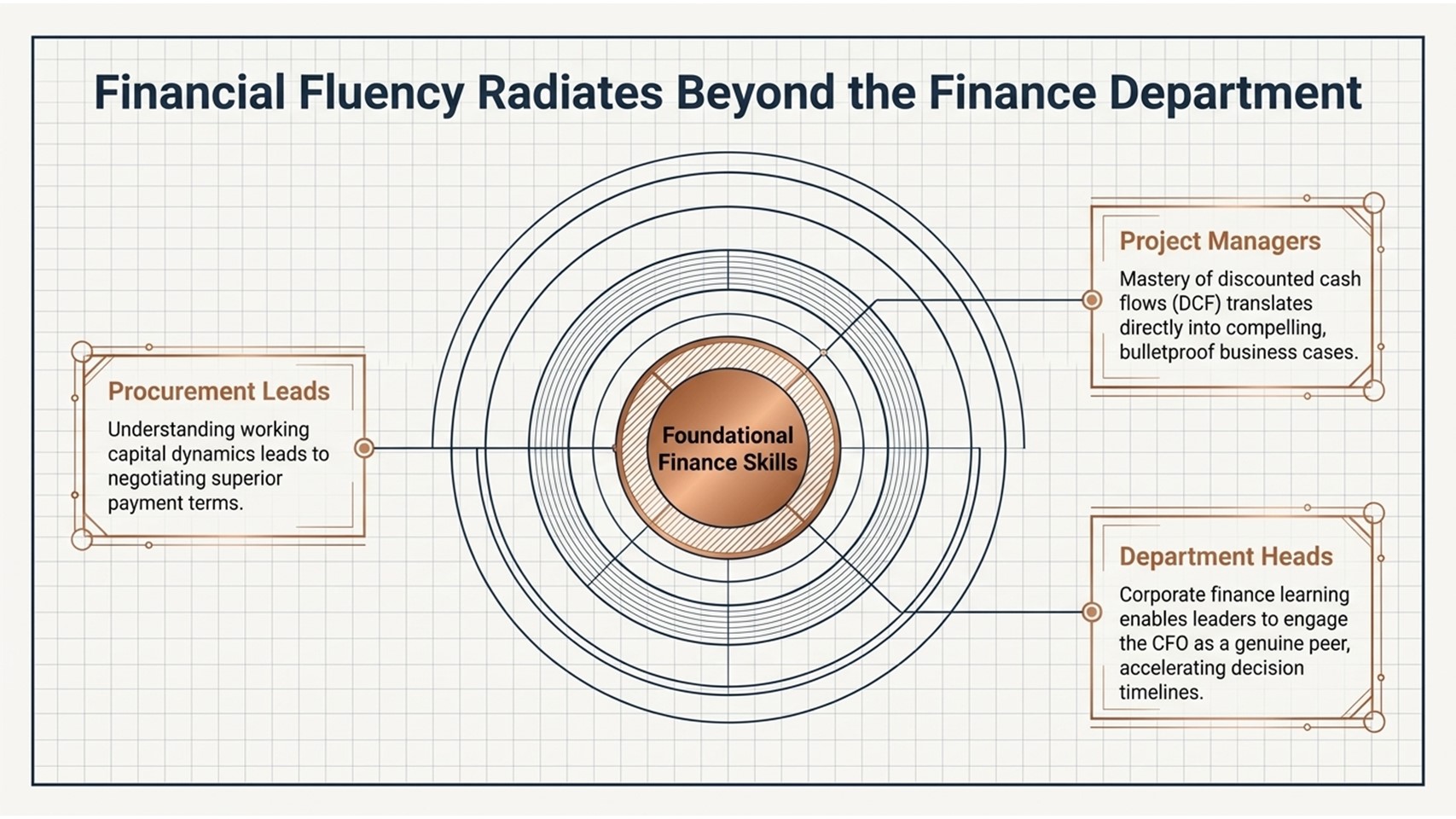
This isn’t just about cutting down errors. It’s about providing quicker and more confident decisions in situations where speed and accuracy are both critical. An understanding of working capital dynamics by the procurement lead can lead to negotiable better payment terms. When a project manager uses discounted cash flows, you’ll have a better business case. If the department head has already undergone corporate finance learning, they can become a true peer of their CFO, instead of totally relying on him/her for financial advice.
This development is being acknowledged on a worldwide level. In Singapore and across Southeast Asia, corporations are increasingly sponsoring their teams through finance for professionals courses that are tailored not for aspiring accountants, but for business professionals who need applied financial fluency. The emphasis is on real-world applications: assessing options, providing financial stories and financial recommendations based on quantitative analysis.
Financial Modeling as a Core Business Skill
A big competency gap that is reflected in many growing organizations is the capacity to construct, question, and present financial models. Knowing how to use a spreadsheet is widespread, but the skill of building a dynamic model with scenarios, for use in strategic decision-making, is far less common.
Financial models are no academic exercise. They are the tools used by businesses to analyze acquisitions, determine pricing, review new business prospects and test operating hypotheses. A ripe model can turn the course of a board dialogue. If it’s not constructed properly, a bad one can result in catastrophic misallocation.
That’s why investment analysis modeling is a hot topic for corporate training programs in Southeast Asia. Structured business modeling courses for the finance and commercial teams are proving to deliver a significant improvement in the quality of in-house financial analysis, and consequently, a reduction in the need to engage external consultants and a faster time to decision.
In addition to construction, the teams should also be cognizant of the use of these tools in context. Financial decision tools training enables professionals to read sensitivity tables, create scenario analyses, and communicate with non-technical decision makers in a clear and convincing manner using the outputs of a financial model. Within companies that are routinely making investment decisions, the skill of corporate finance modeling is not a special commodity but is a minimum standard for business.
Project Finance and Infrastructure Investment Readiness
Project finance is a specialized and unique field of finance that is applied when a business is undertaking large capital projects such as energy, real estate, infrastructure and public-private partnerships. Project finance focuses on the cash flows of a particular project, in contrast to corporate finance, which is based on the overall creditworthiness of an entity. This difference has enormous implications for structuring deals, allocating risk, and lenders and investors conducting due diligence.
Even for every professional working with the initiation, approval, or execution of capital-intensive projects, it is vital to understand the project finance basics. This encompasses project finance specialists, as well as engineers, operations managers, and business development executives who are responsible for major capital expenditure.
As Southeast Asia continues to attract infrastructure investment — from transport networks and utility projects to data centers and energy transition initiatives — demand for professionals trained in infrastructure finance courses is intensifying. Companies with existing experience in these areas benefit significantly when it comes to assessing opportunities, attracting financiers, and controlling the project risk during the investment process.
Structured project funding training programs typically cover debt structuring, cash flow waterfall modeling, debt service coverage analysis, and the role of sponsors, lenders, and offtakers. For teams involved in capital project analysis, this knowledge translates directly into stronger business cases, better negotiating positions, and more rigorous risk management.
At earlier stages, when developing this capability, a focused project evaluation course starting with a conceptual framework is often first undertaken before the application of modeling work.
Private Equity Literacy in an Evolving Investment Landscape
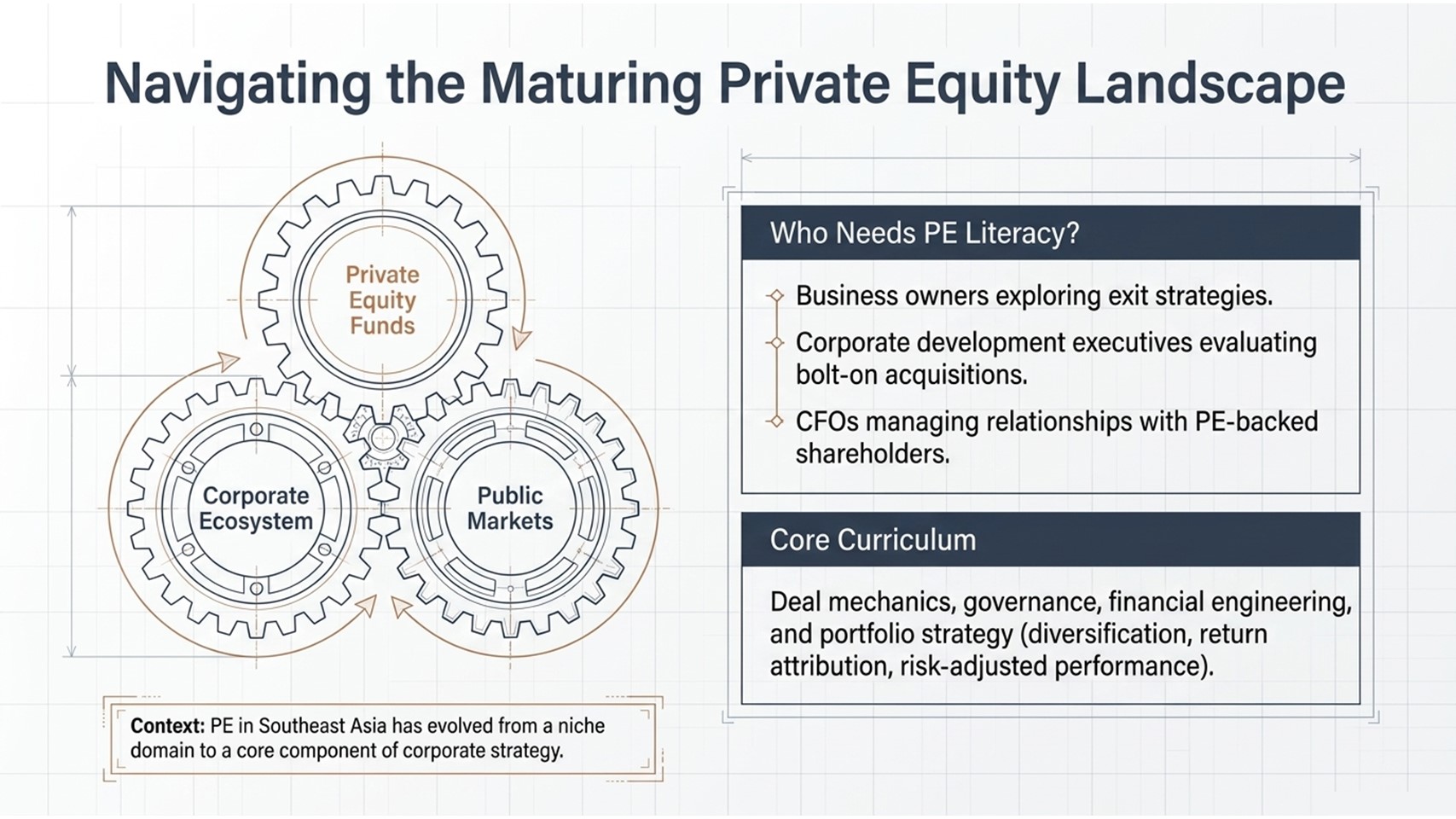
Private equity has come a long way in Southeast Asia in the last ten years. It was once restricted to more specialist practitioners based in the big financial centers, but is now a relevant part of the corporate strategy of a broad spectrum of companies, ranging from potential investees, co-investees, to competitors dealing with PE-backed companies.
That’s why the knowledge of private equity in terms of fund structures, deal sourcing and evaluation, value creation during a holding period, and beyond is becoming a more useful tool for business professionals, other than just an investment community. This is relevant to a number of business owners who consider exit options, corporate development executives who are looking at a bolt-on acquisition and CFOs who are dealing with the PE-backed shareholders.
A private investment course for senior professionals in the business world can help fill in the gap between theory and real business comprehension. Capital markets training expands upon this by giving leaders insight into the interaction of private and public markets, the standard of valuations, and the expectations of investors and how they influence corporate behavior.
If you are directly engaged in the PE deal process (from the fundraise to due diligence to portfolio oversight), the PE fundamentals course or investment deal workshop offers a structured introduction to the PE deal process, governance, and financial engineering. For asset allocators and capital deployment, a focused portfolio strategy course will help clarify the thought process associated with the diversification, return attribution, and risk-adjusted performance.
Valuation: The Language of Commercial Value
Valuation is integral to every business process within the framework of an acquisition, capital raise, divestment or simply understanding how a business is viewed in the market. But for those working on jobs other than traditional finance, valuation is still a bit of a black art, handed over in full to the advisors and analysts.
This deferral is not without risk. Having no idea of the value of companies is a bad position for company leaders to be in when asking questions, questioning advice, and advocating for their company’s interests in high-stakes negotiations.
Building capability in business valuation basics is therefore increasingly seen as a priority for a broad range of professionals — not just M&A analysts or investment bankers. Whether you need to understand how different valuation methods will yield different results for a GM looking to structure a joint venture, a CFO raising capital for a growth round or a founder considering offers, it’s a worthwhile understanding.
Structured company valuation courses explain the fundamental valuation methods (DCF, comparable company, precedent transaction and asset-based valuation) and teach professionals when each method is applicable and how these methods dovetail into one another. The ability to make reasonable qualitative judgments underpinning quantitative outputs, e.g., formulating growth assumptions, pricing risk, and its impact on narrative, will also be discussed during a sound valuation training program.
Asset valuation courses are designed for asset holders and/or those who are dealing with asset-level financial reporting, and are specialized in areas such as property, infrastructure, intangibles, and other non-standard classes of assets. Financial analysis valuation training also connects all these threads together through the modeling and strategic assessment field, focusing on a coherent strategy for commercial decisions.
In-House Training: Bringing Learning Closer to the Business
Although open enrolment programs have a role to play, many training organizations are seeing the best ROI from the in-house, customized delivery of training. The relevance of learning and therefore the uptake is significantly enhanced when it is placed into the specific field, operating model, and strategic focus of a company.
An in-house leadership training program with a good design enables high-level trainers to access real-life examples, discuss actual problems, and adjust the depth and speed of learning to the specific audience. However, it also establishes common ground and common language within a team, which isn’t so easy to achieve when people are enrolled in a variety of external programs at various times.
Organizations that have to train larger groups can reap further efficiencies in cost and logistics from Corporate skill training that is offered in-house. Internal training workshops can be scheduled around operational cycles, kept confidential where commercially sensitive content is involved, and tied directly to performance development frameworks.
The most forward-thinking organizations are taking the next step and starting to implement ongoing business training programs, rather than simply a single workshop. They’re not seeing training as an event; they’re seeing training as a process, and one that is resourced, measured, and managed in the same way that they manage other strategic investments. The transition can be assisted by specialist providers who can provide workforce training solutions, create curricula, train internal trainers to be certified, and assist organizations in developing learning capability.
The Role of Digital Learning in Scalable Capability Building
The digital platform has always been a crucial component of modern corporate learning, and it can’t be forgotten. The concept of e-learning has changed significantly since the early 2000s, when it was still in its beginnings and consisted of click-through modules. When designed well, today’s digital learning environments are immersive and adaptive and are effective in building knowledge.
Online education tools are scalable and suitable for businesses with geographically distributed staff members or those looking to deliver consistent training throughout multiple business units. Online learning tools are scalable and ideal for businesses with geographically dispersed workforces or those that want to ensure consistency across multiple business units. A learning environment for a finance program can be well developed to make it accessible to teams in Indonesia’s cities of Jakarta, Kuala Lumpur, and Manila, while offering a significant cost reduction per learner without compromising on the quality of the program.
Quality is a key factor in the distinction of digital course development in the training market. Organizations investing in bespoke e-learning solutions are moving away from generic content libraries and toward programs that reflect their specific contexts, use cases, and learner profiles. When training content design is executed properly – having clear learning goals, well-structured learning pathways, and relevant assessment – digital delivery can match and in some instances exceed in-person delivery.
Interactive learning tools such as simulations, branching scenarios, and real-time feedback mechanisms are especially effective in finance education, where assessing judgment and applying it is as important as learning it. These resources put learners in “real” decision making situations, not merely concepts to be absorbed, but situations that reflect real professional issues, building confidence and competence.
Measuring the Return on Learning Investment
An ongoing issue in corporate training is proving the value of this training in financial terms that decision makers can understand. The ROI on the learning investment is very real and could manifest itself in a number of ways, such as faster decisions, better performance, quicker execution, improved collaboration across functions, and increased employee engagement and retention.
Progressive organizations are improving their capacity-building measurement methods. These include pre- and post-training measures, indicators of achievement of learning outcomes, and capability growth measures over time across cohorts. Where frameworks for measuring business finance education are developed at the design stage of the program, from the beginning, rather than as an add-on, the evidence for further investment in business finance education is greatly enhanced.
One other point to consider is the retention factor. Staff who believe that their organization is making a real effort to develop them are much more likely to stay in the job and be committed. In the competitive talent market, a strong finance skill development program is not just a talent builder; it’s a retention program.
Building a Finance-Fluent Organization: A Strategic Imperative
The organizations that will succeed in the next ten years are those that have intentionally created environments that have practices for finance fluency amongst their leadership, commercial teams with finance modeling and valuation capabilities, and the infrastructure (human and digital) that can continue finance learning as a practice.
This will involve more than just approving a training budget. It needs a cultural mindset of learning as a competitive edge, executive support of development programs, and investment in quality, both in terms of content and delivery.
It can be a pre-designed corporate finance learning journey for a leadership team, a series of modeling techniques workshops for an analytics team, or an extensive in-house capability building program covering leadership, finance, and digital skills. Today, these companies are investing in their employees to create the performance results they want for the future.
Conclusion of Business Capability Growth
Corporate capability building is no longer a side activity, but has become a strategic discipline. In finance, where the impact of analysis and decision making on business outcomes is directly related, the business case for structured, rigorous and continuous learning is compelling.
Whether in basic financial education or advanced modeling, from valuations to project finance, from internal delivery to scalable, digital platforms, the tools and methodologies that organizations can use today are more powerful than ever. It’s not about investing in capability, it’s about investing in capability with clarity, focus and ambition.
If your business is prepared to make the leap, resources are available. The know-how exists. What is needed is a commitment to putting learning at the heart of the organization’s strategy – and sticking to that commitment just as rigorously as if it were an investment in materials.