
Business Learning Strategy
The world business environment is more challenging than ever. In today’s increasingly complex regulatory landscape, fluctuating markets, speedy digitalization, and a constant evolution in the economy have created increased demands on people, particularly in the finance, strategy, and operations environments. In this environment, it is no longer a luxury to have a well-crafted business learning strategy. It is one of the most crucial components to the success or failure of a company’s growth.
For HR, finance, and corporate leaders, there is no longer any doubt that it is an investment that needs to be made in employees; the only question is how to make it effectively, meaningfully, and in a way that can be measured. The organizations that are moving ahead think about learning strategically, as more than a compliance-based exercise. They are creating cultures where a culture of continual improvement is ingrained in people’s way of working, and where knowledge of finance, analytical skills and investment savvy are considered the assets of a professional.
This article delves into the critical elements of an effective business learning approach and specializes in the importance of finance education – financial modeling and valuation, project finance, private equity, etc. – for today’s business world.
The Shifting Demands on Finance and Business Professionals
Until a few recent years, finance was a field reserved for accountants and treasury staff. Financial literacy is expected in today’s day and age in all departments. Marketing managers are expected to interpret the ROI model. The operations leader shall read and review capital expenditures and be prepared to challenge capital expenditure proposals. HR business partners should be familiar with the cost structure of the workforce and also the report of variance for the budget. The ability to read, write, and speak the language of numbers is now a standard part of the professional world at all levels.
There are significant implications for corporate learning strategy with this shift. An organization that previously held a one-off finance-for-non-finance event has now realized that they need more formal and ongoing training. They are looking to invest in finance workshop training that goes beyond just being aware of finance and to develop useful skills which employees can use in their daily work, not just in a classroom environment.
The demand is not limited to the inside demand. The finance savvy of the individual is becoming a requirement for clients, investors and boards alike. A business development manager with some credibility on the structure of deals, or a project leader who has an understanding of cash flow, will have a quantifiable edge over a non-possessor. This is why many forward-thinking organizations are now treating corporate financial learning as a strategic investment, not an operational cost.
Building a Finance-Forward Learning Culture
Value creation, risk management and capital flow through a business is a finance-forward learning culture, at all levels of the business. It takes more than just scheduling trainings to build that culture. It needs to be aligned with the business objectives, planned in a strategic manner, and reinforced.
So, the first thing that most organizations do is to conduct an honest skills audit. Where are the gaps? Do frontline managers find themselves confused when reading financial statements? Is project team investment decision-making taking place based on the thin ice of cash flow modeling? Do commercial teams not understand the valuation processes of the finance function? Having identified gaps in the learning, programs can be developed that are relevant rather than generic.
With an applied finance course that is based on real-world situations and specific case studies from the industry, the course has always been superior in terms of skills that are retained or put into practice. Content that is relevant to learners’ problems is more engaging, and managers are more likely to provide learning time when they can see value in what they are doing in terms of team performance.
In-house training programs are a very effective solution for organizations that have multiple business units and/or geographies. They enable content to be tailored to the company’s financial frameworks, specific terminology, and strategic circumstances – establishing a common platform and language throughout the organization that generic off-the-shelf training cannot match.
Financial Modeling: The Skill That Connects Strategy to Numbers
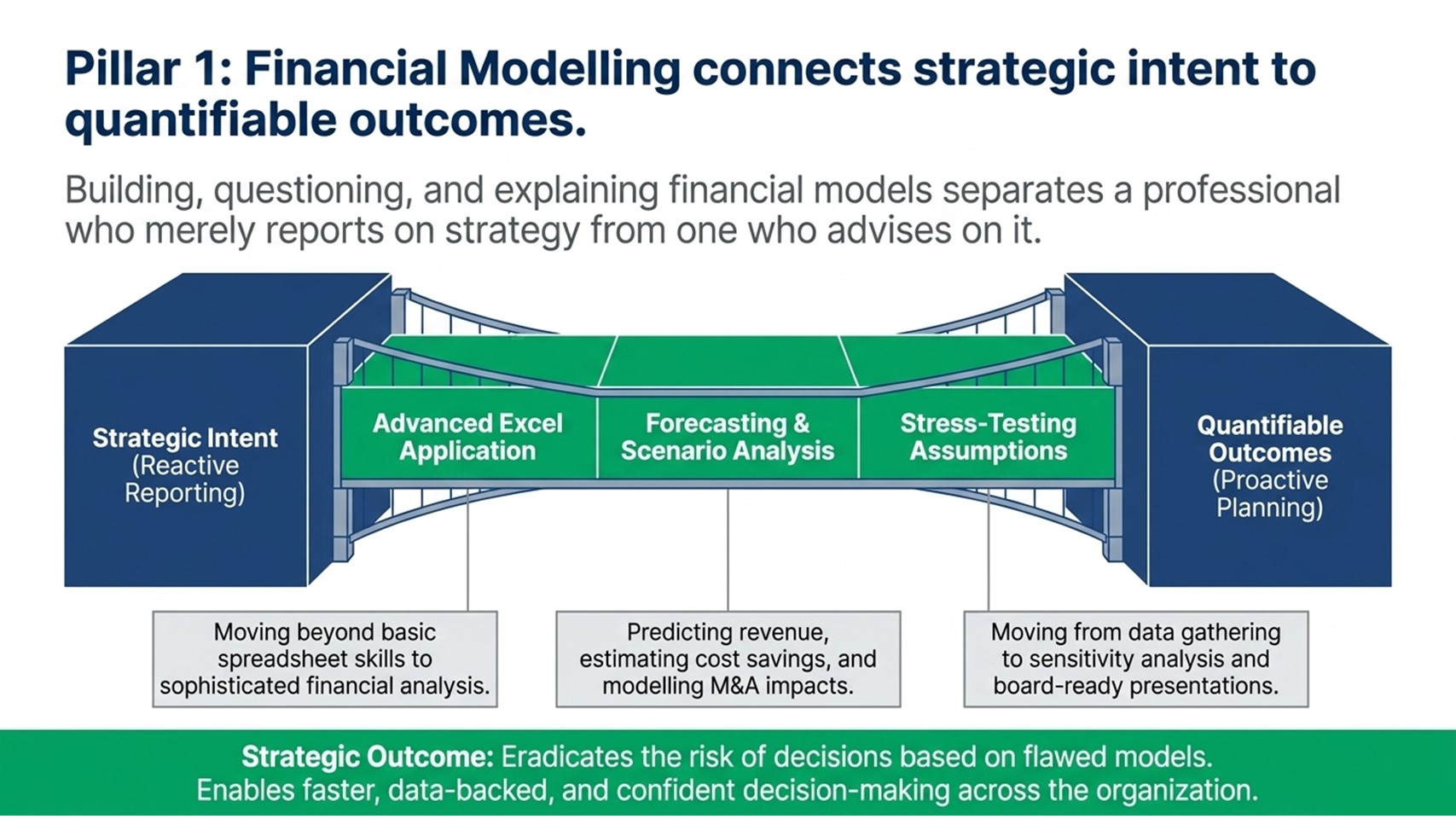
Financial modeling is a top-priority skill that organizations are looking for to acquire amongst all of the finance skills. Building, questioning, and explaining financial models is what sets a finance professional who advises strategy apart from one who only reports on it.
Financial models form the driving force for making investment decisions, preparing budgets, conducting scenario analysis, and managing performance. However, numerous successful users (or potential users) of these tools are not formally trained in the construction of these tools, nor in their limitations. This puts us at a major risk; decisions based on a misconception or a flawed model.
Understanding financial modeling basics is increasingly considered foundational for anyone working in corporate finance, investment management, banking, or consulting. However, for professionals who do not work in these functions, model literacy (the capacity to critically read a model, understand the assumptions made, and pose the proper questions) is beneficial.
A good financial analysis course will not only help you to construct the model, but also teach you how to think analytically. It learns to test assumptions and stress test scenarios and to present results in a manner that leads to clear decisions. These are skills that build over time – each model created or enhanced will now make the next model quicker and more insightful.
In many respects, the way that learners enter the world of financial modeling is through the practical application of Microsoft Excel. Although financial software is becoming more and more specialized, the use of Excel for financial analysis is still prevalent in all industries. Excel finance training that goes beyond the core of spreadsheet skills is one of the most valuable investments an organization can make in its finance team when it comes to Excel finance training.
The need to predict is also crucial. Whether projecting revenue for a new product line, estimating cost savings from an operational change, or modeling the financial impact of a strategic acquisition, forecasting skills training equips professionals to move from reactive reporting to proactive planning. In an organization where the finance team can confidently predict — and back up their prediction with reasoning — they are able to make faster and more confident decisions.
A well-structured financial planning course ties these threads together, covering the full cycle from data gathering and assumption-setting through to model output, sensitivity analysis, and board-ready presentation. This ability, from start to finish, is what makes a competent analyst a trusted advisor.
Project Finance: Specialized Knowledge for Complex Investments
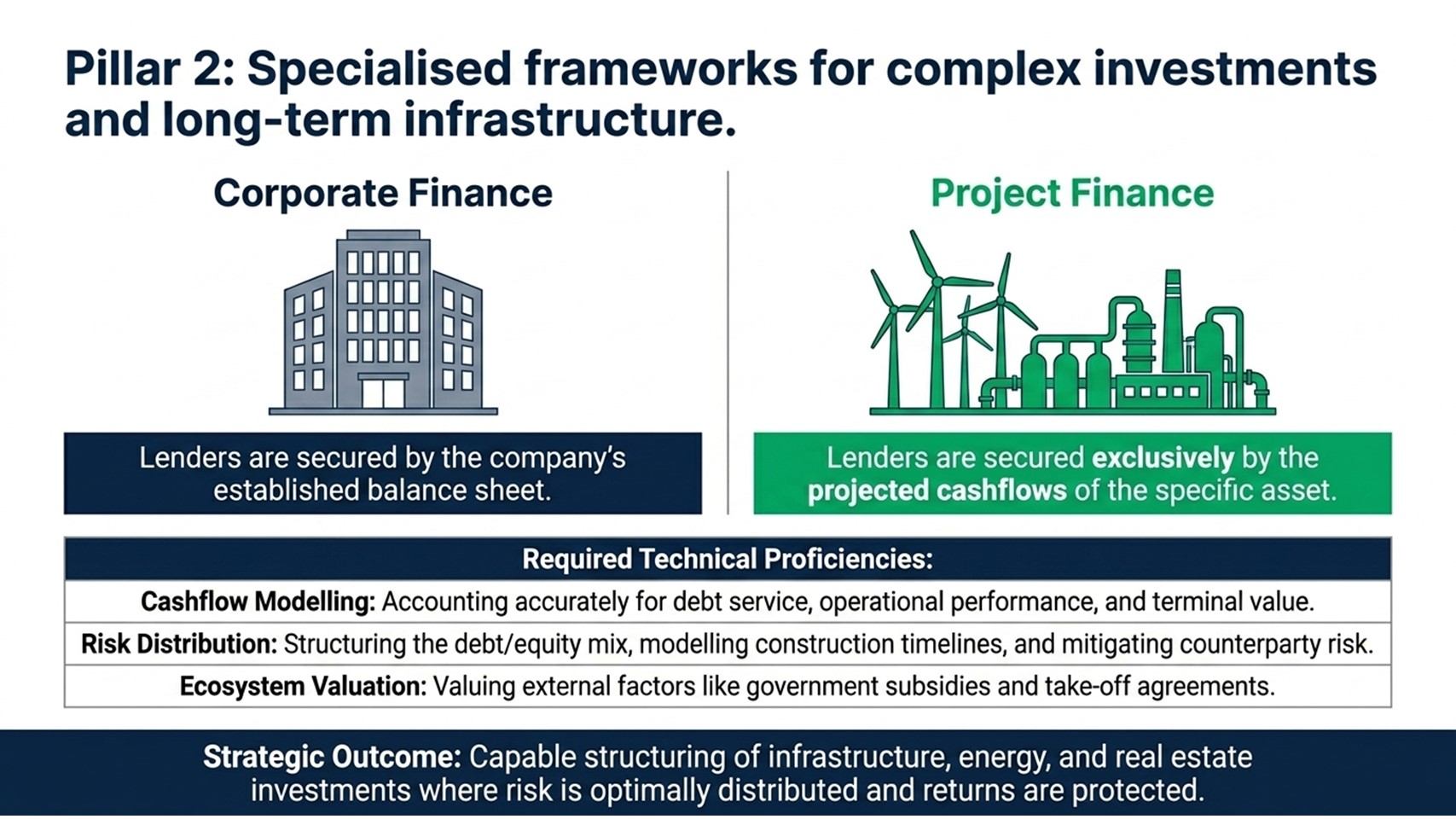
The need for project finance skills has increased dramatically as organizations start to enter into infrastructure, energy, real estate, and large-scale capital projects. Project finance, which is a specialized area of finance, is distinctly different from corporate finance and involves understanding very long-term investment structures, financing, and management.
In recent years, there has been a significant expansion of Energy finance training, as a result of the worldwide expansion of renewable energy projects, investments in energy infrastructure, and the financing regimes that support them. In these industries, whether it’s the developer, the lender, the advisor, or the government counterpart, the professionals have to be well-versed in the dynamics of project economics, risk distribution, and modeling returns.
An important part of this is having the capability to do a detailed project cashflow analysis. . Project finance is different from corporate finance, where the balance sheet of the company gives the lender security, in that project finance is based on the projected cash flows of a particular asset. The technical skill of modeling these cash flows accurately, accounting for construction risk, operational performance, debt service, and terminal value, takes time to practice and a high degree of expertise.
A development finance course teaches the frameworks and tools to evaluate the viability of a project from start to finish. This involves knowledge of debt and equity mix structuring, understanding counterparty risk, construction timeline modeling, and the ability to value government support (subsidy, take-off agreements, etc.).
Project structuring training is another level: Knowing how to structure and negotiate the contractual and financial framework of a project in a way that allows risk to be distributed in an appropriate manner, and returns to be protected. It is a very desirable skill for infrastructure developers, lenders, and development finance institutions.
For investment professionals, a project investment course gives the analytical means to analyze opportunities, carry out due diligence, and build investment cases that are capable of surviving the test of both internal investment committees and external stakeholders.
Private Equity and Investment Knowledge: Closing the Knowledge Gap
That has always been the case with private equity, a group of a few experts. As the asset class has matured, however, so has the need for more private equity expertise — and more corporations, pension funds, sovereign wealth funds and family offices have begun investing in private equity.
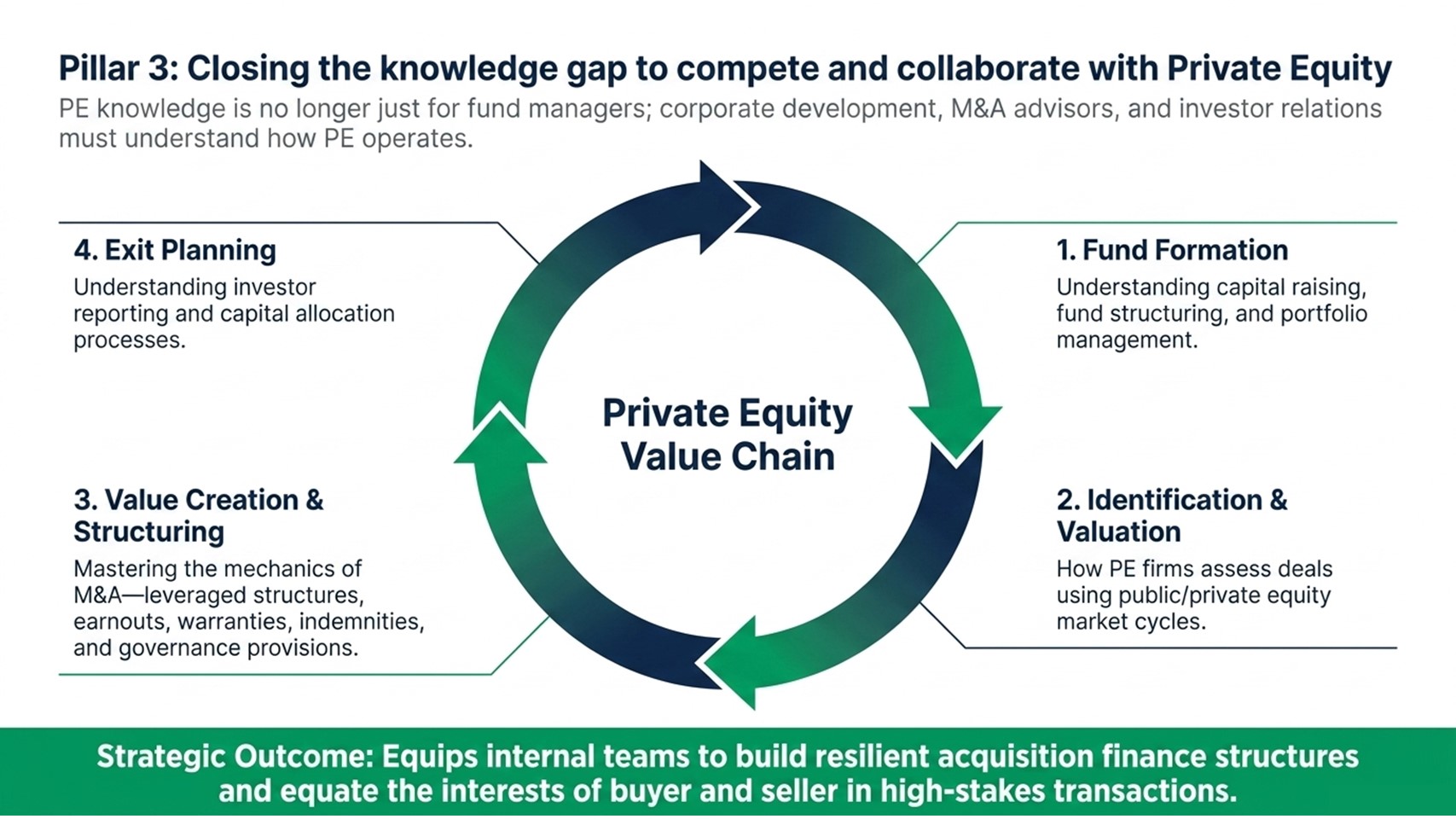
Understanding private equity basics is now relevant not just to fund managers, but to corporate development teams, M&A advisors, investor relations professionals, and finance directors who interact with PE-backed companies or compete against them. It is crucial to understand the way private equity companies are organized, how they identify, assess, and value deals, and how they generate value over the holding period.
Investment fund training includes the nuts and bolts of investment fund management; formation of the fund, capital raising, portfolio management, exit planning and investor reporting. Familiarity with these dynamics will enable professionals to convey information to fund managers, evaluate investment opportunities and provide input to the capital allocation process.
Complementing this is the Equity market course content, which will give participants a solid foundation on the complexities of the public and private equity markets, the effects of market cycles on deal activity and how valuation tools from the public markets provide a valuation perspective for private company valuations.
Deal structuring training is particularly valuable for professionals involved in M&A, joint ventures, or strategic partnerships. Knowledge of how transactions are structured — both the use of earnouts, warranties, indemnities, and governance provisions to somewhat equate the interests of buyer and seller — is a skill that directly impacts deal results.
For companies that are looking to grow through acquisition, an acquisition finance course can offer them the tools to look at funding options, create leveraged structures, determine debt serviceability, and understand how lenders and equity investors look at risk.
Business Valuation: The Language of Strategic Decision-Making
Valuation is central to the discussion in all types of situations where an organization may be thinking about an acquisition, planning a capital raise, carrying out a joint venture, or analyzing the performance of a business unit. One of the most valuable skills a finance professional can have is being able to value a business (or an asset) and then defend it against being challenged in this regard.
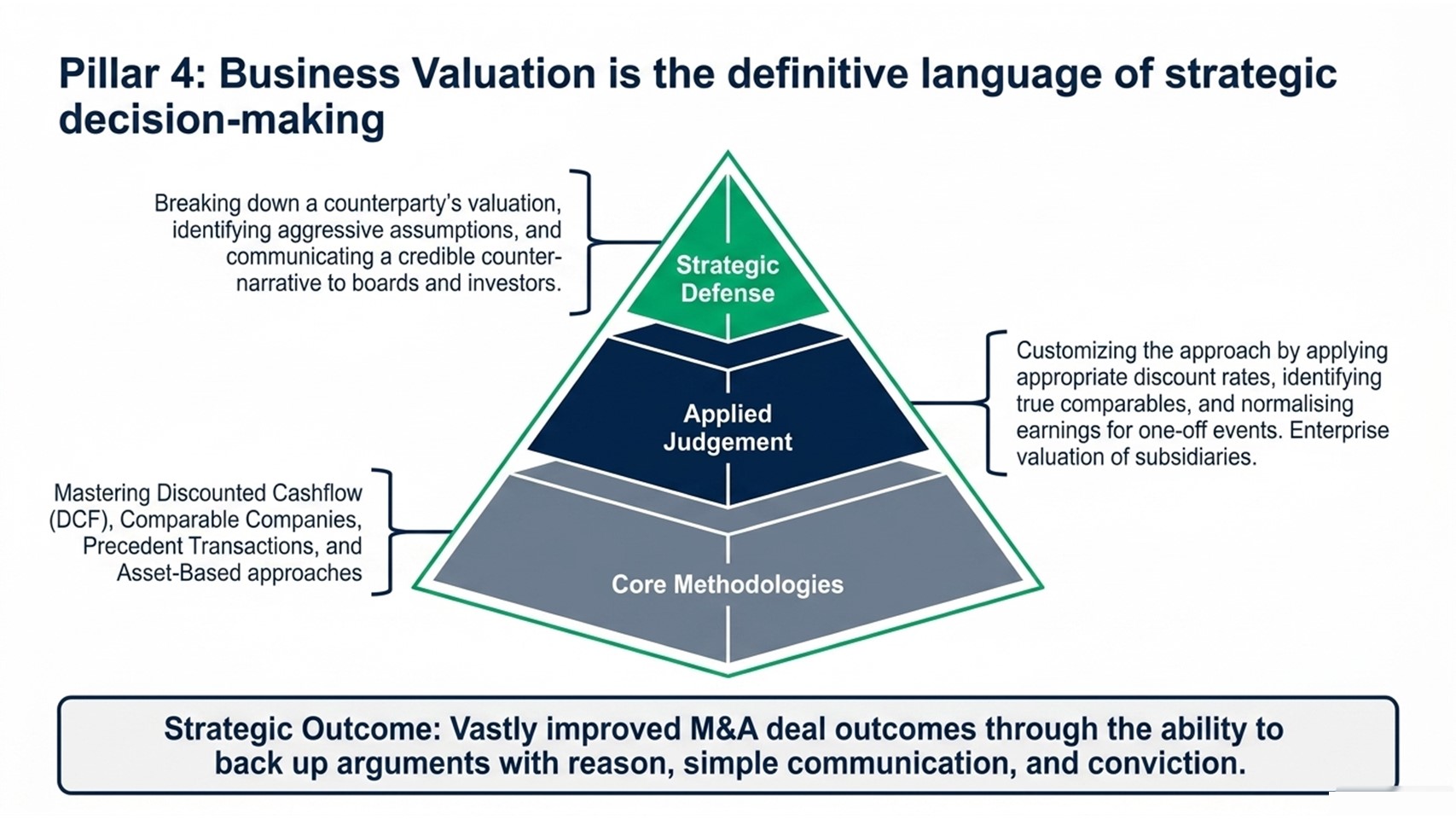
Understanding corporate valuation basics means mastering the principal methodologies — discounted cashflow analysis, comparable company analysis, precedent transaction analysis, and asset-based approaches — and knowing when each is most appropriate.It also entails comprehending judgments such as using the appropriate discount rate, identifying comparable companies, and normalizing the earnings for one-off events.
A comprehensive business appraisal course is not just about methodology but also how to use it in real-life, complex situations as a professional. Each company is unique, and a seasoned valuer understands how to customize a typical approach to match the industry, risk profile, company structure, and growth phase of the company under evaluation.
For M&A teams, corporate development professionals, investment analysts, and CFOs who are involved in challenging and defending valuation assumptions in highly negotiated transactions, Valuation methods training is key. Knowing how to break down a counterparty’s valuation, find aggressive assumptions, and build a compelling other side case is a valuable skill to improve deal outcomes.
The enterprise valuation course material covers valuing a whole company group, such as subsidiaries, minority interests, contingent liabilities, and off-balance-sheet entities, for those undertaking bigger, more complicated deals. This type of analysis is a necessary component for any person who is involved in serious volume M&A or group strategic planning.
Company worth analysis skills are useful in communicating value to stakeholders, including investors, boards, and counterparties, in terms of communicating the analytical output as clear and credible stories. It’s not the techs who are best; it’s those who can back up their arguments with reason and communicate it simply and with conviction.
Digital Learning: Making Development Scalable and Accessible
The best learning content can only have the most impact if people can access it at the right time and place. Digital learning infrastructure is now playing a vital role as an enabler for corporate training strategy.
The pandemic drove the digital learning transformation across industries, and it has become somewhat of a permanent transformation. Organizations that invested in robust e-learning course design during this period gained a lasting capability: the ability to deploy high-quality training content to employees across geographies, time zones, and schedules without the logistical overhead of classroom-based programs.
The situation of Online training development has developed a lot in recent years. Initially, e-learning was often boring and unengaging, simply a PDF, turned into a series of slides. The best digital learning programs of today include interactive exercises, case studies, assessment tools, and adaptive learning paths that adapt to the individual learner’s progress. This is a more efficient and more effective learning experience than many traditional learning experiences.
Today, Digital learning systems, such as learning management systems (LMS), content authoring tools, and learner analytics platforms, provide HR teams and learning and development (L&D) professionals with a new level of transparency into learning and training consumption and impact. This data-driven approach enables content and delivery to be continually improved, ensuring that the investment in learning is measured.
Learning content creation is an altogether different talent, which includes a learning designer’s skills in instructional design and knowledge of adult learning, as well as the expertise of the subject matter. Organizations with this capability in-house or from suppliers who have the capability are able to create content that is not only compliant but also engaging.
Virtual training programs are a compromise between fully asynchronous e-learning and classroom training. Whether it’s a webinar, virtual workshop or cohort-based learning, live virtual sessions maintain the engagement and excitement of in-person learning while still offering many of the conveniences of digital learning. This has been successful for more complicated subjects where a discussion and Q&A is helpful.
Tailoring Learning to the Organization: The Case for In-House Training
There is a time and place for off-the-shelf training programs, in the case of fundamental skills or generic knowledge. However, in-house training always provides a greater value to organizations with specific learning needs, such as a specific industry context, a specific methodology, or a strategic priority that requires a customized approach.
Corporate training courses designed specifically for an organization can incorporate the company’s own financial data, deal history, and strategic challenges. Participants don’t just learn about discounted cash flow analysis—it’s used with real-life projects that their organization has considered. They don’t study generic valuation cases, but rather, they study transactions that are relevant to their industry. The contextualization takes the learning process to a great speed and brings it much closer to the job.
Employee training workshops also provide a chance for cross-functional training. A combined vocabulary and understanding of how financial decisions are made is developed when Finance professionals, Commercial Managers, Project Leaders, and HR Business Partners learn together. This enhances the collaboration, minimizes misunderstandings, and speeds up decision-making at the organizational level.
Workplace learning courses developed for in-house delivery can be developed to coincide with the company’s performance cycle — at the beginning of budgeting, prior to a significant transaction, or when planning for a strategic planning process. This relevance to time is necessary to ensure that learning is relevant and can be immediately applied and to motivate the participation of the participants.
Last but not least, staff development training that is clearly linked to career progression signals to employees that the organization is invested in their growth. This is important in a competitive talent market. Experts, especially high-performing finance and commercial professionals, are looking for workplaces that have higher standards in learning and development, and are looking for them with greater frequency.
Measuring the Return on Learning Investment
The issue of impact is always a part of serious business learning strategies. What is the evidence of the effectiveness of training? How would you know if the effort is successful and how would you measure it?
The strictest organizations take the same measures when conducting this type of investment as any other: they set goals beforehand for what they want to achieve; they have a baseline measurement to use as a yardstick; and they monitor their results over time relative to that yardstick. An example of an evaluation of a finance knowledge training program might be pre- and post-assessment scores, or the rate and accuracy at which participants undertake financial analysis tasks, or the quality of the financial information that they feed into strategic decisions.
Notably, the downstream impacts of sustained finance learning programs are more difficult to measure as a direct outcome of the learning but are nonetheless tangible: improved financial models, reduced forecast inaccuracies, quicker deal-speed, better investor communication and performance in commercial negotiations.
It is important to ensure that learning is treated as a program and not an event. Skills tend to fall into disrepair when they don’t get reinforced. Financial markets evolve. Deal structures begin to change. New deal structures arise. Regulatory frameworks change. A really “fit for purpose” business learning strategy should be one that continually refreshes its content, regularly evaluates learner progress, and continuously adapts to the evolving needs of the organization and the environment in which the organization operates.
Conclusion of Business Learning Strategy
Organizations that succeed in the coming 10 years will do so by making the development of their people a strategic priority rather than an administrative task. The world of finance and business is in constant flux, and often the consequences of acting either right or wrong can have a significant impact. The difference between people investing in learning and those who don’t will only continue to widen in finance and business, where things are changing rapidly, and the stakes are high.
The key to building a proper business learning strategy is to invest in the right content – finance fundamentals, financial modeling, project finance, valuation, and knowledge about investments – through the most accessible and engaging channels possible that will ensure the content is kept in front of their learners. It is about creating programs that are tailored to the needs of the organization, that are delivered in the most appropriate way, either within the organization, via digital, or through cohorts of workshops. It means taking as much care and commitment to measure results as you’d take to any other business investment.
This investment pays off – it is no idle promise. It reveals itself in good decisions, sound deals, sound financial planning, and an in-foothold staff. The organisations which develop financial sophistication deliberately and systematically will be the ones in the lead, in a world where financial sophistication has become the minimum requirement and not a specialism.