
An interactive e-learning approach to finance training can make complex financial concepts more interesting, meaningful, and engaging by enabling employees to practice what they learn, simulate decisions and variables, and get instant feedback. Interactive Finance E-Learning can therefore help organizations to demystify technical topics like financial analysis, budgeting, valuation, compliance, and risk management, and facilitate flexible professional development that is measurable.
What Makes Finance Training Difficult for Employees?
Finance training can be challenging because staff members may require information and be able to apply it in the correct way in the workplace. For topics like financial reporting, cash-flow analysis, budgeting, valuation, risk management, and compliance, learners should not just be able to define the elements; they should have an understanding of how changes in the elements can impact financial results.
These topics may be delivered in a traditional training format and can appear too theoretical, as the learners are getting little information but have very limited opportunities to practise. This can be solved using interactive digital learning, in which the employees are allowed to complete examples, provide answers, explore scenarios, and receive feedback on the way they go.
How Can Interactive E-Learning Make Finance Concepts Easier to Understand?
By dividing complex financial information into small learning activities, interactive e-learning helps to make financial concepts more understandable. A module can include a short explanation, a diagram, some calculations, some questions, some simulations, and some decision-making exercises, rather than providing a complete explanation of a financial concept in a long presentation.
For instance, the budgeting module might provide a simplified company budget and ask learners to identify where an unexpected variance is. The learner might then be able to choose a response and see the rationale behind the choice, making a more real-life link between the concept and the workplace application.
How Does Interactive Finance E-Learning Encourage Active Learning?
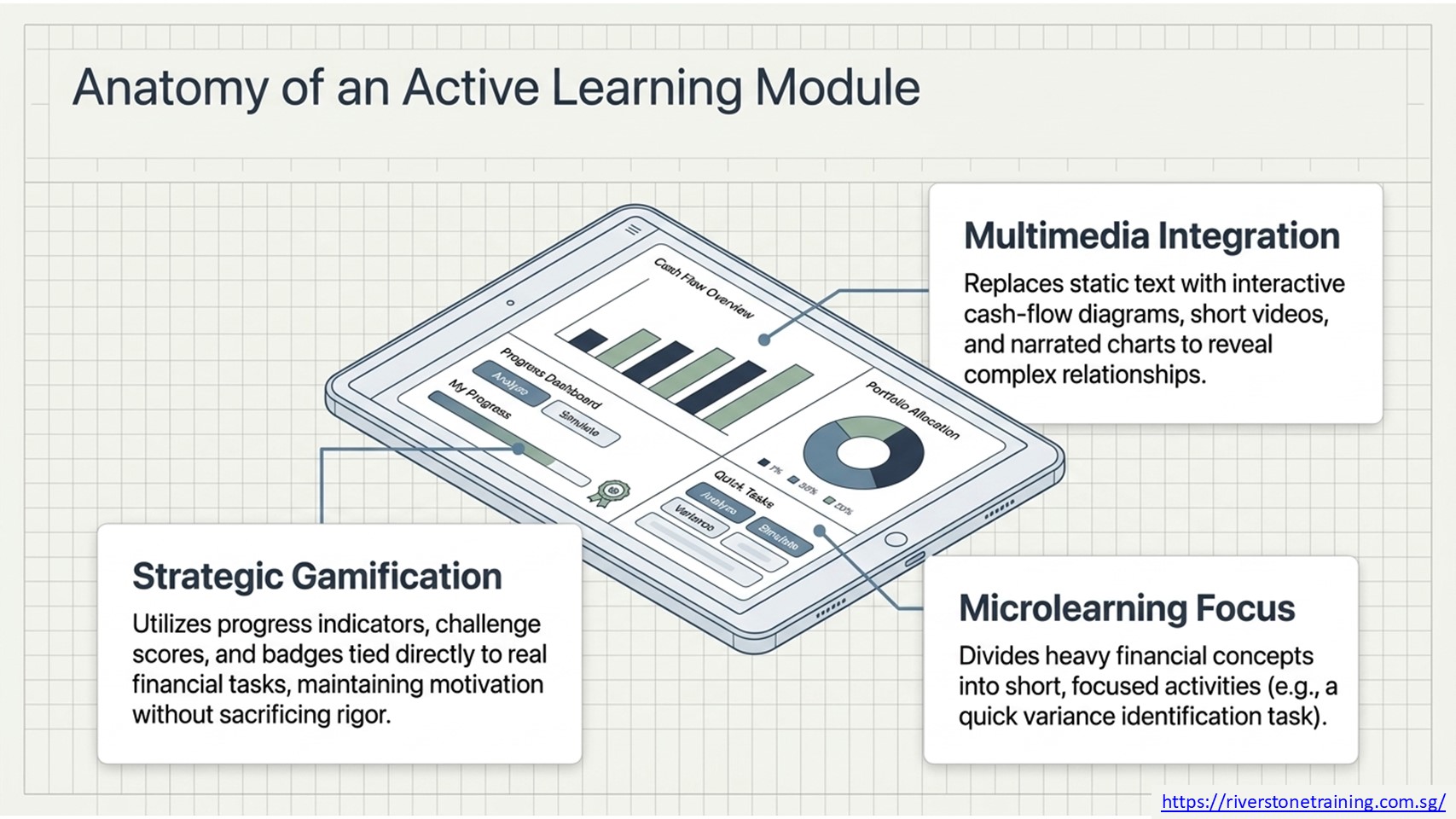
Interactive Finance E-Learning encourages active learning because employees have to interact with the material instead of simply reading or watching it. When learners need to interpret information and make choices, they can be asked to do so in quizzes, financial calculations, branching scenarios, simulations, and/or knowledge checks.
This method can be helpful when dealing with subject areas in finance where there is a lot of common sense involved. In the case of credit risk, for example, a learner might be examining a company’s financial data, which could include warnings, and deciding if there is a need for further analysis before authorizing a hypothetical transaction.
How Can Scenario-Based Learning Improve Finance Training?
Scenario-based learning for finance education enhances the training of finance by putting learners in realistic scenarios in which they are required to use their finance knowledge. A scenario could describe a company in financial difficulty and question the learner about what they would look at first to try to resolve the problem, rather than asking them for the definition of cash-flow management.
A custom e-learning content development company can design these scenarios around an organization’s actual processes, job roles, and learning objectives. The usefulness of customization is that you can create training that’s industry-specific and employee-specific instead of taking a one-size-fits-all approach. Customized e-learning is a process that begins with needs analysis, content development, review, feedback, and delivery and involves content that is customized around client needs and workforce needs, says Riverstone Training.
What Finance Topics Can Be Taught Through Interactive E-Learning?
Interactive e-learning can be used in a variety of finance courses, ranging from basics to highly specialized professional courses. The format is ideal for use when students must interpret information, perform calculations, or make financial decisions.
Finance Topics and Interactive Activities
| Finance Topic | Possible Interactive Activity |
| Financial Reporting | Identify reporting errors |
| Budgeting | Adjust a departmental budget |
| Financial Analysis | Interpret financial ratios |
| Cash Flow | Analyze cash-flow movements |
| Valuation | Compare valuation assumptions |
| Risk Management | Assess a financial risk scenario |
| Compliance | Select the appropriate response |
| Investment Analysis | Evaluate an investment case |
Another option is to branch off the subject into various levels and have non-specialist employees learn the basics before the more advanced scenarios are tackled by senior employees. This provides a more formal learning environment without having to have all employees do the same tasks.
How Can Simulations Develop Practical Financial Decision-Making?
The simulations give learners the opportunity to experience the effects of financial decisions without the financial risks to the organization. A learner may be required to make an adjustment to a forecast, choose a financial option, analyse an investment opportunity, or respond to a change in business circumstances.
Branching simulations are especially useful because the decisions that learners make can take them along different learning routes. Riverstone’s e-learning development materials explain the terms scenario-based learning, gamification, branching logic, and simulation as interactive components that assist learners in practising their decisions in real-life scenarios.
Why Is Immediate Feedback Important in Finance Training?
Immediate feedback is crucial as it assists learners in understanding whether the answer is correct or incorrect, as well as why it is correct or incorrect. The module can retell the concept behind the calculation or financial situation in a way that helps the worker understand the concept if they have selected the wrong answer or made an incorrect financial decision.
Example: In a financial analysis exercise, an employee might be asked to explain the factors that have contributed to a company’s deteriorating liquidity situation. The module does not just indicate an answer as incorrect; it can also explain the relationship between the working capital, cash conversion, and short-term obligations and the answer.
How Can Gamification Increase Finance Learner Engagement?
Technical finance subjects can be made more engaging with progress indicators, scores, challenges, badges, or decision-based activities, all of which are features of gamification. These elements can help to provide a better sense of progress to learners and keep them motivated to attempt tasks and return to challenging topics.
But it shouldn’t be at the expense of real financial education, either. The best method is to incorporate the game elements into a real learning task, e.g., to correctly analyse a financial statement, to complete a risk assessment, and not just for entertainment.
How Can Microlearning Improve Finance Knowledge Retention?
Microlearning allows breaking down bigger topics into shorter learning sessions that are more focused, which enhances finance training. Rather than taking an overall course in financial management, learners could take individual modules focusing on budgeting, cash-flow forecasting, financial ratios, and management reporting.
This also allows for more convenient refresher training. An employee who wants to know how to conduct a particular financial process can find the corresponding module without having to go through an entire training. In the custom-made e-learning materials made by Riverstone, modular microlearning, mobile access, scenario-based activities, and refresher learning are identified as useful elements of custom-made digital training.
How Can Multimedia Improve Understanding of Complex Finance Concepts?
Multimedia can enhance understanding by providing financial information in ways that make it easier to see the relationships. When a concept has more than one step or relationship, charts, animations, narrated explanations, interactive diagrams, and short videos can be used to supplement written explanations.
For example, an interactive cash flow diagram might illustrate the flow of revenue through operating expenses, debt payments, tax payments, and cash flow distribution. This allows the employees to focus on the individual parts and not have to do so from a static paragraph.
How Can Interactive E-Learning Support Different Finance Skill Levels?
Interactive e-learning can be used to cater for varying skill levels by structuring training content into basic, intermediate, and advanced activities. A new finance person could start out with financial statement terminology; a seasoned analyst can dive straight into forecasting or valuation scenarios.
These more sophisticated learning systems can also use the performance of the learners to determine what they don’t know and can suggest further material. Riverstone’s custom e-learning approach explains adaptive learning paths and performance-based content recommendations as personalization of learning experiences.
How Can Custom E-Learning Content Address Finance Team Needs?
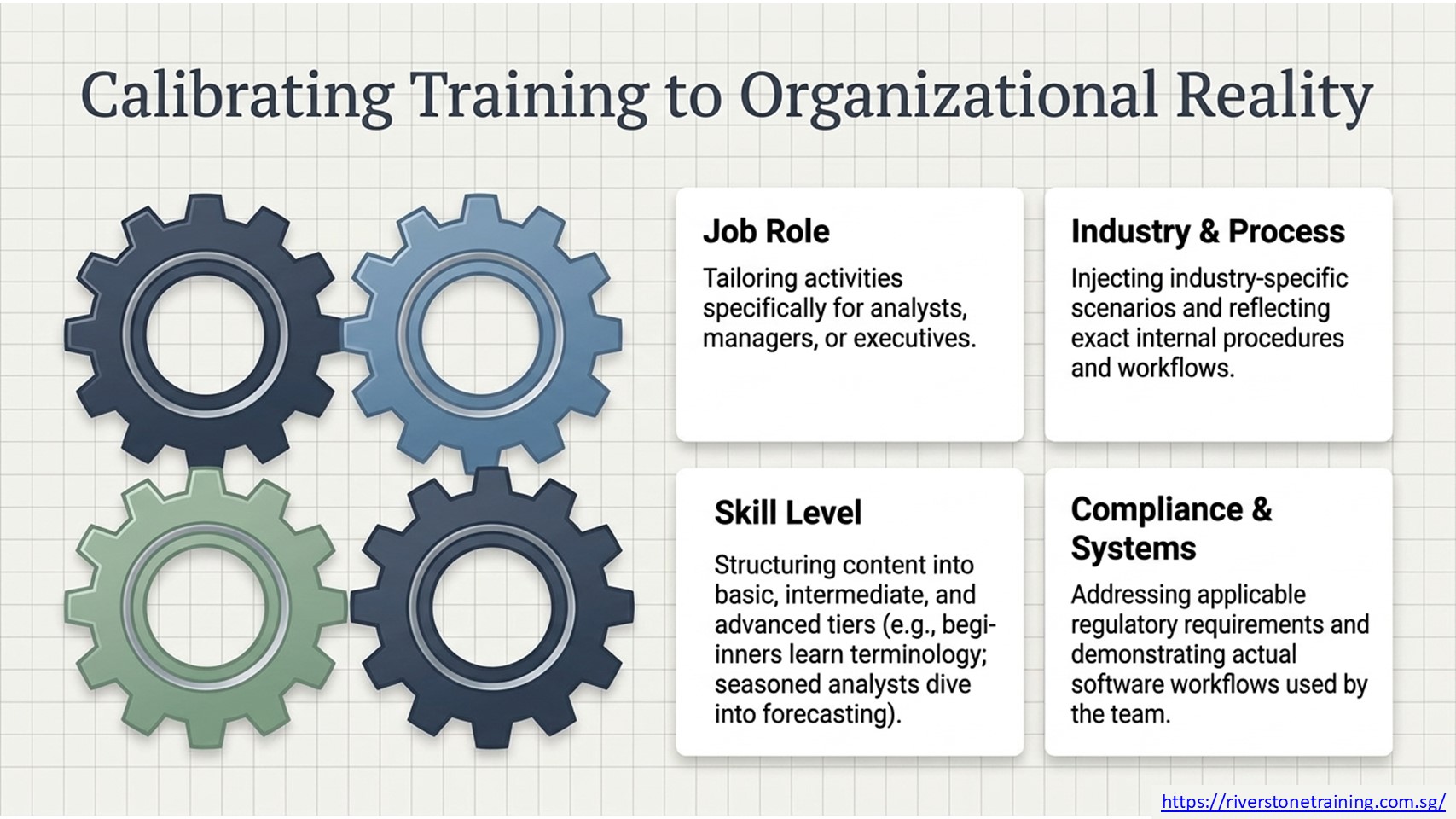
Custom e-learning material can help finance teams by aligning the learning with the business processes, terminology, systems, and situations. This can help make training more relevant than finance generalisations as employees practice skills that more closely match their actual work.
A custom e-learning content development company can work with subject-matter experts to identify knowledge gaps and transform technical material into structured digital learning. This may include developing sections of internal reporting protocols, financial controls, budgeting processes, investment analysis, or compliance requirements for finance teams.
Customization Areas for Finance Training
| Customization Area | Finance Training Application |
| Job Role | Tailor activities to analysts, managers, or executives |
| Industry | Use relevant financial scenarios |
| Business Process | Reflect internal procedures |
| Skill Level | Provide beginner to advanced modules |
| Compliance | Address applicable requirements |
| Systems | Demonstrate relevant workflows |
This form of customization also enables organizations to update content in the event of procedure or business changes. Riverstone says the development process for their e-learning involves looking at client needs, creating content that matches those needs, incorporating feedback and completing the deliverables.
How Can LMS Features Strengthen Interactive Finance Training?
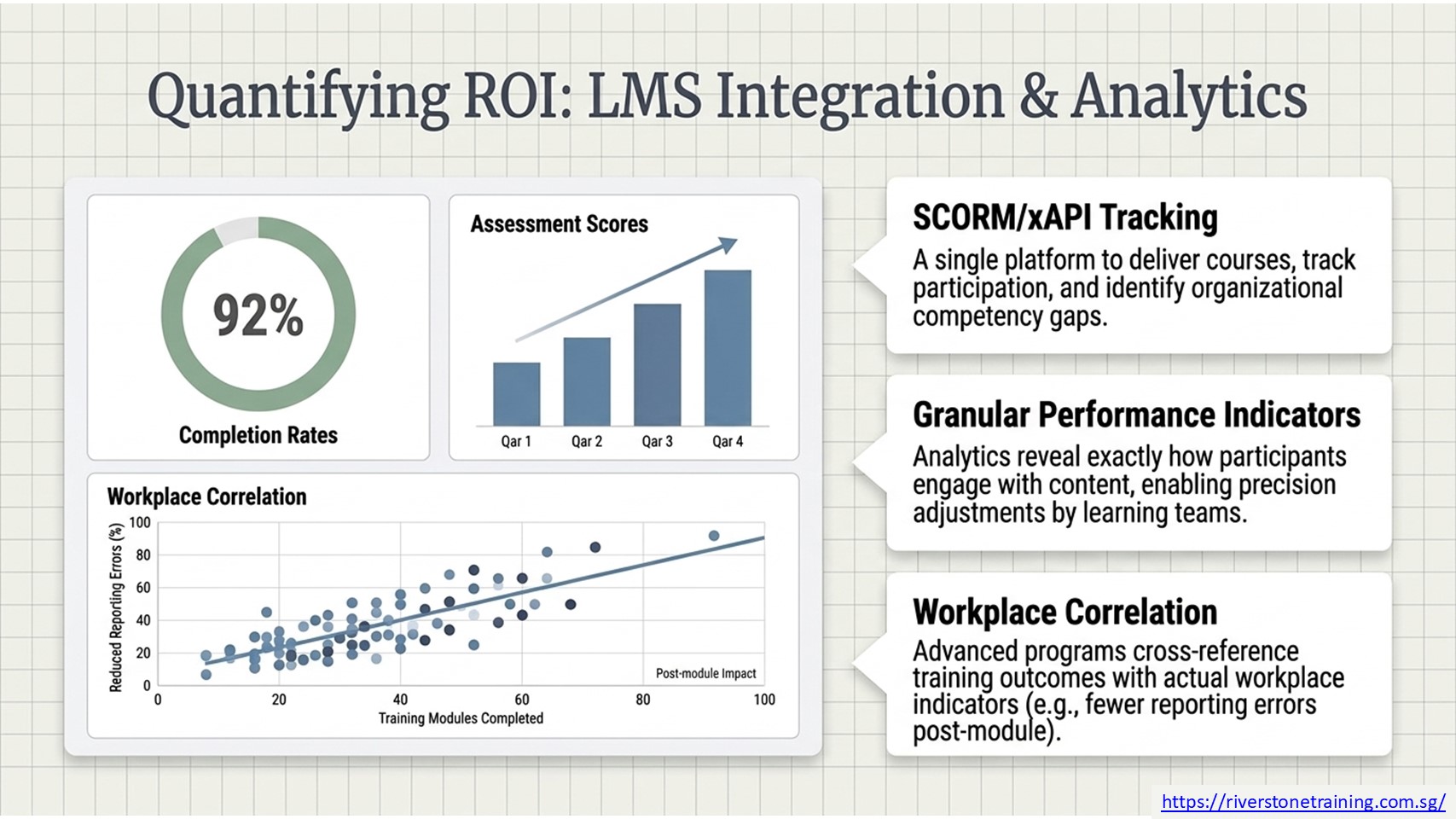
An LMS can be used to improve interactive finance training by providing an organization with a single platform to create courses, track attendance, and assess student progress. This can assist the training teams in seeing the areas where employees have done training and what areas they need more training on.
Assessment and learning data can also be integrated into the LMS in interactive courses. Riverstone’s e-learning resources provide an overview of what LMS integration, SCORM/xAPI standards, participation tracking, performance indicators, and analytics can enable in terms of measurable digital learning.
How Can Finance Training Use Real Business Data?
When financial information is provided that is not just theoretical but real, finance training becomes more practical. Case studies may include a simplified income statement, balance sheet, cash-flow statement, budget, forecast, or an assumption about cash flow, and then require the learners to interpret the data.
An interactive exercise might give the company’s quarterly results and challenge the learners to determine which operating expense increased the most. A second question might ask what the change means for profitability, leading the student to make links between individual financial measures and business performance.
Why Should Interactive Finance E-Learning Include Assessments?
Assessments aid in identifying whether employees are able to apply what they learned during the training. Instead of just checking for completion, assess learners’ comprehension of the material with quizzes, calculations, case studies, simulations, and scenario-based assessments.
Assessment Types and Skills Tested
| Assessment Type | Skill Tested |
| Multiple-Choice Questions | Concept recognition |
| Financial Calculations | Technical accuracy |
| Case Studies | Financial analysis |
| Simulations | Decision-making |
| Scenario Questions | Practical judgment |
| Final Assessment | Overall knowledge |
The assessment should be appropriate to the learning objective. If the objective is to be able to read and interpret financial data, for instance, it might be more meaningful to inquire whether employees can do that than it would be to quiz them on the definitions of terms.
How Can Interactive E-Learning Support Finance Compliance Training?
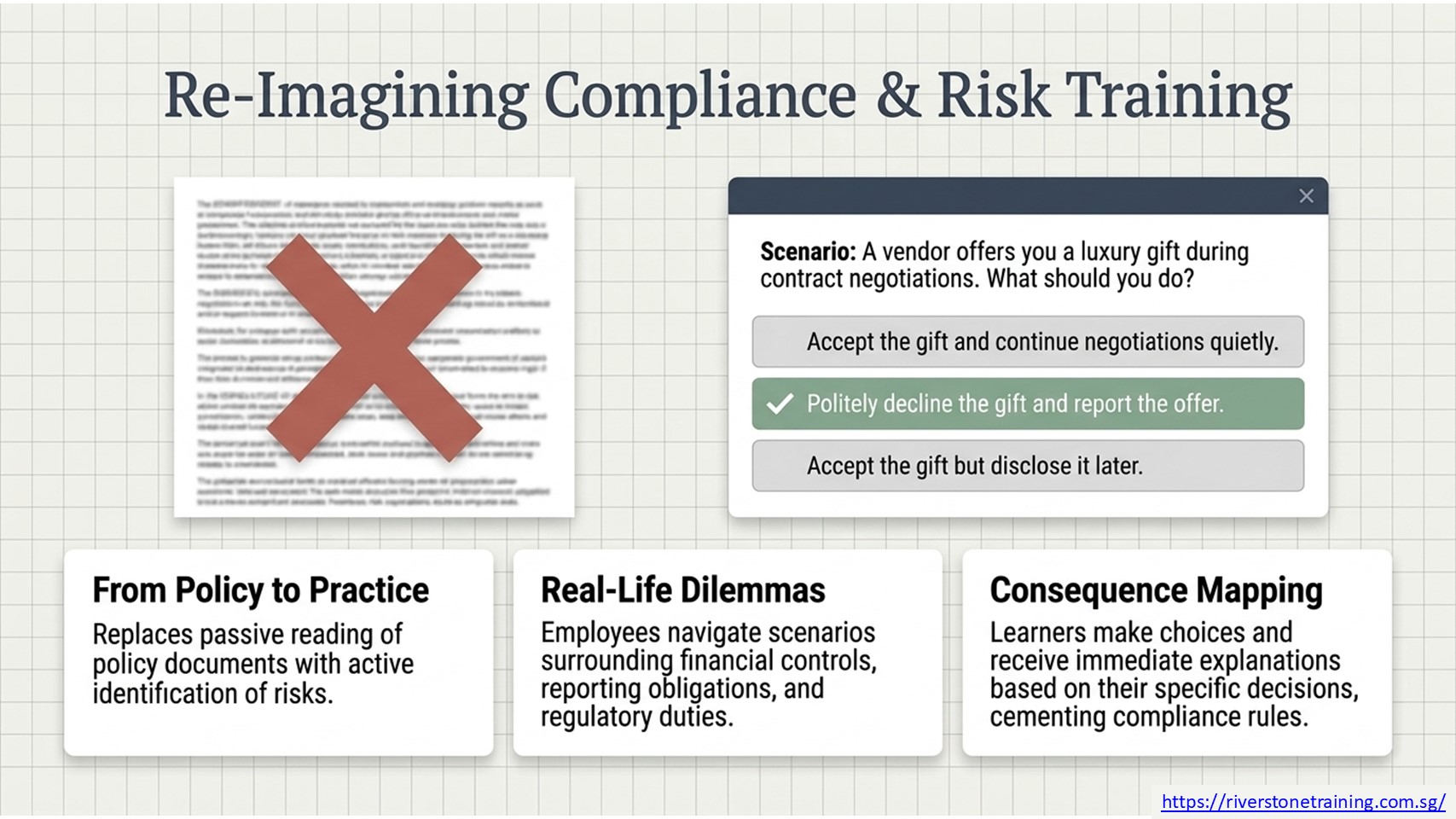
Interactive e-learning can also help make compliance training more real-life by showing employees scenarios surrounding financial controls, reporting obligations, regulatory duties, or ethical issues. Learners will be able to decide what they would do and get explanations based on their choices.
This is helpful because knowing the rules of compliance may require specific conditions to be met. These activities can then enable employees to work on scenarios to practice identifying risks and the corresponding procedures involved, as opposed to reading policy documents.
How Can Organizations Measure the Effectiveness of Finance E-Learning?
Completion rates, assessment scores, learner engagement, knowledge checks, and performance data are all measures of effectiveness for organisations. In more advanced programs, training outcomes may also be correlated with workplace indicators as appropriate.
A company might check to see if a module has been effective for employees in reporting financial transactions if they become more accurate after the module. LMS analytics can offer more insight into how participants engage with and perform on the content, enabling learning teams to determine what adjustments might be needed.
How Should Organizations Design Effective Interactive Finance Training?
The first step in development is for organizations to determine which finance skills they require to have in their workforce to effectively execute their work. The training team can then set learning goals and choose suitable content formats, design plausible scenarios, design assessments, test the module, and adjust the module based on the learners’ feedback to make the final course better.
Development Stages for Interactive Finance Training
| Development Stage | Key Question |
| Needs Analysis | What finance skill is missing? |
| Learning Objectives | What should employees be able to do? |
| Content Design | What information is necessary? |
| Interactivity | How will learners practise? |
| Assessment | How will knowledge be measured? |
| Testing | Does the module work as intended? |
| Improvement | What feedback should shape revisions? |
Interactivity does not become superficial with a structured development process. All quizzes, simulations, animations, and branching scenarios should relate to a financial skill that the employee is expected to learn.
What Role Does Interactive Finance E-Learning Play in Modern Finance Training?
Interactive Finance E-Learning can play an important role in modern finance training because it combines technical knowledge with opportunities for practice, decision-making, feedback, and assessment. It is ideal for organizations that require staff to use financial ideas, instead of merely taking informative courses.
It can also be used in conjunction with instructor-led workshops, coaching, and workplace practice. Digital modules can introduce or recap concepts before or after live sessions, and instructors can dedicate classroom time to discussion, more complex case studies, and higher-level problem solving.
How Can a Custom E-Learning Content Development Company Support Finance Teams?
A custom e-learning content development company can help finance teams by converting technical source material into structured, digital learning experiences based on specific employees and business goals. This may be scenario-based modules, microlearning, simulations, videos, assessments, and LMS content.
The process can also include working between instructional designers and finance content matter specialists. This will help to ensure that interactive activities are accurate, presented in a way that employees can understand, and applied. Riverstone says its strategy is to take a customized, industry-focused training approach with a content development orientation aimed at filling in organizational competency gaps.
Conclusion
By providing a mix of technical explanations, scenarios, simulations, assessments, the use of multimedia, and immediate feedback, interactive e-learning can help make finance training more practical. Rather than just delivering financial information, organisations can leverage digital learning to enable employees to practise financial analysis, budgeting, forecasting, valuation, risk management, and compliance in real-world scenarios.
These experiences can be further customized by a custom e-learning content development company for a particular business process, the role of employees, and skill gaps. Meanwhile, Interactive Finance E-Learning can provide a flexible way to reinforce technical knowledge while giving organizations measurable insights into learner participation and performance.
Interactive training is not enough to make it the best training for the finance team. Individual activities should build a certain skill, enable better financial decisions, or allow for more confident use of knowledge in the work environment.