
Learning Competitive Edge
How Finance Education and Corporate Upskilling Are Reshaping the Modern Business Landscape
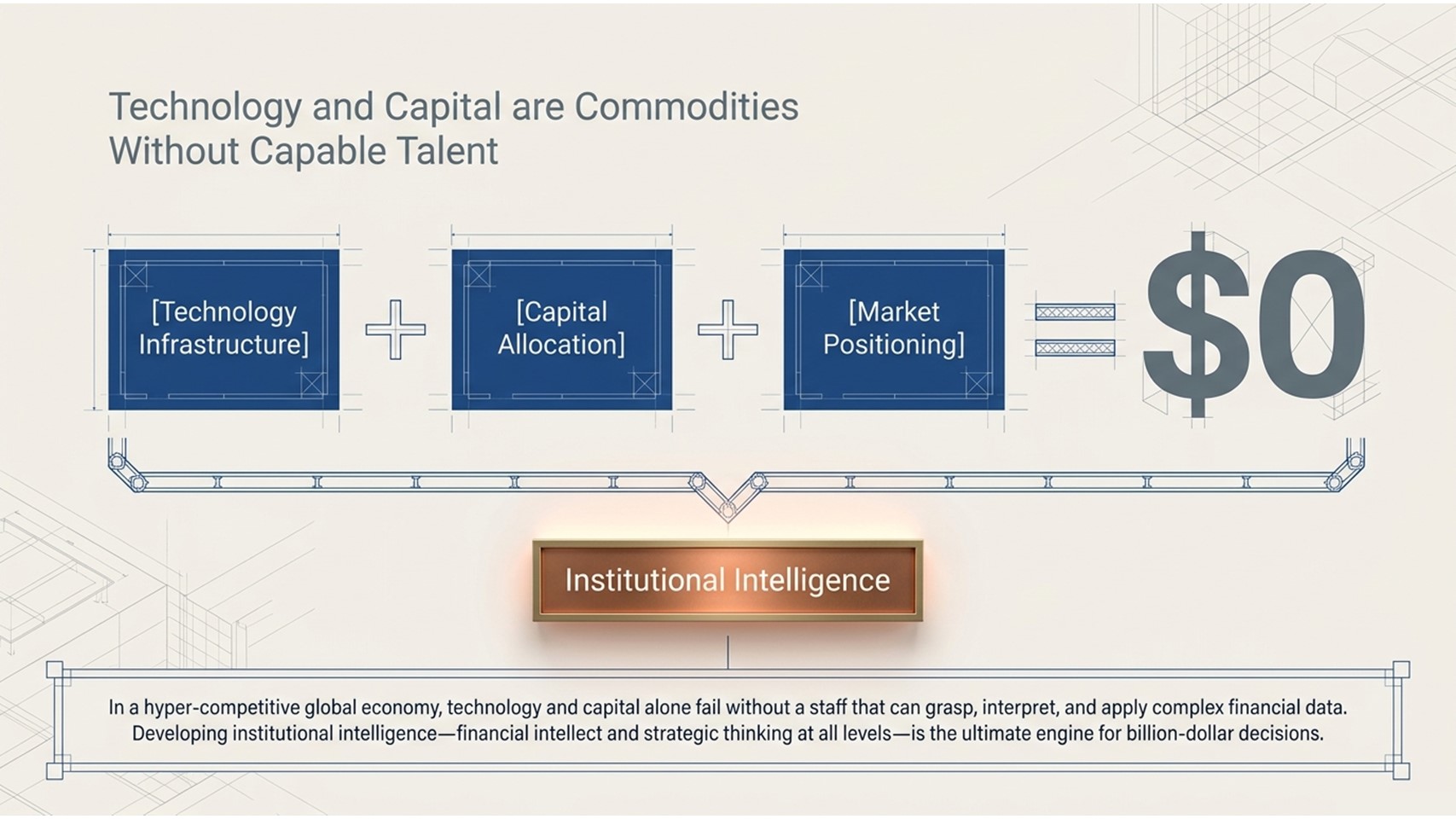
Organisations can be successful or fail to be successful because of their one strength or weakness – that is, the extent and quality of knowledge possessed by their people in the hyper-competitive global economy. Technology, capital, and market positioning are all important, but they are essentially useless without a staff that can grasp, understand, interpret, and apply complex financial and business data. Hence, progressive companies around the globe in Asia and beyond are making a clear investment in learning – not as a one-off compliance task, but as an integral part of their future competitiveness.
The idea of learning for competitive advantage is not just about improving staff’s current jobs, but about developing them for new ones. It’s about developing institutional intelligence — creating an institution that is characterised by financial intelligence, analytical ability and strategic thinking at all levels. The experts who know the “hows” and “whys” of money making are the ones who have been the engines that have produced the best results, whether they are making billion-dollar decisions about capital allocation or planning multi-year projects with infrastructure deals.
The Business Case for Investing in Finance Education
The ROI of employee development is more apparent than ever. Studies have long demonstrated that companies with strong learning cultures achieve significantly superior performance in just about every measure of profitability, financial growth, retention rates, and innovation production — and in other areas as well. However, despite the proof, lots of companies are still under-investing in training that is more finance-oriented, resulting in employees operating with obsolete or inadequate knowledge in the ever-evolving business landscape.
This is especially true in the finance sector. This financial market has been completely changed in the past few years. There has been an increased level of scrutiny in regulatory requirements, higher expectations from stakeholders, and more developed tools to make informed decisions. In this environment, enrolling employees in a structured finance workshop training programme is no longer a discretionary investment — it is a strategic imperative.
The only question for HR professionals and business leaders is now how to invest in finance education in an effective and efficient manner. The best organisations have a systematic approach – they recognise that they have areas of their organisation where there is a knowledge gap and work to address it in a structured way, to be both relevant and precise.
Building Financial Acumen Across the Organisation
A common assumption that many people have when it comes to corporate training is that finance training is only for people who are employed in finance departments. In truth, financial literacy is a multifaceted skill that impacts each and every facet of a company. It is essential for sales teams to know how to operate with profit and pricing. An understanding of the financial consequences of procurement decisions is important to operations managers. For marketers, campaign ROI needs to be treated just like a capital expenditure proposal would be for a CFO.
The impact of corporate financial learning on scale is more than just to the finance function. Decisions improve. Cross-functional collaboration deepens. And the organisation builds a common language for business performance, collaborating around a common set of business goals.
The difficulty, however, is creating programmes that are accessible and interesting to non-finance professionals, while maintaining the rigor necessary to be useful! The top trainers do so by relating finance to the industry and the role of those they train, putting ideas into action, and putting theory into practice.
Financial Modelling: The Engine of Sound Business Decisions
The financial model is the core of modern-day financial analysis. The capacity to create, understand and question financial models is a key skill any finance professional should have, whether to be used when analysing an acquisition target, predicting next year’s income, or to test a business plan against bad scenarios.
However, financial modelling is a skill that needs to be learnt and practised. There are many professionals who work with numbers every day, but who have never been formally trained in model architecture, so that their models are fragile, error-prone and/or simply not fit for purpose. Knowledge of the financial modeling basics — and how to create logical model structures as well as use the appropriate valuation methodologies — is a competency that provides a career payoff.
For organisations looking to elevate their analytical capabilities, enrolling key team members in a financial analysis course is one of the highest-impact investments available. A strong financial analyst/finance manager who can construct a strong financial model from the ground up, question assumptions in third-party models, and present financial data in a clear manner to senior leaders makes a tangible contribution to their organisation.
The majority of this work is carried out within a spreadsheet (Microsoft Excel), the preferred financial analysis medium in corporate settings throughout the world. Proficiency in Excel finance training, such as the use of advanced functions, dynamic arrays and scenario analysis tools, as well as best-practice model design, is thus a must-have for anyone looking to develop a high-performance finance function.
In addition to the historical analysis, organisations are increasingly needing their finance teams to create believable forecasts. Forecasting skills training can help professionals develop forecasting models that account for uncertainty, incorporate a number of data elements and present scenarios that truly support strategic decision-making rather than simply putting on a show of rigor.
For those in FP&A roles or working closely with business unit leaders, a structured financial planning course can transform the budgeting and planning process from a backward-looking compliance exercise into a dynamic tool for performance management and value creation.
Project Finance: Structuring Complex Investments for Success
Structuring and assessing a project finance transaction is now an essential skill for organisations that are looking to expand into infrastructure, energy, real estate, and other capital-intensive businesses. Project finance is at the crossroads of engineering, law, accounting, and economics and it’s also a discipline in which the impact a good financial analysis can make to the success or failure of a multi-billion dollar project can be quite literally felt.
Professionals working in energy finance training and related infrastructure sectors need to understand how to structure deals that are bankable, efficient, and resilient to the inevitable risks that arise over the life of a long-term project. This involves a detailed knowledge of debt/equity structures, cash flow waterfalls, covenant packages and the sensitivities lenders and equity investors will review during the due diligence process.
Central to this is the ability to build and interpret a project cashflow analysis model that accurately reflects the economics of the underlying asset — from construction cost and timeline to operating revenues, debt service, and equity returns. These models are complicated, can be very critical and typically form the underpinning for investment committees that invest hundreds of millions of dollars.
For professionals entering this field or experienced practitioners looking to sharpen their skills, a development finance course provides the conceptual framework and practical tools needed to operate effectively in this demanding environment. Similarly, project structuring training provides knowledge to the deal team on how to build coherent and sustainable transaction structures that align the interests of various stakeholders: sponsors, lenders, off-takers, and governments.
Whether you are a banker, developer, government official, or infrastructure investor, completing a project investment course can change the way that you look at complex, long-duration investments and make you a more credible and effective player in the deal.
Private Equity and Investment: Understanding the World of Capital Allocation
The growth of the private equity industry has been exponential in the last 20 years, with more than just buyout funds expanding its footprint in growth equity, VC, credit, infrastructure and real assets. This means that, beyond fund managers, many others – such as members of corporate development teams, family offices, pension funds, and senior executives with businesses that are acquisition targets or investment prospects – are now interested in understanding the mechanics of private equity: how funds are structured, where deals come from and how they are assessed, how value is added and realised.
Private equity basics training is an easy introduction to an industry that’s apt to be complex and opaque for professionals seeking to gain a basic understanding of the field. This knowledge of the private equity asset lifecycle, fee models, return measures and processes, which shape the investment world, offers a powerful perspective to inform all aspects of professional life.
Professionals who are directly involved in or supporting private markets will need more specialised knowledge, such as investment fund training, equity market course content, and knowledge of the mechanics of deal structuring training. These skills are especially useful during periods of corporate change, such as a company’s acquisition, when the company is introducing a new strategic partner, or when an organisation is considering a divestment of a non-core business division. Knowing how to understand and negotiate the financial aspects of such deals – and knowing what will be taught in an acquisition finance course – can be the difference between success and failure.
Business Valuation: Knowing What Things Are Worth
There are a few things that are more widely applicable in financial skills than in business valuation. Knowing the worth of a business and why is essential at all times, whether you’re negotiating the sale of a division, considering an acquisition, raising equity capital, or deciding if your business is creating or destroying value, or simply trying to understand the situation.
But there are some areas where the competence is not as high as the confidence, such as valuation. There are many professionals who are superficially familiar with valuation multiples and discounted cash flow analysis, but aren’t really ready to know when it is appropriate to use it, how to set up its important parameters, and how to interpret and challenge the results. A comprehensive corporate valuation basics course will systematically address such gaps, laying the conceptual underpinning for good valuation practice.
A business appraisal course offers practical instruction in the most commonly used techniques such as the ‘comparable company analysis’, ‘precedent transaction analysis’, DCF modelling, and ‘sum-of-the-parts valuation’. Valuation methods training that goes beyond the formula can help train professionals to be more judgmental when they can’t get an exact answer from a formula.
For senior executives and board members, access to enterprise valuation course content provides the literacy needed to engage meaningfully with advisers, challenge assumptions, and make decisions that are grounded in a realistic assessment of value creation and destruction. And for anyone involved in capital allocation decisions, the ability to undertake rigorous company worth analysis is a competency that pays for itself many times over in the quality of the decisions it informs.
In-House Training: Bringing Learning to Your Organisation
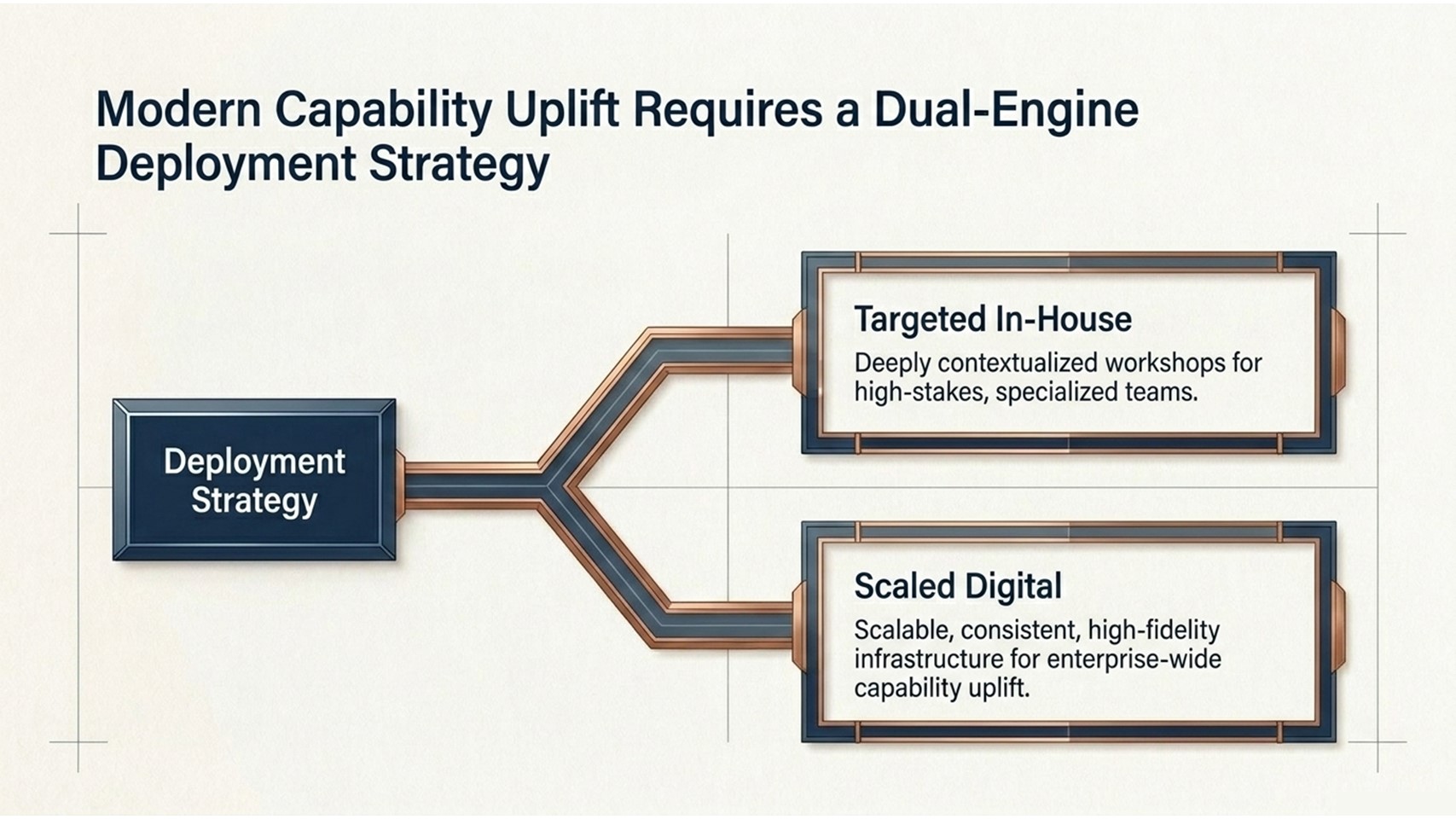
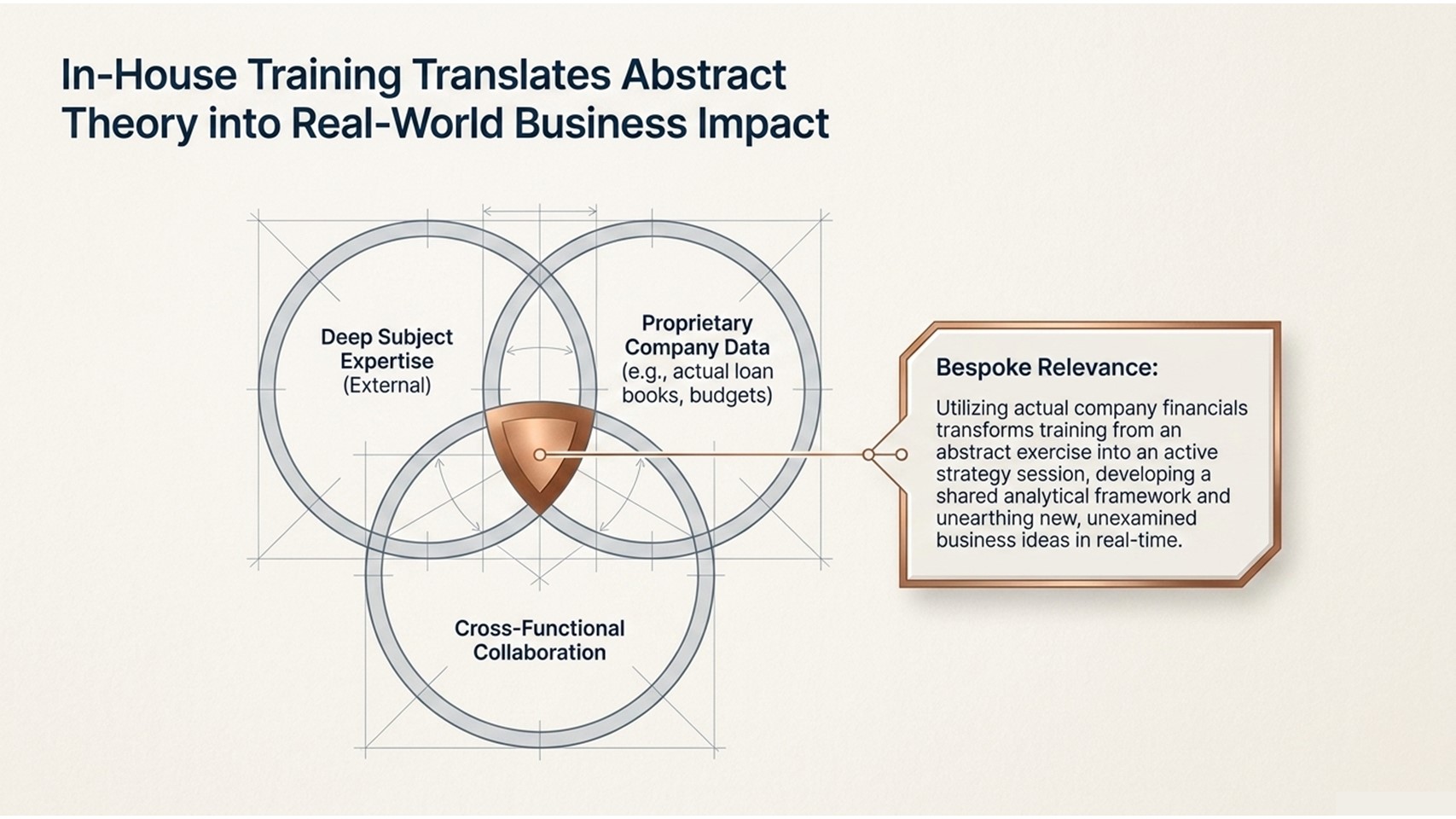
Participation in public training opportunities is an opportunity for individual professionals to greatly enrich their professional lives, but the greatest learning opportunities are often those developed and delivered specifically for an organisation. In-house training programs have various advantages over generic courses in the public, most of all, they have the ability to put into context the content, the industry, the business model, and the challenges with which the participants are confronted.
Training as part of a bank’s credit team on project finance modelling with real-life examples from the bank’s loan book is more relevant, more interesting, and more likely to have an impact on the quality of their in-house work. The training is not an abstraction of financial planning, but an extension of the actual financial planning, when the corporate treasury team works through financial planning scenarios based on their respective company’s actual budget.
Corporate training courses delivered in-house also create significant organisational benefits beyond individual skill development. They develop common analytical languages and frameworks between teams. They bring up opinions and ideas that can be considered without being examined. They provide opportunities for cross-functional training that are not easily seen within public programmes.
For HR teams designing employee training workshops in finance and business skills, the key is to partner with training providers who combine deep subject matter expertise with the instructional design capability needed to translate that expertise into engaging, effective learning experiences. Workplace learning courses that tick the compliance box but fail to genuinely develop capability are a waste of resources and a missed opportunity. The best staff development training providers deliver programmes that participants remember, apply, and reference long after the training day is over.
Digital Learning: Scaling Finance Education Across the Enterprise
Digital learning has revolutionized the business training model. While investment in training was once capped by the cost and complexity of getting people into a classroom, digital technologies now enable excellent learning experiences to be offered to staff from anywhere, anytime and at a much reduced cost.
For finance and business training in particular, well-designed e-learning course design can be remarkably effective. Financial concepts have a natural fit for the interactive, self-paced learning modalities that can be achieved with digital platforms, from animated explanations of complex structures to interactive model-building exercises, scenario-based assessments to video-based lectures by financial practitioners, and more. All can be delivered with high fidelity and consistent quality through digital channels.
In recent years, Online training development in the financial field has grown considerably, and the most successful providers are offering a blend of high-quality content knowledge and cutting-edge instructional design that produce programmes that truly captivate and advance participants’ capabilities. To roll out a digital learning system to the entire organisation at the same time, and provide the same high-quality learning content to all relevant employees, is something that most organisations didn’t have 10 years ago.
For learning and development teams tasked with building enterprise-wide finance capability, learning content creation that is customised to the organisation’s specific context and learner profiles is significantly more effective than off-the-shelf content. And as organisations become more comfortable with hybrid learning models — combining digital content delivery with live virtual sessions and in-person workshops — the most sophisticated providers are designing virtual training programs that leverage the best of both worlds.
Digital learning can also be scaled, as this allows the development of capability in line with the strategic goals of the organisation. A business transformation, whether it’s a new market entry, integration of an acquisition, or repositioning of the business model in the face of competition, can be enabled by a well-designed digital learning infrastructure, thereby aiding a rapid capability uplift.
From Knowledge to Competitive Advantage: Making Learning Stick
Training for training’s sake is an empty exercise unless it is planned to have an impact on work performance. Organisations that reap the biggest competitive benefits from their investments in learning – those who see capability development as an ongoing process, rather than a series of discrete actions – are the best place to begin.
This means training material is implemented in the workplace, which can involve on-the-job projects, peer coaching and reinforcement of behaviours and skills acquired during training in performance management systems. It measures the effects of learning interventions not on the business, but on the satisfaction scores of the participants. And it means developing a culture that values, resources and celebrates learning as a contributor to the organisational performance.
An applied finance course that connects theoretical concepts to real business challenges, a finance knowledge training programme that builds both technical competence and analytical confidence, or a comprehensive finance learning program that structures development over months rather than days — these are the kinds of thoughtful, sustained investments that create lasting competitive advantage.
Conclusion: Learning Is Not a Cost — It Is a Strategy (Learning Competitive Edge)
The companies that will dominate their sectors in the coming years are already spending the capital on their people, who will make the difference. They know that technology is commoditising many of the traditional bases of competitive advantage and, as such, the depth and quality of the knowledge of their people is one of the few bases of sustainable competitive advantage that remains.
Training in finance is not something that is a sideline. All manner of training related to finance, whether it be financial modelling, project finance, private equity, or business valuation, is not a sideline. Essentially, it is a key aspect of any organisation’s strategy that is focused on long-term performance. This is also the case with digital learning infrastructure and in-house training skills that allow organisations to create and maintain the knowledge at scale.
For HR professionals, business leaders, and finance professionals reading this, the message is clear: the learning that you put in today is the competitive edge that you will have tomorrow. It’s not about whether your organisation needs to invest in finance education; it’s about how. But can it afford not to?