Structuring Risk Analysis Workshops for Insurance and Corporate Sectors
Introduction to Certified Corporate Insurance Risk Training
Both the insurance and the corporate business environment are characterized by growing uncertainty, changing regulatory views and altered world economic forces. Risk exposure is becoming more complex and multidimensional as organizations go global, embrace new digital procedures and are exposed to complex financial instruments. The insurance companies have to deal with underwriting risks, price pressures, capital adequacy requirements, model of catastrophic events and solvency. The corporate organizations are subject to the volatility in the supply chain, cyber-threats, operational risks, financial reporting risks, and misalignment. The capability of undertaking stringent risk-taking analysis is the key to the long-term sustainability and stability in governance in both sectors.
Organizations should overcome this complexity by having well-organized training programs, which enhance the level of risk assessment in organizations. The programs equip the professionals with analytical, conceptual, strategic skills in order to assess risk exposures appropriately and to develop structures or frameworks that assist them to make an informed decision. Training programs become relevant as the regulatory bodies require firms to have better governance practices as they look forward to the training programs to equip firms to develop internal expertise that meets the industry expectations.
With or without an intensive Authorities have their way With any of the above, or to a more detailed evaluation in another scene displaying dramatic elements the author aims to depict. With or without an intensive The authorities have their way With one or the other or to a more exact assessment in another scene that shows dramatic features the author wants to portray insurance risk analysis and capital adequacy training program or an extensive corporate risk modelling and appraisal workshop, organizations acquire the means necessary to enhance their risk culture, as well as to enhance the level of analytical discipline and competitive advantage.
The Need for Structured Risk Analysis Workshops
Enhancing Institutional Competence in Managing Modern Risk Challenges
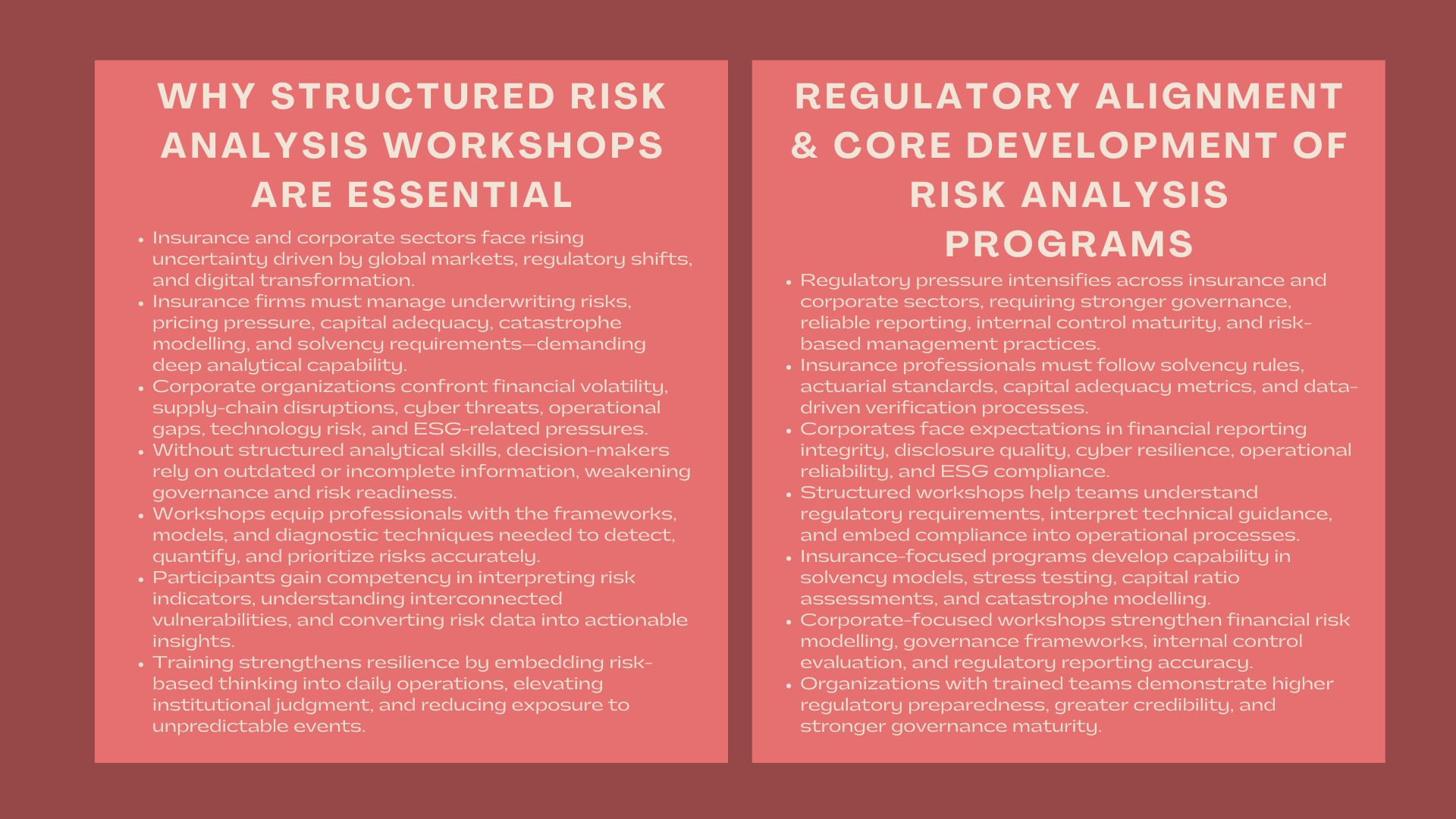
Current organizations are forced to deal with risks that change very fast and in most cases randomly. The insurance firms have to determine the quality of underwriting, review the quality of reserves and ensure that the solvency requirements formulated by the authority and demand complex quantitative models. Certain underlying risks such as catastrophe events, risks as well as climate changes, shifts in the patterns of mortality and unstable investment portfolios cause more layers of vulnerability. Corporate organizations are exposed to the strategic risk, financial uncertainty, technological discontinuity, supply chain dependency, ESG pressure, and operational unpredictability. In the absence of good analytical skills, the institutions may make the decision based on incomplete or old information.
Organized training equips the participants with the schemes and procedures that will be needed to detect, quantify, and deal with various risks. The participants gain some competency in approaching techniques to models, acquire knowledge on interpreting risk indicators, and be aware of how resilience of risk dependencies involving each other contribute to organizational resiliencing. Workshops further enhance the knowledge of how the internal controls, governance processes and data analytics can help in risk evaluation. As organizations are exposed to structural conditions whereby reactions are more compressed in quicker timeframes, and there exists a level of risk visibility, preset learning programs reinforce the competence of individuals as risk indicators and change them into usable insights.
Strengthening Regulatory Preparedness and Industry Alignment
The regulatory pressure in both sectors of insurance and corporate is increasingly gaining momentum. The insurance firms are subject to their solvency frameworks, actuarial reporting standards, capital adequacy requirements and governance requirements which focus on accuracy of the data as well as verification of risks. Corporate bodies have to fulfill the requirements in the sphere of financial reporting integrity, risk disclosure, internal control reliability, and ESG governance. In both industries, regulators would like the organizations to implement risk-based management in which they have solid analytical structures and sound judgments.
This is because structured training gives them the expertise to know the requirements of the regulation and how to incorporate them in the day to day operations. Workshops also assist the professionals to read technical direction, react to the regulatory screening procedures, and build on credibility of reporting. The properly designed insurance risk analysis and capital adequacy training program enables the participants to learn about solvency models, the stress capital situations with regulation ratios evaluation.
A comprehensive corporate risk modeling and assessment workshop assists company executives to build robust internal governance procedures, review control frameworks, and generate measurements that is in accordance with the supervisor requirements. Making regulators increasingly keen on this matter, organizations with trained teams have an evident edge in staying in line and proving their maturity regarding governance matters.
Core Components of Risk Analysis Workshop Development
Building Analytical Foundations for Assessing Insurance and Corporate Risk
The introduction of a workshop on risk analysis starts by creating a good ground on the principles and methodologies that are used to determine the risk exposures. In the case of insurance professionals, this involves risk knowledge of underwriting risk, pricing risk, the manner of reserving, catastrophe modeling, investment portfolio risk and solvency projections. The workshops look at the intersection of actuarial methods and capital models and the effects of risk assumptions on the financial results. The participants will have an exposure to scenario-based analysis, stress test, capital adequacy models, and loss allocation models that influence the strategic choices made by insurance organizations.
Corporate workers discuss the enterprise risk management frameworks, financial risk modeling, supply chain risk management, operational vulnerability analysis, and quantification of cyber risks and strategic risk forecasting. The quality of risk awareness is part of the training programs that highlight the need to appreciate the risk at process and organizational levels. The participants are provided with the skills of detecting the control gaps, analyzing the financial exposures, analyzing risks of technology and analyzing the market dynamics. With the help of guided learning, professionals develop analytical competence that will foster the effective prioritization of risks, resource allocation, and strategic planning.
Developing Quantitative and Qualitative Skills for Comprehensive Risk Evaluation
The analysis of risk needs both quantitative and qualitative evaluation. Formal workshops enhance the talents of the participants in probability theory, sensitivity analysis, methods to forecast, and interpretation of data. Insurance specialists get to know how to use quantitative techniques in estimating the frequency of claims, the severity distributions, the reserves adequacy, and also the solvency positions. Corporate professionals get to know the analysis of financial reports, modeling the risk of cash flows, analysis of credit exposures, and measurement of operational performance.
Simultaneously, the participants gain qualitative skills that enable them to review the process of governance, organizational culture, the behavior of stakeholders, and strategic decision-making patterns. Risk analysis is also concerned with numerical precision as well as the contextual interpretation that has impacts. The workshops assist the professionals in relating the models to real world decision making and in such a way that the assessment of risk will be based upon the operational realities and strategic objectives. This balanced training will enable the organizations to be less reliant on numbers, and increase their capacity to make judgment based on analytical evidence and better understanding.
Implementation Across Insurance and Corporate Sectors
Adapting Risk Workshops to Sector-Specific Needs and Operational Contexts
The insurance industry and corporate sector are widely different in terms of their operation structure, risk exposure, regulatory environment, and decision making process. In this case the risk analysis workshops should be formulated with specific sector content that should contain the special needs of the environment. Training in the insurance industry focuses on the actuarial techniques, solvency, reinsurance design, underwriting risk assessment process, claims management process, or investment portfolio volatility. The workshops enable the participants to have a clear view of the interactions between these elements and the effect they have on choosing the position of solvency and distribution of capital among the programs in the firm.
Corporate training concentrates on training financial reporting risks, operational disruption, governance vulnerability, and cyber threats, project risk assessment framework, and supply chain analysis. The below are some of the ways that the participants discuss the effects of risk in strategic planning, capital investment decision-making, operations, and compliance. Making the workshop industry specific will provide the members with practical information, which participants can use in their respective work classification. The alignment to this sector also has the effect of making organizations realize a direct value in the value of the training with respect to enhancing risk competencies in the name of organizational priorities.
Strengthening Cross-Functional Collaboration and Risk Governance Maturity
Risk management entails working in conjunction within several departments. The insurance companies need to coordinate the actuaries, underwriters, investment teams, finance teams as well as compliance teams. Corporate entities have to organize the finance units, operation heads, compliance teams, technical units, and internal auditing. Workshops note the significance of creating cross-functional risk communication and developing a joint burden of governance, as well as connecting the risk analysis with extended decision-making processes.
The participants are taught on how to convey risk insights in a manner that appeals to the executive leadership, risk committees and operational stakeholders. They learn to convert the analysis results into strategic suggestions to be used in making business decisions. Training is a process that builds the alignment of all the units in organizations as they move to strengthen their frameworks on risk governance and, through training, the risk assessment process must be incorporated in the daily operations of organizations. Enhanced cross-functional cooperation and corporate resilience, quicker recognition of risk occurrences, and more knowledgeable exemplary planning at all levels are all products of augmented cooperation.
Strengthening Critical Thinking and Professional Judgment in Risk Analysis
Developing Strategic Foresight for Anticipating Emerging Risks
The risk environment has been dynamically changing fast, shaped by the economic changes of the world, regulatory adjustments, and technology as well as society demands. Professionals should handle how to predict the emergence of risks and not astute. Workshops assist the participants to polish on the capabilities of studying external tendencies, assess the market indicators, outline the manifestation of early warning signs and determine the impact of macroeconomic factors on operational exposures.
Insurance practitioners get to understand how risk profilers change with changes in demographics, climatic risks, regulatory changes, and technological changes. Corporate professionals try to analyze the nature of risk environments that are influenced by the geopolitical tensions, market cycles, supply change instability, technology adoption, and the restructuring of organizations. Through the development of strategic foresight, participants will be active contributors to the organization stability leading the leadership in the turbulent situation.
Enhancing Communication and Interpretive Skills for Informed Decision-Making
The analysis of risks has strategic value only in case the results are presented in a clear and effective manner. The use of workshops trains the participants on how to write reports, presentation abilities, and how to engage the stakeholders in a clear manner. The professionals are taught how to convey complicated modeling outcomes to non-technical people, how to state risk assumptions openly, and how to deliver action-related recommendations that can be adhered to in order to facilitate leadership choices.
Effective communication helps the risk professionals to earn credibility, develop trust and play a significant role in organizational strategy. Through better interpretation, participants gain the capacity to facilitate the debates on capital sufficiency, vulnerability risks faced in the operations, financial risks, and concept of governance. This improves the awareness of institutional risks as well as makes sure that decisions are based upon the well-analyzed and well presented risk insights.
Conclusion
Risk analysis workshop is important in enhancing the governance capacity in insurance and corporate realms. Under organized systems of learning, participants develop analytical richness, strategic acumen, and professional judgment with the ability to adjust to the contemporary risk environment. The insurance risk analysis and capital adequacy training program provides the participating insurance professionals with technical as well as regulatory skills that they require to ensure their solvency and operation resiliencies.
In the meantime, a properly structured corporate risk modeling and evaluation exercise allows corporate departments to examine financial risks, advanced risk analysis workshops for insurance and corporate professionals operational risks, as well as strategic risks, with a high level of certainty. Investing in systematic training, organizations develop the effective cultures of internal risk, enhance the quality of decision making, and organize their food to sustainable success in the complicated and fast-changing global environment.