
Case Study: E-Learning Services on Hotel Business Financial Modeling Strengthening Hospitality Investment and Financial Decision-Making
Background on Case Study Hotel Business Financial Modeling
The hospitality industry is a very dynamic business environment which is affected by tourism trends, economic cycles, seasonality and fluctuating consumer preferences. Financial models are essential to the hotel owners, operators, investors and finance professionals in the appraisal of acquisitions, new developments, renovations, and the current operational performance.
Although financial modeling is significant, most of the professionals occupied in hotel projects are of operational, sales or asset management background and have not been properly trained in hotel business financial modeling. The old classroom-based training method proved to be impractical most of the times because of the shift-based working schedule, geographical distribution, and the flexibility of learning.
In an effort to overcome the challenges, our firm was contracted to design and implement a complete e-learning programme on Hotel Business Financial Modeling, allowing learners to develop valuable and practical, industry specific financial modeling skills, using scalable self-paced digital learning programmes.
Issues and Challenges
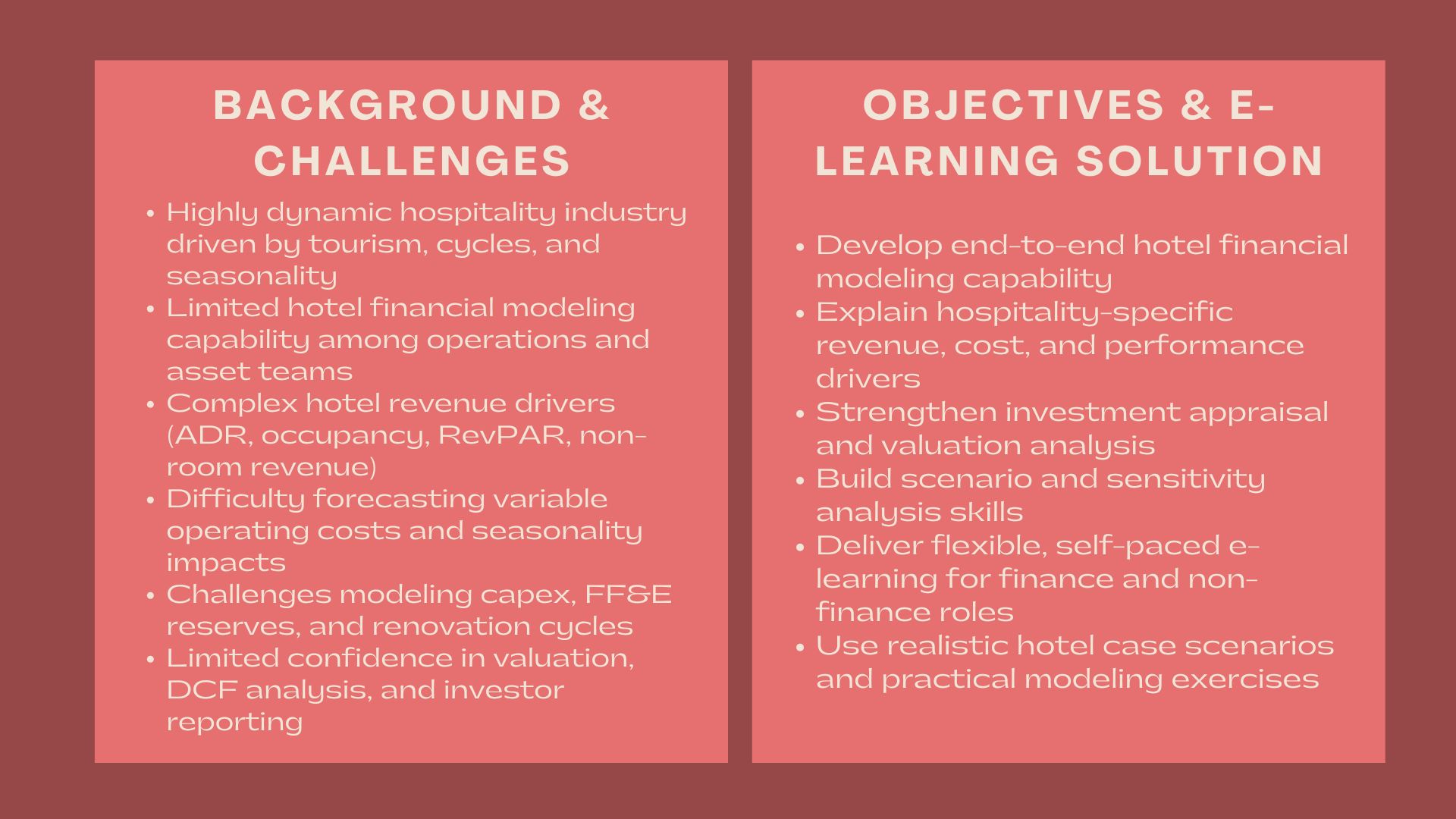
There were numerous issues that the participants experienced, which underscored the necessity of specialised hospitality financial modelling training.
Among the main problems, the dynamics of hotel revenue were to be considered. Hotel revenue is a factor of room rates, occupancy, average daily rate (ADR), and revenue per available room (RevPAR) and non-room sources of revenue, including food and beverage, events, and ancillary services.
The other problem was the ability to forecast the operating costs. The cost structure of hotels is complex in nature consisting of staffing, utilities, marketing, and maintenance which vary with occupancy levels and seasonality.
Planning of capital expenditure was also a challenge. Students had a hard time modeling renovation cycles, furniture, fixtures, and equipment (FF&E) reserves and long-term asset maintenance expenses.
The further complexity was with valuation and investment analysis. The use of discounted cash flow (DCF) techniques, assumptions of exit, and the use of right discount rates needed a good knowledge of the risks in the hospitality market.
Lastly, a lot of professionals did not have confidence in working out financial outputs and reporting the results to investors, lenders, or senior management.
Objectives
The main aim of the involvement was the development of an e-learning programme on Hotel Business Financial Modeling that had the potential to create viable and industry specific modeling capacity.
Key objectives included:
- Instruction in end to end hotel financial modeling strategies.
- Describing the hospitality-specific revenue and costs drivers.
- Increasing investment and valuation analysis.
- Increasing the capacity of scenario and sensitivity analysis.
- Offering varied learning opportunities to different learners.
The programme had to be realistic, relevant to projects of live hotels and accessible to finance and non-finance professionals.
How We Helped
Our instructional design model was systematic in an effort to come up with an integrated hotel business financial modelling e-learning programme.
The involvement started with curriculum design. We designed the learning process to shift between the basics of hospitality business and sophisticated financial models and valuation processes.
The initial modules taught the business model of the hotel business, including positioning in the market, room stock, pricing policies, and demand. Such key performance indicators like ADR, occupancy, RevPAR, and GOP were discussed in a balanced and intuitive way.
The main part of the programme was to create a model of a hotel finances step by step. Learners were taken through:
- Organizing model schedule and assumptions.
- Predicting ADR and occupancy in the room revenue.
- Food and beverage and other operating revenues modeling.
- Estimating departmental margins and operating expenses.
- Recording capital expenditure and FF&E reserves.
We had then presented cash flow analysis and valuation techniques. The modules explained how to create a cash flow projection, a discounted cash flow analysis and terminal value estimation of assets of a hotel.
They incorporated scenario and sensitivity analysis across the programme. Students discussed the impacts of the occupancy, pricing, operating cost and capital investment on profitability and valuation.
The e-learning experience was partly practical modeling exercises. Students were provided with guided tours based on real-life hotel situations and motivated to construct and modify models on their own.
Interpretation and communication was also highlighted in the programme. Students were made to understand how they could analyse financial outputs and present them in a clear manner to the stakeholders like investors, lenders and hotel operators.
Everything was presented in an easy-to-use e-learning system, with the use of video tutorials, templates, and reference materials.
Learning Design and Delivery
The e-learning programme was created in such a way that it would suit various learning styles and career backgrounds.
The information was presented in a modular lesson which included visual explanation, worked examples and modeling exercises. Learning was supported by knowledge tests and tasks that were not distracting.
The self-paced mode enabled the learners to be able to juggle training and operational duties hence the programme could be applicable to both the individual professionals and corporate hospitality staff.
The digital delivery model guaranteed the same training quality and scalability of the model across portfolios and regions.
Value Delivered
The present case study illustrates that E-Learning Services on Hotel Business Financial Modeling can improve the financial literacy and investment preparedness in the hospitality industry.
Through the integration of structured learning and practical, hospitality-specific model exercises, the programme helped learners to comprehend hotel economics more effectively, assess investment opportunities and help them make informed financial decisions.
The scalable e-learning will offer a long-term capability development solution in response to the ever-changing hospitality markets, operating models, and investor requirements.