
Case Study: Banking E-Learning Services Building Scalable, Practical Banking Capability Through Digital Learning
Background on Case Study Banking E-Learning Services
The banking industry is working under a very complex and dynamic environment. The quick regulatory changes, the development of risk management standards, the digital revolution, and the increased customer demands have all contributed to a substantial increase in the knowledge and skills that are needed among the professionals in the banking sphere.
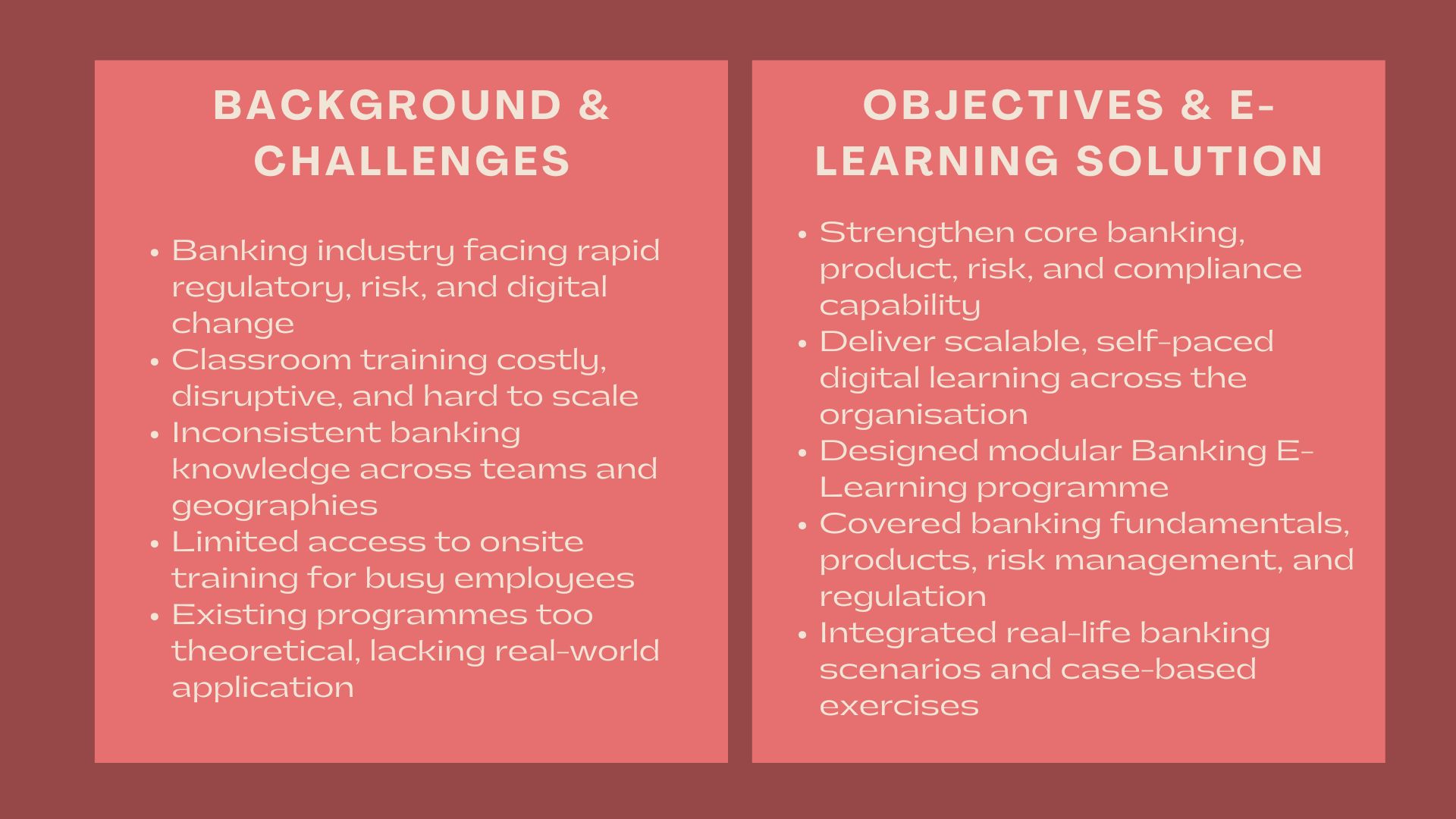
The conventional classroom training models find it hard to cope with these changes. They are also resource intensive, intractable to scale and in many cases disruptive to normal banking activities. There is a challenge of upskilling high-volume and diverse workforces in many financial institutions and maintaining consistent learning outcomes regardless of organizational departments, branches, and geographies.
To respond to these issues, one of the financial services organisations hired our firm to design and implement an overall Banking E-Learning programme. It aimed at developing an organised, nimble and practical digital learning that could reinforce the banking principles, regulatory cognisance, and practical skills throughout the organisation.
Issues and Challenges
The organisation had a number of learning and capability gaps before the engagement which minimised the effectiveness of training.
The low level of knowledge levels was one of the key problems that were not consistent across teams. The workers possessed different educational and professional backgrounds which led to the uneven knowledge of the fundamental banking concepts of credit analysis, risk management, and financial products.
The second challenge was inaccessibility. Onsite training had to be heavily scheduled and in most cases left out employees who were unable to attend classes because of the demands of work.
New regulatory and compliance developments were also hard to communicate. Banking regulations changed frequently and hence the regular training refreshments were necessary, yet the conventional modes of delivery posed a challenge in keeping the knowledge transfer timely and constant.
Also, there was an increasing demand for practical application-oriented learning. Most of the training programmes that currently exist were theory-based and failed to connect concepts to the real world banking decision-making and situations.
Objectives
The engagement was a bid to come up with a solution to Banking E-Learning which would not only increase capability but also contribute to operational efficiency.
Key objectives included:
- Enhancing the basic banking skills.
- Enhancing the perception of banking products, processes, and risk.
- Improving regulatory and compliance awareness.
- Providing real-life applications of banking.
- Education of scale through flexible, self-paced learning.
The programme had to accommodate new employees and the highly experienced ones and also have a uniformity of learning levels in the organisation.
How We Helped
We have developed a Banking E-Learning programme that is modular in nature and will address key areas and applications of banking.
The programme commenced with the basic definitions of core banking criteria such as the banking system structure, roles played by financial institutions, and major functions of banks. This provided a common foundation to all learners irrespective of the experience.
The following modules were concerned with banking products and services. Students visited deposits, loans, trade finance, treasury products and fee-based products learning how these products are revenue generating and how they deal with risk.
Risk management was an important part of the programme. The credits risk, market risk, operational risk and liquidity risk were covered and examples of the practical use of risks and their mitigation by banks were presented.
The regulatory and compliance issues were incorporated in the learning process. The learners were exposed to major regulatory provisions, compliance requirements and governance principles that are applicable in banking operation.
In order to make it more practical, the programme included real-life situations and case-based learning. Students were taken through scenarios of the common banking scenarios including loan evaluation, client acquisition, and risk assessment so that they could put into context what they learnt.
The entire material was presented in a digital learning environment where the learners had the ability to learn at their own pace, although in a structured and coherent learning process.
Learning Design and Delivery
The Banking E-Learning programme was also developed in a way that would maximise interaction, retention as well as practical training of the skills.
Instructional videos, visual explanations and applied examples were included in small modules that divided content. Complicated banking terms were made easy with well-built structures and step-by-step interpretations.
Learning was also supported by interactive elements including knowledge checks, scenario based questions, and practical exercises which helped to stimulate participation.
The self-paced structure allowed the learners to strike a balance between training and operational duties whereas the online delivery guaranteed uniformity of quality and message throughout the organisation.
The modular design meant that updates were easily made so that the programme was not left behind in regards to changing regulatory and industry developments.
Outcomes and Value Delivered
This case study illustrates the usefulness of the Banking E-Learning Services in the development of scalable, uniform and viable banking proficiency.
Students gained better insights into the banking operations, products and risks such that they could play their roles more confidently and successfully. Better regulatory awareness facilitated better compliance culture and risk management practice.
The e-learning solution offered an affordable and scalable method of workforce development in the organisational context. The training might be provided to teams regularly and help decrease the skills disparity, as well as make operations more resilient.
The programme also helped in continuous professional growth through developing a systematic learning progression which could be updated or extended with changes in business requirements.