
Case Study: Budgeting In-House Training Services Strengthening Financial Planning and Cost Control
Background on Case Study Budgeting In-House
An organisation was becoming complex in its financial planning and budgeting due to growing complexity in the organisation which was working in various departments and business units. With the growth of the organisation’s operation, the introduction of new initiatives, the budgeting responsibilities were becoming more decentralised, and the managers of different functions were anticipated to prepare, manage and monitor budgets.
Although the organisation already had the annual budgeting process, the management found that there were inconsistencies in the quality of the budgets, assumptions as well as cost discipline among the departments. There are managers who were okay with budget preparation and those that depended on the finance team to give meaning to numbers and how the variances occurred.
In enhancing the level of effectiveness of budgeting and facilitate better financial accountability, the organisation sought our Budgeting In-House Training Services to formulate and administer a more business-specific training programme that suits its financial structure, business setup and commercial realities.
Issues and Challenges
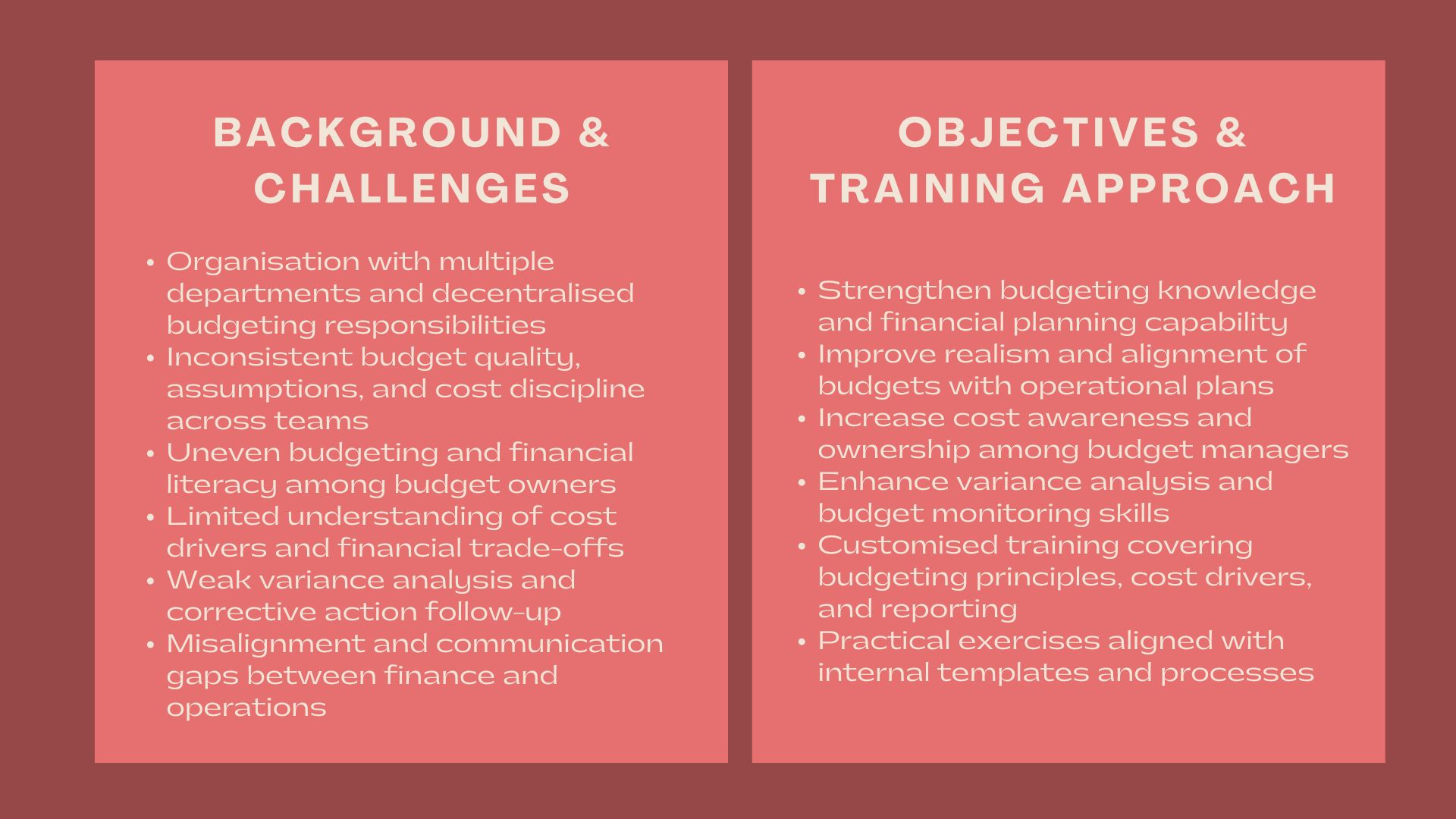
The organisation was confronted with some challenges that indicated that budgeting training should be structured.
Unbalanced budgeting ability was one of the challenges. Budget managers were not always financially literate with varying degrees of financial experience and in turn made varied assumptions, over-relyed on past data and had minimal connections between budgets and operational plans.
The other complication was the poor knowledge of cost drivers. Budget owners eventually found it challenging to determine and handle the most significant cost elements hence failing to determine and make trade-offs, regulate costs or react appropriately to budget variances.
Budget monitoring and variance analysis were also challenging. Although periodic budget reviews were made, not all managers were sure about interpreting variances or determining corrective measures which decreased the efficiency of financial controls.
Another area of concern was communication between the finance and the operational teams. Terminological differences and expectation differences were sometimes a source of misunderstanding which in turn caused delays and inefficiencies in budget preparation and review processes.
Lastly, the top management wanted to instill greater financial discipline and accountability wherein the budgets would not be utilized merely as financial instruments but as viable management tools as well.
Objectives
The main purpose of the engagement was to consolidate the budgeting capacity within the organisation by using bespoke budgeting training within the company.
In particular, the organisation was seeking to:
- Enhance knowledge in budgeting principles and process.
- Enhance realistic and aligned budget preparation.
- Increase budget owners’ cost consciousness and control.
- Enhance budget report and variance analysis interpretation.
- Encourage financial responsibility and interdepartmental cooperation.
This training was required to be realistic and available to the non-finance managers, as well as congruent with the internal budgeting procedures of the organisation.
How We Helped
Our budgeting in-house training process was structured and collaborative in nature based on the financial processes of the organisation, reporting structure, and operational requirements.
We were initially involved in a budgeting needs assessment. We collaborated with the finance department and the budget owners to learn more about the budgeting cycle in the organisation, internal templates, formats used in reporting, and the challenges that are normally faced when preparing the budget and reviewing it.
On this basis, we have developed tailor made training modules on basic budgeting concepts. These involved the basics of budgeting, the connection of the operational plans with financial projections, cost drivers, assumptions preparation, and fix and variable costs.
Another issue discussed was budget monitoring and variance analysis. The participants were led in the interpretation of the budget reports, identification of meaningful variances, and formulations of appropriate management responses.
The practical application was highly stressed. The realistic budgeting scenarios, simplified templates and interactive exercises were implemented in the training sessions and resembled the real budgeting environment of the organisation. This facilitated the participants to associate the training material with their duties.
The programme was set to fit the respondents of various functions and financial familiarity levels. Explanations of the concepts were clear and progressive and were made accessible and at the same time relevant to the more experienced ones.
Our training was delivered in a flexible way that included both the physical workshops and virtual training. The interactive dialogue and questions and answers were promoted to solve the particular issues that the participants encountered.
As a reinforcement tool, we offered practical aids and reference materials such as budgeting checklists, cost management models, and guidelines, which the participants could use in subsequent building of budgets.
During the engagement, we collaborated with participants to explain and answer questions and tailor explanations to the context of the operations of the organisation.
Value Delivered
This case study shows how Financial Planning and Cost Control throughout an organisation can be enhanced through professional Budgeting In-House Training Services.
The engagement assisted in improving the quality and consistency of the budgets, raising the cost awareness of the managers, and promoting a more efficient monitoring and control of financial performance through customised and practical training.
The training program of budgeting in-house created as a result of this engagement offered a scalable base of future capability building, enhanced financial discipline, and enhanced cooperation between financial and operating departments.