
Case Study: Finance In-House Training Services Strengthening Financial Capability and Decision-Making
Background on Case Study Finance In-House Training
A middle-sized company working in a variety of business units was going through a period of strategic expansion and business change. As part of the expansion, the senior management realised there was an increasing need to enhance financial knowledge and discipline within the organisation especially in the non-finance managers and operational leaders who were increasingly becoming involved in budgeting, investment decisions and performance management.
As the organisation had a well organised finance team, the burden of financial decision making was being decentralised. Operation, sales, procurement, and project managers were supposed to understand the financial information, budget management, and evaluation of the financial impact of business decisions. But there was a great deal of disparity in team-related financial literacy and confidence.
In order to fill these gaps and make more informed decisions, the organisation approached our Finance In-House Training Services with a view to designing and providing customised training programmes that met its business model, financial framework, and its internal reporting practices.
Issues and Challenges
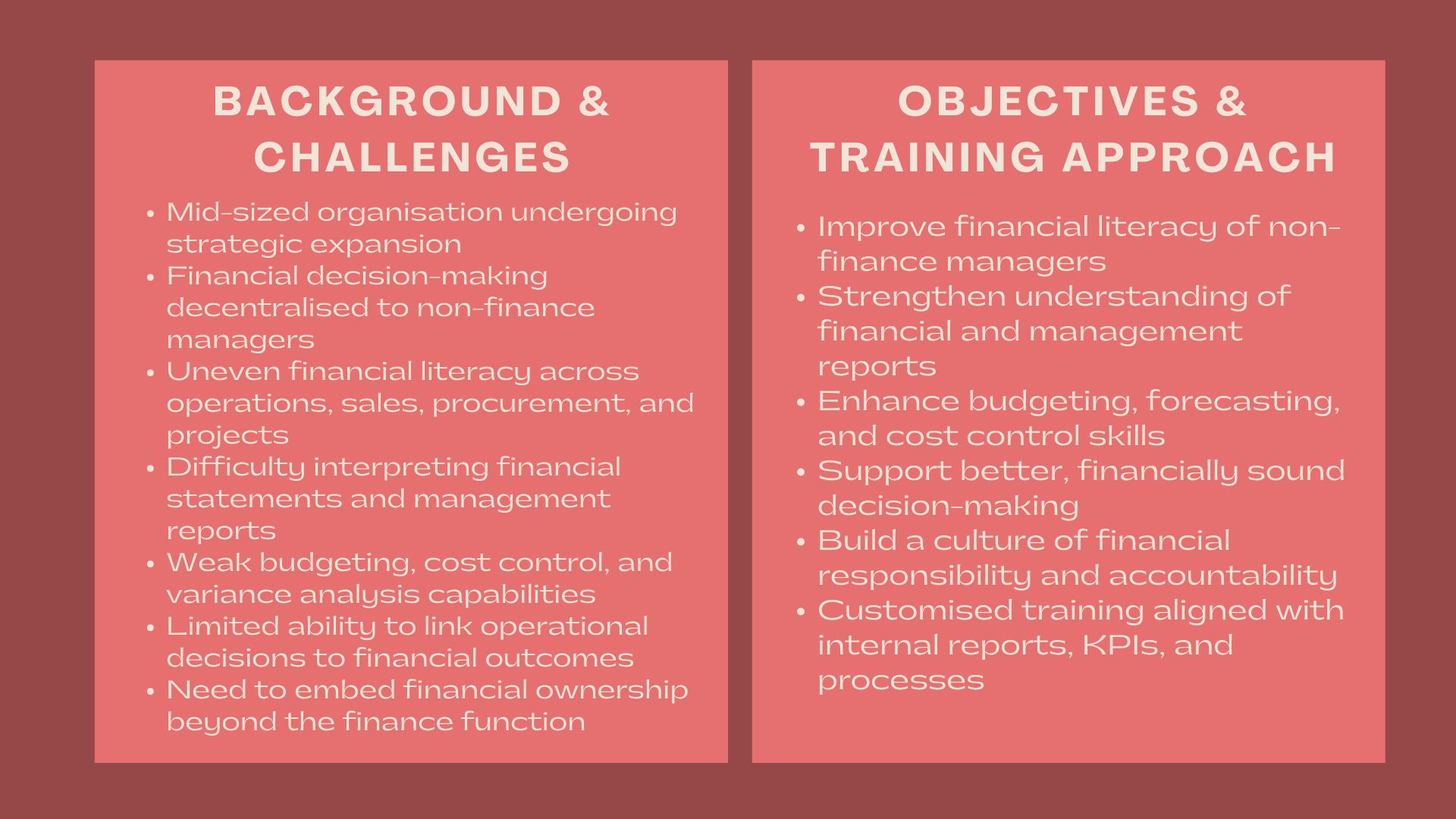
The organisation had a number of challenges that raised the issue of organised training in finance orientation.
Poor inter-departmental financial understanding was one of the problems. Although the financial statements and performance measurements were clear to the finance professionals, the non-finance managers would not always understand how to interpret the financial information or how operation choices can be linked to the financial performance.
The other obstacle was its practical application. The training materials that are available were either too technical or too general so that the participants could relate the financial concepts to their daily duties. This restricted training effectiveness and lowered the confidence on application of financial principles.
The areas of concern also included budgeting and cost control. Budgets were left to the managers who did not necessarily have complete knowledge of cost drivers, variance analysis, and financial trade-offs, which augmented the threat of inefficiencies and distorted spending decisions.
Also, the organisation was making changes within its internal reporting and performance management procedures. The employees required instructions on how they should read management reports, comprehend key performance indicators and utilize the financial data to aid in planning and accountability.
Lastly, the management aimed at developing a more powerful financial ownership culture. The organisation did not want to just use the finance functionality and instead financial awareness was to be incorporated in the various teams to facilitate sustainable growth.
Objectives
The main aim of the engagement was to improve financial capacity throughout the organisation by tailored finance in-house training.
In particular, the organisation tried to:
- Enhance financial literacy of non-finance managers and operational groups.
- Enhance knowledge in financial reports and management reports.
- Enhance planning, expenditure control and allocation of available resources.
- Empower managers and make their decisions in a better, financially sound way.
- Develop a culture of financial responsibility and ownership.
The training should have been realistic, role-specific and inline with the internal finance structure of the organisation.
How We Helped
We also took a systematic and participatory strategy towards the in-house finance training, which was industry based, mode of operation and internal reporting procedures.
Our interaction has started with a training needs assessment. We also liaised with the senior management and finance team to get to know about the financial set up of the organisation, format of reporting, budgeting procedure and critical decision making issues. This guaranteed that the content of the training was based on actual needs of the operations and not in theory of finance.
On the basis of the evaluation, we developed tailored training programs on fundamental finance like financial statements, management reporting, budgeting and forecasting, cost analysis, cash flow management and financial decision making. The content was customised to internal terms, reports and performance measurement of the organisation.
There was a high priority given to practice. Financial concepts were related to daily duties through real-life situations and simple problems addressed during the training in order to make the participants relate the new knowledge to their roles and duties. Learners were also taken through sample management reports and budgeting exercises as a way of reinforcing learning.
To meet the varying financial familiarity levels, we designed the training. The modules were constructed in such a way that they developed a basic knowledge and at the same time they dealt with more complex ideas that were applicable in the process of making decisions related to management.
It was supported by flexible formats of delivery such as on-site workshops and virtual sessions. It enabled the organisation to handle the demands of operation and have the same coverage of training in teams.
We also used supporting materials and reference guides to help the participants with what they have learned once the training was over. These materials were useful in maintaining the learning results and a continuation of the use in the job environment.
During the interaction, we were so close with the participants to answer questions and explain what was meant by a certain concept, and or even modify explanations to help in understanding them. The use of feedback was also done to enhance involvement and relevance.
Value Delivered
The case study highlights the ability of professional Finance In-House Training Services to enhance financial capacity and assist in making superior decisions throughout an organisation.
The engagement aided in increasing financial confidence in non-finance managers, improving knowledge in financial information, and adopting a more disciplined approach to budgeting and cost management through customised and practical training. The training also enabled greater coordination between the finance and operation teams.
The finance in-house training model that arose as the result of the engagement offered scalability as the basis of further capability development, enhanced financial governance, and sustainable business operation.