Case Study: Investment Banking In-House Training Services Enhancing Deal Execution and Advisory Excellence
Background on Case Study Investment Banking In-House
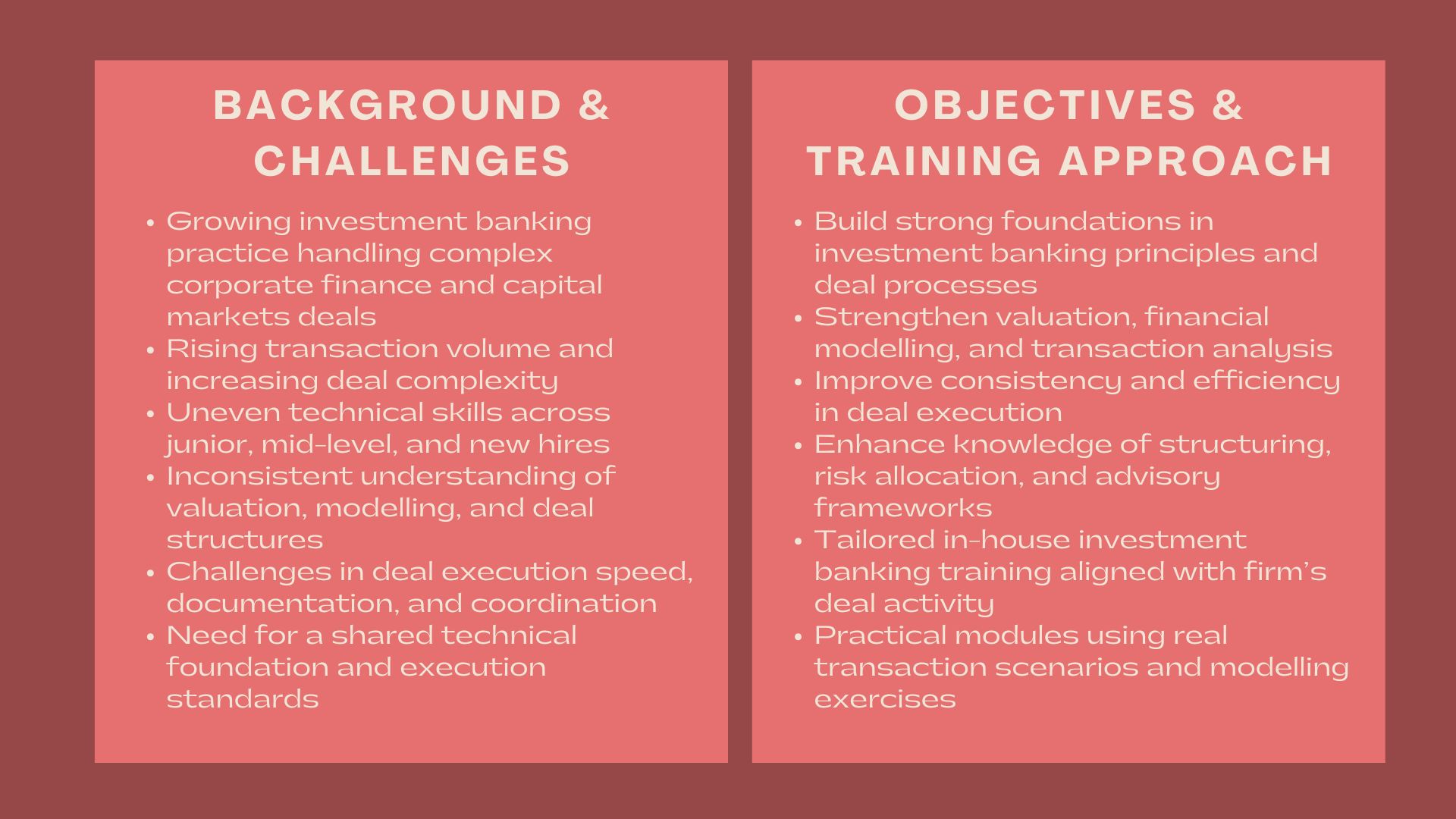
A growing investment banking practice was a financial advisory firm where there was mounting demand on the complex corporate finance and capital markets transactions. The company consulted customers in terms of mergers and takeovers, capital fundraising, valuation, and strategic financial plan in various sectors. Through the volume of deals and complexity of transactions that were being made, the management realised that it was necessary to empower the internal technical capacity and uniformity of execution standards throughout the investment banking team. Whereas the senior bankers had decent transaction experience, junior and mid-level professionals needed formal training that would enhance their knowledge on the fundamentals of investment banking and deal mechanics. Besides this, the company was also recruiting new employees with varying professional backgrounds such as accounting, consulting and corporate finance. It also became a strategic imperative to secure a shared technical base and a similarity in the way deals are being done. The firm used our Investment Banking In-House Training (IHT) Services to meet these demands.
Issues and Challenges
The company experienced various problems which indicated the necessity of the organized investment banking training. The problem of inaccurate technical skills among team members was one of them. The variation of previous experience led to the uneven perception of valuation techniques, financial modelling, and structure of transactions. The other issue was on the effectiveness of deal execution. With the growth of the transactions and strict time schedules, the junior employees needed to be equipped with more knowledge in financial analysis, due diligence assistance, and presentation. It also had difficulties in structuring and documenting transactions. The team members should have had a better comprehension of the effect of deal terms, financing structure and risk allocation mechanisms in the outcomes of the transactions. Inter-deal team communication and coordination were other issues. Technical language and knowledge of deal processes were necessary to work closely with analysts, associates and senior bankers. Lastly, the management tried to reinforce internal talent development and retention through clear learning channels of junior professionals to further develop in the investment banking capability.Objectives
The main aim of the engagement was to enhance the internal investment banking capacity by undertaking tailor-made investment banking in-house training. Particularly, the company wanted to:- Establish a solid background in investment banking principles and processes of a deal.
- Enhance valuation, financial modelling and transaction analysis.
- Enhance the consistency and efficiency of deals.
- Increase the knowledge of the transaction structuring and advisory considerations.
- Benefit talent advancement and career growth in the company.

How We Helped
In-house training in investment banking has been a structured and collaborative process, which is based on the requirements of the deal activity, client base and internal capability of the firm. We commenced our interaction with the training needs assessment. We collaborated with partners, directors, and team leads to learn about the types of transactions that the firm does, the frequent issues that have been faced in execution, and the skills that are lacking in various levels of seniority. On this evaluation we have come up with tailored training modules on core investment banking. These were the basics of investment banking, life cycle of transactions, roles and responsibilities of the deal team members in each of the stages. The programme was founded on valuation and financial modelling. The training covered valuation methodologies used (common), structure of the models, main assumptions, sensitivity analysis and best practices in financial modelling. We also discussed such aspects of the transaction execution and advice as M&A processes, capital raising structures, the coordination of due diligence, investment memorandums and client presentation preparation. There was a high concentration of practical implementation. The training was introduced with transaction-based scenarios, simplified case discussion and (real-life) modelling exercises to enable the participants to practice the concepts in real deal situations. The programme was programmed to accommodate the participants in various levels such as the analysts, associates, and the junior managers. This guaranteed accessibility as well as facilitating a common technical standard throughout the investment banking team. The use of interactive workshops was used to deliver training, both in-person and virtual as needed. The facilitated discussions enabled the participants to pose questions, bring out technical issues and agree on the methods of execution. To enhance learning, we helped by giving practical templates, valuation schemes as well as reference schemes which the participants can refer to during live transactions. During the engagement, we collaborated with the firm and tailored content to the changing deal pipelines and market conditions.Value Delivered
In this case study, the role of the professional Investment Banking In-House Training Services has been shown to empower the technical capability and help in high quality deal execution. The engagement was useful in improving technical conformity, analyzing transactions better, and building stronger collaboration among deal teams through structured and practical training. It was the in-house training structure created as part of this engagement that gave a scaffoldable basis of continued capability building, execution perfection, and long term expansion of the investment banking practice of the firm.Frequently Asked Questions
Q1. What is Investment Banking In-House Training and how does it benefit organizations?
Investment Banking In-House Training is a customized learning program designed to help organizations strengthen capabilities in corporate finance, capital markets, mergers and acquisitions, valuation, financial modeling, and transaction execution. The training is tailored to the organization’s business objectives, deal activity, and employee development needs, enabling teams to build practical skills that support better financial analysis and strategic decision-making. Investment banking training can also help create consistent standards and methodologies across teams.
Q2. Who should attend Investment Banking In-House Training programs?
These programs are suitable for investment bankers, corporate finance professionals, financial analysts, business development managers, private equity professionals, corporate bankers, finance managers, and executives involved in evaluating transactions or strategic investments. Training can be customized for both junior and experienced professionals to address specific skill gaps and organizational requirements.
Q3. What topics are typically covered in Investment Banking In-House Training?
Training topics commonly include financial statement analysis, valuation methodologies, financial modeling, mergers and acquisitions, capital raising, due diligence, transaction structuring, investment analysis, deal execution processes, and corporate finance strategies. The content is often tailored to reflect the organization’s industry focus, transaction environment, and business priorities.
Q4. Why do organizations choose customized investment banking training instead of public courses?
Customized in-house training allows organizations to incorporate their own transaction scenarios, financial models, investment criteria, and business challenges into the learning experience. Real-world case studies, deal discussions, and practical exercises can be aligned with the organization’s objectives, making the training more relevant and directly applicable to participants’ daily responsibilities. Similar customized learning approaches have been shown to improve capability development and operational alignment across teams.
Q5. What makes practical Investment Banking In-House Training valuable?
Practical training incorporates valuation exercises, financial modeling workshops, transaction case studies, due diligence simulations, investment analysis projects, and deal-related discussions. This hands-on approach helps participants strengthen analytical skills, improve financial decision-making, gain confidence in evaluating transactions, and apply investment banking concepts more effectively in real-world business situations.