Cross-Border Investment and Risk Management Workshops for Multinationals
Introduction to Certified Cross-Border Investment Risk Course
With a globalized financial environment, multinationals (MNCs) are moving to cross-border investments to diversify their activities, acquire new markets and competitive advantage. Nevertheless, global expansion presents organizations with risks of political ambiguity, regulatory uncertainties and market risk. In order to overcome such obstacles, practitioners need superior training that is a combination of financial modeling, risk evaluation, and strategic administration. Some of the programs like the cross-border investment analysis and country risk management course and the multinational investment and foreign market risk workshop prepare individuals with skills to test opportunities and manage the global risk exposures in the most efficient way possible.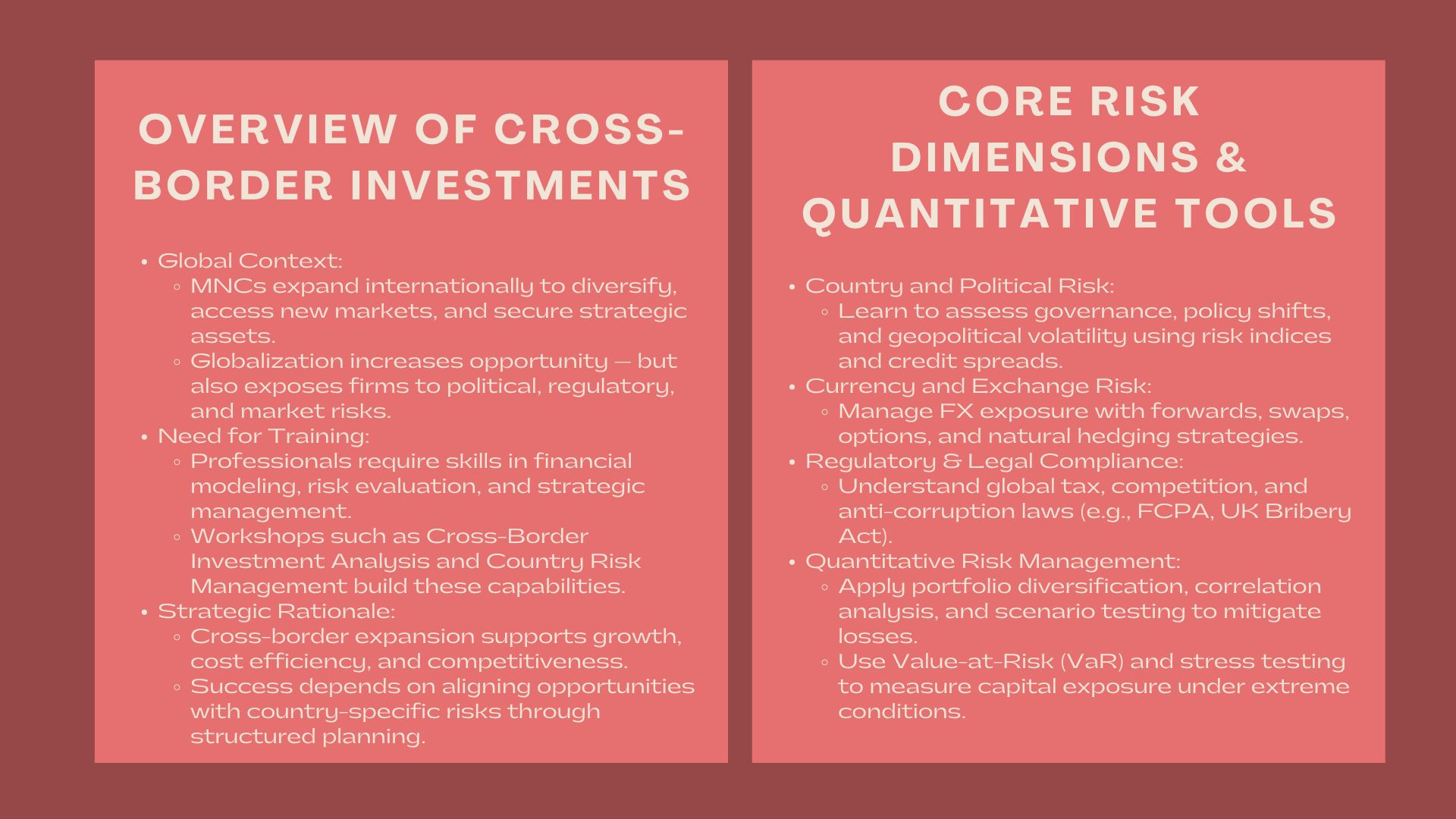
Knowledge of what Cross-border Investments entail.
Strategic Rationale
The cross-border investments enable the firms to expand their operation, reach out to new customers, lower the cost of production, as well as taking advantage of strategic assets including technology, talent, or natural resources. In the case of MNCs, internationalization is frequently a foundation of growth and competitiveness amidst the long term. Global expansion strategies however have to be very sensitive to the regulatory measures, macroeconomic prospects and the geopolitical conditions of every country. An investment plan should be well laid out to ensure that the opportunity is matched with the risk since the potential returns should be worth the exposure to the external uncertainty.The Major Foreign Investment challenges.
Investing in more than one jurisdiction means working around tax systems, accounting systems, labor laws and environmental regulations. Profitability can be influenced by currency volatility and transfer pricing regulation, whereas geopolitical risks like trade restrictions, sanctions, and regional conflicts can be used to interrupt the continuity of the business. The course on cross-border investment analysis and country risk management informs those who attend it about the ways in which these obstacles can be assessed and measured in a systematic way as well as in a risk modeling process. Professionals get to understand how to be able to use country risk ratings, credit spreads, and market indicators to predict and hedge against unwanted developments.Fundamental Elements of Cross-Border Investment Research.
Country and Political Risk Assessment.
One of the greatest threats to the multinational investors is political risk. Any policy changes, expropriation risk, and unstable governance may have a direct effect on the asset valuation and profitability. These training programs enable the participants to learn the ways to perform systematic country risk assessment, both qualitative and quantitative. The macroeconomic stability, fiscal policy, political institutions, and trade relations are analyzed by participants to estimate the overall risk exposure to countries. The models used to measure the potential losses and measures risks in various regions include the Political Risk Index, credit default swap spreads and yield on sovereign bonds.Currency and Exchange rate Risk.
International investments are potentially significantly affected by currency fluctuations in terms of their profitability. The slight shifts in the exchange rates can dilute returns or swell liabilities. Training workshops focus on techniques of identifying, quantifying, and hedging the foreign exchange exposure. The participants are taught how to use the financial instruments like the forward contracts, currency swaps, and options as a method of hedging against the undesirable currency movements. They also discuss the concept of natural hedging using operational changes such as balancing revenues and expenses within the same currency.Regulations and Legal Iss.
There are several local and international laws to be followed in global investments. This involves competition policies, taxation policies, and anti-corruption policies like the U.S. Foreign Corrupt Practices Act (FCPA) and the UK Bribery Act. The multinational investment and foreign market risk workshop can give an insight into the compliance frameworks, investment treaties, and mechanisms of dispute resolution. The participants are taught how to cope with legal systems differences and establish corporate governance structures that are compliant but flexible in different markets.Risk Management Techniques that are quantitative.
Diversification of Portfolio across Regions.
Diversification has been one of the major principles of cross-border investment risk management. The companies can minimise local based downfalls by distributing investments among regions that have varying economic cycles. The participants in the training get to learn how to use statistical packages including correlation matrices and variance-covariance models to determine the interaction of the assets in various countries within a portfolio. They also discuss how the changes of geopolitical events, commodity price shocks or changes of interest rates may change correlations over time and thus necessitate active risk monitoring.Sensitivity Analysis and Scenario.
Scenario analysis Techniques are presented in workshops to test the impact of variation in macroeconomic variables, e.g. inflation, growth in GDP or interest rates on the results of investment. Sensitivity testing enables experts to make important performance determinants and develop mitigation measures in unfavorable scenarios. An example is when a company is investing in emerging markets and there are changes in inflation, sensitivity analysis can be used to determine the reaction of the profit margins and cash flows as the price levels change. This numeric understanding can assist the decision-makers to design dynamic investment strategies that can be adjusted to changes in the market.Value-at-Risk (VaR) and Stress testing.
The participants also get to know how to use Value-at-Risk models to estimate the possibility of loss in usual market scenario and stress testing of extreme events. By doing this MNCs are able to measure their exposure to risk and distribute capital effectively in addition to ensuring compliance with Basel and IFRS models of risk.Funding and Structuring International Investments.
Optimization of the capital structure.
The best financing model of a cross border investment would be determined by few factors, among them, are interest rates, taxation regime, and availability of local funds. The workshops teach the participants how to evaluate the benefits of equity or debt financing, evaluate the impact of transfer pricing, and calculate the level of leverage to use. They also get to know about the hybrid instruments like convertible bonds, preferred shares and project finance structures which can enhance better utilization of capital besides dealing with country-specific risks.Repatriation and Taxation Strategies.
International investment planning is predominantly dependent on taxation. Participants discuss treaties on double taxation, tax implications on withholding, and ways of maximizing profit repatriation. The cross-border investment analysis and country risk management course also covers base erosion and profit shifting (BEPS) regulations to help companies avoid compliance pitfalls.JVs and Strategic alliances.
The entry of many MNCs into new markets is by way of collaborating with local organizations. Training programs underline the necessity of due diligence, the choice of partners, and shareholders agreement frameworks to reduce the conflicts and tune the organizations between strategic goals.New Global Risk Factors.
Geopolitics and Economic changes.
The modern global markets have come to be characterized by trade wars, regional conflicts and economic sanctions. Training programs put emphasis on how these factors may change the attractiveness of investment, upset supply chains, and redefine the global capital flows. Cases in the real world, which are studied by the participants, include the Brexit, the American China trade tensions and the geopolitical role of Russia in energy markets. Through the analysis of such events, they get to know how to integrate geopolitical intelligence into the investment decision.Environmental and Social Risks.
Sustainability is becoming the core aspect of international investments. Environmental, social and governance (ESG) risks are now something that investors have to consider since global stakeholders would insist on responsible business practices. Through the multinational investment and foreign market risk workshop, participants examine how environmental regulations, climate-related disruptions, and social expectations influence foreign investments. They get to know how to incorporate ESG standards in risk management strategies and create investment models that are sustainability oriented.Technological and Cyber risk.
Digitization of the financial systems creates new dimensions of operational risk. The impact of cybersecurity threats, data breaches, and digital frauds may be devastating to multinational companies. Workshops will offer the guidance related to evaluating the risks associated with technologies and the adoption of the strategies aimed at minimizing cyber risks in a manner that is not inconsistent with the international principles of data protection.Advantages of Specialized Cross-Border Training.
- Greater Analytical Competence: Professionals will be able to detect, quantify, and grow sophisticated international investments risks.
- Strategic Decision-Making: The participants will get to understand to synchronize the investment strategies, corporate objectives and international economic trends.
- Better Governance and Compliance: Training enhances the knowledge on legal frameworks, and there is compliance to international standards.
- International View: The experience with a variety of markets and case studies expands the thinking about strategies and enhances the ability to adapt to a dynamic environment.