Structuring Management Workshops for High-Performing Teams Across Industries
Introduction to Accredited Leadership Skills for Teams
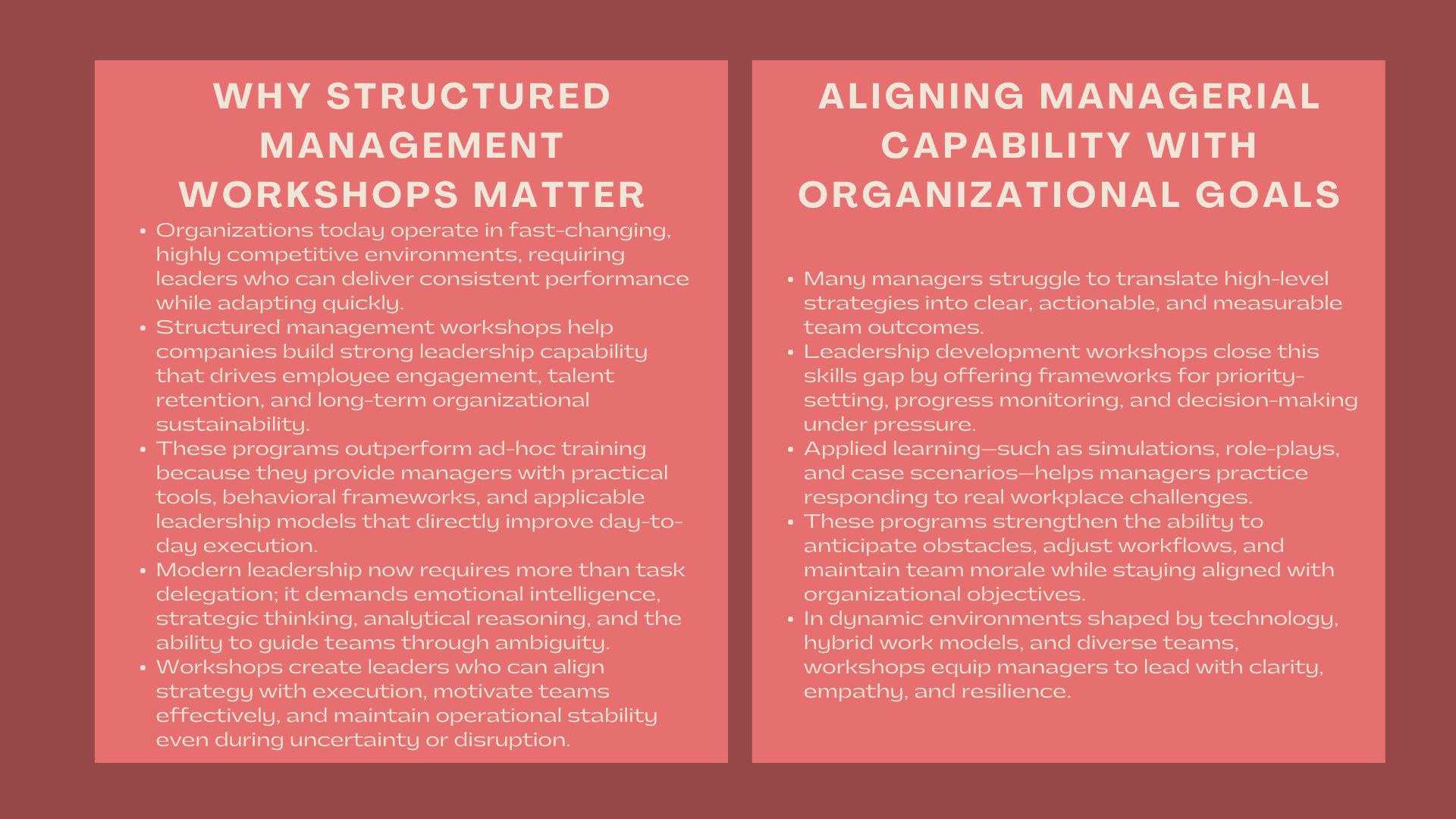
In the modern business world, which is extremely competitive and dynamic, companies have a spectacular pressure to form teams that are capable of producing results monthly and adjusting without issues to swift change and shifting market segments. The leadership capability has a key role in ensuring the performance of not only the team but the engagement level of the employees, retention of talents, and organizational sustainability in the long-term. Companies that are strategic in investing in structured management workshops are always ahead of their competitors as these programs help such managers acquire skills on how to match strategy with implementation, inspire employees, and stabilize operations even in a state of uncertainty or chaos.
Although numerous studies have shown the importance of leadership development, numerous organizations have always been faced with the problem of the lack of such structured training programs that can produce real results. One of the problems is that it is very difficult to implement practical tools, behavioral frameworks, and strategic insights that can be applied directly to the day-to-day leadership operations of the managers. Modern management has gone beyond delegation and control of workflows to involve a sophisticated mix of emotional intelligence, logical reasoning, operational management, long-term vision, good communication as well as flexibility with regard to work in multi-faceted environments.
Performance management and leadership development workshops,among other strategic management and organizational effectiveness training programs, are now essential interventions in dealing with such issues. The programs do not only educate the managers on theoretical foundations, but these are programs that actually re-orient the minds, habits and the thinking patterns of the managers as they relate to management.
The structured exercises, learning in a form of scenarios, interactive discussions, and the practice in building skills equip the managers with confidence, competence, and nuanced knowledge to have them lead the high-performing teams in various industries. In addition, such programs assist the leaders in cultivating an organizational culture of accountability, engagement, and constant improvement, which eventually enhances the overall effectiveness of operations of the organization and its growth in the long term.
Aligning Managerial Capability With Organizational Goals
Bridging the Skills Gap With Leadership Development
A conspicuous mismatch between expectations of what a manager should do and what skills an individual manager contributes to his or her job is evident in modern organizations. Organizations are also demanding managers who have the ability of transforming the overall organizational strategies into specific, measurable results that are knowledgeable and accepted by their subordinates. The managers should establish clear priorities, track progress, foresee difficulties, and change workflow according to the shifting circumstances. The performance management and leadership development workshops are developed specifically to fill this gap by training the leaders with frameworks and practical solutions that enable them to in one way or another incorporate strategic objectives to be incorporated within the normal operations.
These are hands-on learning exercises that focus on hands-on training techniques such as role-playing exercises, scenario instances and reflection exercises that enable the managers to rehearse the application of strategic thinking and decision making to real-life situations occurring at the workplace. As an illustration, one of the managers would create an imaginary scenario where one of the major project milestones could be derailed because of a lack of resources and he or she would have to find the way to get back on track of the team work without demoralizing them.
It is through these experiences that the managers are taught how to make decisions that go beyond mere solving an immediate operation problem but also help in promoting the long term objectives of the organization. These programs align the managerial capability with the objective of the organization in that the managers learn that they are not there to oversee the tasks but rather to be the key players in the success of the organization.
Preparing Managers for Complex Workplace Dynamics
The contemporary work environment has become quite dynamic due to the speed of technological changes, diversity of its workforce, hybridization of work schemes, and changed employee demands. These conditions now require managers to go through ambiguity, guide them with uncertainty and ensure high standards of team engagement and performance. Through the strategic management and organizational effectiveness training programs, managers are exposed to the modern day leadership models and practices that are tailored specifically to the challenges these managers face.
The individuals undertaking these programs understand how to deal with hybrid groups and how to foster teamwork among geographically spread units, and how team cohesion happens in a company that is undergoing changes or facing disruption in the market. The psychological and behavioral motivation of employee performance is also investigated by the managers, and they can react to the individual and team needs with sympathy, straightforwardness and strength.
The skills would be essential in avoiding employee burnouts, retaining top talents, and making sure that continuity of operation advanced even in a situation of high pressure. With such capabilities in managers, the organizations will be able to develop teams that are productive, encouraged, and flexible to guarantee that short-term goals are achieved as well as long-term targets.
Core Components of Effective Management Workshop Design
Cultivating Leadership Identity and Transformational Behaviors
Self-awareness is the basis of good leadership and it sets the ground on all further developments. Managers are supposed to have a profound insight of how their communication style, tendencies in decision making as well as their emotional reactions will influence the motivation, engagement and performance of their teams. The workshops offer guided reflection practices, scenario-based learning units, and behavioral feedback sessions that enable members/participants to identify their strong leadership qualities, discover areas to enhance and achieve a consistently developing (discovering) leadership, which concurs the organizational principles.
Transformation of leadership behaviors is also a stressed issue in these workshops besides promotion of self-awareness. Managers are taught to build on trust, at least act as a role model, facilitate innovation, and build cooperative efforts in their teams. The interactive exercises help the managers to examine how these behaviors will result in a psychological safety, increased engagement and creation of a more innovative and productive work culture. Developing an effective leadership identity, the managers change their role of task-centered supervisors into strategic leaders who can empower their employees, positively affect corporate culture, and lead to improved performance levels in the long term.
Implementing Systems to Drive Team Performance
Performance management is considered to be among the most important areas of managerial responsibility. Workshops inform the managers on how to set quantifiable and attainable objectives, keep track of performance in an organized way, give effective and positive feedback that is practical and inspiring as well as to overcome hindrances that can limit the productivity of team members. The participants get an insight to the aspects of functioning of high-performing teams which may comprise role clarity, efficient communications, accountability frameworks and behavioral expectations that foster cooperation and effectiveness.
Managers also get to know how to evaluate the personal and group abilities, the skill shortages, and how to combine the strengths with company needs. When structured performance systems are put in place, the managers will create a culture of improvement, improve effectiveness of operations and maintain long term excellence in different functional areas of the organization. This way, they will be in a better position to establish work environments that make the teams motivated, supported, and accountable, thus achieving performance gains that can be measured and witnessed after a period of time.
Adapting Workshops Across Industry Contexts
Tailoring Programs to Sector-Specific Needs
Each industry is affected by its own distinctive needs of operation, statutory demands, and workforce relations that require that management workshops to be adjusted to its realities. As a case, financial services managers can be required to have detailed understanding of compliance frameworks, risk management process, and data-based analytical decision making. Customer experience, the fast pace of the operational performance, and the engagement strategies of the employees are the key topics of interest of retail managers whereas the manufacturing executives are more attached to the operational discipline, job security, and the streamlinedness of the processes.
Through incorporation of industry tailored case studies and hands-on exercises and scenario-based problem solving in the workshop, managers can readily discuss the concepts of strategic management and organizational effectiveness training program leadership to the context of challenges they face in their daily operation. Such relevance will make sure that the acquired lessons are not focused on theory but can be put into practice as a means of guaranteeing that the transfer of knowledge is made possible and that there is a high chance of facilitating behavior change and yielding better performance outcomes.
Enhancing Cross-Functional Collaboration
Successful organizations are also those which depend on interdepartmental and interfunctional cooperation with each other in the realization of strategic goals. Independent decision-making may result in a lack of efficiency, responsiveness and performance of an organization. That is the purpose of strategic management and organizational effectiveness training programs, which aim at getting managers to realize the interdepartmental dependencies, to maneuver opposing priorities, and to promote the alignment and cohesion among groups of people.
With the use of hands-on exercises, managers get to know how to organize resources, pass important information to other relevant stakeholders, and meet competing demands in a way that helps the entire organization achieve its goals. Enhancing communication, teamwork, and cross-functional assimilation, managers make sure that the work processes run without any issues, they eliminate any resistance between teams, and enhance their joint problem-solving skills. Such an interdependent approach to the work improves the operational performance, facilitates the strategic implementation, and eventually strengthens the team work and conducts within the organization.
Strengthening Strategic Thinking and Decision-Making
Building Long-Term Strategic Acumen
The decisions made by managers have both short-term and long-term implications on the operations as well as the future direction and fortunes of a particular organization. Workshops reinforce strategic thinking by imparting systematic methodologies of decision making, risk analysis and scenario planning techniques whereby managers prepare before times of crisis and can revert effectively.
The subjects train to predict what might happen, to trade off, to make decisions that fit the company goals. Managers get to know how to make effective decisions that consider both the operational needs in the short term as well as the strategic ones in the long term via case studies and simulations. It is the emergence of strategic acumen that will allow leaders to go beyond reacting to problems and taking a proactive and futuristic stance in addressing issues that will contribute to the overall organizational resilience.
Enhancing Leader-to-Team Communication and Influence
Leadership requires leadership pillars like effective communication. Managers should be capable of clearly expressing expectation, making constructive and meaningful feedback, and be able to influence a team behavior using the help of credibility, trust, and authority. The focus of workshops is put on adaptive communication, conflict management methods, and persuasive messages depending on the types of team dynamics.
The participants will take part in exercises which are the simulation of coaching conversations, team-building sessions, and project briefing, thus gaining the experience in presenting complex thoughts in clear ways and inspiring teams. Through perfecting communication techniques, managers can build trust, collaboration and accountability in their teams which makes them respond positively in promoting harmony with organizational goals and an environment where employees will feel listened to, valued and interested.
Integrating Digital Tools and Data Analytics
Leveraging Technology to Optimize Team Performance
The workplace digital revolution has completely changed the modes of management and functioning of the teams. Workshops expose managers to online collaboration tools, task handling websites and work performance boards that contribute to transparency, coordination and productivity. Another area that is studied by the managers is automation and artificial intelligence that facilitates repetitive operations, enhances data precision, and provides insights accessible to the team in order to manage performance. The knowledge and expertise of the managers to utilize these digital tools allows them to redefine their leadership solutions to these new modern work conditions, where speed, agility and operational efficiency are the key success factors.
Applying Analytics to Inform Leadership Decisions
Evidence-based leadership has emerged as one of the critical elements to success in modern organizations. The workshops emphasize the analytical skills of managers training them on how to interpret performance measures, analyzing the trends and acting by taking evidence-based decisions. Quantitative data help managers to find the bottlenecks or limitations of performance, to allocate resources more effectively, and predict performance of a team. With the use of data analytics in the leadership processes, the managers enhance credibility, increase operational efficiency, and correlate decision-making processes with strategic goals, which subsequently, leads to more predictable and measurable and high performance outcomes of the teams.
Benefits of Structured Management Workshops
Cultivating Cohesive, High-Performing Teams
The organized workshops equip managers with the mechanisms to create a harmonious, strong, and productive team. Managers can learn about how they can build trust, encourage cooperation and a culture of improvement. In learning how to be in a proactive mode in solving problems, developing team morale and sustaining employees, through managers, teams can gain the skills and resilience that they need to perform with in the long run. These abilities eventually reinforce the competitive edge of the organization since there is uniformity, dependability, and flexibility on the team results.
Driving Organizational Growth and Leadership Evolution
The success of organizations in a sustainable way is attained when a continuous transformation of leadership in accordance with the new challenges is carried out. The workshops are used to build a sustainable leadership pipeline through strategic thinking, performance management, communication, and decision making of the managers. The performance management workshops and leadership development programs coupled with strategic management and organizational effectiveness training programs enable managers to lead the teams in the seasons of growth, transformation, and disruption. The promotion of the culture, promotion of innovation and long-term strategic growth and competitive advantage are achieved by encouraging the ongoing leadership development, thus making organizations stronger.
Conclusion
To create high-performance teams that can survive in the highly dynamic business world full of challenges, it is necessary to have structured management workshops. Through cultivation of leadership identity, advancement of communication skills, decision making, empowerment of choice making and assimilation of digital technology and data analytics, such programs equip managers to be effective leaders in various industries.
The workshops on performance management and leadership development, coupled with strategic management and organization effectiveness training enable the managers to ensure their alignment between strategy and execution, cohesion within the teams, and industry-specific leadership development workshops for managers resiliency. Companies who invest in these programs also tend to put themselves in a sustainable growth, excellence in operations, and competitive edge in the long term and generate leaders who are well positioned to adapt to the changing demands of the modern work environment.