Renewable Energy Business Courses for Growth
Introduction to Renewable Energy Business Courses for Growth
The world is moving towards clean and low-carbon energy systems that have generated unprecedented demand to hire highly skilled professionals who are not only aware of sustainability concept but also of commercial realities. With governments, corporations and investors hastening their own commitment to decarbonization, education has become the basis on which a competent workforce is to be assembled. It is in this regard that the renewable energy business courses are very important in equipping individuals to negotiate the economic, technical, and strategic aspects of the energy transition.
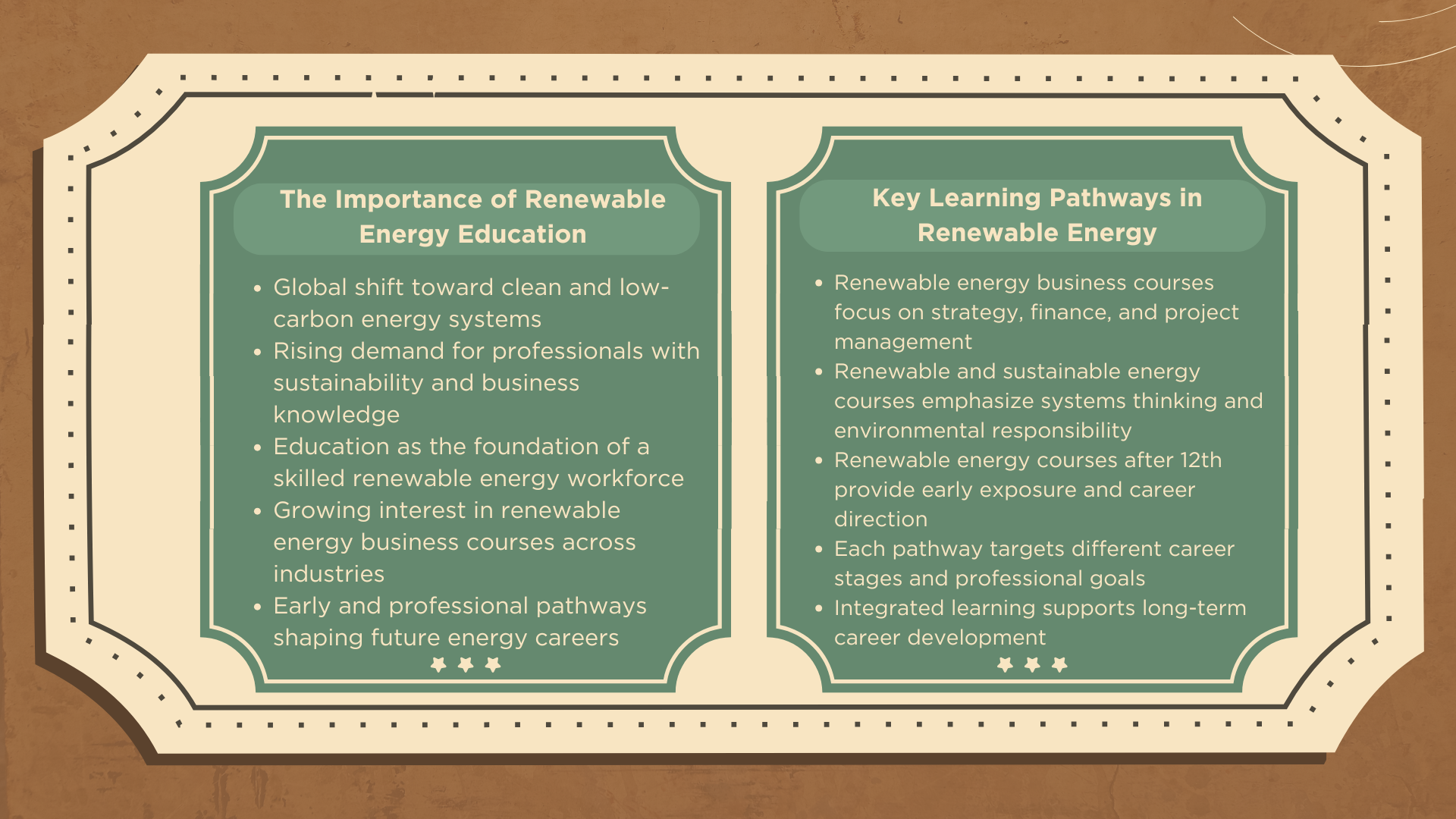
Simultaneously, students at various age groups are in need of laid down opportunities into this expanding industry. The renewable energy courses after 12th are explored by students as an early gateway to a future-oriented sector and graduates and professionals are increasingly turning to renewable and sustainable energy courses to boost employability, leadership capabilities, and career sustainability. In this article, the author offers an overview of the ways those education avenues facilitate career growth, the difference between them in terms of focus and outcomes, and the process of strategy course choice that can result in substantial professional impact in the renewable energy economy.
Strategic Importance of Renewable Energy Business Courses in a Changing Global Economy
The energy is no longer considered as a technical or engineering field. The current renewable industry requires practitioners with knowledge of market dynamics, project financing, policy framework and corporate strategy. The renewable energy business courses fulfill this requirement by combining sustainability knowledge with the field of business and management.
With the increase in scale and complexity of the renewable project, organizations need talent with the ability to assess financial feasibility, stakeholder management, and regulatory compliance. The renewable energy business courses offer a systematic exposure to these competencies and so learners are able to know how solar, wind and bioenergy and other clean energy technologies work in the competitive markets. In addition to technical feasibility, the programs focus on value creation, risk management, and commercial sustainability in the long term.
On an employer side, employees who have formal training in renewable energy business courses are seen to be better qualified to work in any other department, including project development, investment analysis, as well as strategy and operations. Such graduates are especially appealing to the interdisciplinary profile in the sector where the business decisions directly influence the environment and social results.
Learning the Scope of Renewable and Sustainable Energy Courses
Whereas business oriented programs deal with commercial issues, renewable and sustainable energy courses offer a wider outlook of sustainability, systems thinking and environmental responsibility. These courses normally discuss the relationship between the production of energy, climate change, management and socio-economic development.
Sustainable and renewable energy courses can be accompanied by basic science, policy analysis, and ethics. Students get the understanding of energy transition in the world, reduction of emissions and global sustainability models. This is a holistic approach, which will be specifically beneficial to people who will be interested in a career in policy advisory, sustainability consulting or corporate environmental strategy.
Notably, courses in renewable and sustainable energy courses are also attractive to non-energy professionals. Occupations in finance, consulting, supply chain and corporate governance are becoming more demanding in terms of sustainability literacy. Consequently, the courses act as an intermediary between the business careers of the past and the new sustainability-minded responsibilities, becoming more cross-functional and long-term employable.
Early Career Pathways Through Renewable Energy Courses After 12th
When students take the secondary education, it is a deciding choice which academic path to take. Courses Post 12 -Renewable energy on courses provide a formal introduction to a field with high potential to grow and with international significance. These programs aim at forming a background knowledge with exposure to an artistic and professional outlook of the students.
The post 12th courses in renewable energy normally include general concepts of energy systems, principles of sustainability, and an overview of technology applications. In the long run, the learners will be introduced to the basics of the project, environmental evaluation, and economic justification of clean energy usage. The exposure at an early age enables the students to make a sound decision regarding specialization at the later stages of education.
Courses undertaken in renewable energy courses after 12th give a sense of direction in terms of career. Students are made informed about various activities in the sector, including technical support and operations to management and policy. This clarity will help eliminate career doubt and facilitate a easier transition to undergraduate degrees, or professional certifications, or entry-level positions in line with renewable energy development.
Comparison of Academic and Professional Outcomes by Course Type
Despite the fact that renewable energy business courses, renewable and sustainable energy courses, and renewable energy courses after 12th have different targets, they are connected to each other in a bigger learning ecosystem. All the pathways play distinct roles in development of the profession, based on the stage of career and goals.
The courses of renewable energy business courses are based on practical skills, decision making, and leadership preparation. They have proven to be very good with those who aspire to managerial, entrepreneurial or investment related positions. By contrast, renewable and sustainable energy courses focus on conceptual knowledge and systems thinking, which help in research, policy and sustainability strategy careers. In the meantime, renewable energy courses after 12th create the basic competence and career awareness early.
These learning routes when properly timed provide a ladder of learning which aids lifetime professional development. Those who advance on the renewable energy courses after 12th to renewable and sustainable energy courses and then to the renewable energy business courses are equipped with an all round skill set containing a combination of knowledge, ethics and business acumen.
Employability and Market Demand for Renewable Energy Education
Renewable energy is one of the rapidly developing markets in terms of employment worldwide. There is a growing use of clean infrastructure by governments and an accelerating growth in sustainable projects funded by the private sector. Formal education in this environment is now a major distinguishing factor. Renewable energy business courses graduates are usually sought after in positions where it is necessary to think strategically and be financially literate as well as being aware of sustainability.
Equally, employers attach importance to people who have undergone renewable and sustainable energy courses since they exhibit the knowledge of regulatory trends, environmental accountability and long run risk management. The attributes are becoming more important with organizations aligning operations with environmental, social, and governance (ESG) criteria.
Younger candidates take renewable energy courses after 12th, this indicates that they are early committed to future oriented industry. Employers consider such educational decisions as indicators of motivation and compatibility with global priorities, enhanced early-career employability and internship, apprenticeship, and junior access.
Competencies Developed Through Renewable Energy Education
Throughout the learning levels, the focus of renewable energy education is on a combination of technical knowledge, analytical skills and being strategic. Renewable energy business courses coursework reinforces skills in project analysis, financial simulation, engagement, and operational design. These are the skills that are required in leadership and in decision-making.
Environmental impact, policy interpretation and ethical responsibility are all factors in which critical thinking is developed in renewable and sustainable energy courses. Students acquire skills to evaluate energy solutions in extended social and ecological realms, in the context of providing responsible governance and advisory services. In the meantime, renewable energy courses after 12th develop preliminary literacy, interest, and flexibility and equip students to study further.
Another similarity is communication skills that are a common consequence of each pathway. The renewable industry professionals have to explain complicated ideas to various stakeholders, including investors and regulators, communities, and customers. This ability is supported by structured education, which improves professional performance and competence.
Quality and Credibility of Renewable Energy Courses
Not every program has an equal value, and it is necessary to be careful with the assessment. Renewable energy business courses that are high quality have well-defined learning outcomes, use real-world case studies, and are aligned to the industry practice. Initiatives that are created in partnership with industry players or professional organizations are more likely to be more relevant and recognized.
In evaluating renewable and sustainable energy courses, students need to look at academic quality, professors and their expertise, as well as how they relate to global sustainability systems. Interdisciplinary courses usually offer more profound knowledge and become more practical. To early learners, renewable energy courses after 12th offer clear progression pathways; in order to allow them to transition to higher education or professional training.
Openness in terms of curriculum design, evaluation tools and professional success is one of the pointers of the quality of the programs via all the renewable energy education programs.
Long-Term Career Impact of Strategic Course Selection
Renewable energy education is not a one-year affair, but it determines career paths in the long-term. Career progression of professionals who take renewable energy business courses tends to increase faster, they are also offered leadership positions and they get involved in high impact projects. Life-long learning also improves flexibility in an industry characterized by high rates of technological and regulatory dynamics.
Alumni of renewable and sustainable energy courses are often involved in policy, strategy, and innovation, which can change the way a given organization and government deals with the problem of sustainability. Individuals who start renewable energy courses after 12th have the advantage of initial orientation in a growing sector, which contributes to building confidence and clarity that helps in the continuation of a successful career.
In the long run, professional credibility is the aggregate impact of systematic renewable energy education. Professionals are identified as being not only technically competent but also responsible and future oriented.
Conclusion
The world trend of sustainable energy systems has turned education into a career success instrument. Renewable energy business courses give the professional the business and strategic skills necessary to be at the forefront of the competitive market. Ecological sustainability and renewable and sustainable energy courses equips with theoretical and moral compass to address the sophisticated environmental issues. Renewable energy courses after 12th provide an early and organized access to an industry characterized by the increase and international significance.
As a part of a coherent learning strategy, such educational opportunities help the individuals to develop resilient, impactful, and future-ready careers. With the continued trend of sustainability influences in an economy, the choice of investing in renewable energy education is not only a career option but a long term dedication to responsible and sustainable growth.