Case Study: Services E-Learning Services Building Consistent Service Excellence and Capability Through Digital Learning
Background on Case Study Services E-Learning
Service based organisations exist under a very competitive climate with customer experience, quality of services and consistency of operations taking centre stage to success. Service organisations contrast product based industries in that they need a large number of people, processes and interactions to provide value. Consequently, the capability of the workforce is a key factor of organisational performance.
Most service organisations are experiencing greater pressure to re-skill employees on customer engagement areas, service delivery standards, operational efficiency, and compliance. Conventional classroom-based training approaches can be challenging to scale especially where an organisation has its staff scattered across, extremely high employee turnover or flexible work schedules.
To deal with such issues, one service-oriented organisation contracted our firm to plan and execute an all round Services E-Learning programme. This was directed toward the development of a structured, scalable, and practical digital learning solution that would enhance the ability to provide a service, enhance consistency and sustainable business growth.
Issues and Challenges
Before the engagement, the organisation had a number of training and capability issues that are usually prevalent in service-based industries.
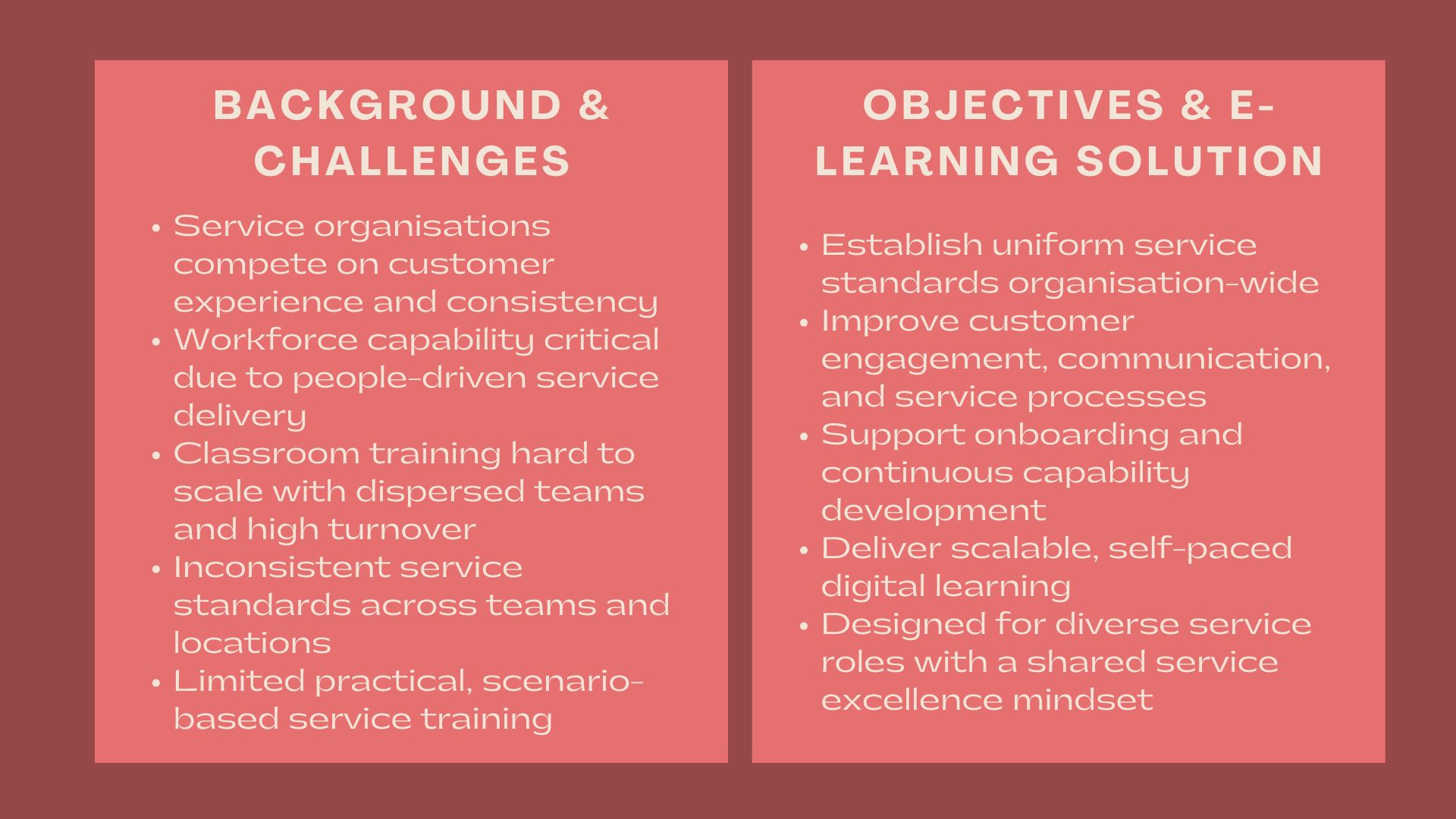
Inequality in service delivery was one of the major problems. Service standards were perceived in various ways by employees in various teams and places creating a difference in customer experience.
The other problem was low availability of training. Training in the classrooms meant that employees were out of the line of duty, a factor that was very disruptive to operations in service-oriented set ups where the level of staff directly relates to quality of service.
The issue of onboarding new employees was also a problem. The high turnover and the rapid growth of the business demanded a more effective and consistent process of introducing new hires to the service standards, processes and organisational values.
Moreover, more realistic learning, which was practical and scenario-based, was required. The current training resources usually emphasized on general principles but failed to adequately capture real life service scenarios like dealing with customer complaints, service expectation management or team coordination.
Objectives
The contract was meant to come up with Services E-Learning product that would increase workforce competence as well as operational efficiency.
Key objectives included:
- Setting up uniform service standards within the organisation.
- Enhancing the level of customer engagement and communication.
- Improving the knowledge in services process and workflow.
- Enabling successful onboarding and lifelong learning.
- Provision of self-paced training at large scale.
The programme had to be applicable in a large scope of service jobs and be in a single mindset of service excellence.
How We Helped
Our Services E-Learning programme is a modular programme designed in accordance with the requirements of service based organisations.
The programme started with the basics of service which made the learners understand the concept of service value, the different expectations of the customers as well as the significance of consistency in service delivery. This made a mutual understanding on what service excellence entails in the organisation.
Later modules were based on customer interaction and communication. Students learned strategies of active listening, expectation management, dealing with challenging conversations, and professional problem solving of service.
Service processes in operations were also taken care of. The workflow coordination, service handovers, and process adherence modules were covered and allowed the learners to know how roles of individual people are involved in the final service quality.
The topics of professional conduct and compliance were incorporated in the programme. Students became familiar with ethical behaviour, data protection and organisational policies that are applicable in the service setting.
To make the programme more practical, real-world cases of services and case-based learning were included. One of the situations learned as students used concepts to include responding to customer feedback, dealing with service disruptions, and teamwork within various departments.
Learning Design and Delivery
The Services E-Learning programme was made interesting, practical, and available to a wide range of workforce.
Short and targeted modules consisting of instructional videos, visual frameworks and applied examples provided the content. The concepts of service were simplified with easy language and easy-to-relate situations.
Learning was supported by interactive learning methods like quizzes, scenario based questions and reflection exercises which promoted participation.
The online set of training also enabled the employees to train at their own pace without interfering with the work schedules and still achieving the same learning results.
The modular architecture also facilitated easy updates, which enabled the organisation to update the content as the service standards and policies or customer expectations changed.
Outcomes and Value Delivered
The case study indicates that Services E-Learning Services is worthwhile in developing uniform, extensible, and workable service capability.
Employees gained a better appreciation of service expectations, communication methods and the way operations work, which led to better customer experience and service delivery consistency.
Organisationally, the e-learning solution presented an inexpensive and scalable methodology of workforce development. The training may be provided uniformly throughout the teams and sites and this helps in eliminating variation and enhancing a common service culture.
The programme also assisted the onboarding and the ongoing development as it offered a systematic learning trail which could be extended as the business requirements changed.