
Case Study: Technology E-Learning Services Building Digital Capability and Technology Readiness Through Scalable Online Learning
Background on Case Study Technology E-Learning Services
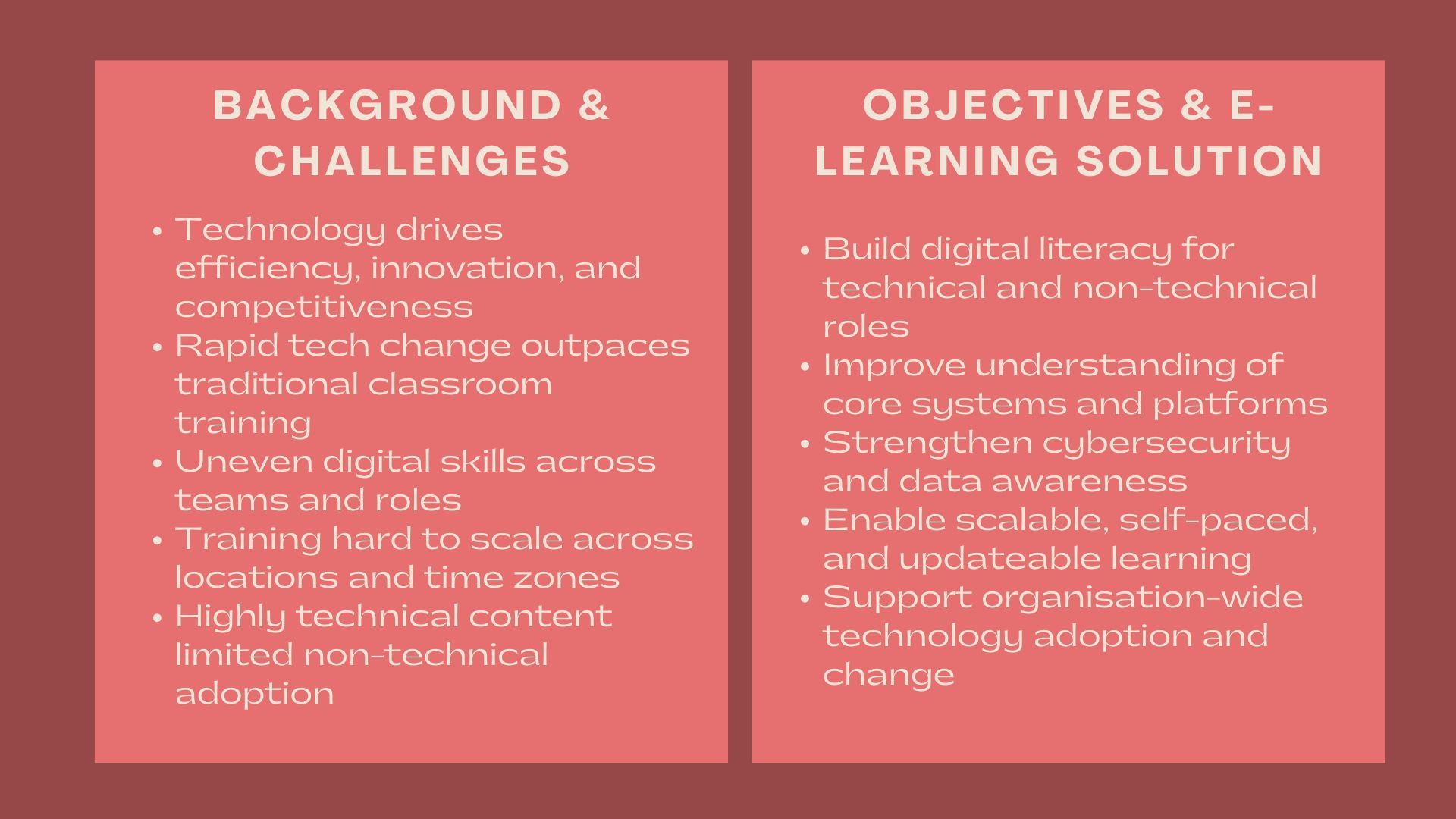
Technology has emerged as one of the most important facilitators in all manner of industries. Organisations are progressively turning to digital platforms, data infrastructure, and cybersecurity and software applications to business drive efficiency, innovation, and competitive edge. This means that workers across the board will have an expanding technical base and digital capabilities.
Technology proficiency, however, tends to change quicker than the traditional training model is capable of keeping up. Training in the classroom is hard to scale, and costly to update and offer uniformity to the training across geographically dispersed teams. Moreover, organisations need to upskill employees of different learning needs and levels of experience, such as technical employees and non-technical employees.
To cope with those challenges, to have a technology oriented organisation, our firm was contracted to design and implement a total Technology E-Learning programme. The goal was to develop a systemic, adaptable and feasible online learning platform, which would enhance the competence in technology, enhance digital literacy and perpetuate initiatives of change.
Issues and Challenges
The organisation has a number of workforce development issues that are prevalent in technology-driven environments before the engagement.
Rapid technology proficiency disparities between teams were one of the major problems. There were those employees who had good technical knowledge and those who had problems with simple digital concepts which created inefficiencies and lack of communication channels.
The other issue was the rapid technological change. Constant updating of systems, tools and platforms necessitated constant learning which was hard to accomplish with the old-fashioned training methods.
The accessibility of training was also an issue. The employees were distributed in various locations and time zones and thus, it was difficult to provide uniform learning experiences.
Moreover, training resources were in many instances quite technical and could not be comprehended by non-technical employees that constrained their efficacy in facilitating cross-functional teamwork.
Objectives
The interaction sought to come up with a Technology E-Learning solution that had the potential to create technology capability within the organisation and assist in versatility and scalability.
Key objectives included:
- Digital literacy of technical and non-technical positions.
- Increasing knowledge on core technology deployment and systems.
- In favor of meaningful adoption of online technologies and platforms.
- Improving cybersecurity and data awareness.
- Provision of self-paced learning that could be easily updated.
The programme had to be expert enough that it was available to a wide audience and at the same time give enough technical expertise to the learners.
How We Helped
We created a Technology E-Learning modular programme module that would address the foundational digital concepts, applied technology skills and practical case scenarios.
The programme started with the basics of digital, which exposed the learners to the major concepts of digital transformation, cloud computing, data analytics, and system integration. This created a common language and perception throughout the organisation.
Other modules were based on practical applications of technology. The learners investigated the importance of using business software, collaboration tools, and digital platforms, which can be applied to their duties.
The programme incorporated cybersecurity and data protection as its key elements. Such modules included the general cyber threats, the data privacy ethics, and the employee role in ensuring safe online spaces.
In the case of more technical students, the higher level modules offered a further understanding of system architecture, technology project lifecycle, and new technologies. Simplified explanations and role-based examples were used in supporting the non-technical learners.
The practical situations and case based learning were introduced so that the learners could apply concepts to the daily technology challenges like adoption of systems, automation of the processes, and solving digital problems.
Learning Design and Delivery
The Technology E-Learning programme was to be structured in such a way that would combine technicality and accessibility.
The content was provided in short modules that were focused with both video instructions and visual illustrations and applied examples. The complicated technology concepts were divided into understandable, rational steps.
Learning was supported and active participation was stimulated by the interactive learning features like quizzes, simulations, and scenario-based exercises.
The digital format provides a flexible approach to training whereby the employees could continue with their duties without disruption and yet deliver consistent results in training.
The modular design facilitated the updating of content in the organisation as the technologies changed to maintain its relevance and sustainability in the long term.
Outcomes and Value Delivered
As per this case study, Technology E-Learning Services are conducive to the development of scalable, consistent and future ready technology capability.
The employees became more digitally literate, more confident, and aware of cybersecurity and data responsibility. Technology concepts were also understood more, which improved the collaboration of technical and non-technical teams.
The E-learning solution was cost-effective and was scalable as far as the organisational perspective is concerned. Unified learning requirements minimized differences in knowledge and helped in successful adoption of technology.
The programme also established a platform of sustained digital upskilling so that the organisation is better able to respond to technological change and innovation.