
Treasury Management Training for Corporate Finance and Multinational Firms
Introduction to Certified Corporate Treasury Management
In a business world where capital markets have become volatile, interest rates are cyclical, and global cash flows are growing more complex, treasury management has become a key strategic asset to both corporate finance departments and multinational enterprises. Successful treasury is no longer just an operational department that performs responsibility in terms of payment and cash position but is the core component of financial strategy, risk management, optimization of liquidity, and stability of the enterprise in the long term. The demands of the treasury professionals have also broadened greatly as businesses globalize, increasing their sources of funds and are ever more contingent on digital financial infrastructure. This has created an increased need to have systematic training sessions that improve analytical skills, improve financial decision-making, and equip teams to handle international treasury issues with some confidence. The subsequent paragraphs discuss how treasury training helps the organization to deal with liquidity, financial risk management, the exploitation of treasury technology, and the expansion of the business internationally. Both sections integrate the best practices and frameworks in the real world that are contemporary with the new dynamic treasury landscape.

1. Building Corporate Treasury Capabilities by Training.
1.1 Improving Cash Flow Forecasting and Working Capitals.
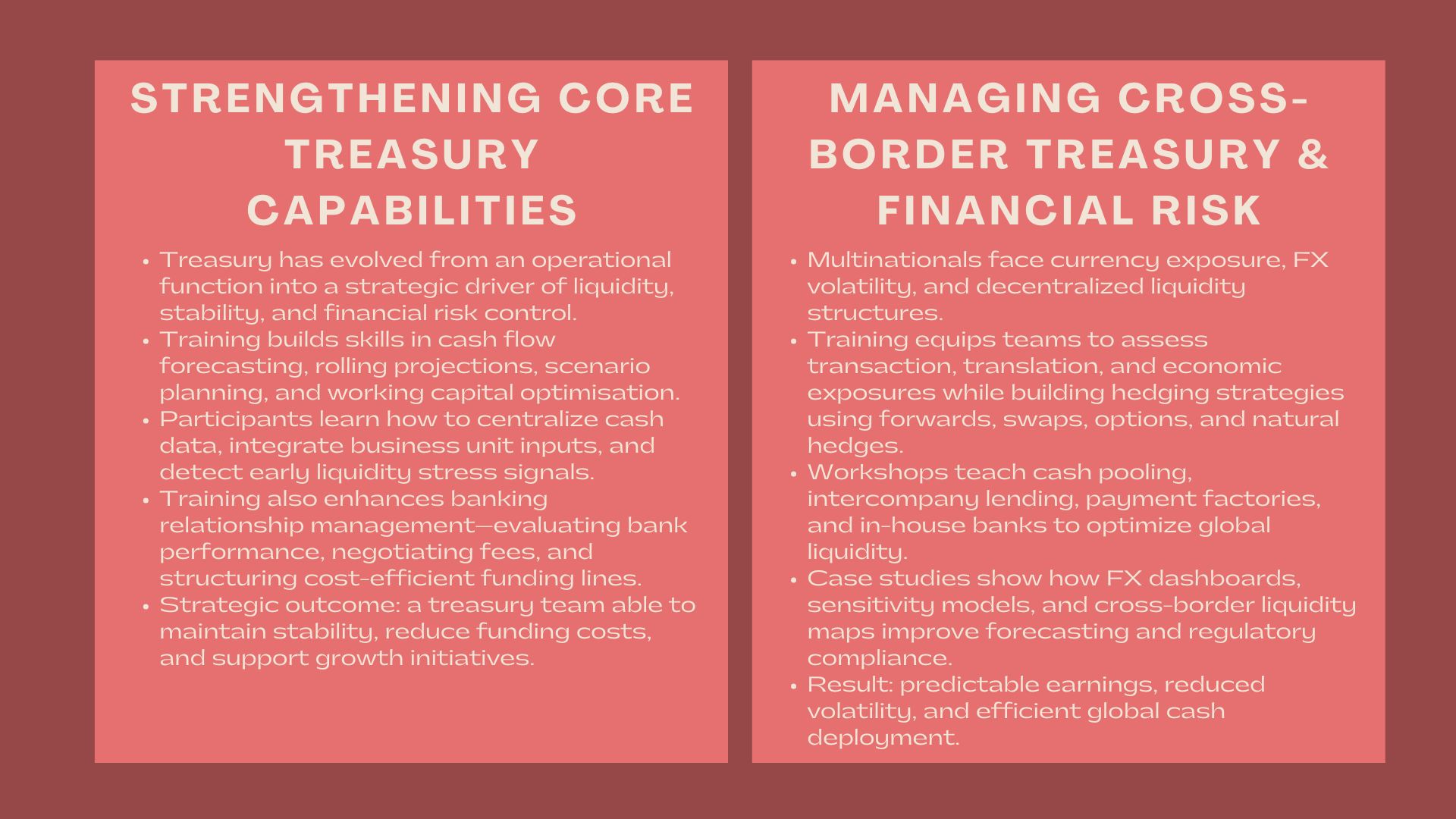
Precise prediction of cash inflows and outflows is vital in ensuring stability in the operations. The training programs in treasury usually start with a good background in both long term and short term forecasting of cash flow. The participants are taught how to centralize information on the business units, integrate sales pipelines, work around market variations and identify the first signs of liquidity strains. A systematic workshop could be followed and involve some practical activities involving the participants to evaluate the historical sales, the effects of seasons and the behaviors of the customers to pay. These activities are useful in strengthening the application of rolling forecasts, scenario planning and variance analysis as working capital visibility. During this training, facilitators may introduce the concept of a corporate treasury and cash flow management training program, linking the curriculum to formalized skills that treasury teams need to master.1.2 Improving Banking Relationships and Funding Efficiency
The corporate treasury departments have to ensure that they maintain good relations with domestic and overseas banks to avail credit facilities, assist in financing trade dealings, and bargain prices on banking services. The training programs provide the treasury teams with knowledge of how to analyze the performance of the banking industry, determine whether an individual is creditworthy, compare fee structure and negotiate good rates. Practical examples tend to include the analysis of a multinational banking network in order to kill redundancies, cut expenses, and consolidate account to enhance the visibility. With knowledge of how to deal with bank scorecards and credit reviews, treasury professionals are able to keep funding costs as low as possible and at the same time have adequate access to liquidity to fund either expansion or market entry plans.2. Treasury Management Multinationals Cross Border.
2.1 How to deal with Currency Exposure and Forex Volatility.
In the case of multinationals, they are exposed to various currencies and this presents risks that will wipe the profitability in case it is not dealt with. Training in Treasury assists the participants in analyzing transaction exposure, translation exposure, and economic exposure in various markets. With the help of practical exercises, professionals get to know how to develop hedging strategies through forward contracts, options, swaps, and natural hedges. In a typical case study, a multinational that sells products in Southeast Asia has to deal with revenue that is being expressed in different local currencies but has to report its results in a single functional currency. The training shows that FX dashboards, market indicators and sensitivity models can be used to make better hedging decisions. These lessons in practice allow the treasury groups to have predictable earnings even during the turbulent markets.2.2 Liquidity Centralization and Intra-Group Treasury Solutions.
Multinational companies with large size usually have its subsidiaries, which are decentralized with their cash balances and financing needs. A treasury training course demonstrates to the attendants the operating mechanics of centralization of liquidity instruments including cash pooling, intercompany loaning, payment factory and in house banks. The tools minimize the cost of borrowing, increase liquidity disclosure, and create greater centralized control. One of the typical training settings would be to map the existing liquidity structure of a multinational, measure inefficiencies and develop an optimal treasury model. This portion of the workshop may reference the need for a treasury operations and liquidity management workshop for multinationals, emphasizing the specialized skills required to coordinate cross-border liquidity movements while complying with local regulations.3. Developing Risk Management Expertise Within Corporate Treasury Teams
3.1 Interest Rate Risk and Capital Structure Considerations
The treasury units should also know the impact of the interest rate fluctuations on the cost of borrowing, returns on investments and company value. The basic principles of duration, the yield curve, the interest rate swaps, the conversion of fixed to floating, and as well as the optimization of a debt portfolio are normally touched upon in training programs. The discussion of cases tends to concentrate on the firms whose debt is high in terms of the variable rates and the way in which they are able to smooth their interest rates by employing hedging mechanisms. These scenarios assist the participants in assessing the capital structure choices in the wider risk management and long-term financial planning.3.2. Counterparty Risk, Credit Risk and Financial Controls.
Besides handling market risks, the treasury professionals should protect the organization against counterparty failures, fraud incidences, and internal control failures. In treasury training, workshops entail elaborate training of the credit assessment, exposure limits, collateral management, and adherence to the treasury policy. Individuals tend to interpret actual cases of failed counterparties or operational failures to determine what internal controls might have averted the problems. Information on the design and implementation of governance frameworks makes treasury departments better custodians of corporate finances.4. Implementing Technology and Data analytics in Treasury activities.
4.1 Leveraging Treasury Management Systems (TMS) to generate Insights in real time.
The digital transformation realigned the work of treasies in international organizations. Training modules on treasury management systems (TMS), cloud-based systems, and API-led integrations of ERP solutions have become part of training programs. The participants can be taught about automation of reconciliations, central reporting, real time cash monitoring, and minimising the errors of manual processing. Simulations of the systems are frequently involved in real-life practices, as this shows that dashboards, automated alerts, and combined data make better choices. These teachings enable the treasury teams to embrace the adoption of digital solutions better to enhance efficiency and transparency.4.2 Leveraging Data Analysis to empower Treasury Decision-Making.
The treasury operations in the modern times are heavily dependent on data analytics to make sense of trends, detect anomalies, and aid in financial planning. The techniques that are emphasized in the training programs are variance analysis, predictive modeling, liquidity stress tests and cash flow scoring. Analytic tools allow the treasury departments to be quicker to respond to disruptions, enhance forecasting accuracy, and streamline investment strategy optimization. To illustrate how analytics-driven case studies may ease the process of treasury responses, participants can complete liquidity bottlenecks, delayed customer payments, or unexpected market shifts case studies.Conclusion
Treasury management has now become a strategic activity that determines corporate stability, financial stability and long-term business development. With companies operating across borders and operating in a more volatile market, the demand of advanced treasury competencies is on the increase. Organized training sessions enable the corporate finance departments and multinational treasury units to gain more expertise in the liquidity planning, risk management, banking strategies and digital treasury technologies. Investing in lifelong learning helps organizations to build financial infrastructure and anticipate the future by keeping the treasury operations nimble, knowledgeable, and oriented to the overall corporate strategy.Frequently Asked Questions
Q1. Who should attend a Certified Corporate Treasury Management course?
This course is ideal for treasury professionals, finance managers, CFOs, corporate finance executives, accountants, cash managers, risk managers, bankers, and business leaders responsible for managing an organization’s liquidity, funding, and financial risks. It is also suitable for professionals seeking to build a strong foundation in treasury operations and strategic financial management.
Q2. What topics are typically covered in Corporate Treasury Management training?
Participants generally learn cash and liquidity management, working capital optimization, treasury operations, financial risk management, foreign exchange exposure management, funding strategies, banking relationships, corporate finance, treasury governance, and financial planning. The training focuses on helping professionals manage an organization’s financial resources efficiently and strategically.
Q3. Why is treasury management important for organizations?
Effective treasury management helps organizations maintain sufficient liquidity, optimize cash utilization, manage financial risks, support strategic growth initiatives, and improve financial stability. Strong treasury practices contribute to better decision-making, enhanced operational efficiency, and long-term business sustainability.
Q4. Do I need prior treasury experience to join the course?
No. While experience in finance, accounting, banking, or corporate finance can be beneficial, treasury management courses are often designed for professionals with varying levels of experience. Participants can develop practical knowledge of treasury functions, cash management, and financial risk management through structured learning and real-world applications.
Q5. What makes practical Corporate Treasury Management training valuable?
Practical training incorporates case studies, cash flow management exercises, liquidity planning scenarios, risk management simulations, and treasury decision-making workshops. This hands-on approach helps participants understand how treasury functions operate in real organizations and equips them with skills that can be applied immediately in the workplace.