Build your career with our industry-related courses. call us now at +65 9730 4250

Sales Training Programs for Financial Services, B2B, and Technology Sectors

Introduction to Certified Financial Services Sales Training

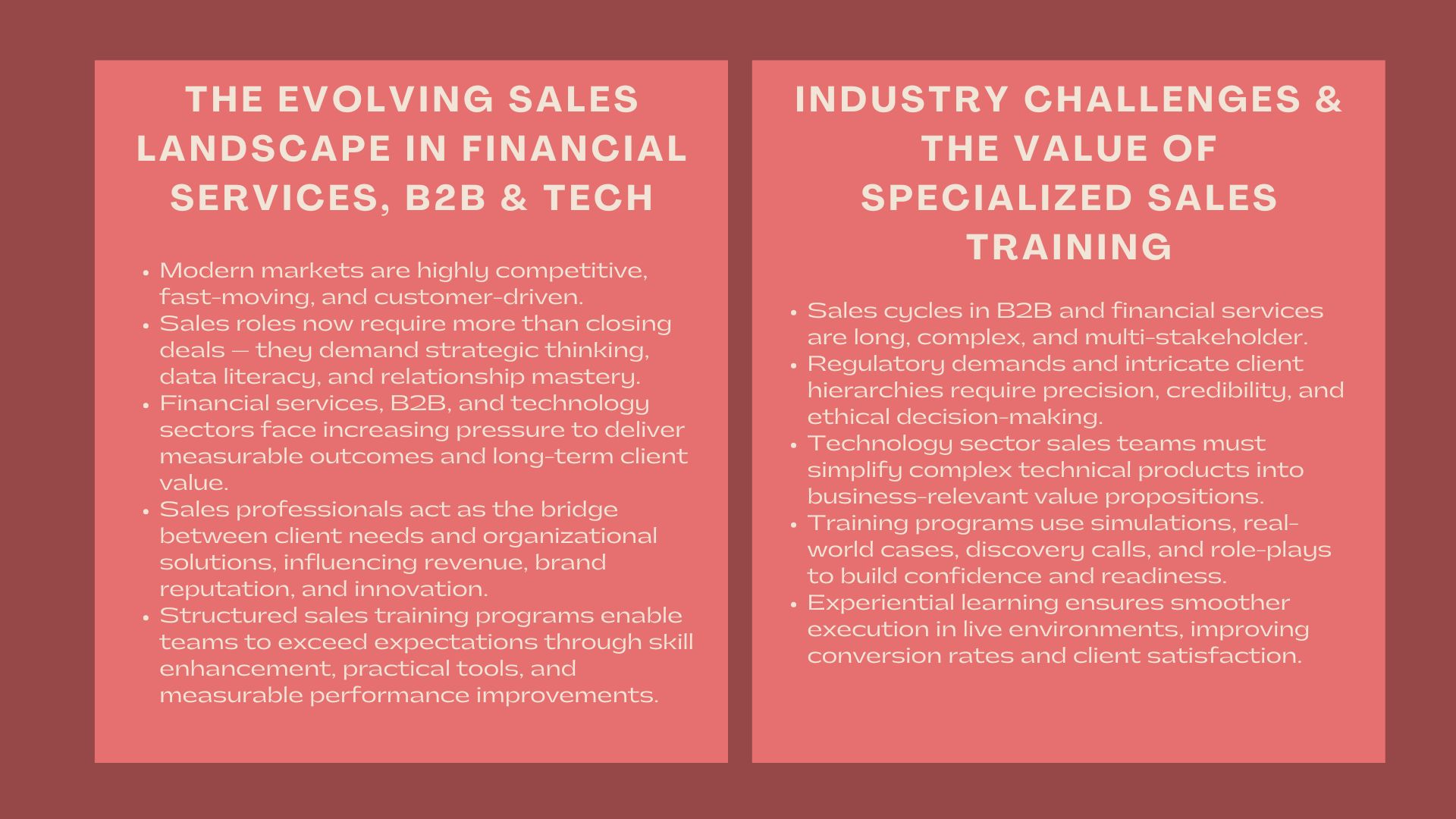
The modern business world is very competitive and rapidly evolving, and in financial services, B2B, and technology industries, organizations are pressurized continuously to achieve excellent sales outcomes, establish healthy relationships with the clients and respond promptly to the changes in the business world. Sales performance cannot be passive deal making anymore, it is a part of learning the needs of the clients and understanding the market and data, balancing strategies with corporate goals, and creating long-term relationships that will promote sustainable revenue growth and brand loyalty.

It is through the sales professionals that there is a bridge between the goals of the client and inside solutions. Their performance has implications on revenue base, efficiency in operations, organizational image and innovation and ability of the company to remain ahead on both the frontline and competitors. By investing in extensive sales training programs, organizations are at an advantageous position of preparing highly competent sales teams that not only perform within the expectations levels but also manage to perform better. These programs also prepare participants with realistic competencies and behavioral skills, and strategic instruments that are translated into quantifiable outcomes, greater customer satisfaction and team performance.

Contemporary selling problems are complicated. Teams have to go through lengthy sales cycles, intricate client hierarchies, work in different departments, as well as adapt to technology-related disruptions. Formed programs like b2b and financial services selling performance training courses or tech sector sales strategy and managing clients workshops provide members of the programs with the chance to undertake realistic simulating, role-playing and on-the-job training exercises. The fact that this experiential technique would guarantee confidence of the participants upon the implementation of the learned strategies in their work environments, would result in concrete sales performance and organizational developments.

Certified Financial Services Sales Training

Enhancing Sales Capabilities Across Industries

Elevating B2B and Financial Services Sales Performance

The B2B and financial services salespeople are dealing with specific sales problems, such as long and complex sales cycles, high regulatory demands, decelerating decision-making multi-stakeholder, and more and more advanced client expectations. They need to market with some expertise in technical sales with consultative sales, strategy and ethical judgment to reach success.

A b2b and financial services sales performance training course can be overcome with the help of structured learning modules, such as scenario-based activities, role-playing client sessions, and case studies offered to the participants of the program. The professionals are provided with the information on how to recognize the main decision-makers, foresee the possible objections, adjust the solutions to clients needs, and ensure the adherence to the existing rules.

The consultative selling workshops also involve aiding consultants to develop constructive discovery exchanges with their customers, identify the business issues troubling their customers, and recommend solutions to these issues that foster a quantifiable value. With the strategies of consultative skills, the professionals develop trust and enhance the relations between them and their clients, as well as probabilities of making a business and engaging in the long-term relations again.

These workshops stake on the utilization of data-informed selling methods. The learners will be taught to use CRM systems and interpret pipeline metricals and make use of market intelligence to focus on the leads with high potential, predict a sales opportunity and align it with organizational strategy. Such a mix of strategy, analytics, and interpersonal skills make sure that B2B sales team and financial services sales team would be efficient and effective.

Case Study Example: A multinational B2B financial company was involved in a module of learning that was based on case studies and involved complex negotiation of corporate accounts. With the lessons acquired in the workshop, the company increased its conversion rate of proposals by 25 percent in six months, and this indicates a quantifiable business value and efficiency of a team in its functioning.

Advancing Technology Sector Sales Strategies and Client Engagement

The sales environment in technology sectors comes with its own set of challenges such as a high level of product innovation, technical products, and high level of competition in the market. Challenges in translation should be avoided as professionals should be able to present incomprehensible technical information into aspects of business that can appeal to various stakeholders.

Technology sector sales strategy and client engagement workshops help the participants close the gap existing between technical knowledge and persuasion. Practical exercises permit the participants to practice, presenting the complex solutions, handling the multi-stakeholder negotiations, reacting to the objections of the clients, and structuring the proposal in a way that emphasizes the business value.

There are also workshops that would concentrate on how to combine sales strategies and product road maps and the market trends. Professionals are taught how to expect the new updates on the product, see the opportunity to upsell, cross-sell, and integrate the new technological solutions into the model of engaging with clients. This is a strategic perception that allows sales plc to become a trusted advisor who provides a solution that will not only match the goals of the client but also the goals of the organization.

Case Study Example A software-as-a-service provider used insights about a workshop in the technology sector to add technical consultants into their client engagements early on. This modification shortened the onboarding process by a quarter and boosted the scores of client satisfaction highlighting the real-world advantages of organized sales training.

Core Competencies Developed Through Sales Training

Building Consultative and Strategic Selling Skills

The successful sales training can center on consultative selling and strategic account management, which equip the participants with the models that may be used to formulate the needs of the client, account plans and provide their businesses with quantifiable results.

With discovery calls, client interviews, solution presentations and handling objections, the participants are practiced through guided exercises. They are presented with situations where they have to think critically, negotiate and make ethical decisions. Sales professionals are also prepared with a level of confidence on how to handle tricky accounts, organizational layoffs and persuade decision-makers by simulating real-life situations.

The workshops focus on both strategic thinking so that the participants have the ability to consider short-term wins as compared to the long-term relationship value as well as predict the market changes and actively plan on how to achieve client fulfillment but at the same time helping the organization to achieve its goals.

Strengthening Client Engagement and Relationship Management

Client relations are the main key to success in the long run. The workshop is conducted to learn how to create rapport, get to know the needs of the stakeholders and how to keep the trust throughout the client relationship lifecycle.

The participants acquire how to map client decision-makers, create communication cadences, and follow-up procedures to be put in place in order to maintain the engagement. Practical activities are aimed at effectively dealing with problematic discussions, negotiation, and expectation management in complicated organizational constructs. Professionals can enhance retention, expansion, and growth of an organization by learning to build strong relationship management skills and this will result in increased client retention and growth of the organization.

Industry-Specific Customization for Maximum Effectiveness

Tailoring Training for B2B and Financial Services

B2B and financial services people are exposed to industry-specific specifications, including regulatory conformity, the control of sensitive information and decision-making across the departments. The training programs combine case studies and simulations, each of which are industry specific and exercises which enable the participants to put the acquired techniques into practical use.

The workshops are dealing with compliance-related situations, investment advisory process, negotiating with corporate accounts, and coordination among different departments. Simulation of a realistic situation also provides the participant with hands-on experience to minimize chances of making mistakes during face to face interaction and enhances their power to bring value to the clients without violation.

Tailoring Training for Technology Sector Professionals

The technologies industry conferences focus on the translation of technical product knowledge into business-focused information. The participants are exposed to client presentation, product demonstrations, as well as, multi-stakeholder negotiations in simulations. The curriculum covers trends in digital transformation, the emergent technology uses and the issue of clients adopting, so that the professionals can be able to communicate and affect the process of decision-making in both technical and non-technical clients.

Integrating Data, Analytics, and Performance Measurement

Leveraging Analytics to Optimize Sales Performance

The present-day sales practices are becoming more and more data-based. The participants are acquainted with how to work with CRM systems, performance dashboards, and predictive analytics that allow identifying opportunities, monitor progress, and improve the sales strategies.

Decision-making based on the data allows salespeople to focus on the potential high-potential lead and make changes and allocate resources appropriately. The participants learn how to analyze performance metrics, trends, and use the insights to increase the conversion rate and revenue performance.

Measuring Impact and Ensuring Continuous Improvement

The structured sales programs also come with follow up programs to monitor how the acquired skills have been applied in the real world environment. The conversion rates, client satisfaction, average time of the deal, and the revenue increase are tracked. The nature of continuous coaching and feedback provides the ability to maintain the skills, apply and develop them through time, which optimizes the culture of continuous improvement and sustainable sales performance.

Advanced Sales Practices and Emerging Trends

Adapting to Hybrid and Digital Sales Environments

The workshops equip the participants to work efficiently in the hybrid sales and digital sales environments. They acquire competencies in presenting virtually, negotiating remotely and effectively collaborating online without losing their interest and credibility. The respondents are taught the methods of facilitating face-to-face interactions online, how to utilize virtual collaboration platforms, and how to be able to provide clients with the same communication across the board.

Integrating AI and Automation in Sales Strategy

AI-powered lead scoring, automated outreach, predictive analytics and so on are the emerging technologies already becoming part of sales. Participants are exposed to these tools in workshops where they are taught how to maximize client targeting, make their engagements personalized and enhance strategic decision-making tools. Individuals will use existing technologies and combine them with consultative skills to make the process more efficient, accurate, and effective.

Conclusion

Financial services, B2B and technology sales training should have comprehensive training that enables them to develop skills, knowledge as well as confidence to operate in dynamic markets which are highly competitive and fast changing. The current business environment has evolved where expectations of the clients are becoming more advanced, and market dynamics are changing at a very fast rate, and therefore, sales teams should not use experience and gut feelings only. Formalized training programs offer a methodical way of acquiring the skills required to always produce high performance outcomes, manage complicated decision making situations, and have a proper relationship with various stakeholders.

Through b2b and financial services sales performance training programs and technology sector sales strategy and client engagement workshop courses organizations develop high performance sales teams who can assist in increasing measurable growth in revenues, creating client loyalty in the long term, and maintaining customers competitive edge in their segment. These programs do not just stop at the traditional sales methods, they focus on the synthesis of the thinking, market intelligence, and problem-solving that are client-centered to the daily sales practices. This holistic plan means that sales professionals will achieve the short and long-term goals of the organization, as well as, guarantee its strategic goals.

These programs develop skills of critical thinking in several aspects, such as, consultative selling, strategic account management, client engagement, relationship management, data-driven decision-making, and flexibility to digital, hybrid, and technology-sales-enabling environments. By using interactive practices that are immersive in nature, participants can work on applying the theoretical knowledge to real life situations simulating issues that they would be faced with in day to day sales processes. Case studies and role-playing exercises that are industry-related can also be used to contribute to the learning, as professionals can learn the specifics of client requests, counter arguments, and the ability to create solutions leading to the addition of tangible business value.

Moreover, intensive sales training contributes to professional growth of people since it enhances the levels of interpersonal communication, negotiation, and problem-solving. The professionals obtain confidence in their interaction with various levels of decision-makers, cross-functional working groups, and responsiveness to the fluctuations in the market. By strengthening these abilities, the culture of excellence will be eventually established in the organization whereby the teams are harmonized, responsible, and advanced b2b and financial services sales performance training program driven in bringing out quality results on a continuous basis to clients.

The advantages of the structured and customized sales training in the organization are also met by the organizations that specify the active improvements in the operations of the organization, the accuracy of their forecasts, and the performance management. The inclusion of analytics, performance monitoring, and a continuous feedback loop in the training programs allows the organizations to track their progress, identify the areas of skills deficiency, and execute the strategy of continuous coaching. This will guarantee that the knowledge and skills acquired in the training are well put into practice and results in long term changes in sales measure like conversion rates, deal size, client retention and total revenue performance.

Moreover, the programs will help the sales teams to address the emerging trends and technologies such as AI-assisted analytics, Customer Relationship Management, web-based communication tools, and remote sales strategies. The skill of enabling professionals to capitalize on the use of advanced technology in conjunction with the conventional methods of selling products and services, places an organization at an edge of succeeding in the present and future market environments.

Conclusively, it is not a one time short-term effort of an organization to invest in detailed sales training programs but it is a long-term strategic investment in organization development, client-satisfaction and leading in the market. Through training a workforce of a high level of skilled, flexible, and customer-oriented sales personnel, companies enhance their competitiveness in the dynamic markets, respond positively to the developing needs of customers, and have strong presence in the market in the financial services areas, B2B, and technology markets. These initiatives form the basis of sustainable performance whereby sales teams always make their contributions in business success, win customer confidence, and make businesses a generator of long-term value.

finance/certified-financial-services-sales-training