How Long Does a Real Estate License Course Take: A Professional Guide to Real Estate Education, Practice Tests, and Certification Pathways
Introduction: Learn How to Complete Real Estate License
To become a real estate professional, the market intuition or sales skills are insufficient. The individual must have a proper education, up-to-date with the regulations and have a clear picture of what licensing entails. One of the most common questions from aspiring professionals is how long does a real estate license course take, especially for those balancing career transitions, academic commitments, or full-time employment.
This article dwells precisely on the organization and time of real estate education, how real estate education courses are established, how a real estate course practice test can be used to help students to pass exams, and how a real estate course certificate can be incorporated in professional licensing and career development. Through this learning experience, future agents and property practitioners are able to map out their career with ease and precision.
1. Understanding Real Estate Education Courses
1.1 The Purpose and Scope of Real Estate Education
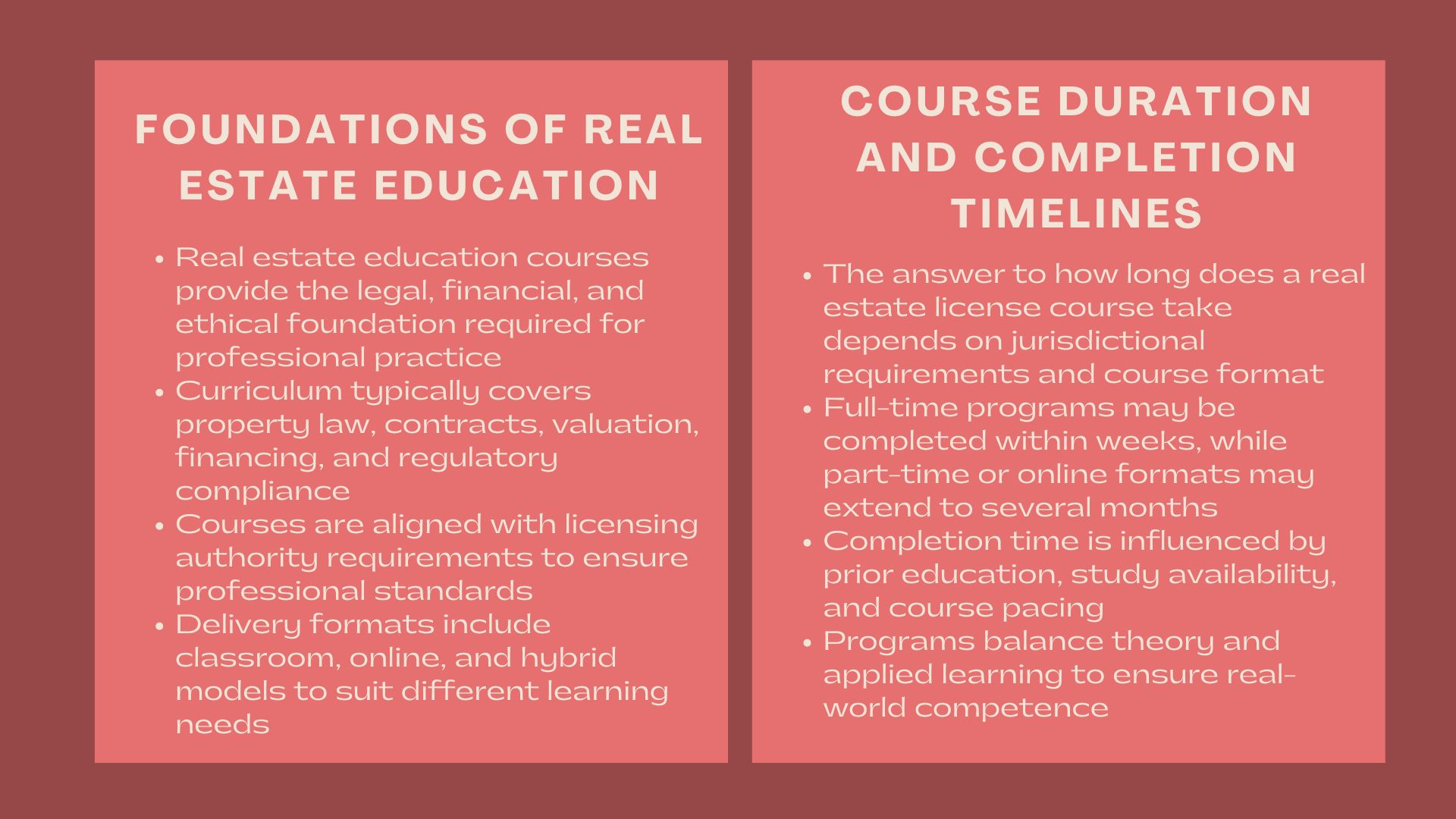
Real estate education courses are organized programs, which aim at helping to provide the candidates with legal, financial, and practical knowledge to act in a responsible manner in the property market. These courses are normally property law, ethics, basics of valuation, contracts, and funding and regulation compliance. The accredited real estate education courses, unlike the informal training, are in line with the requirements of the licensing authorities, where upon graduation the students have met the minimum professional requirements.
Practically, such courses are the basis of professional credibility. As an example, one venturing into residential brokerage should know about disclosures and agency relationships, and someone venturing into commercial real estate requires knowledge of leases, investment analysis and risk. It is this wide based curriculum that justifies the prerequisite nature of real estate education as opposed to an optional one.
1.2 Variations in Course Formats and Delivery
There are different forms of real estate education courses such as classroom-based education, self-paced online and hybrid courses. The type of format adopted could also play a significant role when it comes to determining the duration of time that a real estate license course will take. Full-time classroom programs can tend to be on a predetermined schedule and can finish in less time but part time and online courses can be flexible but may increase the overall schedule. Such variations will be aimed at supporting various learning styles and workplace situations.
2. How Long Does a Real Estate License Course Take in Practice?
2.1 Typical Course Duration and Credit Hours
The question of how long a real estate license course takes is mostly a regulation dependent factor, and depending on the course layout. Licensing bodies in most jurisdictions require the number of instructional hours to be a certain number, frequently a few weeks up to a few months. Others complete their course work within a couple of weeks when doing it full time, and others can take several months before achieving the same standards when they are studying part-time.
Practically, time is an indicator of the ratio of theoretical to practical learning. The courses are well designed so that candidates do not learn by rote but also learn how to implement these rules in a real life transaction. This competence and not speed focus strengthens the professional standards in the industry.
2.2 Factors That Influence Completion Time
There are a number of factors that determine the duration of time that a real estate license course will take on an individual candidate. The previous level of education, knowledge of law or finances, and time to study are factors. Applicants who have financing or law-related backgrounds might either move faster through the content. On the other hand, beginners in the property concepts can be helped by the slower pace they can get to understand more.
3. The Role of the Real Estate Course Practice Test
3.1 Preparing for Licensing Examinations
A real estate course practice test is a critical component of exam preparation, bridging the gap between coursework and formal licensing examinations. These practice exams are a replica of the exam situations, and they assist the candidates to acquaint themselves with the format of the questions, timing, and the frequent testing themes. Candidates can be more effective in their revision since they would be able to identify areas of knowledge gaps earlier.
To put it into practice, candidates that practice habitually perform better in licensing exams. To illustrate, a candidate who is poor in understanding the concepts of property law might find out through a practice examination that he/she must revise some more before attempting the final exam. This repetitive learning helps to lower the anxiety levels during exams and generates general preparedness.
3.2 Integrating Practice Tests into Study Plans
An efficient application of a real estate course practice test must be a part of a planning. Successful candidates practice the tests during the course instead of considering them a termination of the course. This methodology would change practice tests into an active learning tool instead of the assessment tool so that they aid in retention and knowledge in practice in the long run.
4. Earning a Real Estate Course Certificate
4.1 What a Real Estate Course Certificate Represents
A real estate course certificate is a formal confirmation that a student has gone through the necessary educational course and fulfilled the academic standards that have been provided by the training provider. The certificate is not a license, but in most jurisdictions it is a requirement in order to take licensing examinations. Licensing authorities use these certificates so as to determine whether a candidate has met educational requirements.
Professionally, the certificate also is an indicator of commitment and discipline. A certificate in a real estate course is also a common sight by employers and brokerage firms which the candidate is ready to join the profession in a responsible and ethical manner.
4.2 Certificate Validity and Regulatory Considerations
A real estate course certificate might have a time limitation on its validity introduced by regulators. Applicants who take long before they pass licensing exams might have to do the coursework again. This supports the significance of timelines in scheduling the process on how long is a real estate license course and the speed with which a follow-up step to licensing process has to occur.
5. Linking Education to Career Outcomes
5.1 Real Estate Education as a Career Investment
Obtaining real estate education courses is also an investment in professional potential and future career. Effective programs provide not only the candidates with expertise in exams but also equips them with the knowledge required in dealing with clients, negotiating, and complying. In reality, those who are serious with education tend to find it easier to enter brokerage firms as well as be confident in the initial deals.
5.2 Ongoing Education and Professional Development
A certificate of being a graduate of a real estate course is not the culmination of the learning process. To retain licensure, many jurisdictions have stipulated continuous education so that professionals are up to date with any changes in regulation and market trends. This continuous need highlights the dynamism of the real estate business and the need to engage in lifelong learning.
6. Practical Scenarios: Education Pathways in Action
6.1 Career Changers Entering Real Estate
To professionals switching out of other industries, it is important to know how long a course is to obtain a real estate license so that there is planning of income transitions and career paths. A large number of career changers are choosing part time or online real estate studies programs so that they can continue their studies without leaving the current job. These programs are flexible and they help an individual to enter into the profession gradually without compromising on financial stability.
6.2 Young Graduates and Accelerated Programs
Graduates in recent years have been known to take fast-tracked programs to get into the job market fast. These candidates can be able to undertake the coursework and licensing requirements in less time by committing to intense study schedules and regular practice test sessions on real estate courses. Their education pace and exposure to exam conditions can prove beneficial when they are licensing.
7. Choosing the Right Real Estate Education Provider
7.1 Accreditation and Curriculum Quality
The choice of the appropriate education provider is an important matter. Accredited providers put in place assurance of the compliance of real estate education courses to the regulation standards and the consequential real estate course certificate is accredited by the regulatory authorities. Quality of the curriculum, professionalism of the instructors and the resources to prepare the exams should also be put into consideration.
7.2 Support Services and Exam Preparation
Quality programs are usually ones that incorporate planned revision courses, access to a comprehensive set of real estate course practice test libraries and scholarly assistance. The features themselves are directly related to exam success and overall efficiency of candidates in their educational progression.
Conclusion
Understanding how long does a real estate license course take requires a holistic view of real estate education, from foundational coursework to exam preparation and certification. real estate education courses provide the essential knowledge base for professional practice, while a well-designed real estate course practice test strengthens exam readiness and confidence.
The resulting real estate course certificate serves as a formal milestone on the path to licensure and professional credibility. By choosing accredited programs, integrating practice tests effectively, and planning timelines strategically, aspiring real estate professionals can navigate the licensing process efficiently and position themselves for long-term success in a competitive and regulated industry.
The answer to the question of how long a real estate license course takes can be seen in the holistic perspective of real estate education, including the initial course work up to practice test and license certification into professional practice. The real estate education courses offer a base of knowledge to practice, and exam preparation and confidence is reinforced by the real estate course practice test.
The certificate of the resulting real estate course is a formal step on the licensure and professional credibility. With effective selection of accredited programs, incorporation of practice tests and preparation of schedules, future real estate professionals can sail through the licensed process with ease and place themselves in the competitive and regulated industry position to succeed in the long run.