
Case Study: Banking In-House Training Services Enhancing Capability and Regulatory Readiness
Background on Case Study Banking In-House Training
The hotel is a banking institution that is working in a highly regulated and competitive environment that is going through a transformational period. The bank was growing its product offerings, reinforcing digital operations, and recruiting new employees in front-office, operations, risk and compliance roles. The bank had prior training programs but the management realised that generic or externally sponsored programmes could not be effective any longer. The various teams were facing different regulatory, operational and risk based challenges and there was an increasing demand for tailor made in-house banking training that clearly matched those of the bank policies, procedures and regulatory requirements. In order to meet these needs and enhance organisational potentials, the bank approached our Banking In-House Training Services to design and present customised training programmes in various functions.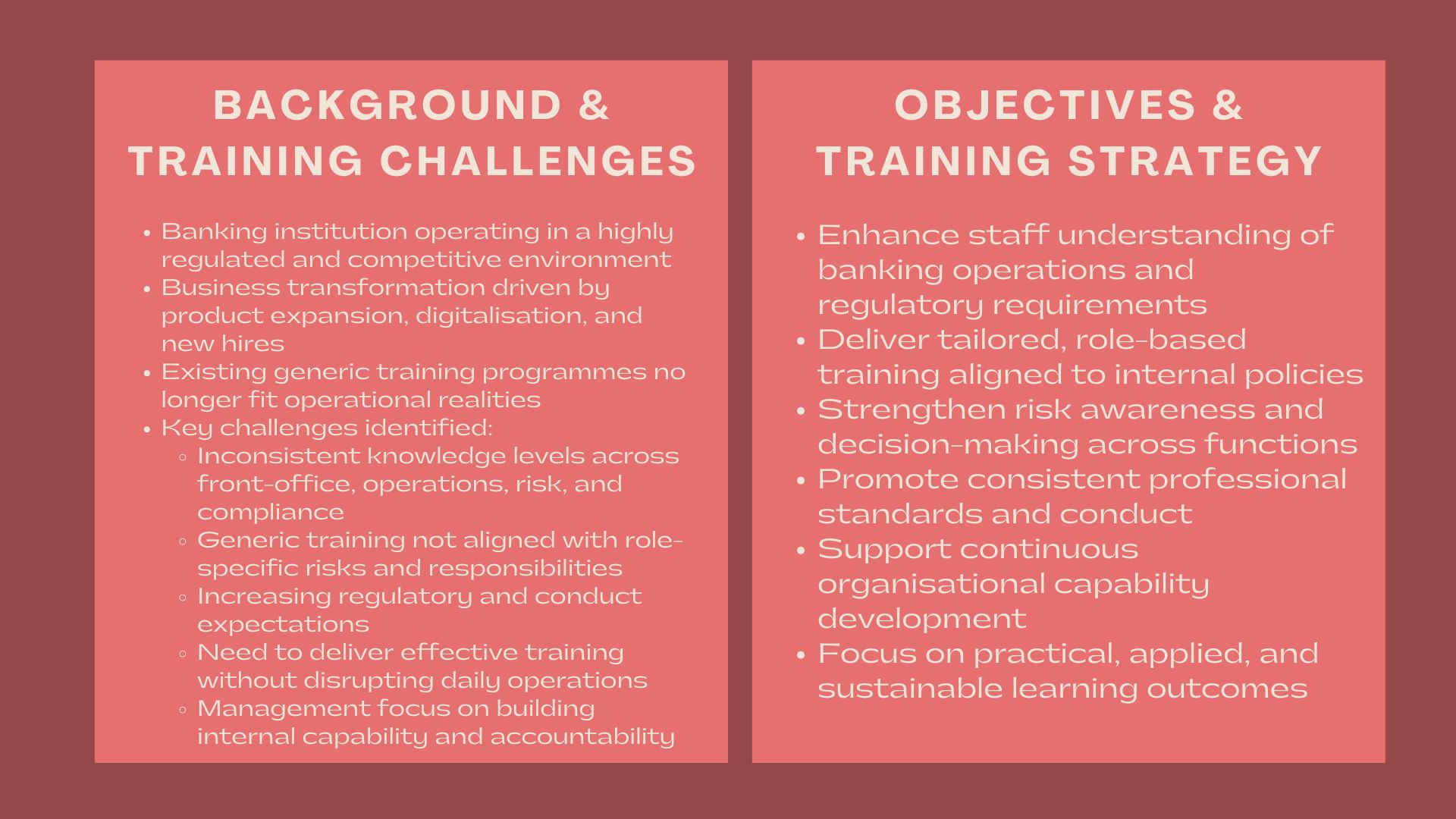
Issues and Challenges
The bank had a number of challenges that influenced the necessity to organize inside training. Lack of uniformity in the levels of knowledge among teams was one of the issues. The personnel had a wide range of backgrounds and their experience in the banking and regulatory field was different, which made it hard to guarantee that there would be similar knowledge of the banking principles, internal processes and regulatory expectations. A different difficulty was role relevance. Front-line staff, middle-office teams and control functions were exposed and liable to varying risks. These differences were not sufficiently reflected in generic training material and could not be used in practical implementation in day-to-day operations. Complicated regulations also put pressure. Regulations, risk management expectations, and conduct standards were still developing, and the staff members had to keep on the cutting edge and be sure of their abilities in implementing the regulatory requirements in real-life situations. There was also the issue of operational constraints which complicated the delivery of training. The bank had to have training programmes that would be effective to be delivered without interfering with the business activities, and yet must be comprehensive, interactive and effective to learn. Lastly, the management tried to enhance internal capability and accountability. Internal training was regarded as one of the primary tools that would help to instill uniform standards, build up governance anticipations, and contribute to the long-term advancement of talent.Objectives
The key goal of the engagement was to design and implement tailored banking in-house training programmes in accordance with the operating requirements and regulation of the bank. In particular, the bank was to:- Improve the knowledge of the staff about banking procedures and regulation requirements.
- Provide role-based and training that is practical based on internal policies.
- Enhance functional risk awareness and risk-making.
- Encourage uniformity and professional behaviour.
- Encourage continuous improvement of the organisation.