
Case Study: Credit In-House Training Services Strengthening Credit Assessment and Risk Awareness
Background on Case Study Credit In-House
An organisation whose operations are related to financial services and subjected to lending, trade credit, and counterparties risk management was witnessing growing complexity of its credit-related operations. The credit decision-making of the organisation occurred across various functions whereby sales, finance, risk management and operations functions were all involved in the evaluation of credit exposure and management of credit. With the increase in volumes of business and the dynamic market conditions, the management realised the need to establish better internal credit knowledge and harmonisation of credit assessment practices among teams. Though the credit professionals were available, they were also sharing the credit related duties with the non credit employees who needed to better understand the basics of credit and risk factor. The organisation has hired our Credit In-House Training Services to design and implement a structured training programme in line with the credit policies, risk appetite and business climate to optimize the internal capability and make sound credit decisions.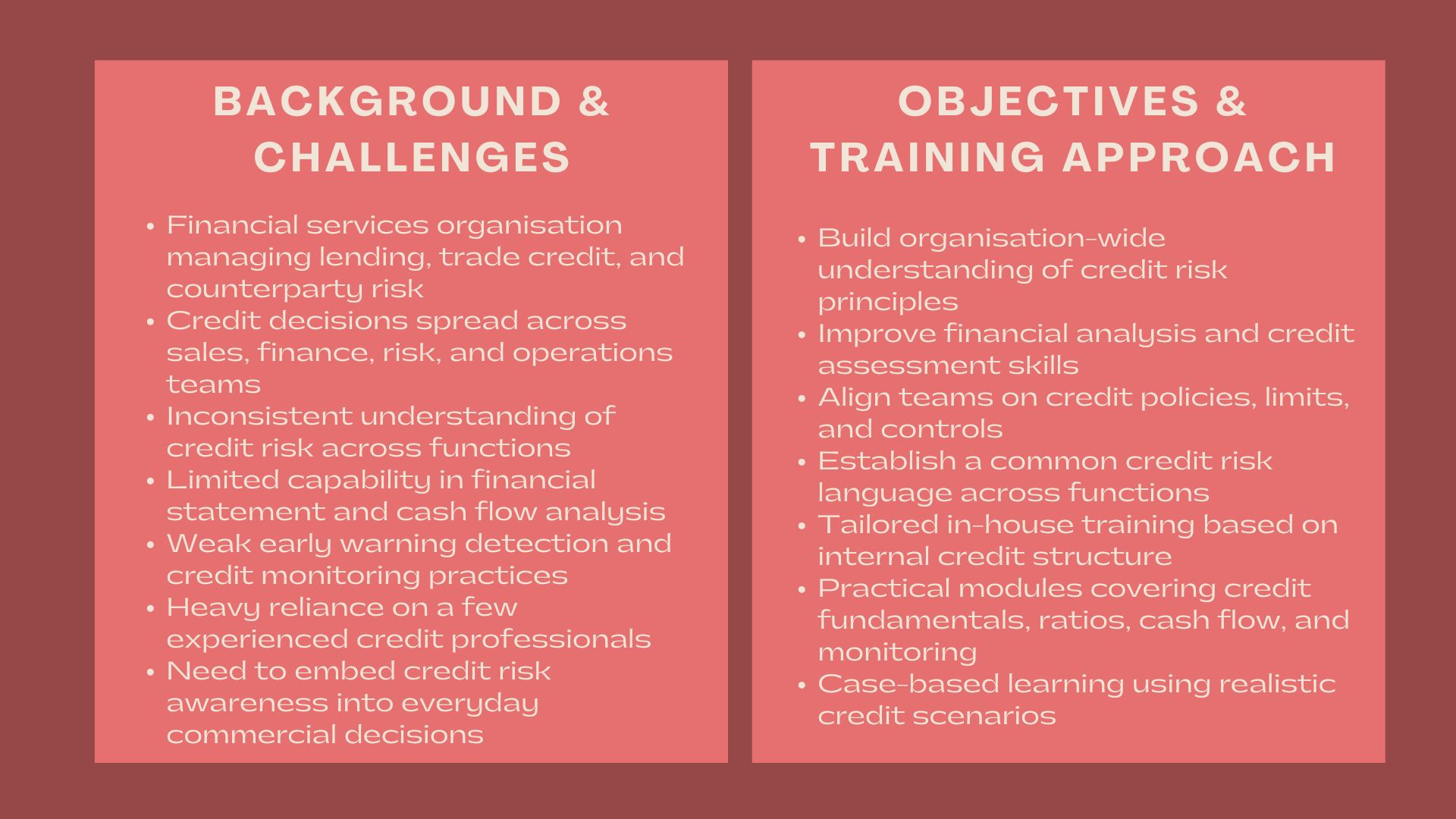
Issues and Challenges
There were a number of challenges the organisation was facing that showed the need for formal credit training. Poor cross-functional congruence in the definition of credit risk was one such challenge. There was a tendency of inconsistency in approaches and decision making among the employees who had different levels of familiarity with credit assessment principles, as was shown in customer onboarding, contract approval, and account management. The other difficulty was financial statement analysis. Although financial data was on hand, not all the participants were sure about analysing financial reports to evaluate creditworthiness, liquidity and solvency. There were also problems with credit monitoring and early warning detection. Not all teams were in agreement on the way of recognizing the signs of credit deterioration or escalating the potential issues in a timely fashion. Credit judgement was also based on the few experienced individuals with the result of bottlenecks and operational risks where the experienced individuals were not available. Lastly, the management aimed at instilling a greater credit risk culture, whereby, credit considerations were factored in commercial decisions, and not as a distinct service.Objectives
The main aim of the engagement was to enhance credit capability in the whole organisation by tailor-made credit in-house training. In particular, the organisation was to:- Enhance knowledge on credit risk principles and measurement systems.
- Improve credit analysis (financial analysis) skills.
- Enhance awareness on credit policies, limits and controls.
- Enhance credit observation and risk exaggeration measures.
- Develop a common language of credit risk.