
Build your career with our industry-related courses. call us now at +65 9730 4250

Case Study: Fixed Income In-House Training Services Strengthening Market Understanding and Investment Decision-Making

Background on Case Study Fixed Income In-House

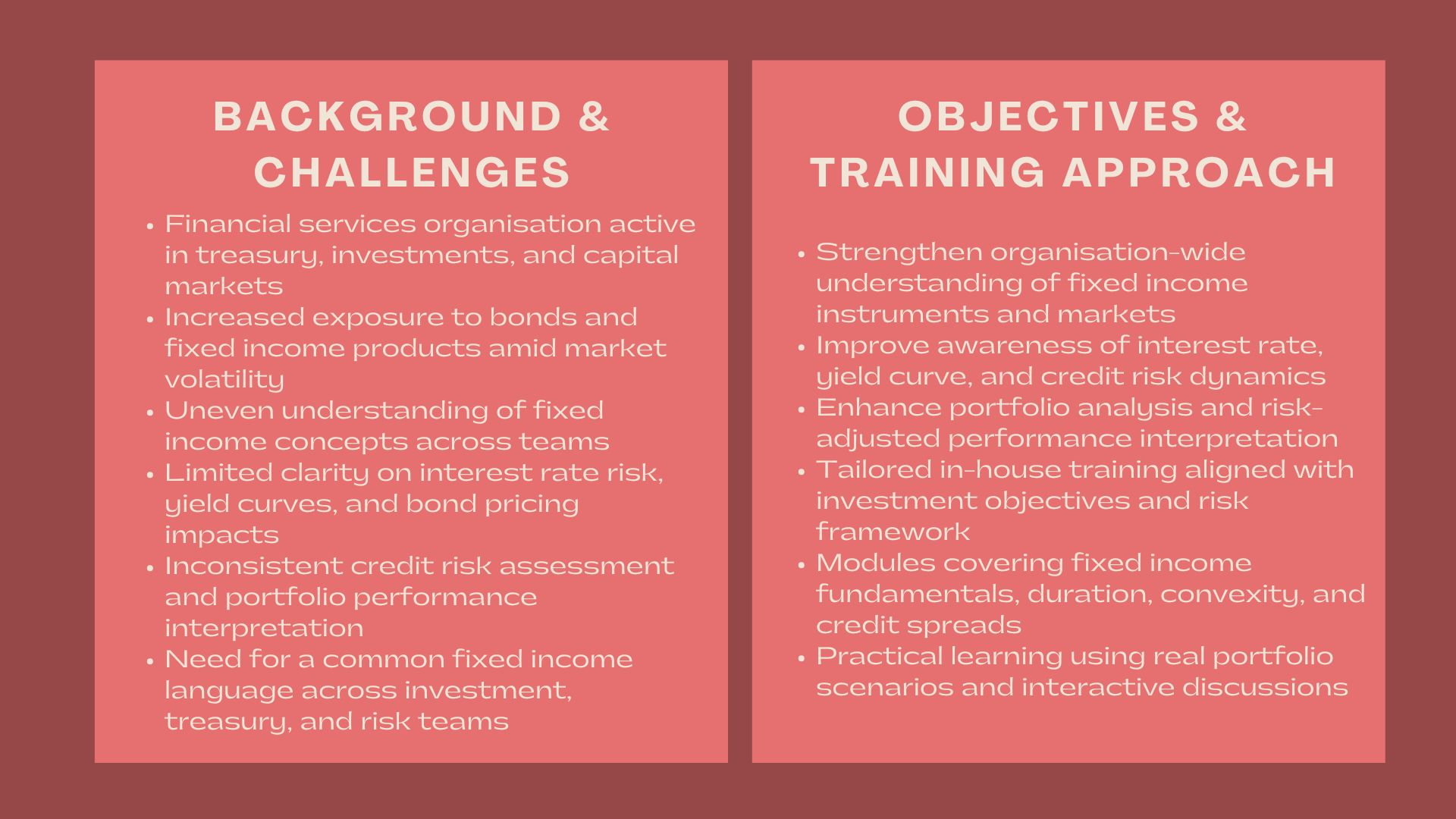
An organisation that operates financial services and is actively engaged in the management of treasuries, investment portfolios and capital markets became more exposed to the fixed income instruments. These activities that the organisation was engaged in related to bond investment management, assessing the opportunity of yields, and the interest rate and credit risk assessments as part of the overall financial and investment strategy of the organisation.

With the increased volatility of market conditions and the expansion of the fixed income products range, management saw the necessity to enhance internal knowledge of the fixed income concepts in more than one team. Although the specialist employees were well informed in the technical aspect, other stakeholders who were engaged in making investment decisions, risk management, and monitoring of the portfolio needed to have a better and more uniform knowledge of fixed income fundamentals.

As part of creating internal capability and informed decision-making, the organisation sought to use our Fixed In-House Training Services to design and provide a structured and practical training programme that was in line with its investment objectives and its risk management framework.
Case Study Fixed Income In-House

Issues and Challenges

The organisation had a number of challenges, which emphasised specialised fixed income training.

The lack of even understanding of fixed income instruments was one of the challenges. The members of the team were not familiar with bonds, notes, and other debt securities, which resulted in a non-uniform interpretation of the yield, duration, and credit risk.

The other risk was market volatility and interest rate risk. The participants were not consistently sure about the ability to measure the impacts of changes in the rates of interest and the yield curves and market conditions on the bond prices and performance of the portfolio.

There were also credit risk assessment problems. As the credit rating review and spreads were tracked, the impact of issuer credit quality, sector risks and macroeconomic factors on the value of the fixed income are not clearly comprehended by all the stakeholders.

Other areas of concern were portfolio analysis and performance measures. The management aimed at making sure that the teams would be able to analyze portfolio reports, evaluate risk-adjusted returns, and learn about the diversification advantage of fixed income portfolios.

Lastly, the organisation wanted to enhance communication amongst investment, treasury and risk teams by having a common understanding of the terminologies and concepts of the fixed income.

Objectives

The core aim of the engagement was to build the fixed income capacity within the entire organisation by having personalised fixed income in-house training.

In particular, the organisation needed to:

  • Increase knowledge on fixed income instruments and markets.
  • Enhance the understanding of the interest rate risk and yield curves.
  • Increase the awareness of credit risk in fixed income investments.
  • Enhance performance interpretation and analysis of portfolios.
  • Develop uniform fixed income team expertise.

The training had to be practical, not restricted to specialists and had to be in line with the investment and risk management goals of the organisation.

How We Helped

We embraced an organised and team-based training in the in-house training of fixed income based on market exposures of the organisation, portfolio and internal decision making requirements.

Our interaction started with a fixed income training needs assessment. We also collaborated closely with the investment, treasury, and risk teams to get to know the fixed income operations of the organisation, the level of skills that were available, and the general challenges that were involved in analysing fixed income investments.

It is on the basis of this evaluation that we developed tailor-made training modules on the most important fixed income aspects. They covered the fundamentals of fixed income, the categories of bonds and other debt instruments, the yield, the duration and the convexity and how the interest rates relate to the bond prices.

We also touched on credit risk in fixed income giving a discussion of the impact of credit spreads, ratings and issuer fundamentals on the valuation and yield of bonds. The market forces, e.g. yield curve changes and macroeconomic factors, were also included to give wider context.

There was a high value of practical application. The sessions covered training consisted of realistic cases, simplified calculation and case discussions which represented normal investment and portfolio management conditions. It was advised that the participants should implement concepts in their respective portfolios and reporting forms.

The programme has been designed so as to fit in the participants of various functions, such as investment, treasury, finance, risk management, and the top management. This allowed access and also encouraged uniformity of fixed income knowledge within the organisation.

The delivery of training was discrete, and it applied on-site workshops and virtual training where necessary. They were engaged through interactive discussions, scenario analyses and question and answer sessions to understand tough concepts.

To buttress learning, we offered supporting materials, fixed income frameworks and reference guides which the participants could resort to post-training in order to facilitate continued analysis and decision-making.

During the engagement, we collaborated with the participants to answer questions, discuss, explain, and modify the discussions to the context of the particular organisation in the field of fixed income.

Value Delivered

This case study will illustrate how professional Fixed Income In-House Training Services can reinforce market intelligence and make informed investment decisions.

The involvement allowed increasing the confidence in the fixed income instruments analysis, understanding the interest rate and credit risks better, and contributing to a better infrastructure to monitor and discuss the portfolio.

This engagement led to the creation of a scalable basis of the continuing capability development, an enhanced level of risk management, and a more knowledgeable approach to the fixed income markets with the help of the developed in-house training framework.

inhouse/case-study-fixed-income-in-house