Case Study: IPO In-House Training Services Preparing Management Teams for a Successful Public Listing
Background on Case Study IPO In-House
An emerging firm with a competitive and highly-regulated industry was planning the possibility of an Initial Public Offering (IPO) as part of its long-term growth and fund-raising strategy. The organisation was at the phase of operational maturity, its revenue growth was high, it had a growing market presence and more institutional investors were interested in the organisation. Although the senior management was highly experienced in the running of the business, a high number of team members were not well exposed to the IPO process. The major stakeholders in the finance, operations, legal, compliance, and investor relations had to be familiar with the expectations, responsibilities, and discipline of becoming a publicly listed company. It was realised by the management that an effective IPO could not be achieved without outside advisors and technical reports. Internal preparedness, cross-functional alignment and understanding of what occurs in IPO related processes were very important. In order to develop internal capacity and organisational readiness, the company enrolled our IPO In-House Training Services.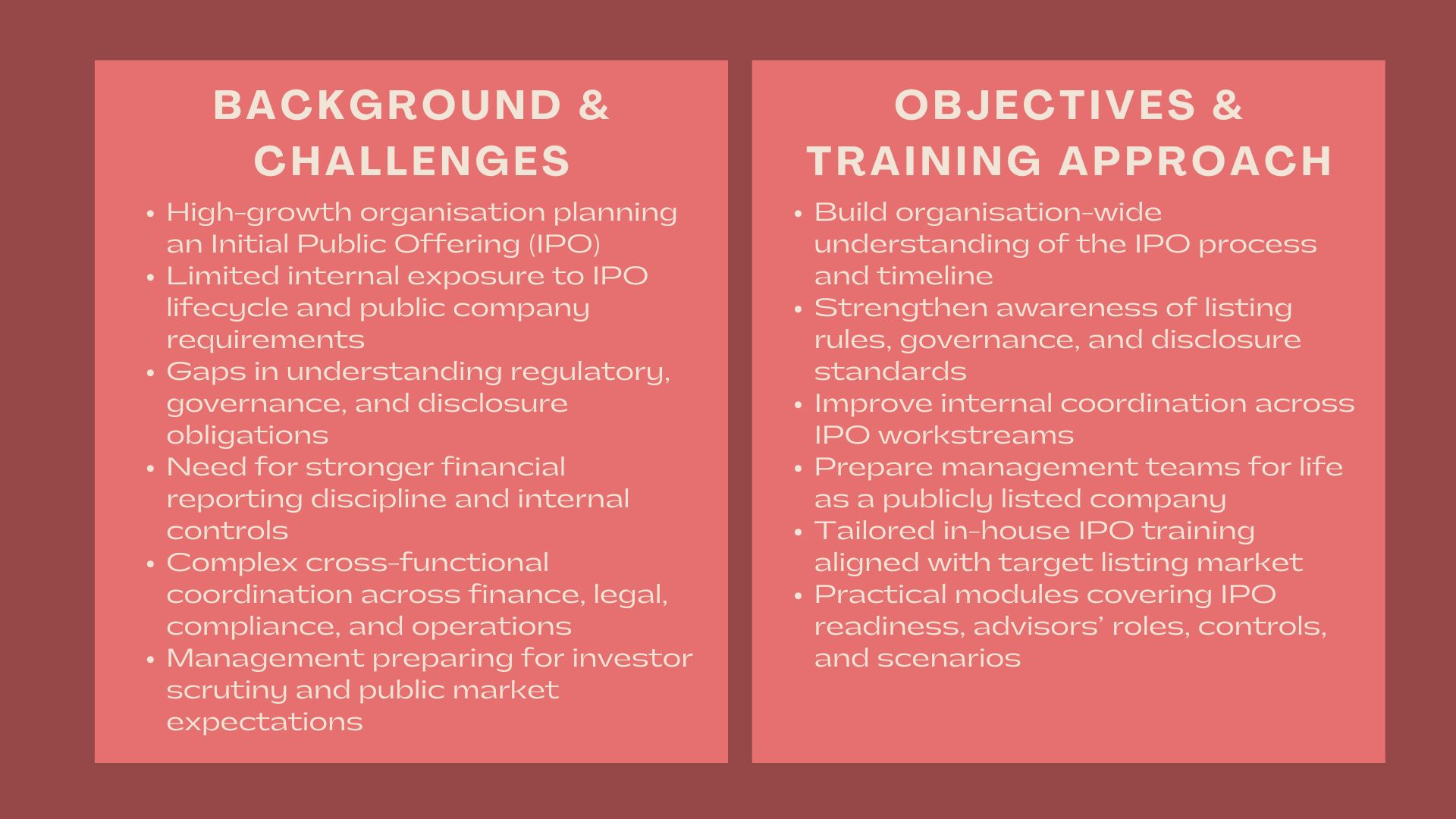
Issues and Challenges
The organisation had a number of issues that led to the necessity of organisation-based IPO-specific training. Lack of expertise in the IPO lifecycle was one of the key challenges. Most of the workers did not know the procedures of IPO, such as pre-IPO restructuring, due diligence, preparation of prospectus, regulatory scrutiny, marketing, pricing and post-listing requirements. Regulatory and compliance expectations were also another challenge. The organisation had to make the important teams aware of listing rules, disclosure requirements, corporate governance standards and continued compliance requirements after listing. There were also the problems of financial reporting and controls. Although the internal financial reporting was healthy in operations of private companies, the public market demands a greater degree of transparency, consistency, and internal discipline of control. Internal coordination was also an issue the management was worried about. IPO involves very high cooperation between departments and failure to understand each other may lead to delays, misunderstanding or risk of more execution. Lastly, the top executives tried to introduce the management teams to life as a publicly-traded company, and how to deal with regulators, analysts, investors, and the board, among other things, and handling market scrutiny and performance pressure.Objectives
The main focus of the engagement was to develop internal IPO preparedness by customized IPO in-house training. Particularly, the organisation intended to:- Acquire a proper interpretation of the IPO process and schedule.
- Create regulatory, governance, and disclosure awareness.
- Enhance internal coordination among work streams of IPOs.
- Get the management ready to handle a company which is publicly traded.
- Minimize execution risk by knowledgeable and coordinated in-house groups.