
Case Study: Compliance In-House Training Services Strengthening Regulatory Awareness and Organisational Integrity
Background on Case Study Compliance In-House
The organisation in the financial services sector and professional services industry was regulated and presently undergoing tougher regulation due to the growth in its operations. The organisation has been exposed to various regulatory demands that relate to governance, conduct, anti-money laundering, data protection, and internal controls. The regulatory requirements were changing and the management realised that compliance was no longer a functional duty. Although the organisation had developed compliance policies and procedures, compliance knowledge in the day to day activities in the various departments was different. The employees were required to adhere to the regulatory provisions, but most of them had little exposure to the legal justifications of the regulatory provisions, as well as how they were applied in the day-to-day operations. The senior management realised that there was a need to accelerate compliance awareness in the organisation and institute a better compliance culture. To do so, the organisation took the services of our Compliance In-House Training Services to plan and execute structured, practical, and role-relevant compliance training programmes.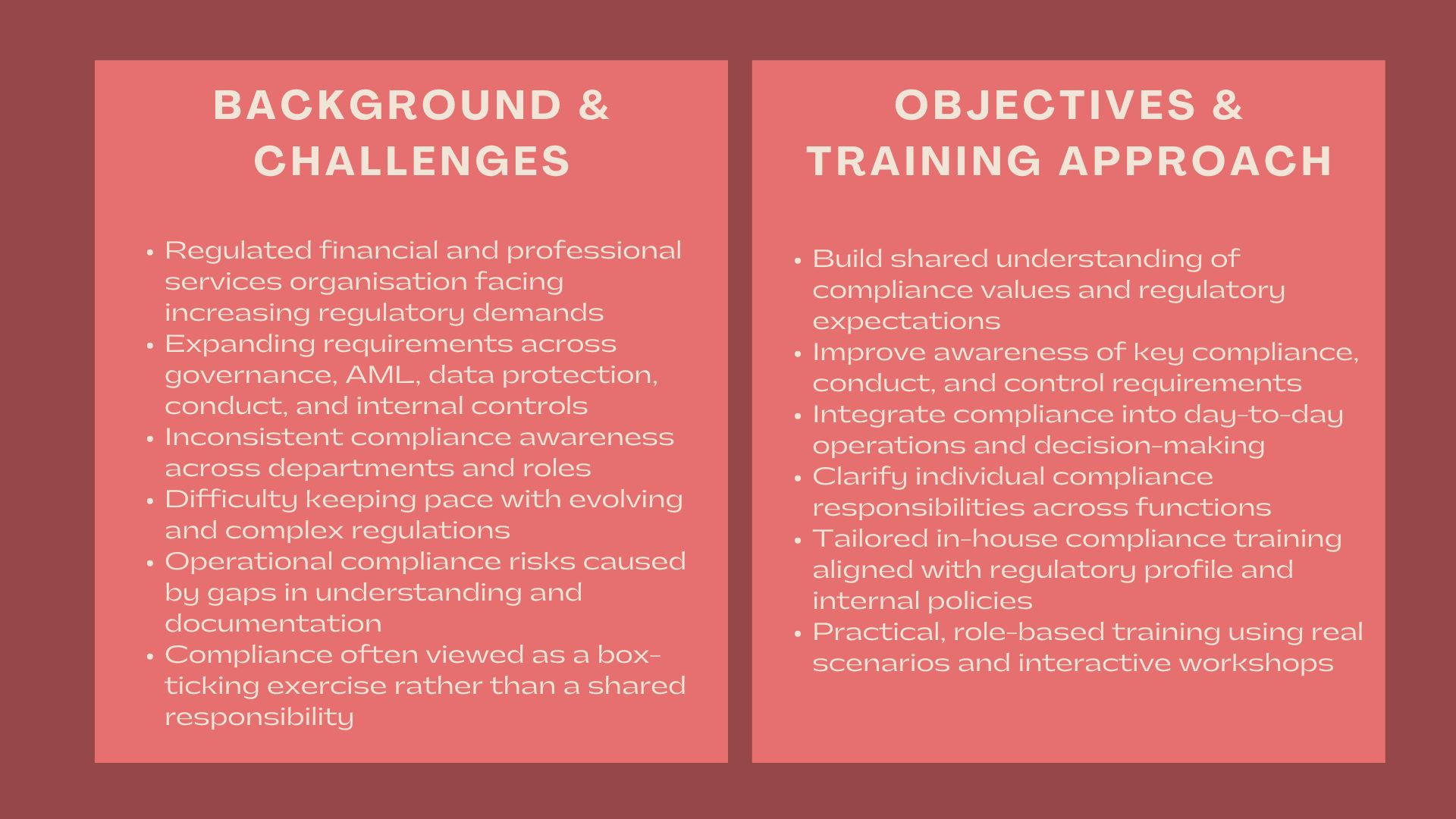
Issues and Challenges
The organisation encountered a number of problems which brought to focus the necessity of organised compliance training. Lack of uniform compliance awareness was one of the issues. Different functions had different degrees of knowledge on regulatory requirements and therefore inconsistent compliance procedures were applied by employees. The other challenge was the issue of regulatory complexity. The organisation was subjected to various regulatory frameworks and employees could hardly cope with a change in regulations, shifting instructions and developing demands. There were also risks of operational compliance. Violation incidents tended to have been linked to the lack of understanding of the processes, documentation habits, or escalation processes instead of deliberate misbehavior. Another situation noted by the management was that compliance is sometimes viewed as a box-ticking exercise of ethical and professional behaviour, as opposed to being part of it. This restricted risk identification and issue escalation. Lastly, the organisation aimed at having employees have a clear picture of their respective compliance responsibilities, such as the role their duties played in the overall compliance system of the organisation.Objectives
The main aim of the engagement was to enhance the organisational compliance capability by tailor-made training on compliance in-house. In particular, the organisation was to:- Develop a shared knowledge on compliance values and regulation needs.
- Enhance awareness on major regulatory and conduct requirements.
- Integrate compliance elements into the day-to-day operations.
- Enforce responsibility and intensification of practice.
- Foster the culture of compliance (strong and sustainable).