
Build your career with our industry-related courses. call us now at +65 9730 4250

Case Study: Retail E-Learning Services Enhancing Frontline Excellence and Operational Consistency Through Digital Learning

Background on Case Study Retail E-Learning Services

The nature of the business environment in which retail organisations operate is fast moving and very competitive in nature, and customer experience, operational efficiency as well as workforce capability are directly related to business performance. Customer contact, product familiarity, inventory, and sales goals are supposed to be handled by the frontline workers who must provide similar customer services at different branches.

Simultaneously, there is high employee turnover, seasonal employment, and consumer behaviour change at a quicker rate in the retail sector. The conventional classroom based training methods tend to be unable to accommodate these dynamics especially when the organisations have a large and geographically distributed network of stores.

In order to overcome these difficulties, one retail oriented organisation approached our firm to develop and implement an all-inclusive Retail E-Learning programme. The goal was to establish a scalable, pragmatic and engaging digital learning system that will assist in maintaining service delivery variables, speedy onboarding and reinforce retail operations throughout the organisation.
Case Study Retail E-Learning Services

Issues and Challenges

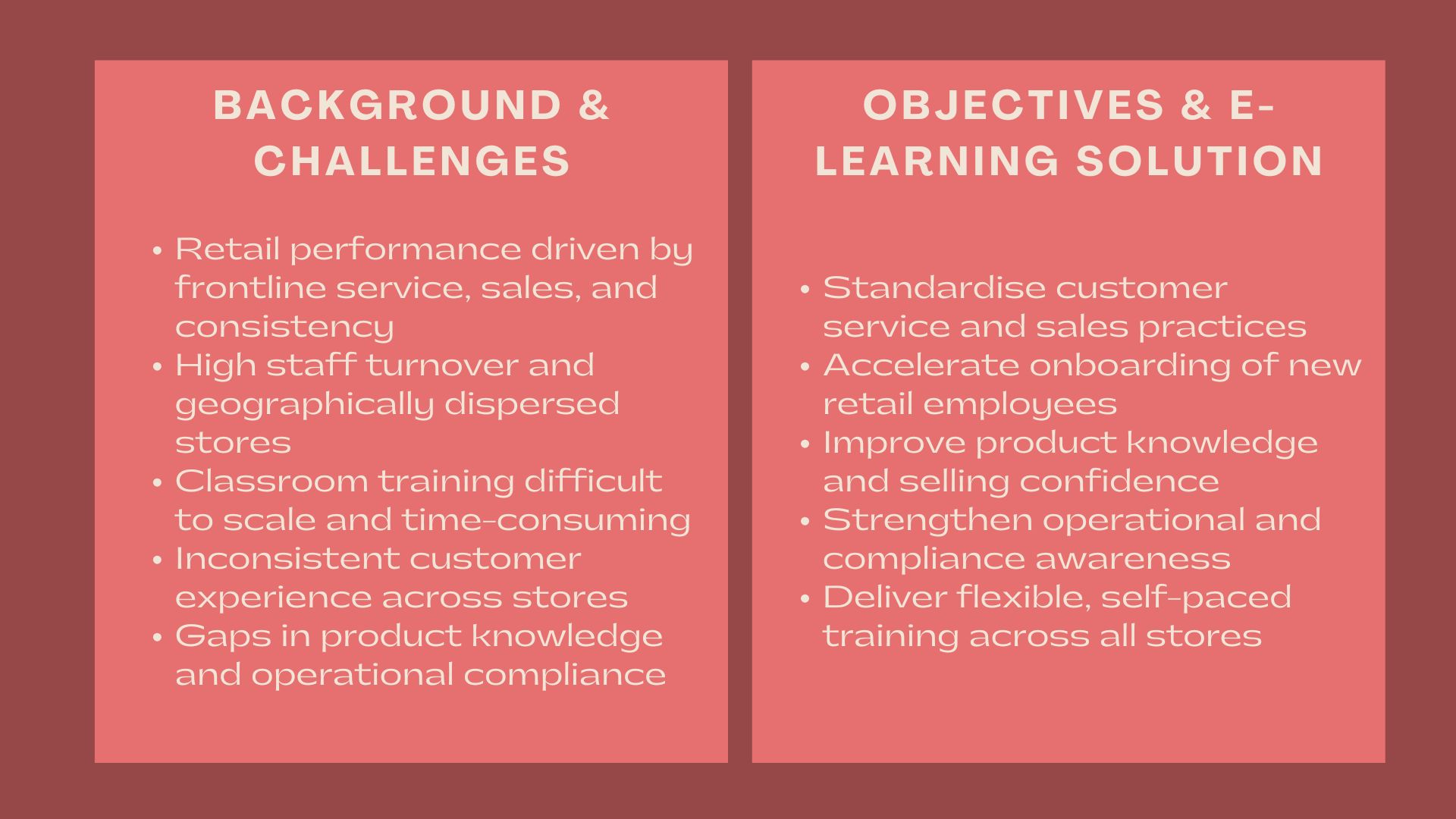
The organisation had a number of workforce development issues that are prevalent within the retail sector before the engagement.

Poor customer experience in different stores was one of the challenges. The variance in the quality and method of training led to the provision of different quality services and sales and the way the customers would be approached.

Onboarding efficiency was another challenge. The new employees needed to be trained quickly in order to be productive, yet the face-to-face training process was too time-consuming and hard to organize, especially around the busiest retailing times.

Sales performance was also influenced by product knowledge gaps. Such constant changes in product offerings, promotions and price changes made the frontline staff find it challenging to keep abreast of developments and therefore assured whenever they interacted with customers.

Another issue was operational consistency. The store procedures concerning inventory management, handling cash and prevention of losses were not strictly used in a consistent manner, which heightened the risk of operation.

Objectives

The interaction was to create a Retail E-Learning solution which would facilitate the enabling of workforce and least interference to the operations of a store.

Key objectives included:

  • Setting uniform standards in the area of customer service and sales.
  • Rapidizing the orientation of new retail employees.
  • Increasing product knowledge and selling confidence.
  • Improving operational and compliance awareness.
  • Providing training with flexible and self-paced delivery in all stores.

The programme had to be pertinent to the frontline employees, supervisors and store managers with a uniform learning platform.

How We Helped

Our Retail E-Learning programme was a modular programme designed to meet the requirements of the modern retail organisations.

The programme commenced with the basics of retail where the learners were introduced to the retail value chain, what customers expect, and why service consistency is vital. This established a similar vision of retail excellence throughout the organisation.

Further modules were on customer engagement and sales skills. Students discussed the methods of meeting customers, finding needs, overcoming objections, and closing sales, with the help of the realistic retail situation.

The programme incorporated product knowledge training, which helped the employees to learn about product features, benefits, and differentiation. This contributed to the establishment of confidence in the customer relations and contributed to the upsell and cross sell.

Operational training covered the most important processes in store operations i.e. inventory control, visual merchandising, cash handling and loss prevention. Learners were provided with an insight to a practical understanding of how these processes help in store performance and risk management.

Issues of compliance and conduct were incorporated throughout the learning experience, which strengthened ethical behaviour, data protection and company policies.

Learning Design and Delivery

The Retail E-Learning programme was made interactive, functional, and easy to use by the frontline retail employees.

The information was also presented in short and concise modules that could be taken in short sessions hence employees were able to study during the intervals between shifts or when the business was slow.

Learning was supported by interactive elements like quizzes, role-play scenarios and knowledge tests which promoted active participation.

The electronic, self-study format enabled the employees to get training at their own pace whereas the managers were able to ensure that the learning outcomes were the same in all the locations.

The modular structure also facilitated quick replacement meaning the organisation could quickly update their content with the new products, promotions, or if there were any changes in operations.

Outcomes and Value Delivered

As presented in this case study, Retail E-Learning Services can be important in creating scalable, consistent, and viable retail capability.

The employees gained better customer engagement, enhancement of product knowledge as well as confidence in sales interaction. The increased awareness of operations facilitated a more usual store process and risk less operation.

The organisational end of the solution was that e-learning offered a scalable and cost effective method of training. The organisation managed to provide consistent learning throughout its retail network to enable the creation of unified customer experience and greater brand presence.

Onboarding and consistent improvement was also enhanced by the programme through offering a defined learning process which could be extended as the business grew

services/case-study-retail-e-learning-services