How to Choose the Right eLearning Content Development Company for Corporate Training Success
Introduction to Elearning Development Company
The reason as to why Corporate Training is moving off Classroom to Digital
The contemporary digitally based business environment does not limit the training of corporations to classroom workshops or even the learning portals that are still. Companies are spending large sums on Elearning Content creation to create agile work forces, speed up the on boarding process, create regulatory compliance, and generate quantifiable productivity improvements. Digital learning provides scalability, consistency, and a view of data that cannot be made available by traditional models as enterprises expand regions and implement hybrid work structures.
The Price of bad eLearning Designs
A lot of organizations do not get any meaningful returns on the digital training initiatives even after substantial investment is made. Failure to select good vendors most of the time has led to poor content that is aesthetically appealing yet has no depth in terms of instructions, performance compatibility, and effect on business. Poor development of Elearning Content might result in low engagement and low knowledge retention, poor behavioral change- which will end up consuming time and budget.
The Benefits of Structured Content Development Checklist by ROI
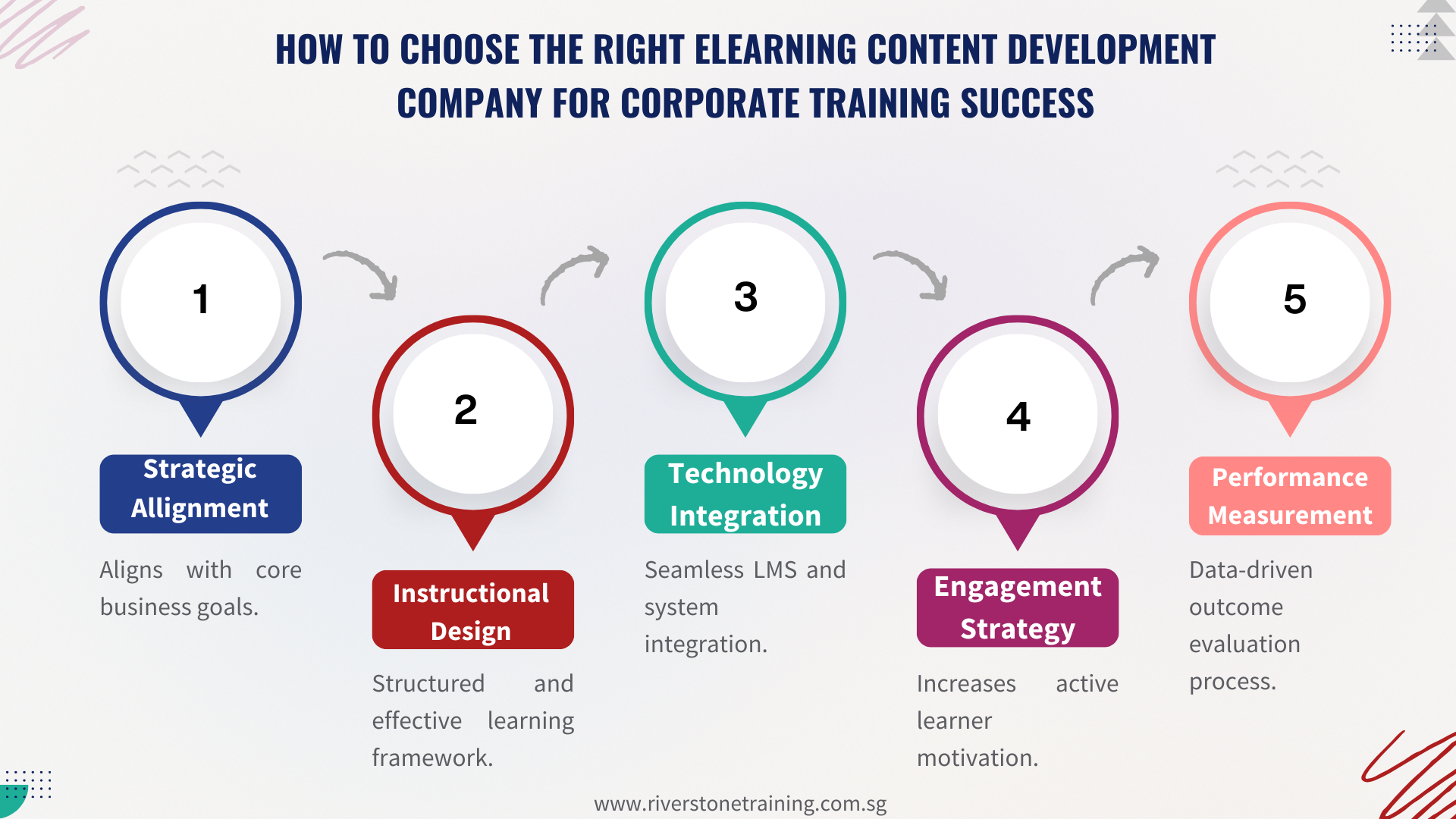
It needs a systematic appraisal system to choose the appropriate development partner. Instead of concentrating on price or the multimedia aspect only, organizations need to evaluate strategic compatibility, teaching approach, technological capacity, and the ability to scale-up on a long-term basis. An organized checklist also makes the Elearning Content development more of a result-oriented investment than a shallow digital conversion project.
What This Guide Will make L&D Leaders accomplish
This guide offers a systematic guideline in assisting HR and L&D leaders in the assessment and choice of the appropriate Elearning Content development company. Through the wide attention on strategic alignment and instructional excellence, organizations can achieve the maximum ROI of training and spur sustainable corporate development.
1. Specific Learning Objectives (SMART-Based)
Training- Business KPIs Fit
Organizations need to establish clear learning objectives depending on their business priority before contracting any vendor. No matter the purpose of minimizing compliance breaches, enhancing sales performance, or operational efficiencies, the objectives should be aligned to specific measurable KPIs. The alignment is something that a competent Elearning Content development partner will insist on prior to production.
Connections between Objectives and Measurable Outcomes
The objectives must be based on SMART principles; they must result in the observable change in the behavior. The vendors that are not interested in discussing performance metrics and only delivery content may not be strategic enough.
2. Audience & Learner Persona Analysis
Writing Ability, Work Position, Online Fluency
A good Elearning Content writing firm performs a thorough analysis of learners, and then, it designs solutions. Instructional strategy should be informed by workforce diversity based on their level of skills, job role and familiarity with digital skills.
Regional and Cultural issues
In the case of multinational organizations, vendors have to be able to show localization, multilingual, and cultural adaptability as well as standardized learning.
3. Training Needs Assessment (TNA)
Performance Gap Analysis
A consultative vendor starts with diagnostics of performance. Instead of introducing instant design solutions, they examine skills shortages, bottlenecks within the operations, and areas of non-compliance.
Stakeholder Interviews
Having good providers will involve departmental leaders and supervisors to know real life issues that hinder productivity.
Compliance vs Performance Training
Type differentiation between regulatory training and performance-enhancement programs is a guarantee of proper design priorities within the general Elearning Content development strategy.
4. Specified Success Measures & ROI Measures
Completion Rates
Completion metrics are also important measures of success, but not in themselves.
Knowledge Retention
To measure retention, the vendors should suggest mechanisms of reinforcement and post follow-up measurements.
Behaviour Change Metrics
Advanced providers combine performance based evaluation methods to evaluate application.
Business Impact Tracking
An established Elearning Content development firm provides models to relate learning participation to productivity, increase in revenue, or mitigation of risk measure.
5. Best Instructional Design Framework
ADDIE vs SAM vs Agile Learning Design.
Inquire of prospective vendors how they will develop it. Formalized models like ADDIE or agile models prove that there is planning and not an ad hoc production.
Adult Learning Principles
Problem centered learning, relevance, and application are part of proper instructional design. The suppliers are expected to explain how the development process of their Elearning Content can be used to apply the theory of adult learning.
Cognitive Load Management
Properly designed modules are free of information overload and deliver content in easy digestible and structured formats.
6. Content Structuring and Storyboarding
Logical Module Flow
Informed sequencing increases understanding and learning.
PSST Retention Tactic-Chunking
Divided material favors cognitive thinking and long term memory.
Development of Script and Storyboard
Professional vendors develop elaborate storyboards defining goals, graphics, interaction and evaluation prior to the actual development.
7. Microlearning & Micro Design
When to Use Microlearning
Microlearning especially works well in reinforcement and real time support of performance.
Creation of Bite-Sized High-Impact Modules
Small lessons with short-term focus enhance access and interactions.
Mobile-First Learning
The best Elearning Content development partner would be the one that would provide responsiveness in the hybrid employees and remote employees.
8. Elements of Engagement and Interactivity
Scenario-Based Learning
Applied decision-making skills are enhanced using simulated real-world situations.
Gamification
The use of achievement systems, leaderboards and points can boost motivation when used effectively.
Branching Logic and the use of simulations.
Interactive routes generate experiential experiences that enhance behavioral results.
9. Multimedia Optimization
Video, Animation, Voiceovers
Strategic multimedia should not be used excessively to the point of instructional intent being lost.
Image Priority and User Interface Readability
Intuitive interfaces are clean and minimize frustrations and navigation mistakes by learners.
Accessibility Standards
Accessibility guidelines provide the opportunity to be inclusive and be at par in the regulations..
10. LMS Compatibility Standards SCORM/xAPI Standards
Avoiding Disruptive LMS Implementation
The ability to be compatible with current LMS ecosystems eliminates the problem of integration.
Information Tracking and Analysis features
The high tracking functions enable organizations to transform into a performance system based on data through the development of Elearning Content.
11. Mobile Responsiveness and Telephone Testing
Hybrid Workforce Reflections
The inter-use feature is available to maintain continuity.
Offline Accessibility
Offline features are helpful to the field-based or remote teams that have low connectivity.
12. Artificial Intelligence and Personalisation
Adaptive Learning Paths
Personalization through AI improves the efficiency of the learner by reducing or increasing the difficulty of the content as the learner advances.
Intelligent Content Recommendations
Individualized suggestions are better at increasing interaction and long term retention.
13. Regulatory Conformity and Compliance
Industry-Specific Training as a Compliance Training
Vendors are expected to be conversant with industry specific rules.
Data Privacy and Security Issues
Cybersecurity measures are strong to guard the proprietary information and data on employees.
14. Pilot Testing and Feedback Lapses
Sample Learner Beta Testing
Pilot projects enable to test the quality of collaboration and the effectiveness of the instruction and then implement it at the full scale.
Continuous Improvement Process
Constant integration of feedback indicates the maturity and the adherence to quality by the vendors.
15. Ongoing Enhancement and Online Upgrades
Quarterly Review Cycles
Frequent content audits are relevant and accurate.
Analytics-Driven Enhancements
Passing of data is used to make changes to enhance performance.
Staying Relevant in Rapidly Shifting Industries
Updating processes are scalable ensuring long term sustainability of Elearning Content development investments.
Typical Blunders in eLearning Development in the corporate world
Businesses tend to choose their suppliers based on price only or the aesthetic design portfolio. Stuffing the modules with information, lack of attention to the engagement of the learner, not measuring the effect of the training, and using the one-size-fits-all strategies are the pitfalls. These errors compromise the long-term strategic importance of the Elearning Content development and diminish the long-term ROI.
Outsourced vs Internal Development Decisions
Determine the fit of internal competence to the complexity of needed learning transformation or the fit of an outside expert to provide strategic results.
Budget Allocation Issues
Invest in strategic alignment, instructional excellence and integration of analytics instead of investing in multimedia improvements only.
Extreme Due Diligence of an Elearning Content Development Partner
Although the 15 component checklist offers a systematic method of assessment, the best performing organizations do more. They not only look at what a vendor produces but also how the vendor thinks, plans and synchronizes the learning efforts with transformation of the enterprise.
In the case of How to Choose the Right eLearning Content Development Company to achieve Corporate Training Success, the decision-makers need to adopt a new way of thinking instead of transactional procurement, which is strategic partnership evaluation. The appropriate developer of Elearning Content cannot just develop modules; they add to workforce capability architecture.
Here are the enlarged evaluation dimensions which should be included in the vendor assessment process by L&D leaders.
Strategic Consulting Capability/ Vs. Content Production Vendor
Among the most significant differences during the process of selecting the vendor, there is the aspect of deciding whether a provider is a partner of strategic consulting or a production studio only. A vendor that is production oriented can exhibit a good talent in animation, graphic designing, multimedia development, and quick conversion of content. Nevertheless, in the absence of systematic performance diagnostics and business KPI alignment, even the visually striking modules do not always have a quantifiable effect.
By comparison, when an Elearning Content development partner is mature, the engagements start with structured consultation and discovery phases. Instead of instantly talking about pictures or timeframes, they explore the problem behind the business. They determine the exact performance issue that the organization is trying to address, what types of business metrics should improve in case of a successful training, what exactly the organization needs to change behaviorally and how the results will be measured, in many cases, it can be 60- or 90-day post-deployment assessments to prove the effective use of the training in practice.
The key things that organizations that consider How to Select the Right eLearning Content Development Company as a Key to Corporate Training Success need to do is to focus on vendors who question assumptions, demand access to operational data and suggest structured diagnostic workshops before development will start. This participatory model will reduce the expensive misalignment and make sure that training programs directly contribute to the strategic goals as opposed to mere provision of digital content.
Level of Instructional Design Proficiency
The conceptual basis of successful Elearning Content development is instructional design. Most vendors would say they are instructional experts, but not all of them are rigorous in theory or proficient in application. The Learning and Development leaders are supposed to check on the involvement of certified instructional designers in carrying out the project as opposed to depending on multimedia developers.
Evaluation must not be limited to the demonstration of the final products. Organizations need to review the process of learning objectives development, the use of structured frameworks using SMART criteria or Bloom Taxonomy, and the validation of the objectives prior to their development. Moreover, it is recommended that vendors clearly explain how they can handle cognitive load to avoid information overload and how the process of reinforcement can be implemented into modules through spaced repetition and retrieval practice.
In the framework of the article How to Choose the Right eLearning Content Development Company to Corporate Training Success, the decision-makers are more likely to demand sample storyboards, learning architecture maps and assessment blueprints as opposed to using polished demos solely. Good vendors are able to justify why a certain format of interactions was chosen, how adult learning principles were taken into account in terms of the structure, and how assessment analytics could be related to quantifiable business results. Failure to explain design rationale is a bigger indication of low strategic maturity.
Scalability and Ready to Deploy Enterprise Readiness
Corporate learning programs are often initiated as pilot projects but have to be expanded to be departmentally, regionally, and even globally wide. The capability of a vendor to facilitate an enterprise-level growth is thus a critical factor when it comes to evaluation.
Scalable Elearning Content development needs modular architecture which allows any content to be updated without complete redesign. Vendors should also show an organized process of multilingual localization to go through the cultural and regulatory disparities that will not alter the basic messaging. The fact that it has cross-device compatibility and is easily integrated with a Learning Management System is also a sign that it is technologically ready to roll out at a large scale.
A company that is evaluating How to Choose the Right eLearning Content Development Company to succeed in corporate training should also look at the experience of the vendor in dealing with enterprise implementation. Case study of global roll outs, complicated compliance societies, or multi-region adaptation are indicative of increased maturity in operations. Scalability is not technical but is a strategic concept. The correct partner expects a growth in the organization and builds flexible learning framework initially.
Measures of Learning and Data Analytics
Corporate learning now requires quantifiable, statistical results. The vendors should show how analytics will be incorporated in their Elearning Content development process. The measurement must go beyond the completion rates and incorporate more profound performance measurements.
Extensive analysis frameworks integrate knowledge retention analytics, application-based tests that measure skill transfer, behavioral performance metrics, and ROI correlation metrics, which align learning interventions to ones that create improvement in the business. Companies that are serious about How to Choose the Right eLearning Content Development Company to be successful in Corporate Training should require examples of analytics dashboards and reporting models utilized in earlier project implementation.
Interestingly, advanced vendors use standards like SCORM and xAPI to record the data about the granular interaction with learners. They help organizations to transform the participation measures into practical performance knowledge. In the absence of solid analytics integration, digital training will be a standalone activity that cannot be linked to quantifiable business results.
Change Management and Adoption Strategy
The most advanced Elearning Content development project would fail in case of employee resistance. Implementing it successfully thus involves structured change management support.
Progressive vendors offer internal communication toolkits to generate awareness, leadership briefing information to clarify executive messaging, manager enablement guides to reinforce frontline, and participation promotion campaign strategies. Companies assessing How to Select the Right eLearning Content Development Company to get successful in Corporate Training should seek to know whether the vendors have knowledge of cultural dynamics and psychology of adoption.
Digital learning does not only mean technical implementation. It involves behavioural compatibility, support by leaders and periodic approval to achieve persistence and quantifiable outcomes.
Model of Vendor Transparency and Collaboration
The long-term relationships rely on information sharing, well-established schedules, and systematic revisions. Professional Elearning Content development firms set clear milestones of the project, review checkpoints that are set, pricing frameworks that are disclosed, and regular feedback processes.
The organizations must be careful when the vendors give them unclear delivery schedules or unclear scope specifications. In the course of negotiations about How to Choose the Right eLearning Content Development Company to Achieve Corporate Training Success, transparency in collaboration procedures is the sign of discipline in operations and maturity of project management. Open cooperation helps to eliminate misunderstandings and shorten the approval process and increase the level of responsibility between the client and the provider.
Innovation Preparedness and Future-Proofing
The corporate learning ecosystems are dynamic, especially with the advent of the age of AI-based personalization, immersive simulations and adaptive learning engines. The selection of the vendor should thus be with consideration of innovation strategy and future-readiness.
Elearning Content development partners, who are future-oriented, invest in artificial intelligence, adaptive learning algorithms, immersive simulation, and data-driven and performance optimization frameworks. They do not just use the old templates but continuously enhance the capabilities in accordance with the market evolution.
When assessing How to Choose the Right eLearning Content Development Company to succeed in Corporate Training, organisations need to ask questions regarding research initiatives, technology partnerships as well as long-term innovation road maps. Future-proofing is a method of making certain that the current investment in learning can be leveraged by the business in the future.
Risk Management Via Due diligence of vendor
The choice of an incorrect vendor creates business, financial, and reputational risks. The typical risks are lack of time to meet the deadlines, budget, quality of instructions, data vulnerability, and post-launch support.
Any systematic procedure to How to Select the Right eLearning Content Development Company to Success in Corporate Training should include the due diligence of the vendor. This will cover the analysis of financial stability, client reference requests, long-term retention rates, and cybersecurity measures. Conducting extensive due diligence protects the organization investment and minimizes the implementation uncertainty.
Value vs. Price Cost Structure Evaluation
There is a lot of differences in the pricing models in the Elearning Content development industry.
Some are paid on a per-module, others on a per-learning hour, and others on a subscription.
Although budget is a factor to be considered, vendor should not be chosen based on the cost as it nullifies ROI in the long run. Low-cost vendors can reduce on instructional rigor, analytics integration or scalability.
Companies contemplating the selection of the appropriate eLearning Content Development Company to ensure a successful corporate training strategy should look at the aggregate worth as opposed to the initial cost.
Premier digital training enhances performance consistency, onboarding reduces onboarding and compliances risk is minimized, all of which are benefits that exceed the initial development expenses.
In-house vs. Expertise Externalized
One of the strategic issues when selecting a vendor is whether internal capabilities should be developed or outsourced to a special vendor. Internal teams can provide a rich organizational knowledge, quicker response cycles and direct access to stakeholders. Nevertheless, third-party Elearning Content development providers tend to offer highly sophisticated instruction design expertise, greater industry expertise, technology expertise, and project management infrastructure.
In the case of How to Choose the Right eLearning Content Development Company to be Successful in Corporate Training, leaders need to consider the internal bandwidth, technical sophistication and strategic priorities. The hybrid models (a combination of internal control and external implementation) provide the best outcomes in most situations as both methods have their advantages.
Potential of Long-term partnership
Corporate training is not a short term project. With the changes in industries, skills of the workforce must be updated regularly and increased. A trusted Elearning Content development firm must be able to establish long-term partnering period as opposed to operating on short-term project deliveries.
This involves regular content refresh, regulatory changes, and adding new learning modules and regular performance analytics reviews. Companies appraising the question of How to Select the Best eLearning Content Development Company to succeed in Corporate Training must consider those vendors that are eager to cooperate with the company on a long-term basis.
Relationships built over the long term lead to a better comprehension of organizational culture, strategic priority, and workforce dynamics, and more highly specialized and effective learning solutions with time.
High-level Reflexivity: AI and Personalization
The concept of artificial intelligence is transforming digital learning ecosystems essentially. The vendors with the ability to incorporate AI in the development of Elearning Content have better strategic value.
The AI-driven capabilities can be an adaptive sequence of content based on the learner progress, automatic generation of assessment, creation of a personalized reinforcement module according to the capability gaps, and predictive performance data based on the capability needs. At the point when the decision is made about the way to select the appropriate eLearning content development company in order to achieve success in corporate training, organizations must consider the implementation of AI framework and data governance policies.
Personalization improves the engagement, competencies gained faster, and the measurable ROI owing to the alignment of the course of learning with the specific performance profile.
Measuring Post-Implementation Success
The evaluation of the vendors should not just be done at the end of the project. The measurement of efficacy after the launch is critical to guarantee continual improvement. Successful Elearning Content development programs monitor the behavioral application levels, quantifiable performance measures progress, compliance and reduction of incidents, and correlation of revenues where feasible.
Review meetings between client and vendor quarterly help in continual optimization on the basis of databases. Companies, which believe in How to Choose the Right eLearning Content Development Company to Corporate Training Success, do not consider evaluation as an end goal but as a strategic process that should be done throughout.
Making Corporate Training a Strategic Performance Engine
Finally, the correct choice of a vendor is what will make the difference between the digital learning as an inactive storage of content or a performance catalyst. Strategic Elearning Content development is congruent with business KPIs, workforce change efforts, innovation roadmap, and enterprise risk management approaches.
Through rigorous and planned evaluation standards, organizations can go beyond the surface-level digital conversion ventures. They create intelligent learning systems that can respond to market volatility and technological change to become a performance engine that can be measured and sustained with corporate training.
Conclusion
The choice of appropriate Elearning Content development company is a strategic move that defines the effectiveness of corporate training and the quantifiable business performance. These 15 systematic items of this guide give a holistic assessment framework that includes aspects of strategic alignment, instructional design, technological capability and long term sustainability.
Organizational planning, KPIs, and design of digital training based on behavior when given priority enable organizations to become a potent performance engine. Auditing the possible partners against this checklist will allow corporate leaders to make sure that Elearning Content development turns out to be a driver towards the increase in productivity, compliance, and sustainable competitive advantage.