
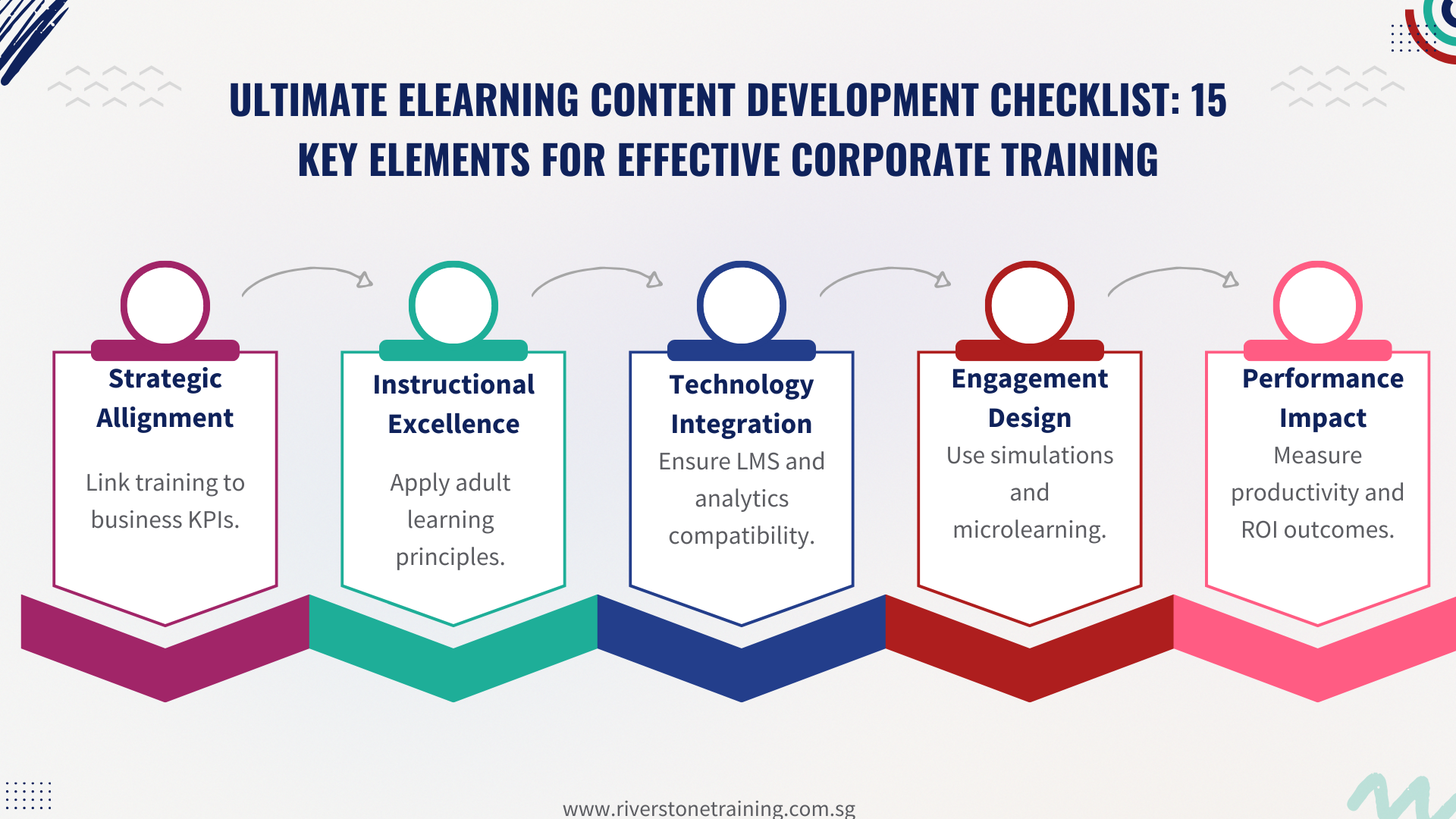
Ultimate eLearning Content Development Checklist: 15 Key Elements for Effective Corporate Training
Introduction to Elearning Content Development Checklist
The reason and importance of why Corporate Training Is Moving out of Classroom and into Digital
The last ten years have seen the corporate training undergo a very great transformation. As much as traditional classroom-based sessions are invaluable in terms of face-to-face interaction, they are no longer adequate to support the needs of a global and hybrid workforce as well as digitally connected workforce. Scalable, flexible and data-driven learning solutions have been identified as what organizations are now requiring to be deployed across regions and time zones without hampering the productivity.
This change has given significance to the systematic Elearning Content development. Digital learning provides the consistency of messages, standardized delivery of compliance and measurable performance tracking, which are challenging to attain under the purely instructor-based training models.
The Price of eLearning a Bad Design
Although most organizations have invested more in digital training, they do not realize substantial results. Unstructured programs tend to lead to low participations, poor knowledge retention and little behavioral changes. Employees can take courses without knowing how to put them into practice.
The poor development of Elearning Content results in squandered budgets and lack of confidence of the workforce alongside the lack of return on investment. It may even raise the compliance risks in regulated industries.
Improve Your ROI with help of a Structured Content Development Checklist
The overall checklist will guarantee that each digital training program is undertaken in a systematic manner- strategic alignment through quality assurance. Organizations can be in a position to enhance training effectiveness and quantifiable results by incorporating performance measures, instructional science, and optimization of technology.
The development of Structured Elearning Contents will turn the training into a strategic business driver, rather than a cost center.
The L&D Leaders Influence that this Guide Will assist in
This guide provides 15 important aspects that Learning and Development leaders can employ in like designing, reviewing or streamlining digital training programs in their companies. With such a framework, organizations are able to improve productivity, maintain compliance and improve long term workforce competency.
1. Specific Learning Objectives (SMART-Based)
Effective training programs should start with specific learning outcomes that are directly linked to the business KPIs that are measurable to ensure that there is a meaningful contribution to the performance of the organization, and they should be SMART defined specific, measurable, achievable, relevant, and time-based, so that expectations are clear, the progress is trackable, and the accountability is structured, and well-developed SMART goals will also provide a guide in the development of Elearning Content since it will help avoid content drift, redundant theory, and excessive focus on the theoretical aspects of the program, whereas it will
2. Audience Persona Analysis & Learner Persona Analysis
To create the effective e-learning material that will comply with the knowledge level, digital skills, and job-related responsibilities of the employees and will not cause cognitive overload or skill deficit, it is crucial to understand the target audience. In the case of global organizations this analysis will also have to be weighed against cultural and regulatory differences to make sure that communication is legally, culturally and even in line with the core strategic message of the organization.
3. Training Needs Assessment (TNA)
Formal Training Needs Assessment provides a clear point of comparison between actual and expected levels of performance by systematic analysis of the gap in performance such that training programs are focused on real weaknesses in operations not on perceived weaknesses or generic development objectives. The inclusion of stakeholder interviews with the managers and department leaders will offer applied feedback on the issues within the workflow and barriers to productivity that could be removed, and the difference between the compliance-based training and performance-based improvement programs will allow the organizations to prioritize the instructional design methodologies and measurement plans based on whether it is the regulatory compliance or measurable improvement in the operation.
4. Specified Success Measures and ROI Indicators
It is essential to specify measurable success indicators that allow determining the success of training programs, starting with completion rates which provide preliminary information of the level of engagement and further to knowledge retention tests done by evaluations and post-training tests to understand the large-scale understanding. Behavior change measures, as observed by monitoring on the job performance, show whether learning has been implemented into practical use in the work place and the greater business impact measures, such as increases in revenue, productivity, efficiency or even reduced errors, could give the means by which Elearning Content development program impacts the organization directly towards its performance and profitability.
5. Effective Instructional Design Framework
The selection of an appropriate instructional design model (ADDIE due to its structured and systematic nature, SAM due to the iterative prototyping, or Agile due to its quick and responsive development) can guarantee systematic and responsive development, which works according to the business needs, taking into consideration the adult learning principles prioritizing relevance and practical implementation, which should be accompanied by the effective management of cognitive load that will eliminate redundant information, improve engagement, understanding, and retention.
6. Content Structuring and Storyboarding
A well constructed training material must have a logical flow that takes the learners through the basic knowledge to the practical application in a coherent and natural order hence aiding in gradual acquisition of skills and boosting of confidence. Comprehensively splitting the material into manageable chunks using chunking techniques enhances the level of memory consolidation and lessens the cognitive load, and extensive scripting and storyboarding of the material establishes coherence and understanding across the whole lifecycle of Elearning Content development.
7. Microlearning & Modular design
Microlearning and modular design strategies are specifically useful in the context of performance support, refresher courses, and reinforcing skills since those are brevity-focused and narrow-themed, making them suitable to the conditions of the fast-paced environment of the contemporary workplace. Brief, real-world training blocks improve access and retention rates because these segments enable employees to consume training in digestible bites and modules designed to be mobile-first ready native to mobile devices are necessary to support a hybrid and remote workforce model with a learning experience that is flexible and device agnostic.
8. Interactivity and Engagement Factors
The interactive design components play a very important role in improving the level of engagement of the learners and the transfer of knowledge and the scenario based learning makes the learners to be fully engaged in the real life scenarios at the workplace, which is good in developing decision making skills and critical thinking skills. Gamification techniques such as points, progress markers and milestones of accomplishments boost motivation and continued engagement, and by simulating and splitting logic, learners can study the impacts of their decisions in safe online worlds, furthering experiential training and practice.
9. Multimedia Optimization
Responsive Instructional design Multimedia Incorporation Multimedia integration that involves videos, animation and voice over by professional guidance can be used with great understanding to improve understanding and interaction, whereas graphical hierarchy and user-friendly interface design can be used to simplify navigation and usability. Accessibility and compliance with the regulations, such as WCAG, guarantee the enhanced accessibility to learning among all employees and address regulatory measures associated with equal access and digital inclusiveness.
10. LMS Compatibility SCORM/xAPI Standards
Also, making sure that an LMS can be compatible with SCORM or xAPI standards helps effortlessly integrate the system and avoids technical issues at any point of implementation, which helps the rollout process to be smooth and ensure a uniform learner experience. The developed analytics and data-tracking tools integrated into the current LMS systems offer practical insights into the engagement patterns, knowledge development, and performance enhancement tendencies that allow organizations to base their decisions on data and optimize their learning approaches.
11. Mobile Responsiveness and Testing
Mobile responsiveness is essential in enabling the hybrid workforce setup, where workers need to access training content with various devices and geography, and extensive testing on platforms guarantees the same level of performance and functionality. Offline access capabilities also make it easier to be more inclusive because field workers or those with limited internet access can access different learning materials without being interrupted, a factor that makes them maintain their productivity and continuity in various work environments.
12. Artificial Intelligence and Customisations
Artificial Intelligence improves personalization of the training process by adapting learning paths to the unique aspects of performance, advancement, and level of a particular learner, so that high-performing learners are not overly challenged but that lower-achieving learners receive reinforcement. Smart content recommendation engines also enhance interaction and efficiency by advising the learners on the pertinent modules in accordance with their roles, areas of performance shortfalls, and career advancement goals.
13. Adherence, Regulatory Compliance
The training programs should be in line with the industry-related regulations and sector law requirements so that there can be adherence to the policies and organizational risk is also reduced as far as there are very stringent policies in certain industries where lack of compliance can lead to severe repercussions. Strong data privacy and security controls will also prove critical because learner information security will enhance trust in the organization, promote ethical data handling, and compliance with regulatory frameworks on digital information protection.
14. Feedback loops and Pilot Testing
The use of feedback loops and pilot or beta testing with representative groups of learners before full implementation will enable organizations to determine the usability problems, lack of understanding and technical inconsistencies at an early stage of the development process. The process of structured review using the feedback of the participants can lead to the implementation of iterative improvement, which means that revisions can improve the clarity of the instruction, the satisfaction of the learners, and the ultimate result of the measurement of performance before the implementation at large scale.
15. Constant Quality and Updates
To preserve the effectiveness in the long term, it is necessary to create consistent review periods (i.e., quarterly reviews) so that the content of the training is up-to-date, relevant, and corresponds to the dynamically changing business strategy and industry standards. The use of analytics-based improvements and predictive analytics data helps to constantly improve, and timely updates in connection with the development of technologies, changes in the regulations and the market conditions help to make learning programs to be competitive and strategically useful in the fast-changing industries.
Typical Corporate eLearning Development Follies
The cramming of slides with too much information minimizes memorizing and interaction. Failure to consider the interaction with learners results to passive consumption and not application. ROI evaluation is impossible in case post-training performance is not measured. Creating universal content does not consider diversity among audiences and is counterproductive.
It is these traps that should be avoided to enhance the overall Elearning Content development results.
How to apply this Checklist as a Corporate L & D Leader
In order to turn this strategy into an implementable vendor assessment system, organizations must appraise the external development partners with the fifteen defined factors to make sure that the processes are organised and aligned with the performance outcomes that are measurable and at the same time compare internal capabilities to outsourcing alternatives in terms of instructional knowledge proficiency, scale of technology usage, governance capability, and sustainability potential and prioritise budgetary allocation consideration by focusing on strategic alignment with business KPIs, professional instructional design, and strong analytics capabilities so as to maximise ROI and not putting disproportional emphasis on surface-level
Its Enlargement of Strategic role of Elearning Content Development in the Modern Enterprises
Although the 15 key elements offer an organized checklist, they become truly valuable when they are viewed as a set of interconnected elements of a larger performance ecosystem by organizations. Subjective Elearning Content development does not exist in the vacuum; it interrelates with the talent management, operational strategy, compliance governance and digital transformation efforts.
In performing organizations, workforce planning models incorporate digital learning. Instead of responding to skill shortages when performance decreases, organizations follow systematic training models to predetermine the needs in terms of capabilities. This proactive strategy shifts the training process to a reactive response to the intervention to a predictive business tool.
Strategic Alignment: Getting Beyond Learning for Learning Sake
One of the areas where corporate training fails is that the training is not directly aligned to the business. Most organizations implement learning programs due to the implementation of such programs by their competitors or due to the fact that regulations have stipulated that there is need to update learning programs periodically. Nevertheless, a well-designed content cannot yield quantifiable returns unless it is strategically well-defined.
Elearnment Content development Structured Elearning Content development is initiated by a question:
What is the quantifiable business issue that we are addressing?
For example:
- In case the customer churn is increasing, do the underlying cause of this be service inconsistency?
- Workflow inefficiencies might be a contributor in case operational costs are rising.
- In case the violations of compliance are increasing, do the employees misinterpret the updates on the regulations?
- Organizations that align digital learning goals with real performance measures will be accountable and have to prove ROI.
In-depth: Performance-Based Learning Objectives
Digital training is anchored on SMART-based learning objectives. But developed organizations will go ahead to incorporate layered objectives.
- Tier 1: Knowledge Objectives
Establish the knowledge to be acquired by learners. - Tier 2: Behavioral Objectives
Establish what should be different among the learners. - Tier 3: Performance Objectives.
Establish the effect of such changes on quantifiable business results.
As an example, in a sales environment:
- Knowledge: Learn to position new products.
- Behavior: Use consultative questioning in the meeting with a client.
- Performance: Grow the average deals size by 15 per cent in a quarter.
Such stratification enhances the development of Elearning Content, which guarantees that the design of instruction is translated into operational effectiveness.
The Leadership Sponsorship and the Success of Training
The most advanced digital learning ecosystems cannot bring any meaningful outcomes without the observable and sustained leadership support. Executive sponsorship implies that training is not an administrative pointless activity but a strategic organizational focus. The involvement of senior leaders in promoting digital learning programs sends a message to employees that they perceive being engaged as part of the performance requirements and career growth over the long term.
Reinforcement of leadership may be in a variety of forms. Belonging of training accomplishment and demonstration of applied skills to performance review structures forms accountability. When executives are viewing learning analytics and operational KPIs, training is incorporated into strategic dashboards, and not available in separation as an HR report. A culture of applied learning is also enhanced by publicizing the employees who demonstrate successfully applying the recently learnt competencies. In situations where the leadership involvement coincides with the organized Elearning Content creation, the adoption levels grow by far since the training is associated with the enterprise performance, instead of being a minor initiative.
Behavioral Design: How to engage the learner
Authentic interaction is not limited to quality of visual designs or gamification. The concept of sustainable engagement is based on the psychological relevance, applied realism, and behavioral alignment with workplace realities.
Contextual Relevance
Adult learners become more interested when they see training material as a real-life example of a professional situation. Instructional design must be capable of replicating real workflow systems, simulating actual customer interactions, dealing with realistic compliance challenge, and time-sensitive decision-making environments. The learners are able to practice their decisions in virtual environments which are secure because the learning environments reflect operational complexity. This realism is such that Elearning Content development creates applied competence as opposed to abstract theoretical acquaintance.
Autonomy and Choice
Intrinsic motivation is greatly promoted through autonomy. When offered use of adaptive learning paths, high performing employees may skip basic content and move straight to higher levels whilst others may be reinforced where needed. This flexibility is sensitive to the level of personal competence and it minimizes frustration that comes with one-size fits all design. Not only is personalization efficient but it enhances satisfaction of the learner and engagement in the long term.
Cycles of Spaced Reinforcements
The studies on memory formation and retention in cognition psychology have continually shown that spaced repetition reinforces memory formation and minimizes the erosion of knowledge. As opposed to having a one-time training event, organizations ought to develop reinforcement cycles that are applied at premeditated intervals. As an example, the employees can take a core module on the first day, and a brief micro-quiz at the end of a week. Fifteen days of refresher of applied judgment after thirty days and ninety days of performance-based assurance after ninety days are also adopted. Integrating this framework of reinforcement into Elearning Content development maintains competency and averts the short-lived nature of competency when isolated training sessions occur.
Operational Continuity and Advanced Instructional Precision
The continuity of the operations is especially successful in microlearning modules as their limited duration of three to seven minutes enables the employees to avoid the focus of targeted refresher courses between the meetings or task cycles without interfering with the regular workload and slowing the productivity. This natural inclusion into day-to-day processes will make the process of learning more of a backup system, as the reinforcement of knowledge will take place automatically as part of the workflow and training will become a supporting force not an operational disruption.
Concurrently, superior organizations enhance the effectiveness of their impact by refining the principles of instructional design beyond just choosing a pre-existing model of development, i.e., ADDIE, SAM or Agile, and, instead, taking care of intentional accuracy in the sequence of content, cognitive load management, and behavior reinforcement to achieve optimal levels of retention and meaningful transfer of learning onto workplace performance.
Optimization of Cognitive Load
Learners are overwhelmed with too much information and this reduces retention. Good design can reduce the time of modules, prioritize the key ideas and use visual effects to explain complicated information. It should cut down redundant narration and be able to do away with redundant material to retain cognitive clarity. The Elearning Content development offers long-term attention and understanding by using a trade-off between information density and graphic simplicity.
Assessment Design Strategy
The methods of assessment should not be based on mere multiple choice questions. Best practices include scenario-based decision exercises which simulate workplace dilemmas, immersive simulations of applied judgment, pensive prompts which foster critical thinking and quizzes which are directly connected to observable performance measures. This shift to active regurgitation to enacted assessment is very robust in transferring behaviour and practical proficiency.
Technology Integration: Converting Data to Strategic insight
Learning Management systems have advanced over the years to be more performance intelligence-centered than the mere-tracking systems. Contemporary LMS settings gather piecemeal data that might be used in strategic decision-making.
The metrics that are monitored with advanced analytics include the average time spent on each module, the places at which learners dropped off, the performance trends on assessments, and how often a learner accessed a particular content block. Put into operational dash boards, this data can bring about patterns that are greater than participation metrics. In the case, when a particular training module is associated with quantifiable productivity increase, the leadership can use the design arrangement of that module in the other departments. By so doing, Elearning Content development can be a source of actionable strategic insight as opposed to a content delivery mechanism.
Introducing AI-enhanced personalization and predictive learning, Google as a first-mover in the field of robotics must take a leap to the next level of targeting and impact with digital training, as artificial intelligence allows learners to have adaptive learning paths that constantly monitor their feedback and modify the content level appropriately, rewarding the high performers with further challenges but offering extra support and targeted reinforcement to the underperformers to be more productive and reducing frustration rates, the predictability of skill gaps analyzed across the departments will help the leaders implement certain training modules before they adversely affect organizational performance, and
Quality Assurance as a Strategic Protection
The concept of quality assurance with regards to digital learning goes way beyond the concept of proofreading or visual checks. It includes a validation of instructional accuracy with the purpose of validating content integrity, technical compatibility testing between devices and platforms, access compliance reviews to help ensure inclusive participation, and data privacy audit to help protect sensitive information.
The failure in any of these areas compromises the credibility of the Elearning Content development efforts. Representative piloting of potential learners prior to full implementation is a priceless source of usability data, can help reveal gaps in understanding, and minimizes the risk of implementation. Organized quality assurance prevents organizational reputation as well as improving user experience.
Training on Compliance: Making It An Engagement Not an Obligation
There are usually negative perceptions about compliance modules as monotonous and boring necessities but with a proper approach and design, they can become meaningful and interesting learning exercises that can help not only to maintain personal awareness but also to be more accountable. Rather than just enumerating the laws, scenario-based compliance training makes use of interactive simulations to show the actual effects of not following the laws, and employees are given the chance to work through real ethical problems and regulatory scenarios reflecting the workplace reality, which enhances judgment and responsibility as well as realistic comprehension of the policy requirements.
Moreover, microlearning is also an efficient tool of reinforcing as it encompasses brief refresher courses to update regulatory knowledge and make it available without overloading learners with the information load. Mitigating compliance risks and at the same time increasing employee engagement through periodic, targeted updates to workflows help organizations reduce compliance risks and make regulatory compliance an active and ongoing behavior instead of an annual compliance requirement.
ROI Measures: More Than Completion Rates
there is not much information about actual training effectiveness in completion rates. Advanced ROI assessment models assess the performance delta analysis through comparing the performance measures before and after training. Calculations of cost avoidance can measure the decrease in the error costs or the penalty costs of compliance. Productivity gain metrics are used to measure the improvements in operational efficiency, and the data on employee retention might indicate the higher engagement due to the satisfactory skill development.
Caught in the middle By integrating intensive measurement structures into Elearning Content development at the very beginning, organizations prove the financial impact instead of shallow engagement rates.
Maximum Impact Strategy of Budget Allocation
Strategic budgeting focuses on high impact elements that will have direct impact on performance outputs. Investment into the expertise of instructional design guarantees conceptual rigor and the adherence to the principles of instructional science. The development of scenarios simulation contributes to the applied realism, which improves behavioral transfer. The integration of analytics facilitates the validation of ROI, whereas mobile optimization ensures the availability of accessibility to the distributed workforces.
The problem that can arise is investing too much in superficial multimedia upgrades with no strategic consideration, they will create appealing modules but with minimal ROI in the long run. There is a balanced distribution between strategic design, reinforcement architecture, analytics, and accessibility making the impact sustainable.
The culture of the life-long learning will not be built by only using digital tools, the sustainable digital change should be supported by a positive organizational culture that will help make training an essential growth experience instead of a mandatory task, inspire a growth mindset at all levels of the workforce structure, and incorporate the learning process right into the daily workflow through microlearnings links embedded within operational systems, making the content more accessible, contextually relevant, and naturally aligned with the daily work patterns, that the Elearning Content development would be organically integrated as an integral part of the performance improvement instead of being seen as an external and disrupt
Typical Strategic Oversights to Steer clear of
Even formal frameworks would not work when implemented without strategic discipline. Introducing online training without any apparent executive sponsorship undermines perceived significance and participation. Failure to consider post-launch analytics denies organizations the chance to determine areas of optimization. The view of training as a one time project instead of a sustained ability building process compromises retention. Failure to engage in systematic feedback feedback restricts responsiveness and enhancement.
These omissions can be prevented to enhance the effectiveness and credibility of the Elearning Content development programs in the long run.
Corporate Digital Training Future-Proofing
Due to the dynamic nature of industries, digital learning ecosystems should be dynamic and technologically strong. Immersive simulation technologies that are simulating high-risk environments, AI-based coaching assistants that offer personalised reinforcement, live performance dashboards that combine learning and operational performance, and personalised competency mapping systems that predict skill gaps are emerging trends that affect Elearning Content development.
Companies that incorporate architectural flexibility in the framework of learning design will be competitive in the unstable markets. Flexibility is the key within the framework of which digital training is going to be in tandem with technological innovation as well as the workforce demands.
Developing the Strategic Worth of the 15-Element Checklist
The 15 items checklist is not only a development guide but also an in-depth framework audit of an organization. By comparing the programs in place to every component, Learning and Development leaders will be able to detect the gaps in the instructional rigor, analytics integration, reinforcement structure, and scalability preparedness.
Internal audits will be done periodically to ensure the Elearning Content development is in line with the changing business objectives, changes in regulations and changes in technology. This systematic analysis would bring the checklist into a continuous improvement tool as opposed to a once-only planning tool.
The Structured Elearning Content Development Long-Term Competitive Advantage
Companies that have a well-planned digital learning system enjoy accruing strategic advantages. They embrace technological change faster since upskilling pathways are already integrated in the enterprise systems. Risks of compliance reduce because standard knowledge delivery enhances accuracy and accountability. The knowledge within the company is more uniformly distributed in geographic regions, minimizing the variability in operations.
In the long-run, systematic development of Elearning Content enhances the interest of the employees, their cross-regional partnership, and overall resilience of the organization. The benefits of these are multiplied, making learning no longer a support activity but a long-term competitive distinguishing force in knowledge-based markets.
Conclusion
The 15 key elements outlined in this checklist provide a comprehensive framework for building effective corporate digital training programs. From strategic alignment and instructional design to technology integration and continuous improvement, each component contributes to measurable success.
Structured Elearning Content development ensures that training initiatives go beyond content delivery and create sustainable behavioral transformation. By auditing existing programs against this checklist, organizations can identify gaps, optimize investment, and position digital learning as a strategic engine for productivity and long-term growth.