
Why Is Cash Flow Management Important?
The significance of cash flow management lies in the fact that it helps businesses determine their ability to pay their bills, cover their expenses, and invest in expansion. The importance of managing cash flow is that it helps determine if the business can pay its bills, cover its expenses, and invest in expansion, regardless of how much profit the business shows on paper. Even the most successful firms can go bankrupt without it. In today’s complex financial landscape, the importance of financial management skills has reached an unprecedented level, making this course essential for anyone seeking to master the economy’s intricacies. For businesses to thrive in a modern financial landscape, the need for professionals with financial management courses has never been greater, highlighting the critical role of cash flow literacy in business strategies.
What Exactly Is Cash Flow Management, and Why Does It Matter?
Cash flow management is the practice of tracking, analyzing and optimizing the timing and volume of money in and out of a business. It’s not so much about ‘cash on hand’ — it’s about having the right amount of cash at the right time to honour obligations, seize opportunities and ride out the financial storm.
One of the biggest misconceptions that many professionals have is the difference between profit and cash flow. A business might be profitable, but still be cash poor; a situation that more often than not results in insolvency. The key differences between key metrics are summarized in the table below:
| Metric | What It Measures | Why It Can Mislead |
| Net Profit | Revenue minus costs on an accrual basis | Includes unpaid invoices; looks healthy even if cash hasn’t arrived |
| Operating Cash Flow | Cash actually received from core operations | Reveals true liquidity; a profitable firm can still be cash-negative |
| Free Cash Flow | Cash left after capital expenditure | Shows what is available for debt service, dividends, or reinvestment |
| Working Capital | Current assets minus current liabilities | Indicates short-term solvency but ignores the timing of cash movements |
Financial experts are starting to develop this skill with the best finance course for beginners or a more advanced certificate course to tie the theory of accounting with more practical financial management.
Good cash flow management enables decision makers to plan with confidence. It supports budget cycles, capital allocation and strategic investments. If not, then the organisations are dealing with issues reactively instead of proactively, which is a dangerous trend for any competitive market.
How Does Poor Cash Flow Management Affect Business Operations?
The repercussions of poor cash flow management can be quick and severe. A company could be doing well on the sales front, but have problems paying its suppliers promptly, payroll, or debt payments. A liquidity squeeze could have a negative effect on supplier relationships, lead to downgrades and a loss in employee confidence.
Below is a list of the most common operational and strategic impacts that can occur when cash flow management is not effective:
| Area Affected | Consequence of Poor Cash Flow Management |
| Supplier Relationships | Late payments damage trust, reduce credit terms, and disrupt supply chains |
| Employee Morale | Delayed payroll or uncertainty around job security erodes workforce confidence |
| Credit Rating | Missed debt obligations trigger covenant breaches and raise future borrowing costs |
| Growth Opportunities | Inability to fund investments or acquisitions means ceding ground to competitors |
| Regulatory Standing | Persistent cash shortfalls may trigger regulatory scrutiny or insolvency proceedings |
Finance teams that are involved with day-to-day operations need to be able to model/cast cash positions. Tools like real-world financial modeling examples give practitioners the practical skills to anticipate shortfalls before they become crises, enabling leadership to intervene early with corrective measures.
Businesses that invest in corporate training services for their finance departments are better positioned to identify and address these vulnerabilities early, building teams that can manage complex cash positions with both precision and foresight.
Why Is Cash Flow Forecasting a Critical Skill for Finance Professionals?
The foundation of proactive financial management is cash flow forecasting. Finance professionals can then forecast the future inflows and outflows for a specific time period, determine if there will be any funding shortfalls, optimise working capital usage, and plan for debt repayment without disrupting operations. There are several different forecasting periods for various strategic and operational uses:
| Horizon | Primary Purpose | Typical Users |
| Weekly (13-week) | Immediate liquidity management and payroll planning | Treasurers, Controllers, CFOs of SMEs |
| Monthly (12-month) | Budget variance tracking and short-term debt planning | FP&A teams, Finance Business Partners |
| Annual / Long-Range | Capital allocation, investment planning, and strategy | CFOs, Board Finance Committees, Investors |
Mastering forecasting at each of these horizons often starts with an accredited online finance course that covers both foundational theory and applied forecasting techniques, before progressing to more sophisticated scenario analysis frameworks.
When creating cash flow forecasting at a higher level, one would build dynamic financial models that consider the assumptions about the revenue growth, payment terms, capital expenditure, and the macroeconomic conditions. Professionals seeking to deepen this capability often turn to an advanced financial modeling course online to develop the technical fluency needed for complex modeling work.
Accurate forecasting is more than just for the finance department. By having a clear cash flow forecast in front of leadership, CFOs and financial controllers can make better business decisions like expansion, M&A transactions, etc., and minimize reliance on “firefighting” tactics that consume organizational resources.
How Does Cash Flow Management Connect to Business Valuation?
A direct link between cash flow management and corporate strategy is the business valuation. Any cash flow information is the basis for the valuation of a company by investors, acquirers, or lenders. As you can see from the table below, cash flow is a factor in several valuation methods:
| Valuation Method | Role of Cash Flow | Best Used For |
| Discounted Cash Flow (DCF) | Directly values projected future free cash flows | Mature businesses with predictable cash streams |
| Comparable Company Analysis | Uses EV/EBITDA, a cash-flow proxy, as a key multiple | Benchmarking against publicly listed peers |
| Precedent Transactions | Applies multiples derived from past M&A deals | M&A advisory and acquisition pricing |
| Leveraged Buyout (LBO) | Tests whether cash flows can service acquisition debt | Private equity deal assessment and structuring |
The discounted cash flow method — one of the most widely used business valuation methods — is built entirely on projected future cash flows. A predictable and well-managed cash flow is worth much more to a business than a cash flow that is unpredictable or uncertain.
Whether you’re handling transactions, fundraising, or strategic planning, knowing how to properly model and present cash flow information is essential. Those looking to formalize this expertise often pursue a business valuation course that covers DCF analysis, comparable company analysis, and precedent transaction methodologies in a structured, practical format.
Finance teams that understand how to value a business are better equipped to present their organizations favorably to investors, acquirers, and lenders alike — particularly when cash flow quality and predictability are key factors in the negotiation.
What Role Does Cash Flow Management Play in Project Finance?
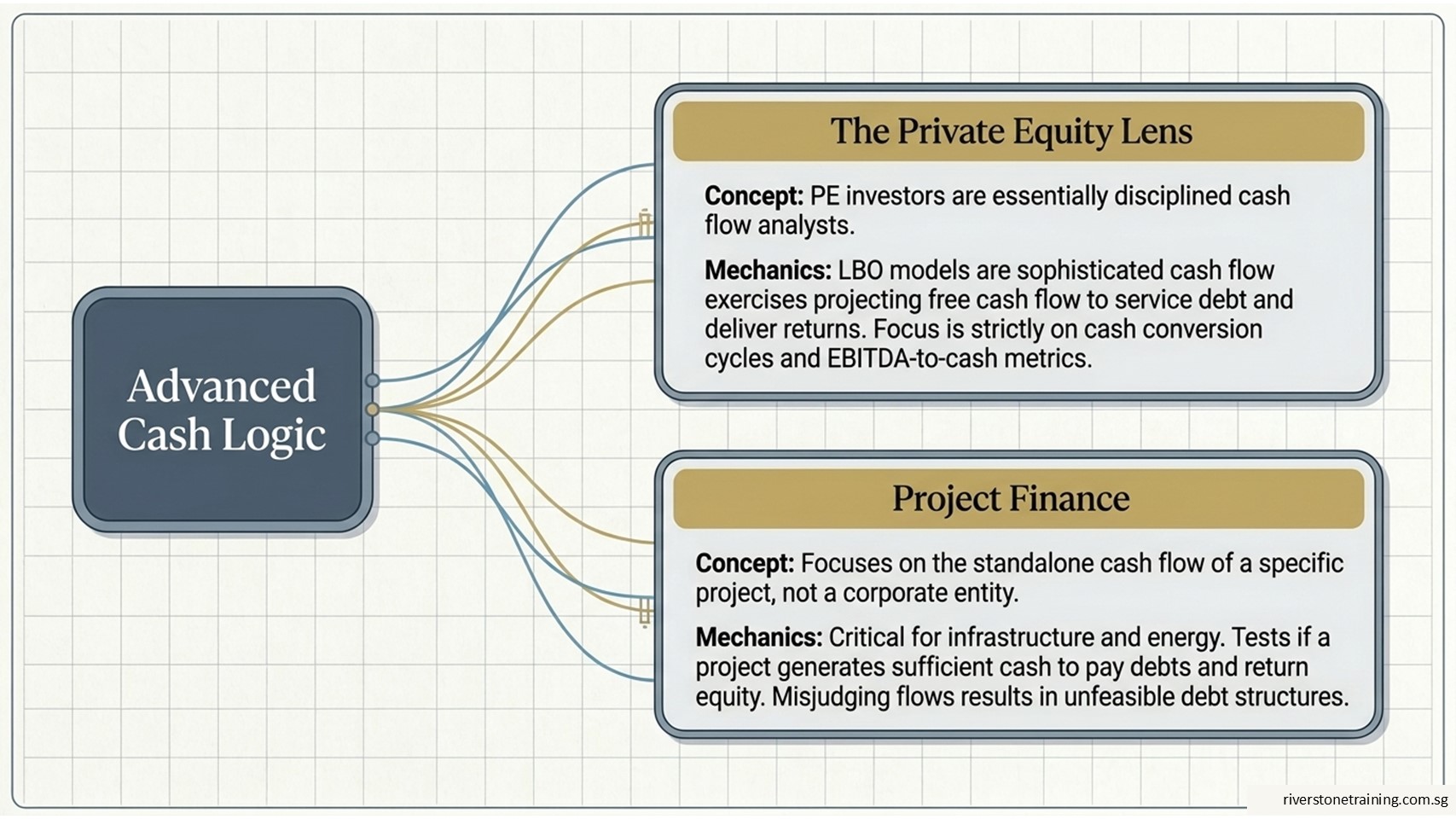
Project finance is a specialized area of finance that is particularly important in industries like infrastructure, energy, and real estate, where cash flow is a major concern. Whereas corporate finance deals with the cash flow of a business, project finance is all about the cash flow of a project and is more geared towards whether or not a project can generate sufficient cash flow to pay its debts and return the money to equity investors.
Those working in this field must be able to model and test project cash flows under a variety of conditions. Learning how to build a project finance model is a core competency for those working in infrastructure finance, energy development, or public-private partnerships.
In project finance, the risks are especially large, as misjudging the cash flows may result in an unfeasible debt structure. This is why demand for project finance training for professionals has grown steadily, as organizations seek to close the skills gap between financial theory and real-world project execution.
For those new to the field, a step-by-step project finance model tutorial provides a structured entry point into understanding how construction costs, operating revenues, debt repayments, and reserve accounts interact across the lifecycle of a project.
How Are Organizations Using Finance Training to Strengthen Cash Flow Competencies?
In the business world, it’s becoming clear that good cash flow management is not solely the responsibility of the finance department, but a matter of business strategy that affects all business levels. The following table provides some general guidance on training focus areas that are most relevant to common professional roles:
| Professional Role | Recommended Training Focus | Key Benefit |
| Finance Analyst | Financial modeling, forecasting, and Excel skills | Builds the technical foundation for day-to-day cash flow work |
| FP&A Manager | Scenario analysis, budgeting, variance reporting | Enables proactive cash management across planning cycles |
| CFO / Finance Director | Business valuation, capital structure, investor relations | Supports strategic decision-making and board-level reporting |
| Project Finance Specialist | Project finance modeling, debt structuring, risk analysis | Essential for infrastructure, energy, and development finance roles |
| HR / L&D Professional | Finance for non-finance, e-learning content design | Enables delivery of targeted finance upskilling at an organizational scale |
Rather than relying solely on external consultants, many companies are choosing to build internal capability through customized training programs tailored to their specific industry context, financial systems, and strategic objectives. This ensures a common financial language between departments, covering operations, procurement, HR, and sales.
For individuals seeking to advance their careers, obtaining a corporate finance course with certification signals to employers a structured understanding of financial management principles — including cash flow analysis, capital budgeting, and working capital optimization.
Why Is Digital Learning Reshaping How Finance Skills Are Acquired?
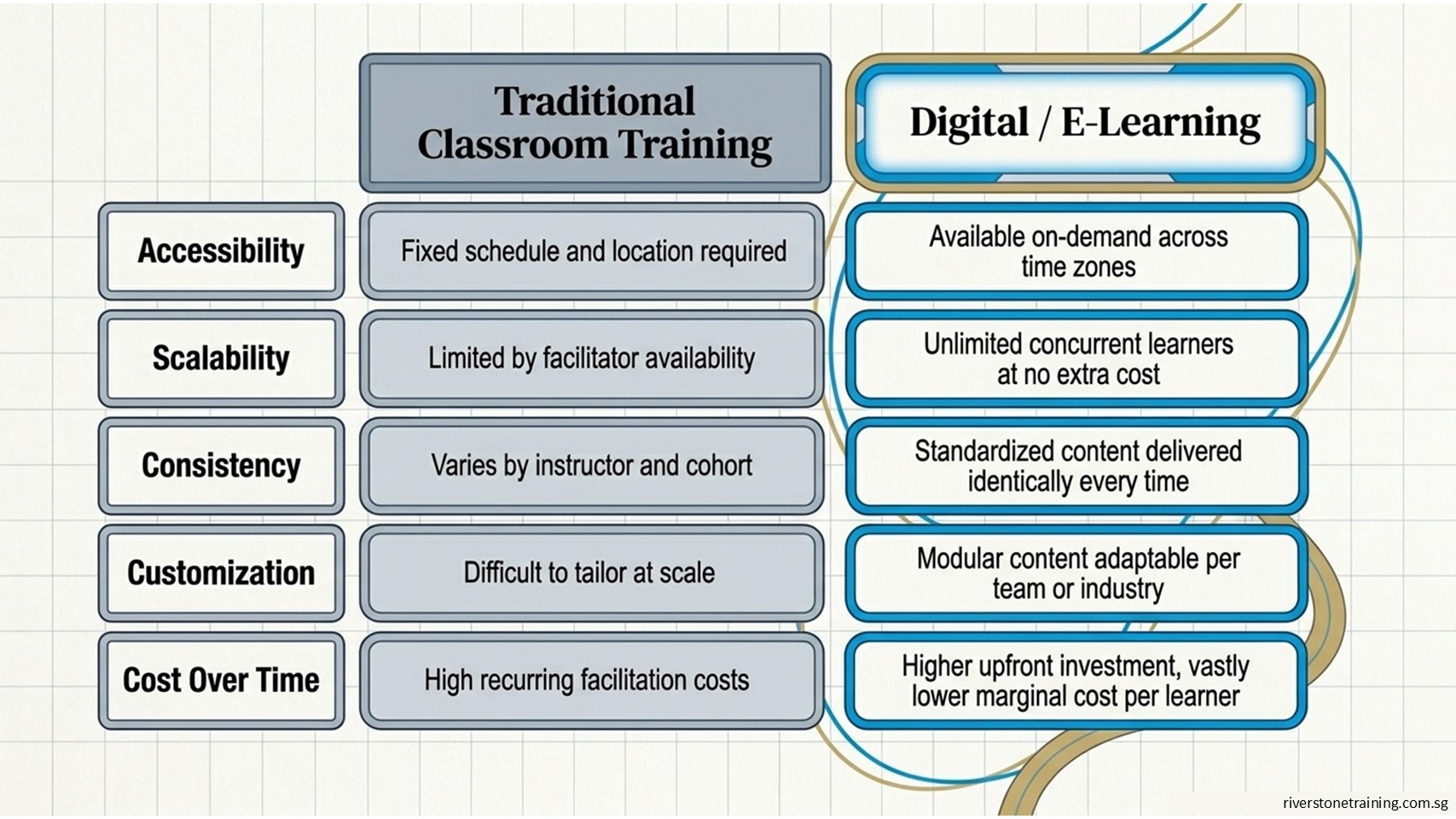
The transition to digital learning has revolutionized the way professionals learn and acquire financial expertise. The following comparison illustrates why it’s now a growing trend for organisations to select the digital format over the traditional classroom setting for their finance training:
| Factor | Traditional Classroom Training | Digital / E-Learning Format |
| Accessibility | Fixed schedule and location required | Available on-demand across time zones |
| Scalability | Limited by facilitator availability | Unlimited concurrent learners at no extra cost |
| Consistency | Varies by instructor and cohort | Standardized content delivered each time identically |
| Customization | Difficult to tailor at scale | Modular content can be adapted per team or industry |
| Cost Over Time | High recurring facilitation costs | Higher upfront; lower marginal cost per learner |
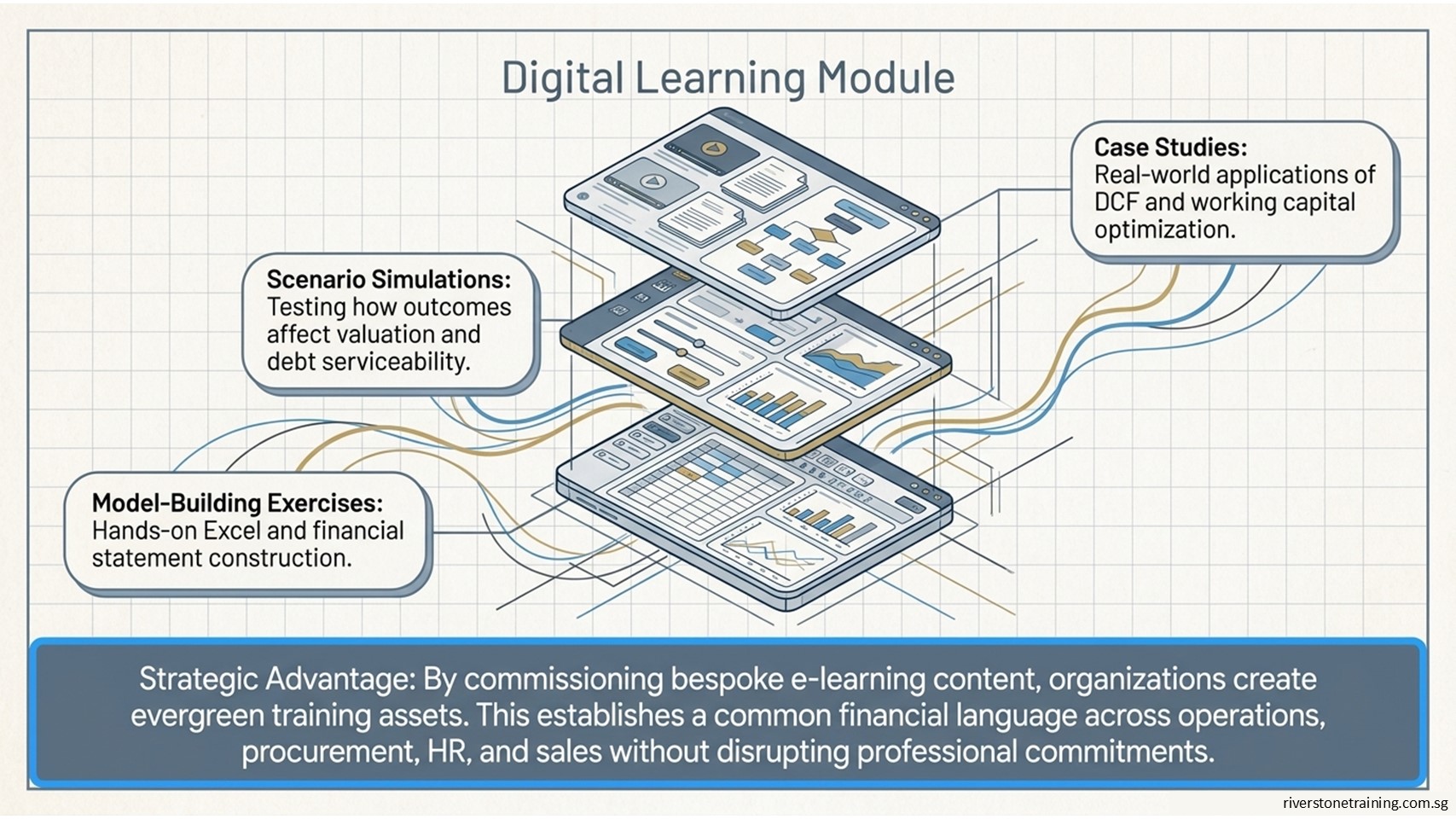
The financial sector, with its topics that range from financial modelling to valuation and project finance, is where this change is most visible, requiring structured and interactive learning formats. Well-designed digital learning content can incorporate case studies, model-building exercises, and scenario simulations that bring abstract financial concepts to life in ways that static textbooks cannot.
For organizations deploying training at scale, the ability to develop online learning content that can be accessed by dispersed teams across time zones is a significant operational advantage. It also provides consistency – all learners are given the same content, regardless of location or time.
From the learner’s perspective, the flexibility of digital formats makes it practical to pursue a finance certification course online without disrupting professional commitments — an accessibility advantage that is helping close the skills gap in finance departments globally.
How Does Understanding Private Equity Connect to Cash Flow Management?
Private equity provides a window into the process of business valuation for institutional investors and is a valuable resource for finance professionals. At their very essence, private equity investors are disciplined cash flow analysts. They have a granular understanding of cash flows at a target business in their investment thesis, deal structuring, and value creation playbooks.
Understanding the simple explanation of private equity reveals how leveraged buyout models are essentially sophisticated cash flow exercises — projecting how a business will generate enough free cash flow to service acquisition debt while delivering target returns to fund investors.
For professionals preparing to work with or within PE-backed organizations, studying private equity basics for beginners provides essential context for understanding why PE firms place such an intense focus on cash conversion cycles, working capital efficiency, and EBITDA-to-cash conversion metrics.
Those pursuing PE roles directly will find that PE interview questions and answers consistently probe understanding of cash flow dynamics — from LBO modeling to liquidity analysis — making a strong foundation in cash flow management not just useful, but essential for career advancement in this competitive field.
What Financial Modeling Skills Are Most Relevant to Cash Flow Management?
Financial Modelling is the application of the principles of cash flow management in practice. The cash flow statement is always the most important and closely examined of any model, be it a three-statement model, a DCF or a leveraged buyout analysis.
For those building this skill from the ground up, a beginner financial modeling course Excel provides the technical foundation — covering Excel mechanics, financial statement construction, and basic forecasting logic — before progressing to more complex analytical frameworks.
Having access to a free financial modeling template Excel can accelerate the learning process by giving practitioners a structured starting point they can adapt and interrogate. However, templates are most valuable when the user understands the underlying logic — which is where formal training delivers lasting returns.
At the advanced level, understanding key financial modeling techniques explained — including sensitivity analysis, scenario modeling, and dynamic assumptions — enables professionals to test how different cash flow outcomes affect valuation, debt serviceability, and investment returns.
How Can Organizations Build a Cash Flow-Literate Workforce?
It is important to develop a training program to build a workforce that is familiar with and actively participates in sound cash flow management. While training the finance team is undoubtedly a good start, the best thing an organization can do is to spread cash flow awareness throughout different departments that are involved in revenue recognition, procurement cycles, and capital expenditure decisions.
Engaging an experienced in-house training provider allows organizations to design learning experiences that are directly mapped to their internal processes, financial systems, and strategic priorities. This makes training more likely to lead to change in work practices, rather than being an abstract activity unconnected with work-related decision making.
For organizations looking to embed financial capability more deeply, commissioning bespoke e-learning content design allows them to create evergreen training assets — modules, simulations, and assessments — that can be deployed repeatedly across cohorts without recurring facilitation costs.
Organizations that invest in staff training programs designed around financial literacy consistently report stronger financial controls and more confident decision-making at every level.
Is Investing in Finance Education a Strategic Necessity for Modern Businesses?
With competition in the market, the answer is a resounding yes. Financial skills have a shorter shelf life than ever before as financial markets, regulatory frameworks, and business models change quickly. A technically outdated finance team becomes a liability as it goes without continuous upskilling.
The range of available learning pathways has never been broader. From a project finance modeling course online for infrastructure specialists to an online private equity certification course for investment professionals, the market now offers highly specialized programs that address specific knowledge gaps rather than forcing professionals into generic curricula.
HR teams and L&D leaders cannot afford not to take action to align investments in training to the strategic priorities. If the organization is expanding into new markets, pursuing acquisitions, or seeking to improve financial performance, investing in structured business valuation training and financial modeling capabilities directly supports those objectives.
The most forward-thinking organizations approach finance education not as a one-time event but as an ongoing discipline — refreshing skills regularly through e-learning content creation initiatives, professional certifications, and targeted workshops that keep teams aligned with best practices and evolving market standards.
Conclusion
Cash flow management is not simply a back-office task; it’s a strategic skill that can make or break a business. The organizations that regard it as such and invest in training their staff to manage and understand cash flows precisely are creating a strong competitive edge.
Whether through a best project finance modeling course, a business valuation calculator, or a comprehensive how private equity investment works program, the pathways to stronger financial competence are well-established and increasingly accessible. The real issue for business leaders is how fast they can bridge the gaps in financial skills between their employees and the financial information their organization needs.
Where uncertainty reigns, cash is always one of the most solid pillars that a business can rely on, and so is the human expertise that helps it manage cash flow.