
How Do Companies in Singapore Develop Stronger Business Decision-Making Skills?
In Singapore, businesses enhance Business Decision-Making by creating finance education and digital upskilling, corporate training and developing a data-driven and financially thinking workforce across all levels. Specialist learning, such as financial analysis and valuation, enables a move from intuition to informed judgement and enhances business performance.
Why Is Decision-Making Skills Development a Business Priority in Singapore?
Singapore is also known as a hub for business activity in the region and experiences a highly competitive talent market, making business decision-making a priority in Singapore. Whether it’s deciding on capital allocation, market expansion, investment appraisal, risk management, and more, companies in Singapore are constantly making complex decisions that can significantly impact their performance.
This is something that Singapore’s Ministry of Manpower and SkillsFuture have been aware of for a long time. Expenditure on corporate training has risen consistently, and a significant proportion of this has been allocated to financial literacy, analytical skills and development of professionals like financial modelling, valuation, etc. and investment analysis.
In addition to regulatory and policy pressures, there is also internal pressures from businesses. With organisations migrating towards models which rely on data, there is a greater need for staff who can read financial statements, make business cases and make rigorous trade-offs. Finance education is no longer just the preserve of accounting and treasury teams but also plays a role across operations, strategy, and commercial functions as a whole, due to the new trend toward more analytical decision-making.
What Role Does Finance Training Play in Building Decision-Making Capabilities?
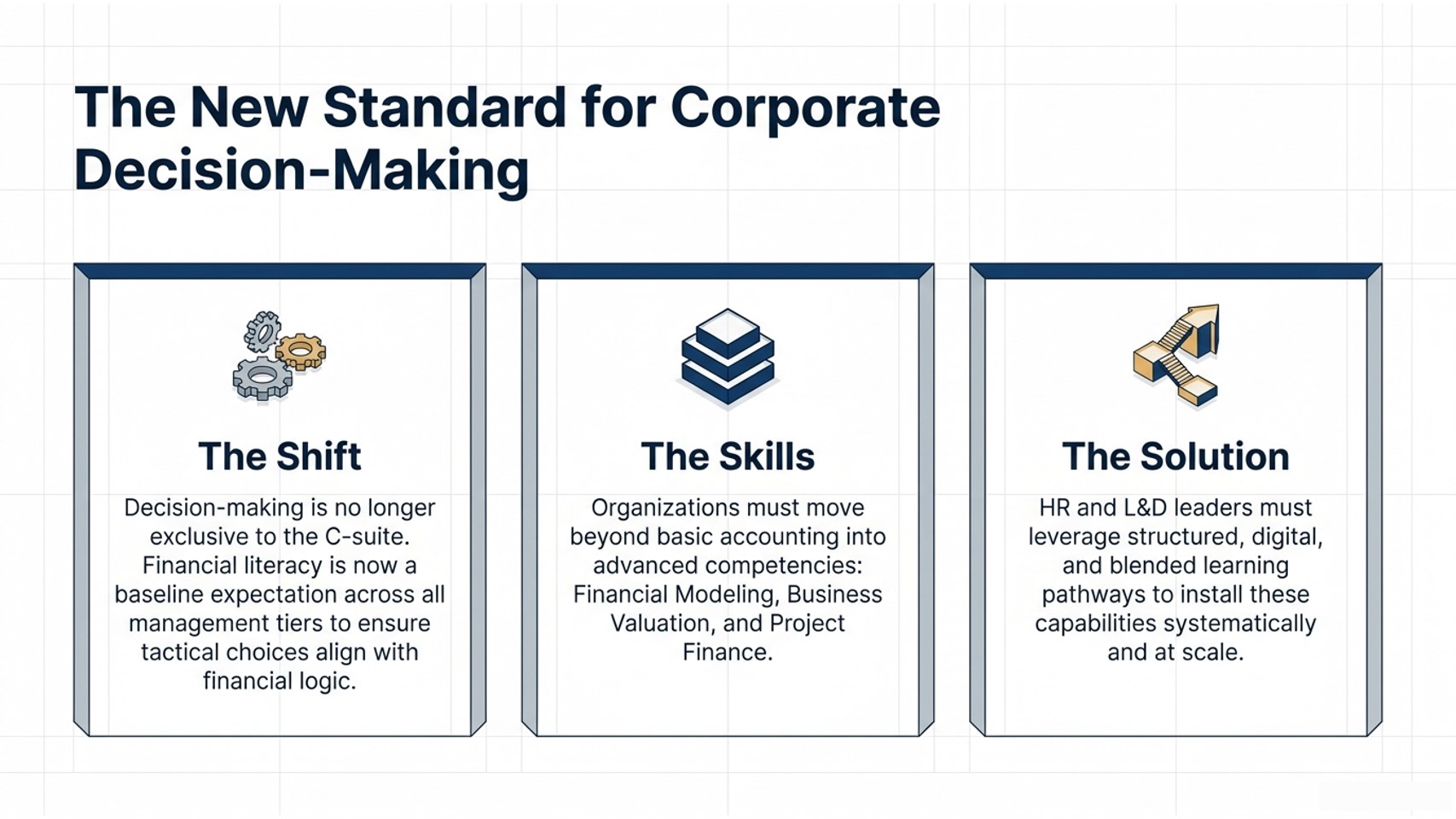
Finance training is at the core of the matter since most business decisions are high-stakes and are financially connected. When the question is whether to enter a new market, buy a competitor, hire new people and staff, or invest in technology, there is always a risk/return to consider. Experts who don’t have this knowledge are prone to taking tactical, rational decisions which are financially incorrect.
For teams that are new to finance, starting with the best finance course for beginners provides a structured entry point into core concepts such as time value of money, financial statements, and basic investment appraisal. These are not only relevant for finance people, but are now demanded by managers from all departments.
Organisations looking to formalise their upskilling programmes often opt for an accredited online finance course that delivers recognised credentials alongside practical knowledge. Accreditation also demonstrates to both employees and stakeholders that the training is of a professional standard, and aids career development and retention.
Good finance training programs aren’t merely about memorizing equations; they’re about cultivating the intuition to apply them correctly. Well-trained finance professionals can ask the right questions, question the assumptions in business proposals, and see when financial forecasts are out of the realm of possibility. The improved analytical confidence has tangible effects on the quality of decision-making throughout the organisation.
Core Finance Skill Areas and Their Impact on Business Decision-Making:
| Finance Skill Area | Relevant Business Decisions | Typical Learning Format |
| Financial Statement Analysis | Assessing vendors, due diligence in mergers and acquisitions, and budgeting | Online course, workshop |
| Financial Modelling | Developing business cases, forecasting and investment appraisal. | Hands-on Excel-based course |
| Business Valuation | Acquisitions, funding and strategic planning. | Certification programme |
| Project Finance | Other capital expenditure, such as infrastructure and BOT structures | Specialist modelling course |
| Private Equity & Investment | Making portfolio decisions, evaluating funds, and co-investing | Online certification |
How Is Financial Modelling Used to Improve Business Decisions?
Financial modelling is one of the most useful tools that professionals can utilize to assess options, predict performance, and create business cases. A financial model is a valuable tool to take the many assumptions of strategy and convert them into numbers and outcomes that can be used by decision makers to test scenarios, stress test projections and the financial impact of various decisions before investing capital or resources.
Financial modeling professionals who finish an advanced financial modeling course online are able to create integrated 3-statement models, conduct discounted cash flow analysis (DCF), and create sensitivity tables that show the variables that are most important to an outcome. These are “real-world,” not theoretical exercises, that can be used in presentations to boards, investment committees and strategic planning processes.
If you’re still early in your career, a beginner financial modeling course Excel will give you a solid foundation in financial modeling using spreadsheets. Financial modelling is still commonly done in Excel within the corporate world, and the way to structure a clean and auditable financial model is a skill that grows with experience.
Understanding key financial modeling techniques explained — such as circular references, dynamic assumptions, and waterfall structures — helps professionals avoid common analytical errors that lead to poor business decisions. It’s a nice skill to be able to create a model that is reviewed and questioned by others, and especially in a collaborative business setting.
Companies that have access to real-world financial modeling examples drawn from actual industries and transactions tend to see faster skill development among their teams. Case-based learning is more efficient than abstract teaching to connect theory and practice.
Why Are Companies Investing in Business Valuation Training?
Business valuation is an area of cross-disciplinary knowledge that merges the fields of finance, strategy and commercial prudence. It applies to CFOs, senior managers, corporate development teams, private equity professionals and investment bankers in the acquisition, joint venture or strategic partnership teams.
Understanding business valuation methods — including discounted cash flow, comparable company analysis, and precedent transaction analysis — allows business leaders to assess whether a deal is fairly priced, whether an internal project generates sufficient returns, and how to frame value creation narratives for boards and investors.
A structured business valuation course equips participants with the technical skills to perform valuations independently, reducing reliance on external advisors for routine assessments and improving the speed of internal decision-making. This is useful for companies that have multiple projects and/or subsidiaries.
Many companies also encourage their teams to explore tools such as a business valuation calculator as an entry point before committing to deeper training. These tools develop familiarity with the valuation input and outputs and facilitate more successful formal training.
Formalised business valuation training also improves communication. When professionals across finance, strategy, and operations share a common valuation language, internal discussions become more rigorous, assumptions are more explicitly stated, and decisions are better documented and defensible.
Overview of Common Business Valuation Methods:
| Valuation Method | Best Used For | Key Inputs Required |
| Discounted Cash Flow (DCF) | Intrinsic value of cash-generating businesses | WACC, free cash flow projections, terminal value |
| Comparable Company Analysis (CCA) | Market-based benchmarking | EV/EBITDA, P/E multiples of peer companies |
| Precedent Transaction Analysis | M&A deal pricing and negotiation | Historical deal multiples in the same sector |
| Asset-Based Valuation | Asset-heavy businesses, liquidation scenarios | Book value, net asset value adjustments |
| Earnings Capitalisation | Stable, mature businesses | Normalised earnings, capitalisation rate |
How Does Project Finance Knowledge Support Infrastructure and Capital Decisions?
Project finance is a specialised branch of corporate finance, where the financing of a large capital investment, like infrastructure, energy, real estate and public-private partnership, is structured around the projected cash flows of the project itself, and not the balance sheet of the sponsor. This expertise is becoming increasingly relevant to bankers, government officials and corporate treasurers in Singapore as the city-state plays a bigger part in its regional role as a financier of infrastructure.
Learning how to build a project finance model is essential for analysts and managers who need to evaluate the viability of capital-intensive projects. Normally, a project finance model will contain sensitivity analysis, equity return modelling and DSCR (debt service coverage ratio) analysis, both for construction and operation.
A project finance modeling course online allows professionals to develop these skills without disrupting their work schedule. Online delivery also enables participants to work through information at their own speed – revisiting more challenging issues like sculpted debt repayment or reserve account modelling as necessary.
For organisations deploying capital in regulated sectors, the best project finance modelling course options combine technical modelling skills with an understanding of the contractual and regulatory frameworks that govern project finance transactions — including concession agreements, offtake contracts, and lender due diligence processes.
Companies investing in project finance training for professionals are equipping their teams to evaluate opportunities with greater rigour and negotiate financing structures with banks and institutional lenders from a more informed position.
What Is the Role of Private Equity Knowledge in Corporate Decision-Making?
Now the knowledge of private equity is beyond the scope of fund managers and investment analysts. By grasping how private equity investors think about businesses, corporate executives are better positioned to ensure their relationship with the investor, prepare for a capital raise and make decisions that align with the investor’s understanding of value and risk.
For professionals new to the asset class, a simple explanation of private equity provides the conceptual grounding needed to engage intelligently with PE investors, understand term sheet negotiations, and anticipate how fund investors assess portfolio companies.
More structured private equity basics for beginners programmes introduce the economics of PE funds — including management fees, carried interest, and return hurdles — which are directly relevant to anyone working within a PE-backed business or evaluating PE as a source of capital.
Understanding how private equity investment works also sharpens a corporate professional’s ability to conduct their own business analysis. Putting the analytical frameworks that PE firms employ into practice – such as LBO modelling, value creation planning, and exit multiple analysis – equates to a more rigorous internal decision-making process.
For finance professionals preparing for a career transition or advancement, completing an online private equity certification course provides both the technical depth and the credentialing to support those goals.
How Are In-House Training Programmes Transforming Corporate Learning?
Industry certification is one of the most effective ways to upskill within the organisation, as it enables an organisation to pull in content that matches their industry landscape, processes and strategic objectives. Instead of sending employees to the public training programs, companies can design custom training programs that address their company’s decisions and challenges.
A qualified in-house training provider works with the organisation to design programmes around its objectives — whether that involves building financial modelling skills for an analyst cohort, introducing business valuation frameworks for a commercial team, or upskilling a leadership group on investment appraisal.
Customized training programs are flexible and can be aligned with the business cycle, include company-specific examples and track learning outcomes to pre-determined competency standards. This enhances relevance, and ROI is more measurable.
Effective corporate training services also help to develop a consistent culture of learning in the organization. A shared language and framework of thinking between the teams fosters the team’s ability to work together and reduces friction in decision-making processes when whole teams undergo the same training.
Well-designed staff training programs also contribute to employee engagement and retention. Organisations that invest in their professional development are more likely to retain those employees and have them implement their learning to achieve measurable results.
Comparison of Corporate Training Delivery Models:
| Delivery Model | Best Suited For | Key Advantages | Considerations |
| In-House / On-Site | Cohort-based team upskilling | Tailored content, team alignment, and cost-efficient at scale | Requires internal coordination |
| Online Self-Paced | Individual skill development | Flexible schedule, accessible globally, lower cost | Requires self-discipline |
| Live Virtual Instructor-Led | Remote teams, regional offices | Interactive, scheduled, and can mirror in-person dynamics | Time zone management needed |
| Blended Learning | Complex technical skills training | Combines theory and practice effectively | Higher design investment |
How Is Digital Learning Reshaping How Finance Skills Are Built?
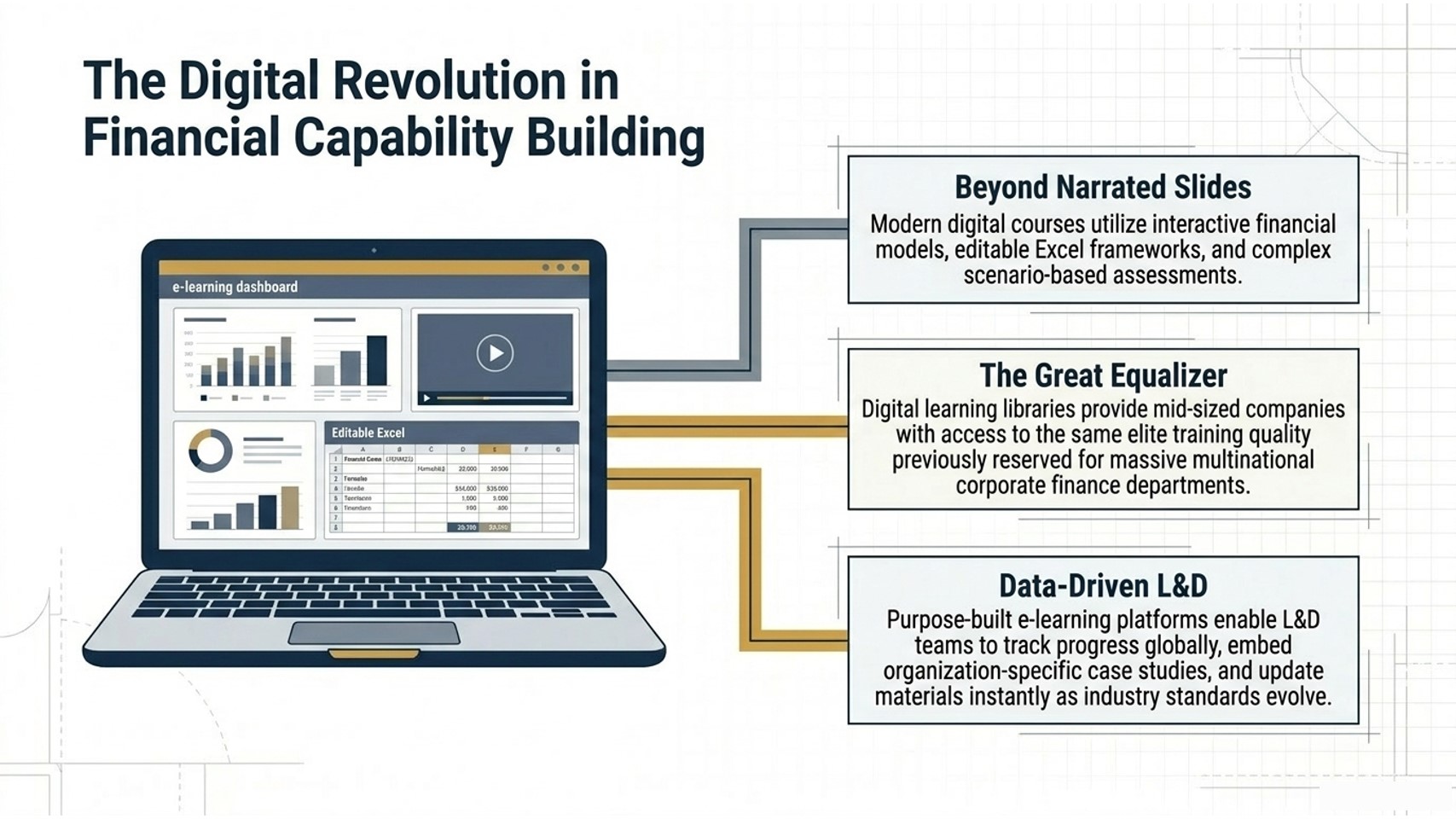
Digital learning has revolutionized the way corporate finance skills are learned and retained. The move from teaching in the classroom to online or blended teaching has increased accessibility to quality training, enabled scaling up and increased measurability of training impact. In Singapore, digital learning libraries are becoming more common as organisations are creating digital learning resources for employees to access whenever they need it, instead of workers having to wait for a specific training calendar.
Professional e-learning content development has come a long way, and today’s learning content utilizes scenarios, interactive financial models, assessment points, and multimedia explanations to aid retention and application. There is a lot less difference between in-person and online instruction in terms of their respective quality of teaching in technical topics like finance and valuation.
Organisations that invest in purpose-built digital learning content for finance and decision-making programmes provide an advantage to organisations in that they can deliver these materials to multiple offices and geographies, have a way of tracking learning progress and can update the materials as industry standards change.
Effective e-learning content design for finance training goes beyond narrated slides. Worked examples, editable Excel models, case studies based on real transactions and reflective questions that encourage participants to put concepts into practice in their own context are key elements of best practice digital finance courses.
The availability of well-structured online learning content has also levelled the playing field for smaller organisations that cannot afford large-scale in-house programmes. Now, this is the same level of teaching that only the finance departments of large multinational corporations could have previously enjoyed, which a mid-sized company in Singapore can offer its finance team.
What Should HR and L&D Teams Consider When Designing a Finance Upskilling Strategy?
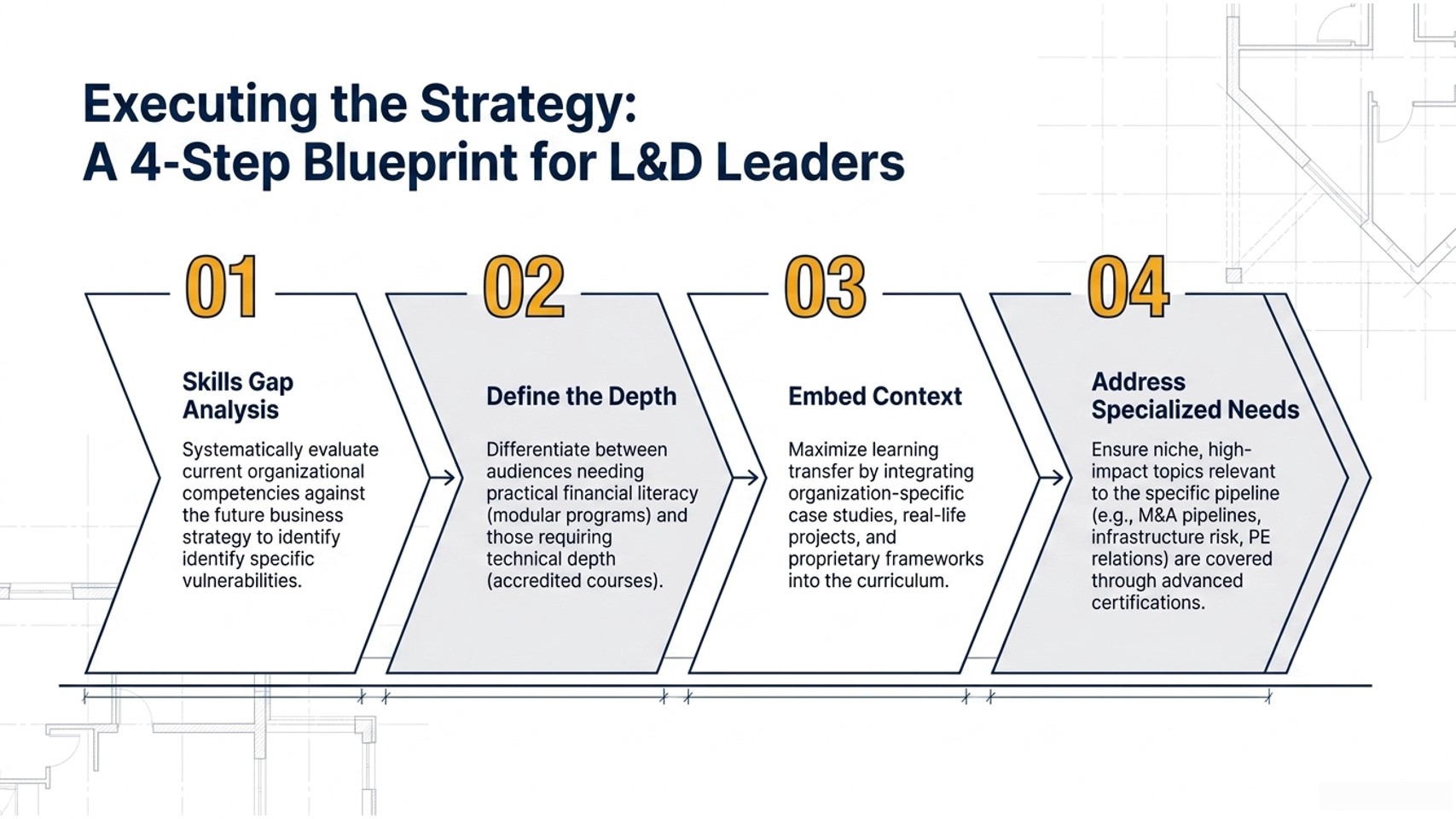
HR and learning and development (L&D) teams are the ones who have a huge impact on turning business objectives into effective training strategies. A skills gap analysis is always a first step when developing a finance upskilling programme, as it involves a systematic process of evaluating the current skills and competencies of the organisation against the ones needed to support the business strategy.
After the gaps are identified, the teams need to consider whether the skills need to be formally certified or whether they need to be trained practically. A corporate finance course with certification may be appropriate for analysts and managers in finance-intensive roles, while a lighter-touch modular programme may be sufficient for commercial or operations teams who need financial literacy rather than technical depth.
L&D professionals should also consider how workplace training programs can be structured to maximise transfer of learning. Evidence indicates that the best training programmes integrate learning with application, be it through real-life scenarios, real-life projects or follow-on coaching.
For teams that require a more structured curriculum, a financial management course for professionals that covers core topics from financial analysis through to investment appraisal and strategic finance provides a coherent learning journey. This is an organised way of developing knowledge over time, which helps to stop learning from being fragmented, as employees have to find out information from different sources.
Last but not least, organisations need to review whether there is enough focus on specialist topics in their learning strategy. Some topics like project finance, private equity and business valuation are not commonly included in general finance training courses, but may be pertinent for companies that have a strong M&A pipeline, infrastructure risk, or PE investment relationships. A finance certification course online that incorporates these specialist areas can significantly broaden the analytical capability of a corporate finance team.
Investing in purpose-built e-learning content creation also enables L&D teams to embed organisation-specific case studies and internal frameworks directly into the learning content, making training more relevant and improving knowledge retention.
How Can a Company Build a Step-by-Step Project Finance Model for Decision Support?
The creation of a project finance model is one of the most in-depth applications of financial decision-making. It involves technical people making assumptions about construction schedules, the cost of running the business, the terms of revenue contracts, debt and equity structures, and the expected returns on their equity investment in the project, and combining those assumptions into a single consistent model. The construction of this model entails clarity of each of the assumptions, and that clarity is directly related to the quality of the investment decision.
A step-by-step project finance model tutorial typically begins with setting up the project timeline and input assumptions, then flows through a construction cost model, an operating cash flow build, a debt structuring module, and finally an equity return analysis. The stages of the model feed into the next, thus providing a self-contained analytical tool that is fully traceable.
Professionals who have worked through a how to build a project finance model course report that the modelling process itself changes how they think about project risk. Scenario and tornado analysis are used to define which assumptions are the most sensitive for equity returns, complementing the insights from qualitative analysis, and improving investment judgment.
For organisations managing a pipeline of capital projects, having team members who have completed a recognised best project finance modelling course creates a shared modelling standard. Harmonized model structures shorten review time, allow better comparison of projects and enhance the quality of the information for investment committees.
Conclusion of Business Decision Making
Through targeted, planned investments in finance education, technical training, and digital learning, Singapore companies are becoming more adept at business decision-making. The organisations that do this best are those that make learning a business strategy – a function that is linked to specific business objectives, skills needs and the analytical needs of their teams.
The themes are all about providing professionals with the tools to make better decisions, whether in basic finance courses, special training in financial modelling or business valuation, or project finance courses tailored to capital-intensive industries. It is not something that can be done once and for all – a learning infrastructure that grows with the business and market is required.
In short, training in finance and numerical skills is anything but an option for HR leaders, HR learning and development specialists and senior executives. Decisions at all levels of the organisation, in a competitive arena, directly affect the long-term performance as a result of the quality of the decisions. Today’s companies that value this development are creating an advantage for the future.