
Knowledge Value Chain
With the hyper-competitive global economy, the competitive advantage that will endure is no longer the company’s physical assets, market position or even its proprietary technology. More than ever, it is knowledge, organised, strategic, and constantly updated knowledge, that distinguishes between achieving success and simply getting by in an organisation.
Traditionally, Michael Porter’s concept of the business value chain, popularized in the 1980s, explained the process of value creation by a company, and how it got value from inbound logistics to after-sales service. However, in the 21st-century knowledge economy, this chain has been changed altogether. The new value chain is based on people – the depth of their thinking, the depth of their technical expertise, and the ability to take and apply specialised knowledge and expertise to real business problems.
There’s no better place to see this change than in corporate finance and professional development. Structured learning programmes are a growing investment in the interests of businesses throughout Southeast Asia, Europe and North America, not as an expense, but as an asset. If HR directors, CFOs and business leaders want their businesses to be future-proof, they can’t afford to know the business value chain of knowledge. An imperative of the executive.
Why Knowledge Has Become a Core Business Asset
Financial literacy has been thrust into the core of all organisations of all sizes as a result of the rapid pace of digital transformation, ever-changing capital markets and greater regulatory complexity. The finance profession can no longer work in isolation. A marketing manager should know about the concept of margin analysis today. Operations leaders should be able to read Cash Flow Statements. No matter, senior executives must be able to communicate effectively with investors, bankers and board members and have the language and judgment to do so.
This democratisation of financial understandings is resulting in a massive upskilling in the corporate world. A well-designed finance training program for executives can transform the way leadership teams make decisions, allocate capital, and assess risk. If the entire organisation can use a similar financial language, the quality of internal discussions is enhanced, and the decisions that are made are better.
But there’s more to the case for investing in corporate learning than just alignment. Organisations that clearly communicate and invest in professional development and training have a better chance of gaining and retaining top talent in a talent-tight market with employee expectations on the rise. In this context, knowledge investment is also a talent strategy.
The Rise of Digital Learning in Corporate Environments
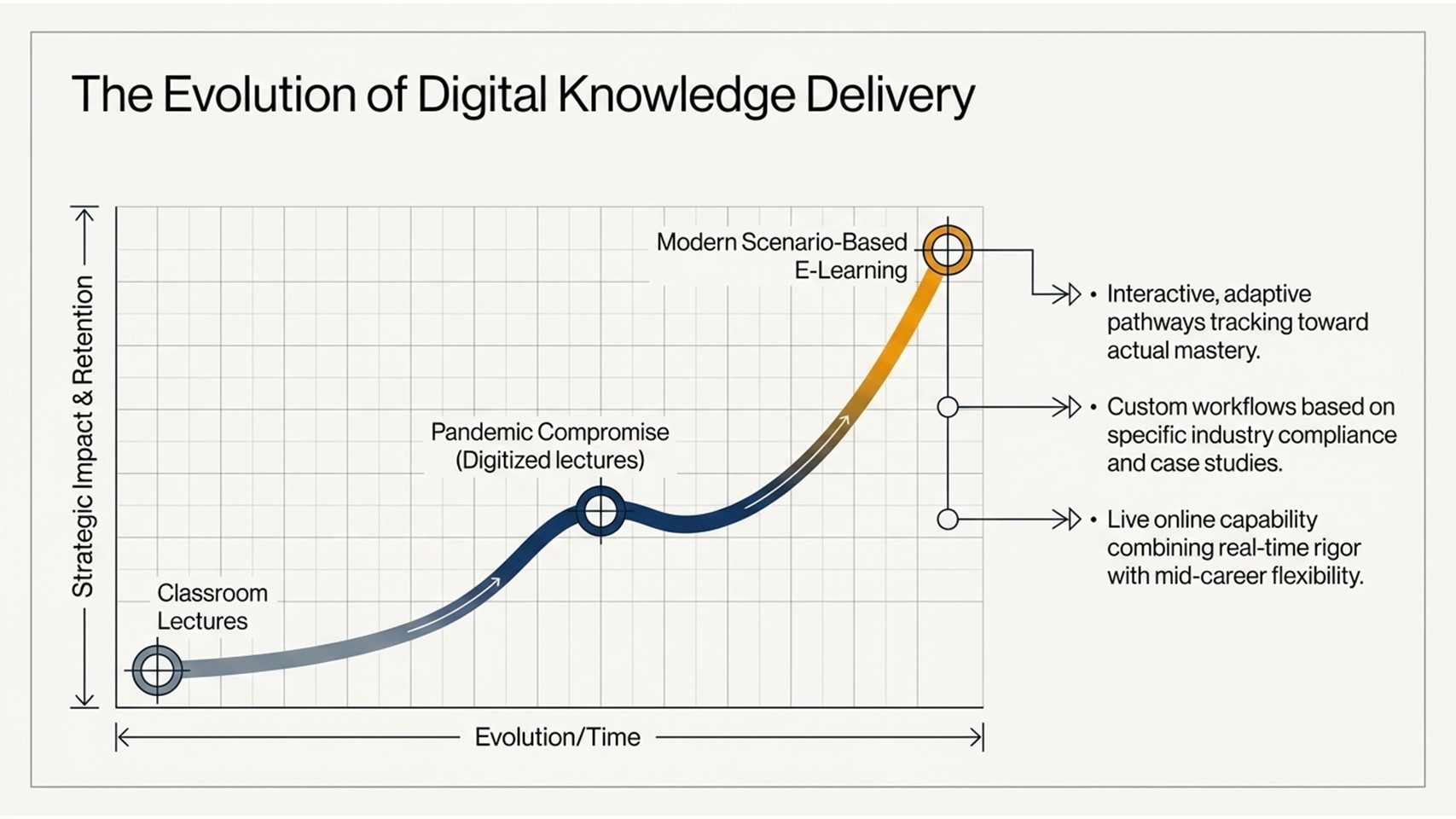
The corporate e-learning market has grown significantly in the last decade, and was turbocharged by the pandemic and the normalisation of working remotely. First, it was a compromise; then it became a sophisticated, high-impact delivery option that is often proving to be more effective in reach and retention than traditional delivery methods.
For organisations looking to deliver consistent, scalable training across geographies and business units, working with a reputable e-learning content development company has become standard practice. The ability to deploy custom e-learning content tailored to the specific workflows, case studies, and compliance requirements of a given industry represents a significant step forward from the era of generic training modules.
Modern corporate e-learning content is not merely a digitised version of a classroom lecture. It is scenario-based, interactive, and increasingly adaptive – it adapts to learners’ needs and works them efficiently towards actual mastery. For finance teams, it’s content that’s relevant to their business needs, such as budgeting cycles, capital allocation frameworks and financial risk assessment, tweaked into a format that integrates with their work schedule.
The flexibility of live finance classes online has also played a transformative role. Previously, finance individuals had to come to the office to participate in training, but now they can have their hands-on training in real-time, discussing case scenarios with the trainer, and getting feedback from industry experts as they go. This combination of flexibility and rigour is especially successful in mid-career individuals who require training in order to upgrade their skills without leaving their challenging jobs.
Financial Modelling: The Engine Room of Commercial Decision-Making
Financial modelling is one of the most valuable technical skills that organisations are looking for to develop. The ability to construct, analyze, and test financial models is arguably at the heart of almost every major business decision – launch a new product, acquire a competitor, expand into a new market, and even seek funding from the outside.
However, financial modelling is a skill that is learned somewhat ad hoc; that is, by observing other models in use, trial and error, and exposure to models created by other people. This will result in inconsistency, errors, and complex models to audit and modify. A more systematic approach, delivered through structured financial modeling training for professionals, produces significantly better outcomes: models that are logically sound, clearly structured, and capable of supporting high-stakes decisions with confidence.
For professionals who are new to the discipline, a step-by-step financial modeling tutorial provides the structured foundation necessary to understand how assumptions, drivers, and outputs interact within a financial model. For those already working in finance, an online financial modeling certification provides formal validation of existing skills while filling in any methodological gaps.
The tools are important as well. Microsoft Excel remains the dominant platform for financial analysis in corporate settings, and proficiency in Excel financial modeling for beginners is increasingly treated as a baseline competency, not a specialist skill. Investing in financial modelling – that is, advancing the financial modelling capability of the broader finance function – brings significant downstream advantages: quicker analysis cycle, reduced inaccuracy in presenting to the board, and a team that can respond more quickly to ad hoc requests for financial information.
Project Finance and Infrastructure: Where Specialist Knowledge Creates Disproportionate Value
Project finance is a field where specialist expertise can be directly applied to securing commercial benefits for organisations in capital-intensive sectors such as energy, infrastructure, real estate, and natural resources. Whether it is the structuring of a complex infrastructure deal, modelling of a renewable energy project, or the negotiation of a financing package for a greenfield development, there is no room for something that is just improvised.
The basic concepts of project finance modelling are complicated. Project finance differs from corporate finance, which assesses a company’s creditworthiness, in that it assesses the cash flows of a particular asset or project. Understanding the mechanics of cash flow modeling in project finance — how to model construction periods, ramp-up phases, debt service coverage ratios, and distributions to equity — is essential for anyone involved in structuring or evaluating infrastructure transactions.
Debt structuring in project finance models is another area where precision matters enormously. The tenor, covenants and repayment terms in the various tranches of senior debt, mezzanine financing or equity injection should also be represented as accurately as possible within the model as any minor misrepresentation could result in significant inaccuracies being drawn when assessing the viability of a project or the lender’s requirements.
For finance professionals looking to build or validate their technical skills in this area, an infrastructure project finance modeling course provides both the conceptual framework and the hands-on practice needed to work effectively on real transactions. Practical tools, such as a solar project finance model Excel template allow learners to engage with realistic deal structures across the renewable energy sector, one of the fastest-growing areas of infrastructure investment in Asia and globally.
Being able to produce and interpret an Excel project finance model example with confidence is increasingly regarded by lenders, sponsors, and advisors as a minimum qualification for professionals involved in infrastructure and energy finance.
Business Valuation: The Intersection of Art and Science
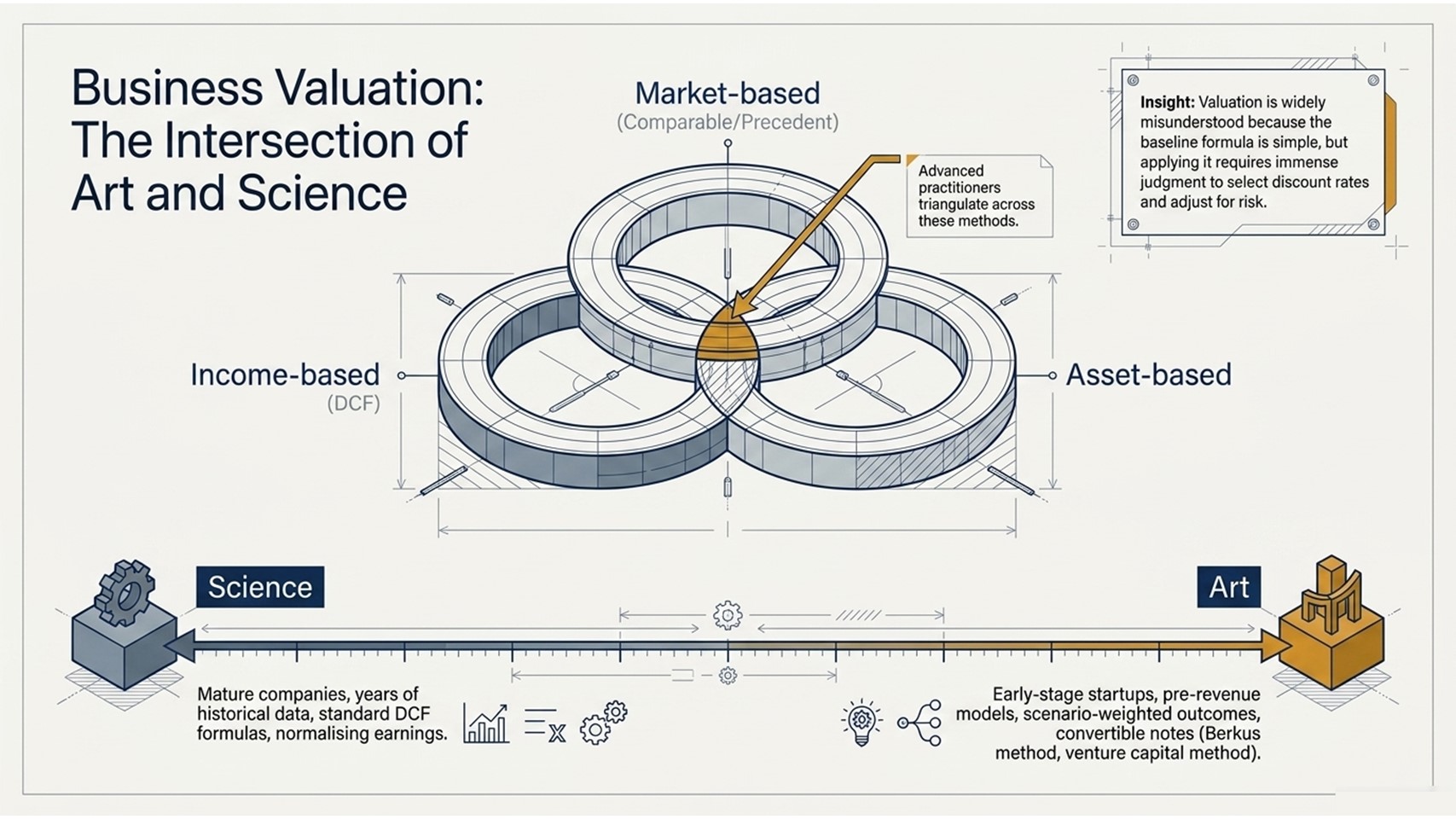
Valuation of businesses is a subject that is important to a very broad group of professionals. Whether in the process of raising capital, negotiating mergers and acquisitions with executives, facilitating transactions for banks, or deciding whether or not to invest in a business, founders need to understand the basics of valuations. But valuation is one of the most misunderstood aspects of finance, for two reasons: It requires real judgment to value a business and the finance jargon can make it hard to understand the logic.
At the most fundamental level, company valuation methods fall into three broad categories: income-based approaches (such as discounted cash flow analysis), market-based approaches (such as comparable company analysis and precedent transactions), and asset-based approaches. All of these methods have their advantages and disadvantages, and there are different contexts in which they are suitable; advanced practitioners are able to triangulate over approaches.
The business valuation formula may look straightforward on paper, but applying it rigorously requires a clear understanding of how to select and justify discount rates, normalise earnings, and adjust for company-specific risk factors. The valuation of a company in a developed market with years of financial history is a fundamentally different exercise from valuing an early-stage business with limited revenue and significant uncertainty about its future trajectory.
It’s a distinction that’s significant for investors and advisors when dealing with tech startups and early-stage businesses. Knowing how to value a startup company requires comfort with pre-revenue business models, convertible note structures, and scenario-weighted outcomes. The range of startup valuation methods — from the Berkus method and scorecard approach to venture capital method and risk factor summation — reflects the diversity of the startup ecosystem itself, and professionals who can navigate this landscape competently are increasingly in demand.
Private Equity: A High-Value Domain Requiring Specialised Preparation
Very few areas of the financial world are as demanding (or profitable) as private equity. PE professionals need to assess enterprises with varying business models, complex deals, hours and hours of value creation discussions with management teams and ultimately, proficient exits. This breadth of knowledge is matched by the breadth of expertise: financial analysis, structuring the transaction, operational strategy, legal aspects, and investor relations.
For professionals considering a career in PE, understanding what is private equity at a conceptual level is an important starting point. Conceptual knowledge is not enough, though. Job seekers are consistently ranked as the most important when it comes to the ability to apply skills to the day-to-day, like financial modelling, due diligence, and deal evaluation skills.
Private equity training for professionals has evolved significantly in response to this demand. Structured programmes are now available for the entire transaction, both for sourcing and screening and for the full end-to-end of portfolio management and exit, and therefore provide a complete preparation for the realities of working in a PE environment.
For candidates actively exploring how to get a private equity job, the most common advice from practitioners is consistent: build your technical skills first, develop a credible investment thesis, and be able to demonstrate your analytical thinking with concrete examples. Knowing which top private equity firms operate in your target geography, what their investment strategies are, and how to position yourself compellingly relative to their stated priorities is equally important in a competitive hiring environment. The best private equity course online will typically combine technical rigour with this contextual, career-oriented dimension.
In-House Training: Aligning Development with Strategic Priorities
While public programmes and online platforms have an important role to play in the corporate learning ecosystem, the most strategically aligned approach to workforce development is often corporate in-house training. In-house training (whether facilitated by in-house staff or external trainers who are introduced into the organisation) can be tailored to the company’s processes, priorities and challenges.
In-house training programs offer a number of distinct advantages. They’re more relevant as they are based on the organisation’s context and decision-making stories. They develop a common language and structures among teams that must communicate with one another. They can be timed and structured to fit business cycles, such as providing training in financial analysis ahead of the annual planning cycle, or financial analysis for project finance education just before a big infrastructure bidding.
In-house training courses also tend to produce stronger cohort effects: when colleagues learn together, they reinforce each other’s development long after the formal training has concluded. For HR directors and learning and development professionals, the ability to design employee in-house training that is deeply integrated with the organisation’s culture and strategy represents one of the most powerful tools available for driving sustained capability improvement.
However, in-house training is most effective when the material is indeed of high quality, and the trainers are reputable practitioners. A well-executed in-house corporate training programme delivered by experienced finance professionals carries far more weight with participants than a generic course repackaged with a company logo.
Building for the Future: From Graduates to Senior Leaders
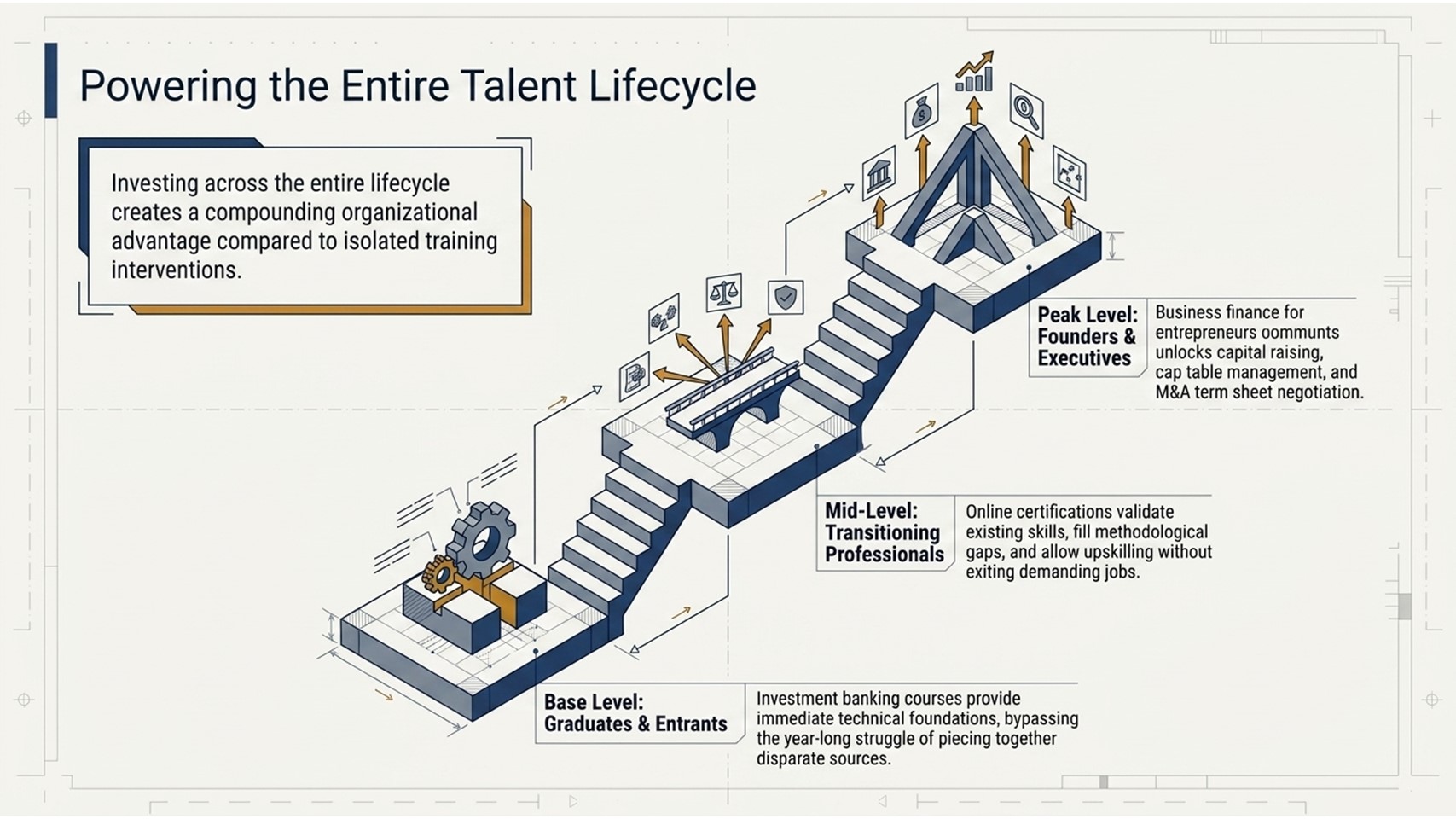
A key decision for organisations is who to focus on for their learning and development strategy. It makes sense to invest at all levels of a talent’s career — from entry-level employees to high-level executives — because the developmental needs at each phase of the career are different, and the impact of investing in the development of talent at each tier is much more significant than investing only at one end of the talent lifecycle.
For recent graduates and early-career professionals entering the financial services industry, an investment banking course for graduates provides the technical foundations that allow them to contribute meaningfully from the outset, rather than spending their first year piecing together knowledge from disparate sources. For professionals transitioning into finance from adjacent disciplines, an accounting and finance diploma course offers a structured pathway into the field that is both rigorous and time-efficient.
At the other end of the spectrum, founders and business owners who are raising capital, considering an exit, or managing rapid growth benefit enormously from a business finance course for entrepreneurs. Being able to communicate with investors as a “financial counterpart,” knowing the cap table and how the term sheet works, the financial aspects of various deal structures, etc., can make a significant difference in the results of fundraising and M&A processes.
The e-learning content provider landscape has matured to the point where organisations can now access high-quality, modular content across all of these segments, and increasingly, they can draw on e-learning course content that is genuinely customised to their industry, regulatory environment, and learner profiles.
Conclusion: Knowledge as Competitive Infrastructure (Knowledge Value Chain)
Knowledge is not just a metaphor for the business value chain. It is a tangible way to think about how organisations transform their learning investments into commercial results – in the form of improved decisions, better teams, more effective processes, and improved ability to compete against challenging markets.
The data from organizations with a rigorous approach to finance education, corporate upskilling and structured digital learning is clear: They are making faster and better decisions, stronger talent is drawn to and stays in their organizations, and they are able to handle complexity more effectively. The knowledge that rests within an organisation’s population is one of the most identifiable assets in the fight for competitive advantage, in a world where capital is becoming more and more commoditised and technology is getting quicker and more widespread.
If you are a business leader, HR director or finance executive seriously considering your company’s development strategy, it isn’t a question of if, it’s a question of how. How best to do this is what it is about – selecting the right content, the right “how” it is delivered, and the right partners to ensure ongoing capability. The value chain of knowledge starts with that commitment.