
Smarter Business Decisions
The decision-making process in any organisation can be a key determinant of success or failure in today’s rapidly changing business landscape, at any level. The decision-making process has become more complex — from boardroom strategy to project execution — in a highly dynamic business environment, under a constantly changing regulatory framework, in the digitalised world and in an environment with a constantly evolving talent landscape, where continuous upskilling is a key requirement. It is not necessarily the most aggressive strategy or the deepest pocket that makes the businesses excel with their peers. Generally, they are those who make a sustained effort to develop their knowledge, skills, and organised learning processes.
One such key competency, in particular, that has become one of the most important ones across industries is financial literacy. The traditional view of finance as a purely quantitative field is no longer adequate: finance professionals must not only understand the flow of capital, but also be able to measure risk and create value. A working knowledge of financial principles is beneficial for business leaders, HR teams, project managers and operational executives. The modern organisation requires cross-functional financial intelligence, and a commitment to training and development across the organisation is required to look after that demand.
The article examines the impact of finance education, digital learning, business upskilling and the emergence of specialist training providers on the way business decisions are being made in the modern world and how these are influencing the training of future business staff.
The Strategic Case for Finance Education in Business
What sets apart good from bad decisions is having the right information and the ability to accurately interpret it, the response is unified from any experienced CFO or business strategist. Money data plays a key role in that equation. Reading, modelling and acting on financial information is a prerequisite for organisations looking at a new market opportunity, an acquisition, or optimizing operational budgets.
That’s why it’s important for leading companies to now increasingly see finance education as an integral element of their talent development efforts, rather than the purview of the accounts department. If a senior marketing executive knows how to analyze the margins, he is better able to make decisions on campaign investments. If you have an operations director who understands cash flow, they can be more effective (and better!) at negotiating the terms of the supplier. A HR leader who knows how to model the cost of the workforce is more likely to be able to make a case to the board about the proposals for headcount.
If you’re aiming to develop or refine these skills, it’s likely that the first and most beneficial course you take is the best finance course for beginners. These structured courses provide an introduction to the fundamental financial concepts learners need to understand, such as reading balance sheets and income statements, the time value of money, and much more, and apply them to real-world business situations.
This investment pays off in so much more than just individual results. When everyone in the organisation speaks the same language, they can work more effectively together, decisions can be made faster and the organisation is more responsive to external pressures.
Financial Modelling: Turning Data Into Strategic Insight
Financial modelling is a skill that has a wide range of applications and impact among the many technical skills that contribute to the success of a finance professional. At its very basic, a financial model is a visual representation of a business or a transaction — a way for decision-makers to test out various scenarios, evaluate assumptions, and understand the consequences of decisions without putting any actual money at risk.
Financial models are employed throughout the business decision-making process, from the evaluation of businesses for mergers to forecasting budgets. But many experts, even those with years of experience, still use models that are poorly conceived and are based on shaky assumptions. This puts organisations at great risk, especially in high-value scenarios where millions of dollars could be on the line of a spreadsheet.
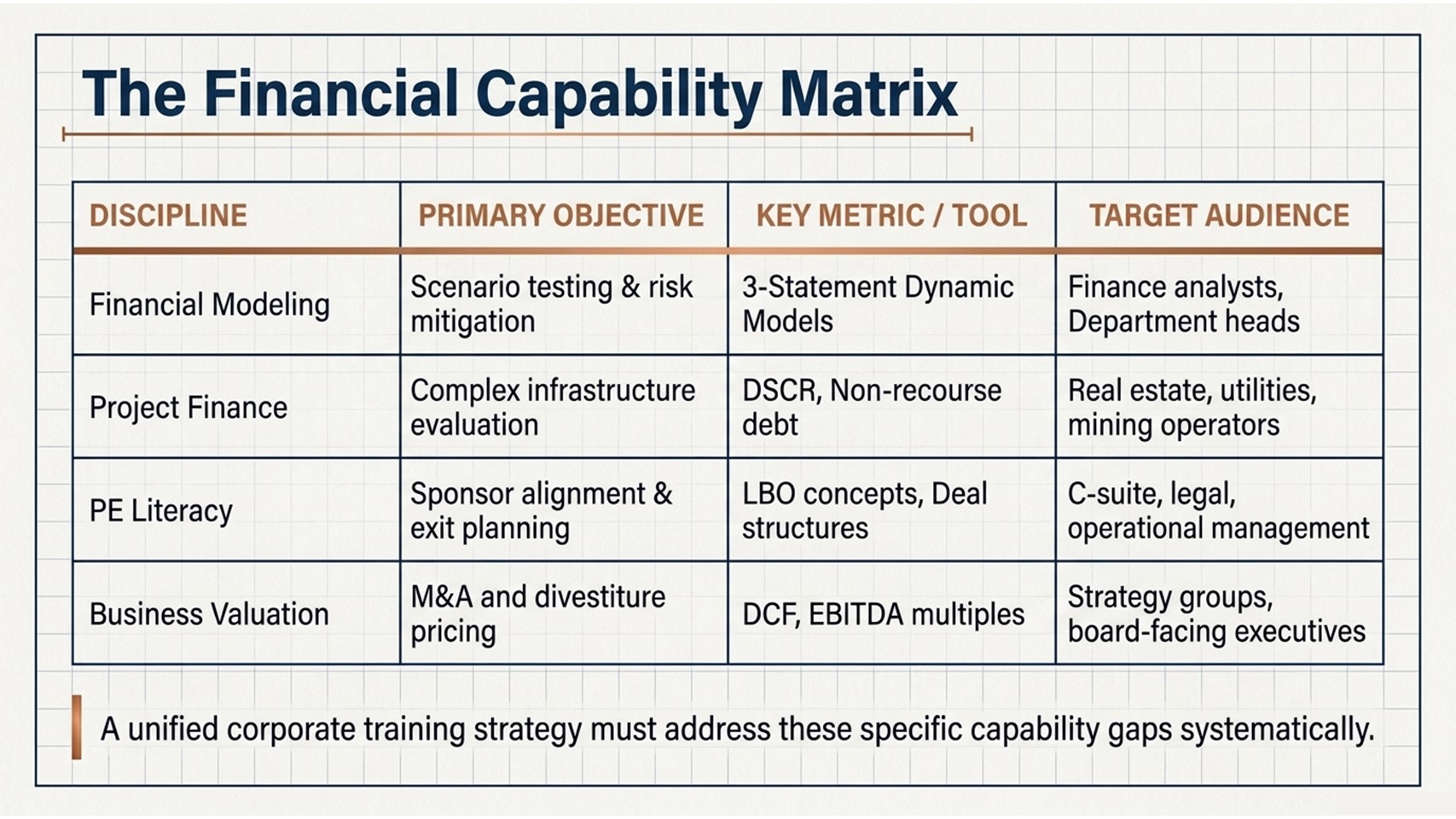
Learning key financial modeling techniques explained through a structured programme can dramatically elevate the quality of analysis within a team. Those with the expertise to create solid, audit-traceable models with industry-standard UX skills will be better able to question the underlying assumptions in forecasts, test for stress scenarios and confidently present financial findings.
If you are new to financial modeling, a beginner financial modeling course Excel starts from basics and teaches you how to set up inputs and outputs, create dynamic three-statement financial models, and so on. More advanced practitioners benefit from an advanced financial modeling course online that covers complex scenarios, including leveraged buyouts, merger models, and scenario analysis frameworks.
Organisations that want to see the concepts in action before committing to a full programme can explore real-world financial modelling examples to understand how these skills translate into practical business outcomes. Many training providers also offer a free financial modeling template Excel as a starting resource, giving teams an immediate, tangible tool to work with while they build their capabilities.
Project Finance: A Discipline Built for Complex Decision-Making
The nature of some business decisions does not conform to the regular corporate finance models. Large projects involving infrastructure investments, energy projects, public-private partnerships, or capital-intensive projects frequently necessitate an analytical approach that is quite different — one that takes into consideration the time horizon of projects, the multiple interests of the stakeholders, the non-recourse debt structure, the complicated cash flow profiles, etc. Project finance is what this is all about.
In recent years, project finance has become more significant in the relevance of a project as governments and corporations have embarked on ambitious infrastructure and energy transition agendas. Knowledge of project structuring, project evaluation, and project management has now become a highly sought-after competency in the real estate, utilities, mining, and telecoms sectors.
Project finance training for professionals and the finance team that supports them is hard to create a competitive edge without investing in project finance training. Analysts who can explain debt service coverage ratio, construction risk mitigation, and offtake agreements are truly different from those who can simply give numbers.
A project finance modeling course online provides the framework and tools to develop complex, bankable project finance models. Courses that walk through how to build a project finance model, from revenue assumptions to construction schedule to financing arrangements to sensitivity analysis, are especially beneficial to those interested in entering the field of infrastructure advisory, project development, or investment banking.
For those looking for the most comprehensive development experience, identifying the best project finance modeling course available online is a worthwhile investment. A quality step-by-step project finance model tutorial should take learners from a blank spreadsheet to a fully integrated model, reinforcing not just mechanical Excel skills but the underlying financial and commercial logic that makes models genuinely useful.
Private Equity Literacy: Preparing Your Team for Investment Conversations
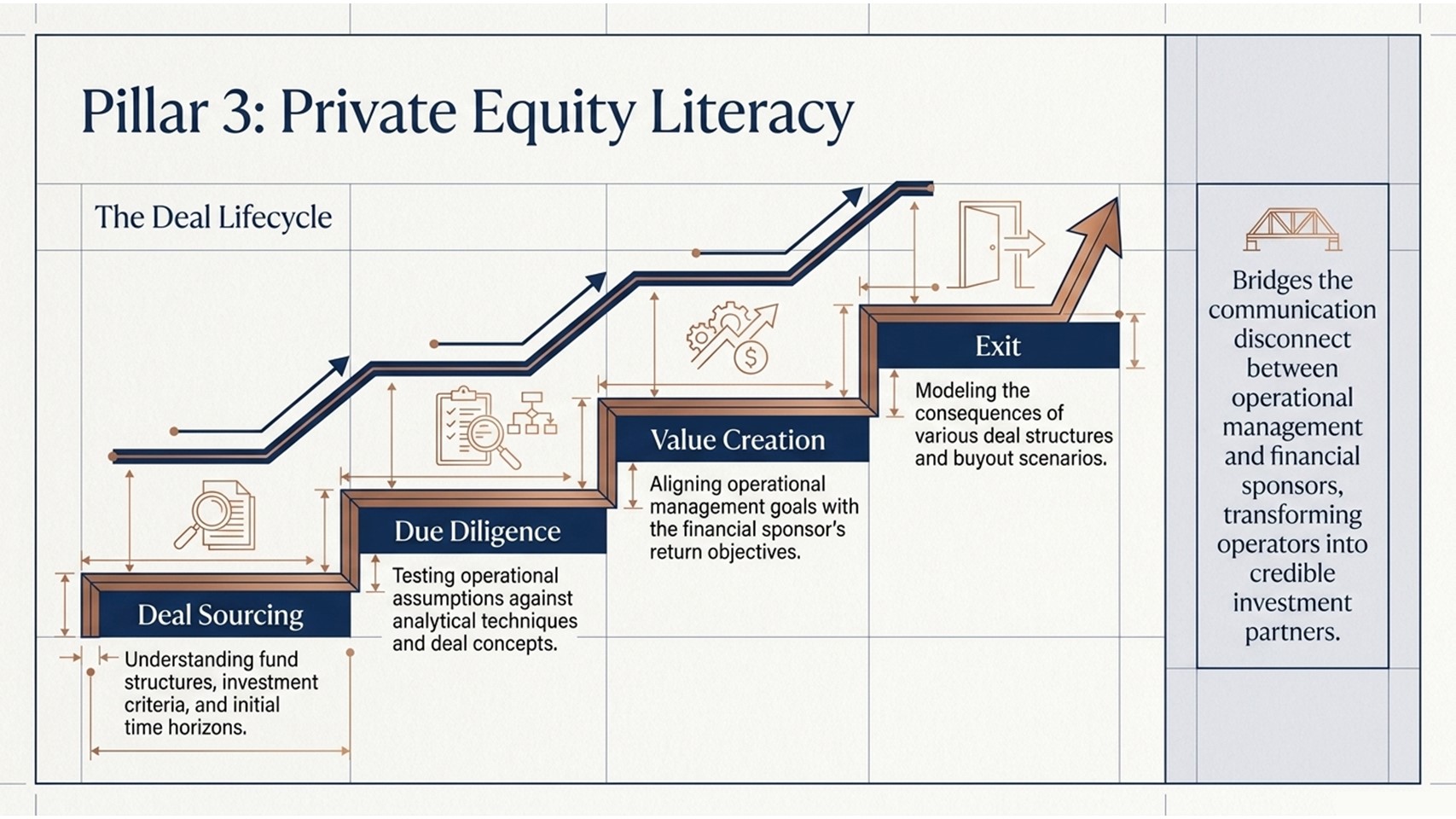
Private equity has become a place of major influence within companies’ strategies, going beyond a niche investment category. Right from the top to the bottom of the rung, it is becoming more and more important for business leaders to understand the thinking, valuation and return objectives of PE firms, as they explore business exit scenarios, the buyout of companies and investment.
However, private equity is not well known to investors beyond the finance specialist. There is a disconnect between many professionals whose job it is to engage with PE stakeholders (such as those in the C-suite, legal and operational management) and their ability to communicate with investors, model the consequences of various deal structures, or comprehend the meaning of value creation in a PE context.
A simple explanation of private equity is often the best starting point. The basics of funds—the structure, investment criteria, the time period, and exit strategies—provide a common basis for effective dialogue between the business operators and the financial sponsors. For anyone new to the field, exploring private equity basics for beginners through a structured online resource builds this foundation efficiently.
For finance professionals preparing for career transitions or seeking to deepen their technical knowledge, understanding how private equity investment works at a deal level — from deal sourcing and due diligence through to value creation and exit — is essential. Those preparing for interviews or career moves into the industry will find resources on PE interview questions and answers particularly valuable, as these programmes cover the analytical techniques, deal concepts, and financial intuition that firms test for. Professionals seeking formal recognition of their expertise can also pursue an online private equity certification course to signal their commitment to the field.
Business Valuation: The Language of Corporate Decision-Making
At the end of the day, it’s all about value in any major business decision, from a merger to an acquisition, a public round to a strategic divestiture. How much does this business sell for? What are the assumptions that are being made in that assessment? How does the value of the number change for various values of the numbers?
Business valuation is the field that provides answers to these questions and is one of the most common but misused fields of Corporate Finance. There are lots of professionals who have a cursory understanding of such concepts as discounted cash flow or EBITDA multiples, but who don’t have the depth to critically evaluate a valuation report, question the assumptions of the investment banker or build a credible independent valuation.
Knowing all of the business valuation methods —such as income, market comparables, and asset-based—allows business leaders to better understand how they interact with the advisor, investor, and counterparty in high-stakes situations. A business valuation course specifically designed for business professionals can give you this understanding, in addition to an understanding of the mechanics of each of the approaches to business valuation and how to apply them to the appropriate business situation.
Structured business valuation training programmes can be the solution for organisations looking to develop in-house valuation skills, which will save on the costs of using external valuers for more frequent valuations. Professionals who understand how to value a business from first principles are far better positioned to identify value creation opportunities, assess acquisition targets with precision, and defend their assumptions in front of boards and investors. Supporting tools such as a business valuation calculator can also serve as a useful reference point during early-stage deal assessment, providing a structured framework for initial estimates.
The Rise of In-House Corporate Training
Capability building is getting intentional in organisations, with many organisations developing learning programmes that are structured and offered to the company at large. The in-house training model has become popular, and it is especially favored by companies that wish to provide their employees with a consistent, contextualised learning experience on a large scale.
In-house training is simple to make attractive. Off-the-shelf programmes have generic content which may not be relevant to the needs, systems or priorities of a specific organisation. In contrast, a good in-house training provider will collaborate with the client to gain a deep understanding of the business environment, adjust training to fit in with the client’s needs, and provide training in a format that will maximize knowledge retention and engagement.
Corporate training services that are designed with business outcomes in mind — rather than simply delivering information — are far more likely to produce measurable results. Customized training programs allow organisations to focus on the skills gaps that matter most, whether that means building financial modelling capability in a project development team, introducing valuation fundamentals to a strategy group, or equipping HR leadership with the financial literacy needed to engage credibly in workforce planning discussions.
Well-designed workplace training programs also contribute to employee engagement and retention. Research consistently shows that professionals who feel their employer is invested in their growth are more likely to stay, perform, and recommend their organisation as a great place to work. Staff training programs that combine technical content with genuine application opportunities create learning experiences that translate into lasting behavioural change — which is ultimately what organisations are paying for.
Digital Learning: Building a Scalable, Modern Training Infrastructure
With the emergence of digital learning, the possibilities in corporate education have been forever changed. What used to take travelling, hiring of a venue, and much disruption of schedules can be provided now through high-quality online platforms, that are available for a variety of learning styles, geographies, and time schedules. For global organisations, in particular, the ability to provide a consistent and scalable training, using digital channels, is no longer a luxury, but a strategic requirement.
Effective e-learning content creation requires considerably more than converting a PowerPoint presentation into an online module. Learners engaging with digital learning content have high expectations: they expect the material to be engaging, interactive, visually compelling, and genuinely useful. To meet their expectations, they need to have expertise in areas such as instructional design, media production, and an understanding of learning science — things that most organisations lack in-house expertise.
This is why specialist providers focused on e-learning content development have become such a valuable partner for organisations investing in training infrastructure. A well-designed online learning content programme uses a combination of video, scenario-based exercises, assessments, and real-world case studies to sustain learner engagement and reinforce key concepts over time. Thoughtful e-learning content design ensures that the learning experience feels intuitive and rewarding rather than tedious, which is critical for driving completion rates and genuine knowledge acquisition.
In the case of financial education, digital platforms have helped a new generation of students to have access to high quality information, something previously reserved for people with the financial means to attend a costly course in the classroom or a prestigious higher education. A professional in Jakarta, Nairobi, or Manila can now complete an accredited online finance course at the same standard as a counterpart in London or Singapore — a democratisation of knowledge that is reshaping career trajectories and organisational capability across the globe.
Building a Culture of Continuous Learning
The most advanced companies recognise that training is not an event, it’s a continuous process that is part of the culture of the business. As financial products, legislation and market structure all change, some professionals have proven themselves to be more successful than others – and they are those who make learning a habit and not a one-off task.
It takes more than a robust training budget to develop this culture. This will need to be led by visible commitment of leadership; linked to employees’ progression into their next roles; and open to employees at all levels to follow through on continuing development. Learning is self-reinforcing when employees see others learning and being recognised and promoted for the skills they acquire in part.
For organisations seeking to formalise their commitment to professional development, offering structured pathways such as a corporate finance course with certification signals to employees that the organisation takes learning seriously — and that completing a programme carries real professional weight. Similarly, an online finance certification course provides individuals with a portable credential that validates their skills in a way that supports career advancement both within and beyond their current employer.
A financial management course for professionals that integrates strategic thinking with technical financial skills is particularly well-suited to mid-career professionals seeking to broaden their impact. These programmes combine the rigour of formal finance education with the practical focus that busy professionals need — delivering maximum value in a time-efficient format.
Conclusion of Smarter Business Decisions
People make decisions that impact organisations, from investments, growth, risk management, and what partnerships to pursue. And the quality of the decisions depends on the knowledge, skills, and judgement which people bring to the table. In a complex and fast world, investing in the capability of humans is not a choice but the basis for building all other competitive advantages.
The days of finance education, financial modelling, project finance knowledge, private equity education and business valuation are over – these aren’t to be the realm of the specialist, but of the business manager. These comprise the common ground of successful leadership in contemporary organisations. These capabilities are complemented by the world-class training infrastructure businesses have available, such as sophisticated digital learning content and in-house delivery models, which enable businesses to make better decisions, get things done faster and build more lasting value.
Those organisations that understand and take action now are preparing to make decisions – and to perform well – for years to come. In all intents and purposes, the investment in learning is the most significant investment that any business can make.