
What Skills Are Developed Through Corporate Finance Training Programs?
Graduates of corporate finance training will possess a skill set of analysis, modelling, valuation and investment evaluation to make informed decisions and advance their careers. Whether through a best finance course for beginners or advanced training, it prepares teams for modern finance roles.
Why Are Corporate Finance Training Programs Important for Business Competitiveness?
In today’s business landscape, corporate finance training is no longer a luxury but a strategic investment for companies seeking to stay competitive. Today’s finance teams are expected to be part of business planning, investment decisions and risk management at the board level, and go beyond traditional accounting and reporting. Even seasoned professionals can slip behind if they are not properly trained as market, regulatory and analytical tools change.
Companies that invest in finance training build teams that can navigate complex financial landscapes with ease and confidence. Individualized courses offered via corporate training services enable organizations to customize their learning objectives to meet their business goals and make sure that the skills gained in the training manifest right away into better job performance.
What Financial Analysis Skills Do Professionals Gain From Finance Training?
Most corporate finance positions revolve around financial analysis. Training programmes build up the professionals’ skills in analysing and interpreting financial statements, ratio analysis, business performance, and making viable conclusions from large data sets of financial information. A well-structured financial management course for professionals will typically include practical exercises using real-world financial data to build these competencies in a hands-on way.
In addition to data interpretation, finance training also teaches them how to clearly communicate financial analysis to non-finance audiences. Experts know how to present their results in an organized way, identify important findings, and validate decisions with data and not inferences. The financial background combined with effective communication skills is an asset to any organisation.
How Does Financial Modelling Training Improve Decision-Making?
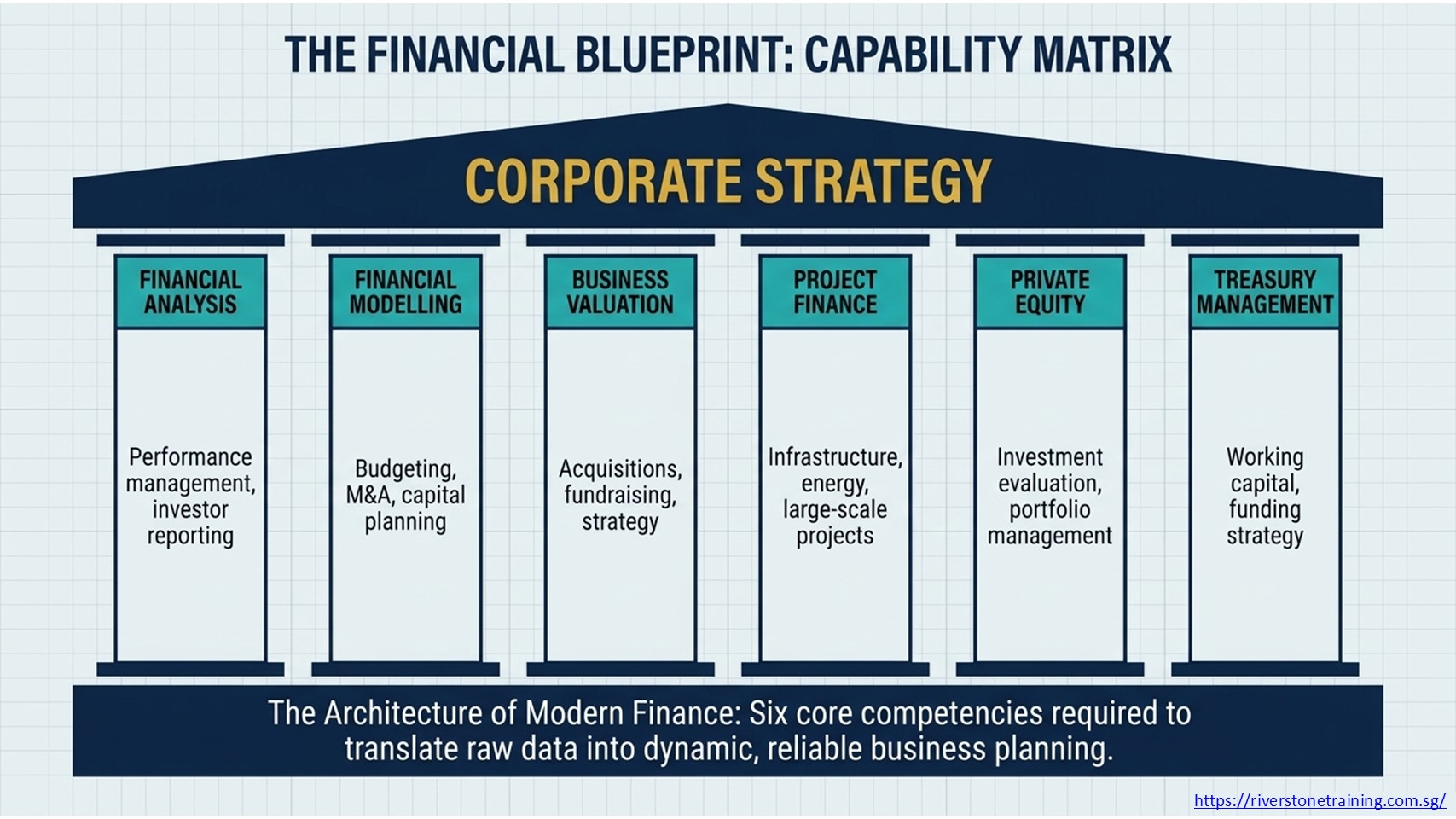
One of the most desired technical skills in corporate finance is financial modelling. A course in this topic provides professionals with the skills to create dynamic models in Excel for forecasting, valuation and scenario analysis. Courses covering key financial modeling techniques explained give professionals a structured framework for translating business assumptions into quantitative projections, enabling more accurate and reliable planning.
Modelling training is not just about how to use a spreadsheet — it is about learning to think logically, to grasp a sense of money, and to think through scenarios. Financial models assist decision makers to appreciate the financial repercussions of various strategic options, be it in budgeting, M&A analysis, or capital allocation. Professionals can start with a beginner financial modeling course in Excel and progressively build to more sophisticated techniques as their roles demand.
Table 1: Core Finance Skills Developed Through Corporate Training
| Skill Area | Training Focus | Business Application |
| Financial Analysis | Analysing statements, ratio analysis | Performance management, investor reporting |
| Financial Modelling | Forecasting and scenario modelling using Excel. | Budgeting, M&A, capital planning |
| Business Valuation | DCF, comparables, asset-based approaches | Acquisitions, fundraising, strategy |
| Project Finance | Cash flow modelling, debt structuring | Infrastructure, energy, large-scale projects |
| Private Equity | Financial economics and deal structuring, IRR | Investment evaluation, portfolio management |
| Treasury Management | Liquidity, FX, cash flow optimisation | Working capital, funding strategy |
What Business Valuation Skills Are Taught in Corporate Finance Programmes?
Knowing the value of a business is an essential tool for any financial professional who is a part of a merger or acquisition process, a fundraising process, a strategic planning process, or an investment analysis process. Training includes the key valuation techniques: discounted cash flow (DCF) analysis, comparable company analysis, precedent transactions, and asset-based analysis, and talks about how each technique should be applied in different situations. Understanding business valuation methods in depth allows teams to evaluate acquisition targets, support fundraising processes, and contribute to strategic negotiations with greater confidence.
Practical business valuation training takes business valuers beyond theory, giving them the chance to practice on real-life case studies, helping them to apply the appropriate method to various businesses, and helping them craft a defense of their valuations to management or investors. These competencies are highly applicable to corporate development teams, investment professionals, and CFOs who are frequently asked to discuss business value and investment feasibility.
How Does Project Finance Training Prepare Professionals for Infrastructure and Capital Projects?
Project finance is a nonrecourse or limited-recourse financing of large-scale capital-intensive projects, including infrastructure, energy, and real estate initiatives. The training provided here helps the professionals to develop and analyze project finance models, structure debt facilities, understand risk allocation among project contributors, and determine the bankability of a project. A project finance modeling course online typically covers the full lifecycle of a project from initial feasibility through financial close.
These skills are directly relevant to real-life transactions for anyone in the infrastructure finance, energy or development banking sectors. Learning how to build a project finance model equips analysts and managers with the tools to evaluate complex financing structures, model cash flow waterfalls, and perform debt capacity analysis. It’s very specialized knowledge that can greatly enhance the ability of finance departments in project-focused workplaces.
What Private Equity Knowledge Can Professionals Gain Through Corporate Finance Training?
Private equity training is focused on the basics of structuring a private equity fund, sourcing deals, how leveraged buyouts work, managing a private equity portfolio, and exit strategies. The students who have finished any private equity basics for beginners programme learn the ways in which PE firms evaluate and purchase businesses and how returns are realized and measured, as well as how investment professionals manage a portfolio during the holding period.
For corporate finance professionals, familiarity with private equity enables them to make better investment decisions around acquisition offers, comprehend investor expectations, and assess the financial structure of deals. Those working in investment banking, corporate development, or asset management particularly benefit from understanding how private equity investment works, as it provides a framework for thinking about value creation, leverage, and return on invested capital that applies well beyond the PE sector itself.
Table 2: Career Pathways Supported by Corporate Finance Training
| Role | Key Skills Required | Relevant Training Programme |
| Financial Analyst | Modelling, analysis, forecasting | Financial modelling, corporate finance |
| Corporate Development | Valuation and M&A, deal structuring | Company valuation, basics of PE |
| Treasury Manager | Liquidity, FX, cash management | Treasury and cash management |
| Project Finance Analyst | Project models, debt structuring | Project finance modelling |
| Private Equity Associate | LBO, fund mechanics, IRR analysis | Private equity certification |
| Finance Director / CFO | Strategy, governance, leadership | Greater financial and leadership skills |
How Does Digital Learning Transform Corporate Finance Education?
Digital learning has revolutionised the way finance training is delivered. For the first time, quality financial education is available to professionals to study at their own pace, without having to attend class. An accredited online finance course offers the same level of rigor as an on-site course, but is more accessible for teams and individuals located around the world who have busy schedules.
Well-designed digital learning content is not just digitized classroom content but also includes activities that engage students, scenarios, templates to download, and formative assessment to promote retention. Digital delivery also offers scalability, consistency, and measurable results unavailable with traditional training, especially for organisations that are training large finance teams.
What Are the Benefits of In-House Finance Training for Organisations?
In-house training allows organisations to tailor the finance programmes to their unique industry, financial environment, and team proficiency. Companies that opt for a seasoned in-house training provider can create content that aligns with their own financial models, reporting systems, and strategic priorities, instead of sending their staff to public courses. This technique helps to make learning relevant and immediately useful to the learner in the real world.
Tailored workplace training programs can also assist companies in developing uniform financial expertise across teams, ensuring competency match and lowering the performance gap between seasoned finance teams and fresher teams. HR leaders and L&D professionals can see the value in in-house finance training and measure it in terms of better performance of their teams and quality of decision-making.
How Does Finance Training Support Leadership Development?
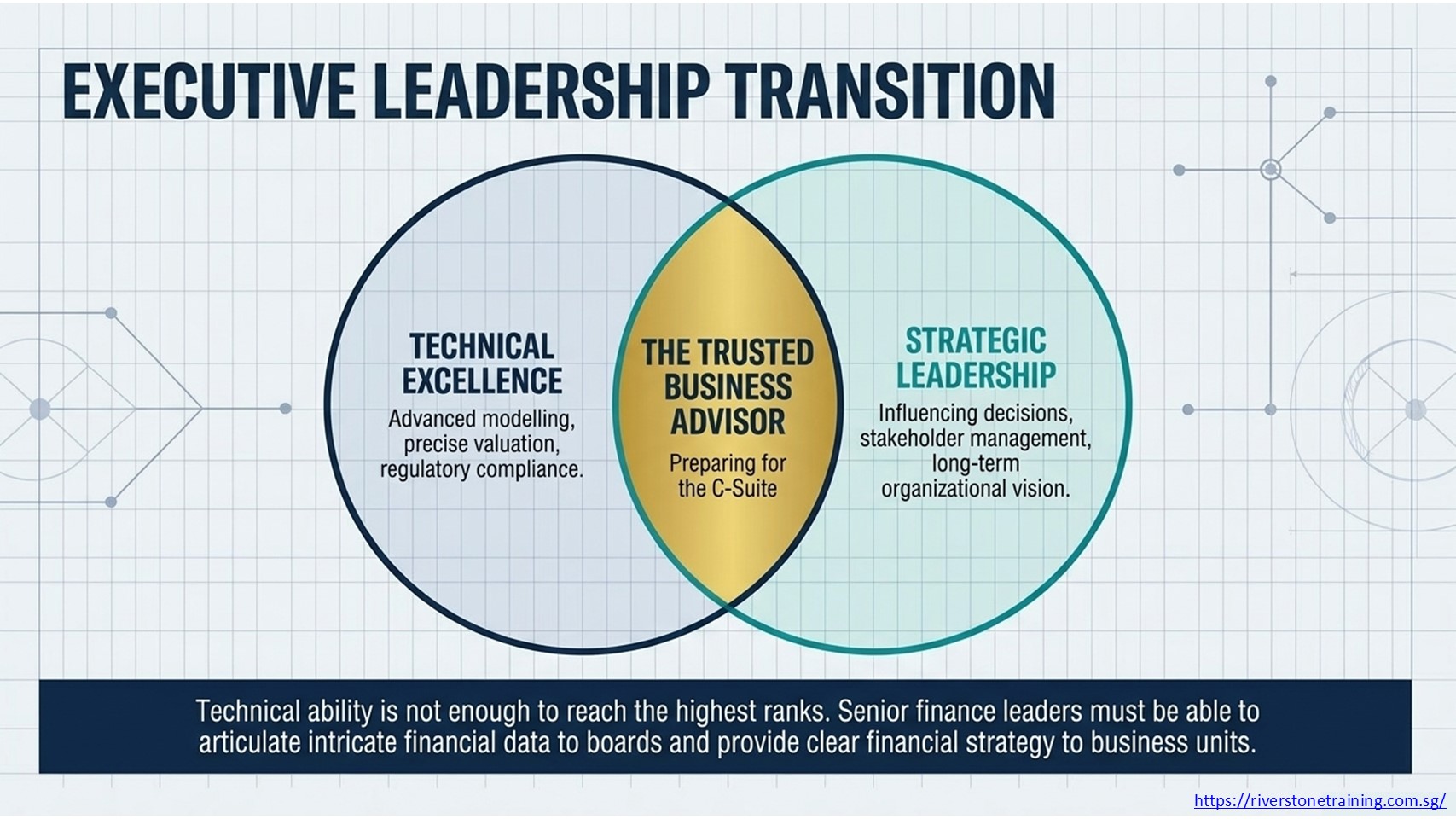
With the progression of finance professionals, technical ability is no longer enough in their work to go into the higher ranks. Professionals become trusted business advisors through finance training with leadership and strategic management. Senior finance leaders should articulate intricate financial data to boards, provide direction and financial strategy to business units, and oversee finance teams with clarity and direction.
Training programmes that combine technical finance content with leadership development build professionals who can influence decisions, manage stakeholders, and contribute to long-term organisational success. A corporate finance course with certification that includes strategic finance components helps professionals prepare for CFO and finance director responsibilities, making structured training a genuine investment in leadership pipeline development.
Table 3: Finance Training Delivery Formats and Their Advantages
| Delivery Format | Key Advantage | Best Suited For |
| Online Self-Paced | Flexible, accessible, scalable | Individuals and dispersed teams |
| In-House Instructor-Led | Customised to the organisation’s context | Corporate teams and departments |
| Blended Learning | Combines flexibility with interaction | Mid-level to senior professionals |
| E-Learning Modules | Consistent delivery at scale | Large workforce upskilling |
| Certification Programmes | Recognised credentials and career value | Career advancement and credibility |
How Can E-Learning Content Development Improve Finance Training Outcomes?
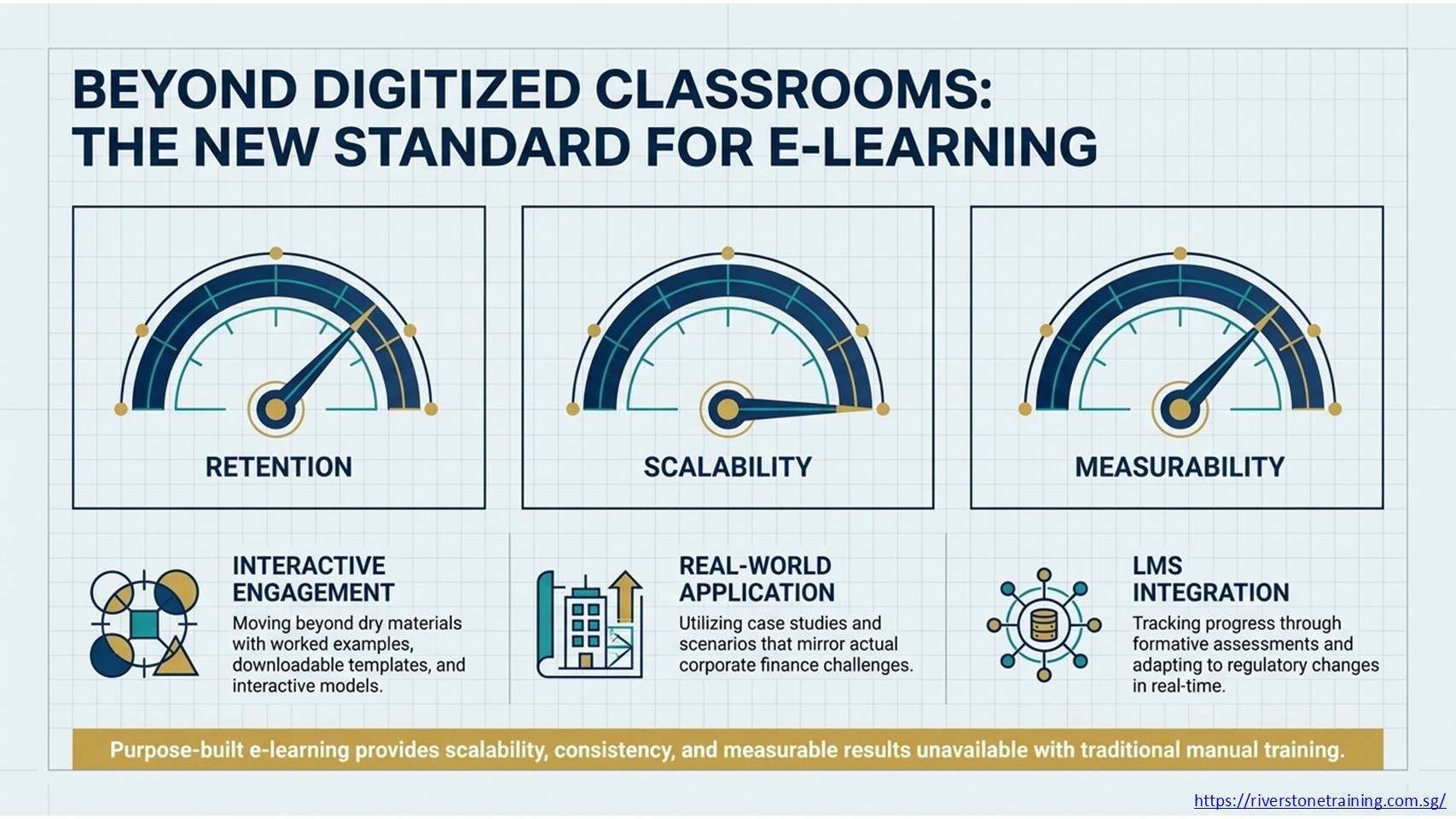
The effectiveness of online finance training is directly related to the quality of the e-learning content. When developed well, the e-learning content development results in the creation of learning materials that are interesting, well-organized, and help in strengthening learning. Learner engagement is lost as soon as finance knowledge becomes dry or too complicated — e-learning helps to make technical topics more relatable by using case studies, worked examples, interactive models, and real-world scenarios.
Organisations investing in online learning content for their finance teams benefit from content that can be updated to reflect regulatory changes, adapted to different roles and experience levels, and tracked through learning management systems. The quality, flexibility, and measurability of this make purpose-built e-learning an effective tool for scaling the capacity for finance in large organisations.
What Role Does Financial Modelling Play in Project Finance Skills Development?
Project finance and financial modelling go hand in hand. A key skill for those dealing in projects, whether in the infrastructure, energy, mining, or real estate sectors, is the capacity to assemble strong, Excel-based project finance models. Training in advanced financial modelling course online programmes develops the technical foundation professionals need before advancing into project-specific modelling contexts.
Dedicated project finance training for professionals then builds on that foundation to teach the specific structures, cash flow waterfalls, debt service coverage ratios, and sensitivity analyses that characterise project finance transactions. Professionals with such a unique mix of skills are some of the most technologically sophisticated and employable in the banking, infrastructure, and development finance sectors.
How Should Organisations Approach Selecting the Right Finance Training Programme?
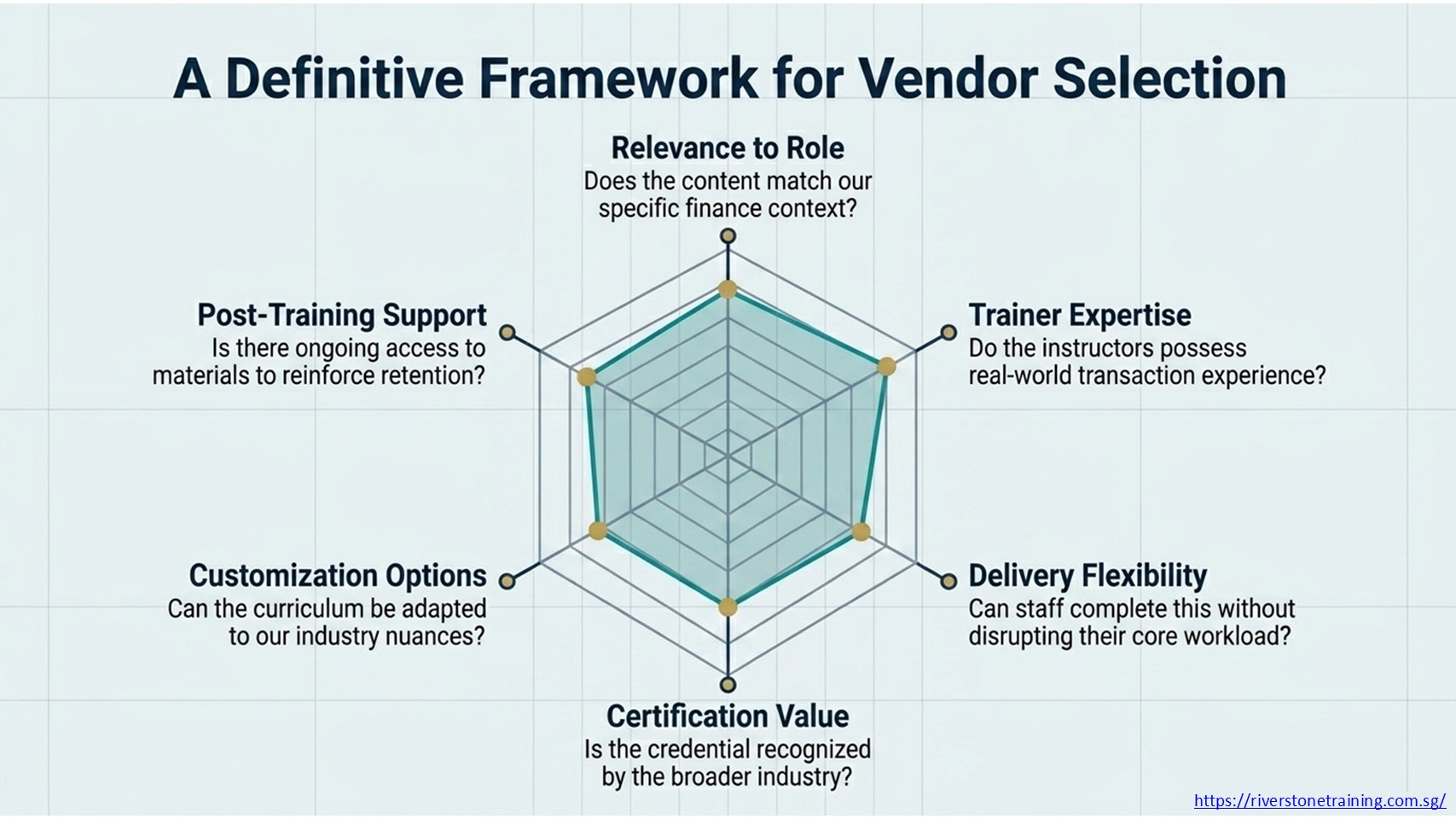
The key factors to consider when choosing a finance training programme include understanding the existing competency within the team, the strategic needs of finance in the organisation, and the limitations of time and budget. HR and finance professionals should focus on programs that are successful, have a clear learning objective, and content that is relevant to financial practice. A finance certification course online against these criteria ensures that the training investment produces measurable returns.
Providers with a wide range of training requirements in various aspects of finance — including modelling, valuation and project finance — will be better served by providers with a well-rounded curriculum, rather than separate courses. Where internal capability building is a priority, working with customized training program specialists allows the organisation to design a learning pathway that matches their team structure, business model, and long-term capability goals.
Table 4: Key Considerations When Selecting Finance Training
| Selection Criteria | Why It Matters | Questions to Ask |
| Relevance to role | Ensures practical application | Does content match our finance context? |
| Trainer expertise | Drives quality and credibility | Do trainers have real-world experience? |
| Delivery flexibility | Supports participation and completion | Can staff complete this around their workload? |
| Certification value | Supports career recognition | Is the credential recognised by employers? |
| Customisation options | Aligns learning to business needs | Can content be adapted to our industry? |
| Post-training support | Reinforces long-term retention | Is there ongoing access to materials? |
How Does Finance Training Support Long-Term Employability?
There is a clear correlation between finance professionals who are constantly learning and those who just rely on experience. There is a clear correlation between Finance professionals who are constantly learning and those who just rely on experience. Rigorous courses, like a business valuation course syllabus or advanced project finance modelling, guide professionals to stay up to date on market practices, analysis methods, and reporting standards. This continuous improvement allows them to be more versatile, more promotable and better prepared to face career changes.
For employers, supporting staff through recognised staff training programs is also a powerful retention tool. Finance professionals who see clear development pathways within their organisation are more likely to remain engaged and committed. The ROI on structured finance training is not just about the impact it has on individual performance; it also has a direct impact on the stability of the team, on organisational knowledge and on the ongoing performance of the business.
What Are the Benefits of Online Finance Certification for Career Advancement?
There are online finance certificates available that can certify professionals with their technical understanding and do not take a long time off from work. An online private equity certification course or a structured financial modelling programme delivers the same depth of knowledge as traditional classroom training, with the added convenience of flexible scheduling. Professionals who are working in demanding jobs and have to pursue their career goals may find that online certification is the most convenient choice.
Finance certifications also help to establish a common language among teams. Where more than one member of the team has undertaken a similar structured programme, there are common analytical frameworks, common terminology, and common ways of conducting financial problem solving in the organisation. This uniformity helps to enhance the completeness and reliability of internal reports, minimizes errors, and boosts the trustworthiness of financial outputs throughout the company. Programmes that offer real-world financial modeling examples as part of the curriculum are particularly effective at bridging the gap between theory and practice.
Table 5: Summary — Skills and Outcomes of Corporate Finance Training
| Training Area | Key Skills Developed | Career and Business Benefit |
| Corporate Finance | Analysis, reporting, budgeting | Stronger financial decision-making |
| Financial Modelling | Excel modelling, scenario analysis | Faster and more accurate forecasting |
| Business Valuation | DCF, comps, transaction analysis | Better M&A and investment outcomes |
| Project Finance | Project models, debt structuring | Confidence in large capital projects |
| Private Equity | LBO, fund economics, deal analysis | Investment and acquisition expertise |
| Digital / E-Learning | Flexible structured learning | Scalable capability development |
Conclusion
A Corporate Finance Training Program cultivates the entire range of capabilities that today’s finance professionals require to excel in finance, including financial analysis and modelling, valuation, project finance, and strategic leadership. Structured training equips finance staff with greater capabilities, confidence and business objectives.
The delivery format is not as crucial as the content itself: e-learning content design platforms, instructor-led in-house programmes and self-paced online certification all make for good delivery. Careers have a compounding effect, and rigorous, hands-on training can earn finance credentials, competencies, and career benefits that continue to build over time.
The question for business leaders and HR decision makers isn’t about whether to invest in finance training; it’s which programmes will make the biggest impact for their teams. Exploring options such as a best project finance modeling course, a how to value a business programme, or a comprehensive finance certification course online is a practical starting point for any organisation serious about building world-class finance capability.