
Corporate Learning Trends
Organisations are changing the way that they develop their people. From a largely reactive function, providing training when something went wrong, or it was required for compliance, it has become a proactive function, a discipline that is part of the way in which leading organisations develop their capability and competitive advantage.
In recent years, the changes in corporate learning focus reveal more of the changing nature of business leaders’ attitudes to talent. Employees are no longer just resources to be managed, but the key tool of adaptation, innovation and growth of organisations. The need to constantly learn and apply new skills is a clear sign of organisational resilience in the context of constant technological evolution, changing market dynamics, and increasingly complex regulatory, financial and business environments.
The HR Director, CLO, and CFO need to be aware of these trends, not only to keep up to date with best practices, but also to inform their investment decisions on where and how to invest in development to get the best strategic return. This article explores the most impactful corporate learning trends of today, exploring the increasing need for targeted finance training, the boom in digital learning, and the trend towards personalised training experiences that are designed to achieve specific outcomes.
From Compliance Training to Strategic Capability Building
For a long time, corporate training emphasized compliance-oriented programs — compulsory training in workplace safety, data protection, anti-money laundering and so on. These are essential, but the greatest change in corporate learning over the last decade has been that trainers do not have to meet compliance criteria anymore. It should need to develop the capabilities the organisation will need to implement the strategy and respond to change.
This shift is reflected in how organisations now approach investment in finance management training. Instead of just making financial education the finance department’s responsibility, innovative firms are applying structured finance programs to spread financial literacy throughout the company, empowering department heads, project managers, and business unit leaders to gain financial literacy, comprehend financial statements, manage budgets and meaningfully participate in strategic planning discussions.
This leaves behind a more economically savvy organisation, with decisions made at all levels based on a better understanding of the economic consequences of the decisions. This is a paradigm shift for HR leaders and learning and development professionals – corporate learning is no longer about controlling performance in current roles but becoming a proactive way to develop the skills and abilities required to address the needs of the business.
This strategic focus has also affected how organisations have come to define the success of training investments. While the standard metric previously was completion rates, now leading organizations measure and track skill acquisition, behavioral changes and even business outcomes. The focus is no longer on whether our people attended the training, but on whether the training helped us to do what we need to do better.
The Rise of Finance-Specific Corporate Learning Programmes
One of the most important developments in corporate learning is the need for more education on finance than goes into the basics. With ever more complex business models, more sophisticated capital markets and more consequential financial decisions, companies are putting significant resources into structured programs to build a true technical depth, rather than a fleeting awareness.
There’s been a particular surge in demand for Corporate finance workshops, and that’s because the fundamental principles of corporate finance (capital structure, cost of capital, investment appraisal and financial analysis) are relevant to uses beyond the use of the finance function. Structured training is a vital enabler for effective cross-functional collaboration, as the number of people in strategy teams, business development, and senior executives who are expected to be fluent with these concepts continues to grow.
Mid-level managers and emerging leaders are similarly motivated by the same as their counterparts, in terms of business finance training. Organisations are de-hierarchizing, devolving power is being delegated further down the business, and people making the decisions must be equipped with strong financial management skills. This foundation is now widely recognized as a key element of many of the top organizations’ learning portfolios and is structured into training programmes that are practical, business-centric, and do not require the learner to become an accountant.
The best finance training programmes are those that focus on the practical rather than the theoretical. The best programmes are designed to transfer learning into better business performance, through real-life business scenarios, relevant business case studies and hands-on exercises. This outcome-driven approach has become the norm to which organisations hold all their learning investments – and finance training is no exception.
Financial Modelling as a Core Corporate Competency
Financial modelling is, if there’s one technical skill that has gained the highest momentum in corporate learning programmes in the past few years, it’s financial modelling. The skills of financial modeling and financial analysis are traditionally the realm of investment bankers and specialist analysts, but now are increasingly seen as essential skills in a variety of professional fields, such as FP&A, corporate development, strategy and operations, and general management.
This is because of the following simple factors. With more and more data and data-driven organizations, structuring the financial information into coherent, dynamic models and being able to get actionable information out of those models has become a very valuable part of the job. Robust, well-structured finance teams are better equipped to aid strategic decisions, to assess opportunities and to control risk. If they are not able to, they are increasingly viewed as limiting the organisation’s analytical abilities.
One of the most popular skills that are in high demand in the corporate finance learning programmes is modeling for investment analysis. It offers frameworks and technical expertise to the analyst and financial professional to carefully evaluate investment opportunities, analyze results and develop the analytical rationale behind capital allocation decisions across various scenarios. This is a key capability for organisations with ongoing M&A or investment programs, and directly related to the quality of deal execution.
As businesses have increasingly identified the quality of forecasts as a direct result of the quality of forecasts they have and the skills of the people who are creating the forecasts, the demand for corporate forecasting training has risen in proportion. During an uncertain economy, financial forecasts must be accurate and properly structured, as they can be an early warning system that can help management be proactive in discovering new risks and course-correcting as needed before issues become crises.
For learning and development professionals designing finance curricula, financial planning models represent a foundational area of investment. Developing this skill in the organisation will help to remove any reliance on external advisers, speed up the financial analysis to a high-quality standard and improve overall levels of financial discussion at the management level. Programmes that develop business valuation modelling skills are similarly valued, particularly within organisations that regularly assess acquisition targets, conduct impairment reviews, or engage with external valuers in transaction processes.
Proficiency in advanced Excel modeling also continues to command significant investment, particularly in organisations where Excel remains the primary analytical tool across the finance function. Despite the numerous pieces of specialised software, Excel’s flexibility and ubiquity are still one of the most useful and transferable skills a finance professional can acquire, and a strong Excel skill set is still crucial.
Project Finance Knowledge: A Growing Priority for Capital-Intensive Industries
The world has seen a growing number of projects that require project finance professionals with extensive experience in the fields of energy transition, transportation, digitalization and urban development. In capital-intensive industries, assessing, structuring and managing project investments on large scales is no longer a specialist job, it is a necessary and critical business.
Project finance is a specialized field of finance which is quite different from regular corporate finance. It involves knowing how to package the financing based on the cash flows of a given project, how to share the risk between the several parties and how to evaluate the bankability of an investment in the lenders’ and equity providers’ eyes. These skills may not be developed in a generic financial education program, but must be developed with a financial specialist.
Project finance workshops have emerged as an important component of corporate learning programmes within infrastructure, energy, utilities, and development finance. These workshops provide practitioners with frameworks and processes to effectively interact with complex project transactions, from the perspective of a project sponsor, structuring finance as a lender, or on project investments.
The growth of infrastructure project finance as a learning discipline reflects the significant capital flows now being directed toward infrastructure globally. With the growing significance of private sector financing for infrastructure programmes, which cannot be funded solely by the public sector, the professionals who manage these funds, both public and private, have to understand project finance principles and practices.
At the technical core of project finance practice is financial modelling. Project cash flow modeling is the analytical foundation upon which most major project investment decisions are made. Being able to build revenue projections, operating costs, financing structures and debt service requirements for a project that accurately reflects a project, and then run sensitivity and scenario analysis on these models is a key capability for someone to work seriously in the field. For organisations with active project pipelines, project funding analysis and infrastructure investment training are among the highest-value investments a learning and development function can make.
Business Valuation: Why Organisations Are Investing in Valuation Literacy
One of the most basic skills in finance is the ability to evaluate the worth of a business, or an asset, or an investment. However, it is also one of the aspects where there is a lack of knowledge in corporate finance teams. While many professionals may be familiar with the concepts of valuation, very few have had the opportunity to acquire a true technical skill in valuation under the guidance of experienced practitioners.
This gap has repercussions. Organisations without effective internal valuation capability are more dependent on external valuation advisors to provide them with transaction and impairment valuations, less able to critique external valuation advice before M&A scenarios, and less likely to be able to undertake a well-informed capital allocation decision if presented with poorly constructed financial analysis. For organisations with a functioning corporate development programme, this is becoming a priority as a structured training path is increasingly clear.
In courses like a company valuation course, finance experts learn the fundamentals of the three key valuation techniques: DCF analysis, comparable company multiples, and precedent transaction analysis. Organisations are developing these skills in-house and, therefore, are less reliant on outsourcing their deal team skills for day-to-day valuations.
Valuation analysis workshops are especially suited for building up applied valuation skills, because the students may be working on live case studies and building models as they go along, with the facilitator’s guidance. This practical, hands-on method helps students move from theoretical to practical concepts, the key to having value in the business world.
For finance teams that regularly produce valuations for internal or external reporting, business appraisal training and financial valuation workshops help ensure that team members are applying consistent methodologies and sound professional judgement. More broadly, enterprise valuation training builds the kind of commercially grounded analytical capability that supports better decision-making at every stage of the investment or transaction lifecycle.
Private Equity and Alternative Investment Education: Meeting Market Demand
Private equity and alternative investment markets have expanded significantly in the last 20 years and now make up a significant share of the substantial capital invested worldwide. Few areas have seen as much activity or growth as the field of private equity, and its operation, value creation, structure and execution have become an integral part of the professional life of many finance professionals, especially those working in corporate development, treasury, family offices, institutional investment or advisory work.
This has led to a strong interest in formal private equity learning in the corporate learning environment. Courses on investment deal analysis provide the analytical skills necessary to evaluate leveraged buyout opportunities, model deal structures and evaluate the returns from an investment deal from the perspective of both the sponsor and co-investor. This is very practical knowledge for those who routinely work with financial sponsors, as advisers, counterparties or management teams.
Private investment workshops and acquisition finance training are also gaining traction among organisations that are actively in the market with an M&A programme or engage in capital markets activities. It helps to have some background into PE due diligence, financing structure and portfolio company management, which can bring more context into the corporate arena and can even help result in better and more commercially savvy negotiation outcomes.
For HR teams building learning programmes for investment or corporate development functions, a portfolio investment course or broader private markets education curriculum provides a structured and efficient way to develop relevant capabilities across a team, ensuring that professionals at all levels share a common understanding of how private capital markets operate.
In-House Training: The Case for Customised, Organisation-Specific Learning
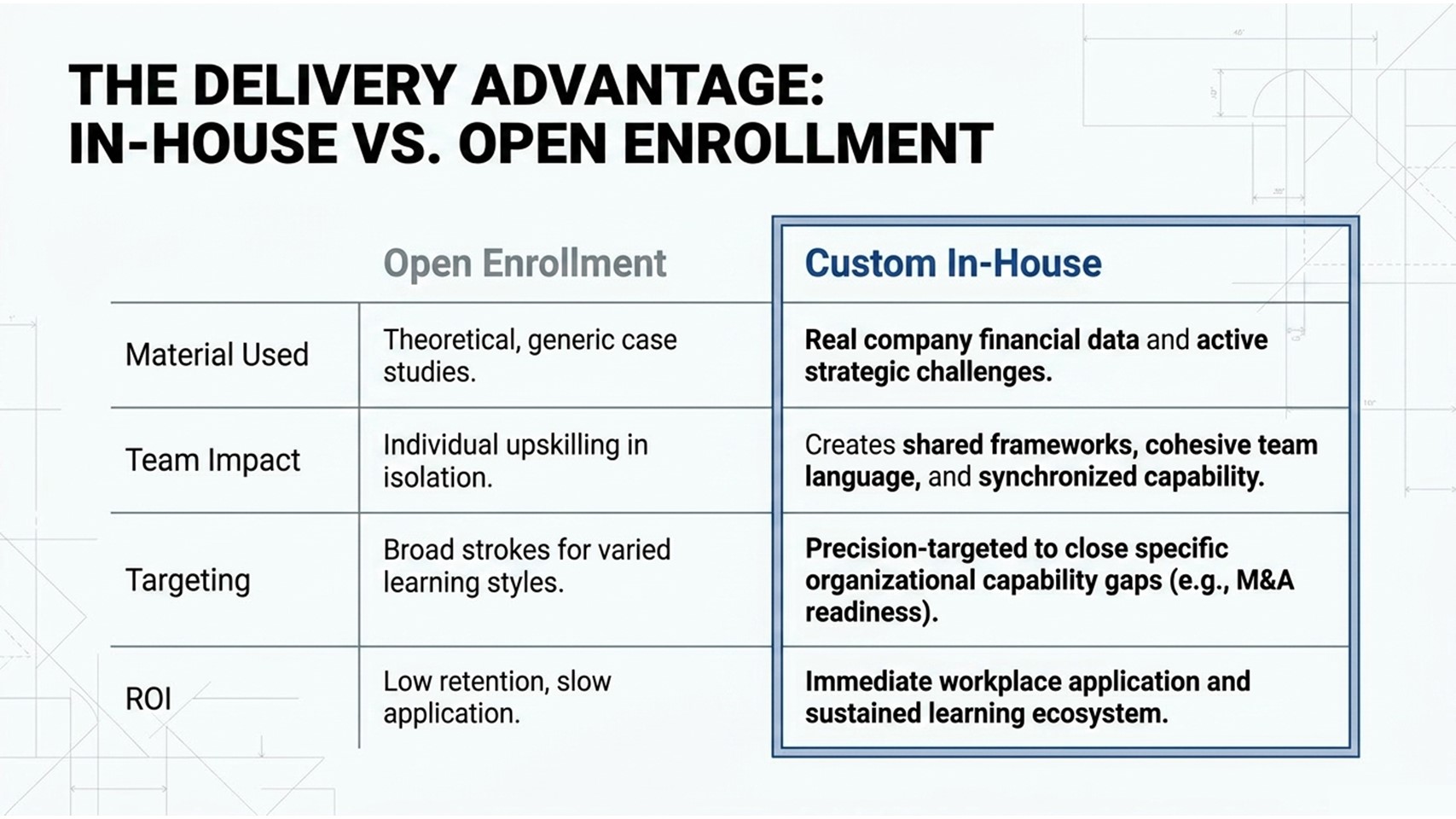
An important corporate learning trend over the last few years has been the shift from open enrolment courses to in-house programmes tailored to individual companies. Organisations have also learned that the best learning is when it is tailored to the local and business context, culture, and problems — for others, specialist courses are appropriate for certain learning styles.
Corporate workforce training delivered in-house allows organisations to use their own financial data, business scenarios, and strategic challenges as the raw material for learning. If participants can see how what they are learning relates to them and their organisation, then engagement is greater, they are more likely to retain it, and they will apply the skills and knowledge they’ve acquired more quickly and effectively in the workplace.
Employee skills workshops designed for specific teams also build cohesion and shared capability in a way that off-the-shelf programmes simply cannot replicate. If you’re learning a new skill as a whole finance team, learning the same frameworks, learning the same language, and learning from the same examples, you’re not just making somebody learn a new skill; you’re creating an incremental improvement in the entire team’s skill level.
Customized staff training has become the model of choice for organisations that have identified specific capability gaps that standard programmes do not address. A finance business partnering programme, an M&A readiness curriculum or in-depth technical training on project finance modelling can all be tailored and implemented to address the needs precisely, optimising the return on the investment in training. When combined with well-structured business training solutions and ongoing workplace learning programs, in-house training creates a sustainable, evolving learning ecosystem that grows with the organisation.
Digital Learning and the Shift to Blended Delivery
It is impossible to ignore the transformational role of digital technology in the design and delivery of learning, in any discussion of corporate learning trends. Digital learning platforms have been widely adopted in the last few years, especially in response to the pandemic that forced people to work remotely and in hybrid settings, and transformed the way people learn within the corporate environment.
Interactive e-learning is now a very evolved medium. The initial online learning models faced criticism for their lack of interaction, disinterest, and ineffectiveness in teaching complex skills. Today’s digital learning experiences are completely different – with simulations, branching scenarios, interactive models and adaptive assessments, these are truly effective in developing applied knowledge and skills.
For finance training in particular, learning content solutions built around interactive financial models and real-world case studies can provide a level of hands-on practice that is difficult to replicate in a traditional classroom — and can be accessed repeatedly, at any time, by learners working at their own pace. Digital education platforms also enable organisations to track learner progress, assess comprehension, and identify knowledge gaps at both individual and team levels, providing the data needed to target further development where it is most needed.
The most effective corporate learning programmes today typically combine digital and in-person elements in a deliberately designed blended approach. Employee online training handles foundational knowledge and self-paced practice, freeing up instructor-led time for the higher-order learning activities — complex problem-solving, case discussion, and skills application — that benefit most from direct human interaction. Custom e-learning modules that align to the systems, processes and terminology of the organisation add to the relevance and impact of digital learning, and can form part of a coherent learning portfolio that is strategically aligned.
Finance Strategy and the Learning Roadmap
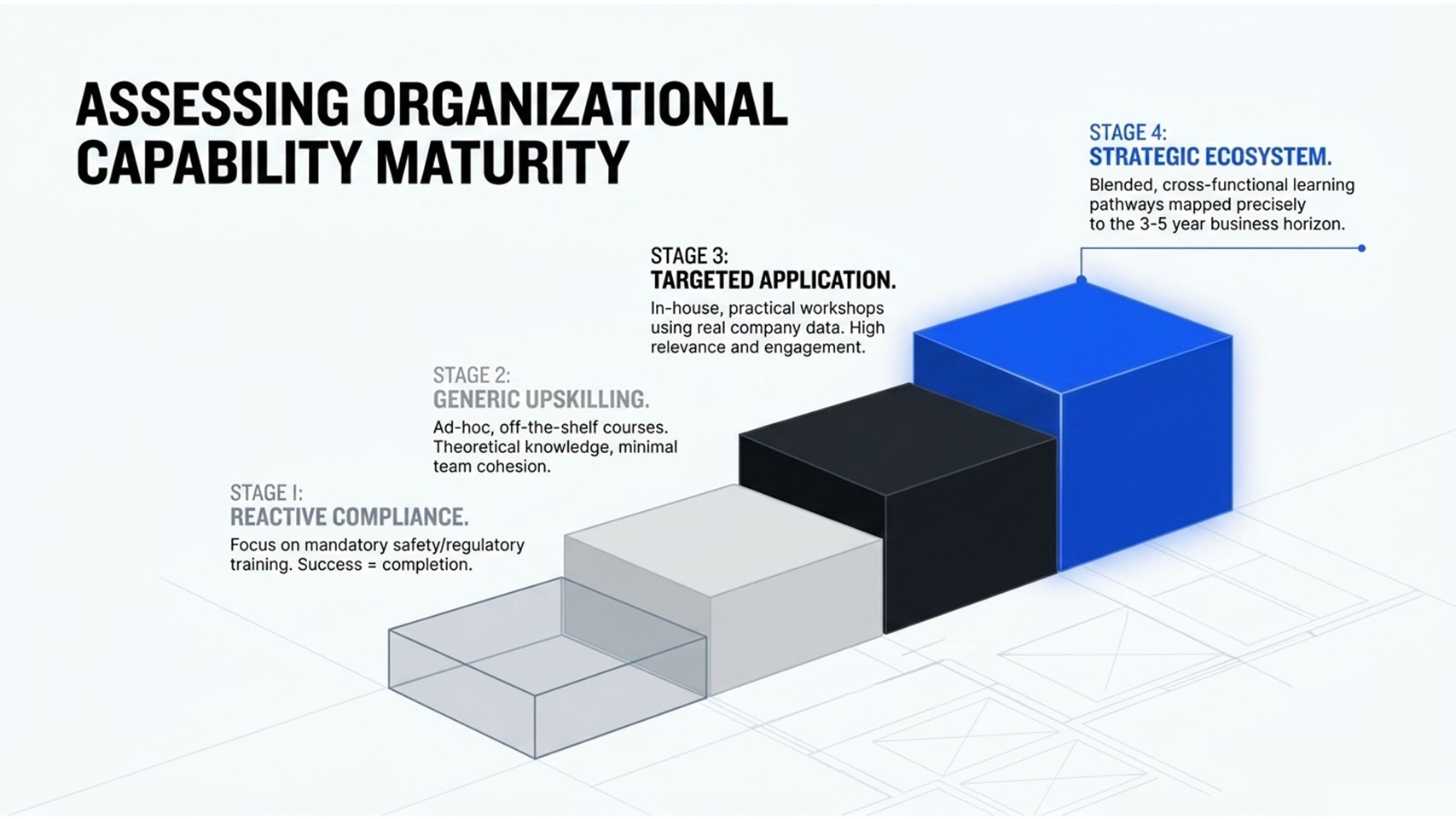
This will not work for organisations that are serious about developing true finance capability. The best finance learning programmes are structured as a learning journey of capabilities – planned and sequenced – based on a thorough evaluation of existing capability and future needs, and aligned to the organisation’s strategic objectives.
Investing in a finance strategy course helps organisations develop the frameworks needed to think about their finance capability development in a systematic way — identifying the skills the function will need over a three-to-five-year horizon, mapping current capability honestly against those requirements, and designing a learning roadmap that closes the gaps in a logical and resource-efficient manner.
Such a strategic investment philosophy in learning is becoming more common for a mature and successful finance function. It reflects a recognition that capability building takes time, requires sustained investment, and delivers the greatest returns when it is planned rather than reactive. Professional finance workshops that are part of a coherent pathway, as opposed to isolated events, have a deeper impact, work together, and achieve more long-lasting effects in terms of behaviour change.
Conclusion of Corporate Learning Trends
The world of corporate learning is evolving quickly, and it will be those who get it right and who invest in learning as a business decision, not a business cost, that will be the most successful. The directions of the trends mentioned in this article are all the same. These trends all indicate a shift in the same direction: toward strategic capability building, toward more finance-specific education, toward increasingly important financial modelling skills, toward the development of project finance and private equity learning, and toward more and more customised in-house training and toward the maturation of the digital learning approach.
The companies that will perform better than their rivals over the next ten years will be the ones that make a conscious effort and plan to invest in their staff to improve their capacity to make informed, sound decisions in complex and rapidly changing situations – to think clearly, analyse rigorously and make well-informed decisions. In short, HR leaders, learning professionals and finance executives: it’s now or never to develop these skills, and the organisations that do so with discipline and strategic intent will be rewarded for years to come.