
Modern Workforce Learning
An underlying change in organisational thinking about its people has taken place. Professional learning took the back seat for a large portion of the twentieth century, and was viewed instead as an “extra” that could be trimmed back when budgets are cut. Now, that’s been turned upside down. In a business world characterized by fast technology change, more complicated capital markets and higher requirements to prove measurable value on each function in the business, learning is no longer just on the periphery of the business strategy, but in the centre of it.
The organisations that make their transition the best explain that their greatest common denominator is that they have begun to view training as a continuous operating discipline rather than an event. They continually invest in developing their people and do so not because it’s cool to do so, but because they know this investment is directly linked to competitive performance.
This article outlines several elements of contemporary learning in the workforce, from the skills of money management and analytical modelling to project finance skills, investment knowledge and digital learning platforms — and explains why an organisation that invests heavily in these areas is taking a leap towards ongoing success.
From Training Events to Learning Ecosystems
The old-fashioned approach of sending a team of employees on a two-day training session, getting back the feedback forms, submitting the certificates, is not ‘bust’, but it’s not enough. Research on organisational psychology has repeatedly demonstrated that, despite a high-quality design, individual learning experiences that are only once in a lifetime are unlikely to be retained in the long term without practice, peer discussion and practical application to real challenges in the workplace.
The importance of leading organisations today is not the number of training events they offer but the quality of the learning ecosystems. They are places where all of the above aspects of capability development combine to form an ongoing cycle of learning — not a series of standalone efforts.
It takes conscious design to create such an ecosystem. It requires HR and L&D professionals to go beyond just scheduling and logistics and start to ask the deeper questions: What are the skills and capacities our organisation must have if it’s going to be able to be competitive in 3 to 5 years? What are the biggest areas of difference between what we’re already able to do and what we need to do? What mixes of learning activities will best close those gaps most efficiently and effectively over the long haul?
For many organisations, the answer to the questions is, clearly, the basics of their business and finance skills, which are so generic and so underdeveloped in every non-specialist population that if they invest in them, they will benefit the organisation in just about every position and at every level.
Financial Literacy as an Organisational Capability
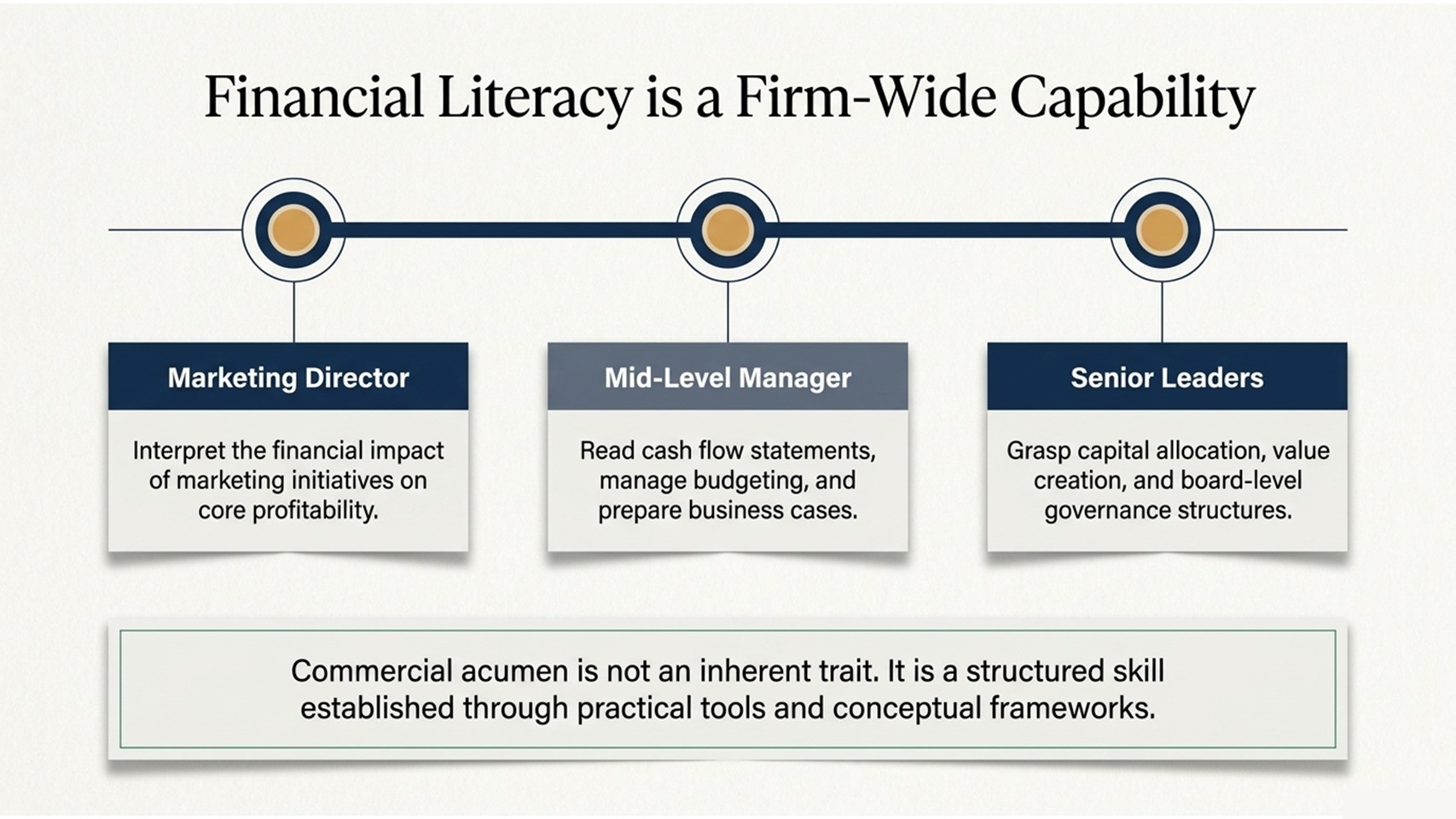
If you ask any business leaders if they would like their staff to be more commercially focused, their answer is almost always, “Yes. When you ask any business leaders if they wish their staff to be more commercially focused, the response is almost always, “Yes. When you ask what they are doing to develop that commercial attitude, it becomes not quite so consistent.
Employees don’t have or lack commercial acumen. It is a skill that can be learnt, and the best way of doing that is to provide people with organised financial management education, providing them with the conceptual frameworks and practical tools to confidently engage with financial information.
This is not just in finance teams; it’s important throughout the organisation. When a marketing director can interpret the impact of his marketing initiatives on a critical and profitable business, when a project manager can read a cash flow statement and understand its meaning about the health of a project, the quality of decision-making throughout the organization improves.
As finance learning courses become more readily available and professionally developed, organisations can increasingly scale their development of this capability. Instead of a one-size-fits-all approach, key organisations are designing learning programmes that are differentiated based on the role, level and business unit – and thus ensuring that the finance knowledge that their people gain is relevant to the decisions that are really being made by the person.
Senior leaders should consider executive finance programs as a more strategic approach, rather than one merely about the mechanics, as these courses will centre on how financial structures influence governance and control, capital allocation and value creation over time. The programmes are aimed at leaders with relevant and deep expertise in their own field, and who want to gain more financial literacy to be able to participate in board-level and investment discussions as credible partners.
The practical finance workshops at the functional level provide mid-level professionals with a foundation to be more effective in the budgeting process, business case preparation and performance review. They are often the employees whose overall actions have the biggest effect on the performance of the organisation, and the development of whose skills is most likely to be under-invested.
The Rise of Financial Modeling as a Core Business Skill
Financial modeling is knowing the language of business, and financial literacy is knowing the language of business fluently. The ability to create and interrogate financial models – essentially to turn business assumptions into quantitative projections and then experiment with these projections in various scenarios – is now one of the most desired skills in business, corporate finance, strategy and operations functions.
However, financial modelling is still not well-known and consistently applied in many companies. Teams have widely used spreadsheets that are undocumented and only the original authors are able to use. Assumptions are included in the background without being clearly stated. There is no scenario analysis; rather, it is an ad hoc addition. The outcome is not only the inefficiency of analytical processes, but also the risk of making decisions, since the models used in making key decisions are fragile and opaque.
Structured financial analysis modeling training directly tackles this by providing a discipline, repeatable and repeatable approach for building models — one that is professional, clear and easy to audit, and allows for flexibility. Participants discover how to extract input from calculations, how to create efficient models that can be rapidly updated when assumptions change, and how to present model output in a manner which enhances and does not hinder executive decision-making.
The application of forecasting model training is especially useful to organisations in markets that are volatile or rapidly changing. But to produce accurate forecasts, practitioners must know and think carefully about their assumptions about the forecast, including what variables are important, how sensitive the forecast is to changes in the variables, and what signs should be considered before revising the forecast. These are skills which can be taught and learned, and aren’t acquired by intuition.
For many practitioners, the journey begins with a well-designed Excel modeling course that builds from foundational spreadsheet proficiency to advanced techniques. Although many people know how to use Excel, it is the one thing that pays off more the longer you use it, and it is the one thing that is used for financial modeling in almost every corporate environment.
Organisations investing in business forecasting workshops and finance modeling workshops are finding that these programmes deliver some of the most immediate and measurable returns of any training investment — because better models lead directly to better-informed decisions, and better decisions translate into better business outcomes.
Project Finance: Specialist Knowledge for a Capital-Intensive World
Some of the largest and most complex investment activities in the global economy are infrastructure, energy, real estate development and public-private partnerships. The practitioners involved, from developer to lender, advisor to government counterparty, must have a degree of expertise that is more advanced than just corporate finance.
Project finance is a specific type of financing with non-recourse or limited-recourse debt structures, complex multi-party contractual arrangements, and long-term cash flow profiles which call for careful modelling and risk allocation. It is important for anyone involved in the structuring, funding and management of large capital projects that they have a technical understanding of this discipline, as well as conceptual.
High-quality project feasibility workshops allow professionals to analyze and determine project viability, financial viability and structural viability of the project for the appropriate financing. The workshops are a mix of theory and practical work based on the case studies, where participants learn to make decisions and make practical judgments that can only be acquired through practical, hands-on work with real project scenarios.
The development finance course landscape has expanded considerably in recent years to meet growing demand from professionals in property development, urban infrastructure, and social housing — sectors where the intersection of public policy, private capital, and community outcomes creates especially complex financing challenges. A knowledge of the structure of development finance, risk assessment by lenders, and how equity returns are modelled is vital to anyone interested in the interplay between these forces.
For professionals focused on infrastructure investment and assessment, project investment analysis training builds the skills needed to evaluate long-term capital commitments — incorporating construction risk, operational risk, regulatory risk, and the various contractual mechanisms used to allocate those risks between project parties. This is knowledge that is directly used during investment committees, credit approval, project governance, etc.
The energy sector presents particularly important training needs as the global transition to cleaner energy sources creates new financing structures, new counterparty risks, and new regulatory frameworks that practitioners must understand. Energy finance training equips professionals in this space with the sector-specific knowledge they need to navigate renewable energy project structures, offtake agreements, carbon markets, and the evolving landscape of sustainable finance. Alongside this, capital project modeling remains a foundational competency — the technical ability to build integrated financial models that capture the full complexity of a major infrastructure project from development through to operations and eventual refinancing.
Private Equity and Investment Strategy: Building Internal Expertise
Over the last two decades, the private equity and alternative investment sector has undergone a huge expansion and influence in the world. But today, private capital is an integral part of the life of a company, whether or not that company is an investment practitioner, in infrastructure investments, real estate markets and technology investments.
It’s no longer just essential for professionals who work closely with private equity, such as those in corporate development, advisory or portfolio management, or senior leadership, to acquire an understanding of how private capital works. Private equity education helps these professionals understand the investment thesis-driven approach that characterises private equity thinking, the mechanics of fund structures and return attribution, and the dynamics of the principal-agent relationships that govern fund management.
At the deal level, investment strategy training builds the frameworks needed to evaluate investment opportunities with rigour and consistency — from initial screening and competitive positioning analysis through to detailed financial due diligence and post-acquisition value creation planning. This type of training is particularly useful for corporate development and M&A teams as they are essentially doing a type of investment analysis for their organisation every time they review an acquisition or strategic partnership.
An equity investment course provides a broader foundation for professionals who want to understand how equity markets function, how investment returns are measured and benchmarked, and how institutional investors construct and manage portfolios. For investment professionals, it’s a context that is not only pertinent to their own work, but one that is relevant to any executive who deals with shareholders, who are involved in capital-raising procedures, or who is responsible for the way that corporate strategy is linked to investor expectations.
More specialised programmes — including private capital workshops focused on fund structures, LP/GP dynamics, and capital deployment strategies, and buyout finance training that explores the mechanics of leveraged transactions — serve professionals who need deeper technical grounding in specific aspects of private markets. These programmes reflect the growing demand for specialist knowledge in a space that was once understood only by a narrow community of practitioners but now influences decisions across a much broader range of organisations.
Valuation: The Commercial Skill That Touches Everything
Business valuation could be one of the most widely applicable of the skills and knowledge that set commercially savvy professionals apart. The industry consists of people who have a wide variety of functional backgrounds who are involved in decisions regarding acquisitions and disposals, fundraising and strategic partnerships, executive compensation, and regulatory compliance, to name a few, and they rely on valuation knowledge.
However, knowledge of valuation methodology is largely still in the hands of specialist finance jobs, and many decision makers lack the tools they need to analyse and question the valuations they receive, undertake or are required to approve. This is an actual risk, especially when negotiating crucial commercial deals where questioning assumptions and testing conclusions can make a big difference to the financial results.
Structured valuation methods course programmes address this by giving professionals a systematic understanding of the principal valuation approaches — discounted cash flow analysis, market multiples, precedent transactions, and net asset value — along with the contextual judgment to understand when each approach is most appropriate and what its limitations are.
Corporate valuation training takes this a step further, exploring how enterprise value is constructed, how different capital structures affect equity value, and how to interpret the range of value outputs that sophisticated valuation analyses typically produce. Participants acquire the technical skills needed to construct and evaluate valuation models as well as the business acumen to apply the models in the overall strategic and market context.
For professionals dealing with specific asset types, asset valuation workshops provide targeted instruction on how physical, financial, and intangible assets are assessed — covering everything from real estate and infrastructure assets to intellectual property, customer relationships, and technology platforms. With the rising significance of intangible assets to the value of the corporation, the types of expertise that these experts offer have gained significance all over the industry.
The ability to perform business worth analysis — forming a reasoned, defensible view of what a business or asset is worth in a given context — is a capability that elevates any professional who possesses it. And a robust valuation strategy course ensures that this capability is grounded not just in technical methodology but in the strategic thinking needed to apply it effectively in real-world commercial situations.
In-House Training: The Case for Bespoke Development
Organisations have more options than ever for professional development, as there have been more good-quality open-enrolment programmes and digital learning content available. For other organisations, however, and especially those looking to develop capacity at scale and/or fast-track the development of high-potential groups, bespoke in-house training is the most powerful option.
That’s because no set of generic programmes can be effectively translated into the context-specific nature of training that is tailored to the problems, culture and strategic direction of an organization. Leadership development workshops delivered in-house can incorporate the organisation’s actual business context, draw on its own case studies and historical decisions, and align learning outcomes with the specific leadership behaviours the organisation is trying to build.
This contextual relevance is particularly important for professional staff training at the functional level, where the gap between generic frameworks and specific job requirements can be significant. A programme focused on financial modeling around the organisation’s existing models with its existing data and business drivers will generate more learning that can be readily applied to the business.
Internal training programs also create shared learning experiences that build social capital alongside individual capability. Shared learning, working through case studies as a group, questioning assumptions, creating common approaches to thinking about complex problems, etc., results in not only new knowledge, but also more cohesive professional relationships and understanding of the issues among colleagues.
Organizational learning workshops that are designed with this social dimension in mind tend to produce more durable results, because the learning is reinforced through ongoing interaction between participants rather than fading once the workshop concludes. And corporate development training programmes that are embedded within broader talent management strategies — linked to career pathways, performance frameworks, and succession planning — send a powerful signal about the organisation’s commitment to the long-term growth of its people.
Digital Learning: Enabling Scale Without Sacrificing Quality
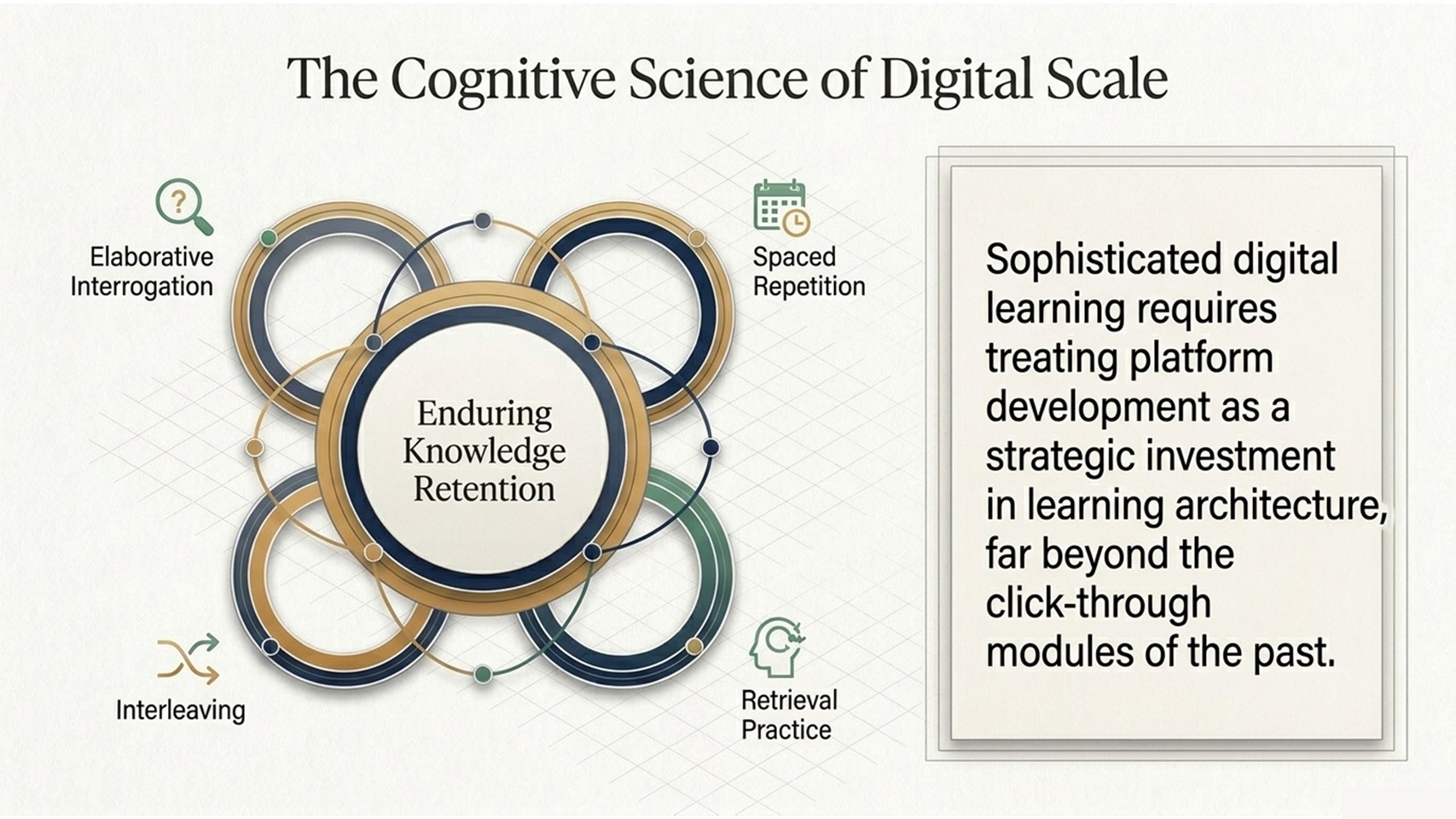
As the digital learning technology has changed what is possible in corporate training, those organisations that have recognised and embraced this change are reaping huge rewards as a result of the reach, consistency and cost effectiveness that it brings.
Online learning solutions today are substantially more sophisticated than the click-through e-learning modules that gave digital training a mixed reputation in earlier years. In the modern digital learning design, strategies of cognitive science are used — spaced repetition, retrieval practice, interleaving and elaborative interrogation — to create learning experiences that are truly effective in developing enduring knowledge and skill.
For organisations with large, geographically dispersed workforces, digital training programs solve a logistical challenge that classroom-based training simply cannot address at scale. Being able to provide employees with consistent, high-quality learning content regardless of time zone or location — with the coordination savings of travel, scheduling and venue management — is a real operational benefit.
The development of bespoke digital learning content requires specialist expertise, and organisations that treat e-learning platform development as a strategic investment — rather than a technology procurement decision — tend to get substantially better outcomes. The best digital learning platforms are not only content repositories, but they are also intelligent platforms which can adapt to the needs of individual learners, surface content that is relevant at the right time, monitor progress in relation to competency frameworks and provide data to continuously improve the learning offer.
High-quality virtual training content — whether in the form of video instruction, interactive simulations, branching scenario exercises, or assessed knowledge checks — requires careful instructional design to be effective. Production values are important, but not as important as the quality of the learning architecture (how content is organized, how concepts are presented or reinforced, how learners are challenged in using what they learn in their work environment).
As organisations build out their digital learning capabilities, the integration of online education systems with existing HR and talent platforms becomes increasingly important. The benefit for the organisations that learn as data flows into their talent management systems is that they can relate skill development to performance results, proactively determine when gaps become problems, and inform their talent and workforce decisions with data.
Finance Skills Training as a Strategic Investment
Across all of the dimensions explored in this article — financial literacy, modeling capability, project finance expertise, investment knowledge, valuation skills, in-house development, and digital learning infrastructure — a common thread runs through the organisations that are getting this right: they treat finance skills training as a strategic investment rather than an administrative overhead.
This difference is of more importance than it might seem. Training is done as an overhead, and is managed for efficiency, to reduce costs, increase throughput, and check off compliance boxes. As an investment, it is managed for return; that is, what is needed, how to develop it, and how to measure and prove the benefits of training investment.
The finance skills training landscape available to organisations today is richer and more varied than at any point in history. Organisations have more tools than ever to develop the financial knowledge and analytical skills of their people, thanks to the specialist programme providers, digital learning platforms, in-house capability and professional networks.
It’s not about access to training, it’s about the organisational willingness and clarity of purpose to invest in training consistently, link training to business focus, and have a culture of rigour and accountability, such as is applied to other important business investments.
Conclusion: Learning as a Competitive Imperative (Modern Workforce Learning)
Learning in the modern workplace is not a programme, a platform or a policy, but a rich tapestry of learning possibilities. It’s a discipline — a discipline which needs the ongoing oversight of leadership, a clear direction and a real interest in the development of the people of an organisation.
Some of the most important but least developed organisational skills explored in this article are finance, analytical and commercial. Those organisations that fill them in – with properly structured finance education, training in modelling, specialist project finance knowledge, expert finance valuation training, and carefully used digital learning – create opportunities that are hard to beat.
Investment is the only thing that goes up in value – people do! Amid the increased pace of change and the complexity of business decision-making, the organisations that make the biggest, most strategic investment in human capital are the ones most likely to have their best foot forward when it comes to what’s next.
The organisations that understand this are not waiting. They are building.