
Case Study: How Custom eLearning Content Development Improved Employee Productivity by 40%
Introduction to Custom eLearning Content Development
The reason why Corporate Training Is a Digital Shift
In the rapidly competitive and technological world of business, organizations are continuously pressurized to improve productivity, continue to be cost-effective and excellent in the operation they undertake. Classroom workshops, printed manuals, and periodic seminars also become a traditional training method that in most cases does not provide and show consistent and scalable results. With the growth of companies in different regions and the advent of hybrid work models, the issue of digital learning has become the most popular option to standardize knowledge delivery and assess the workforce capacity.
As this case study has shown, a mid-sized logistical enterprise took advantage of an Elearning Content development project to leave behind the ad-hoc training practices and move towards a digital ecosystem, which is performance-based.
The Price of a Badly-designed eLearning
Prior to change, the organization spent a lot of money on instructor-based lessons that yielded decent attendance but could not measure any significant change. The content of training was different depending on the location, evaluation was not standardized and did not solve any underlying performance problems.
Badly formatted digital conversion processes are also not very effective in case they only copy the slides in web form. In the absence of connection to business measures and behavioral results, Elearning Content development may turn into an administrative rather than productive facilitator.
The enhancement of ROI by an Enriched Content Development Checklist
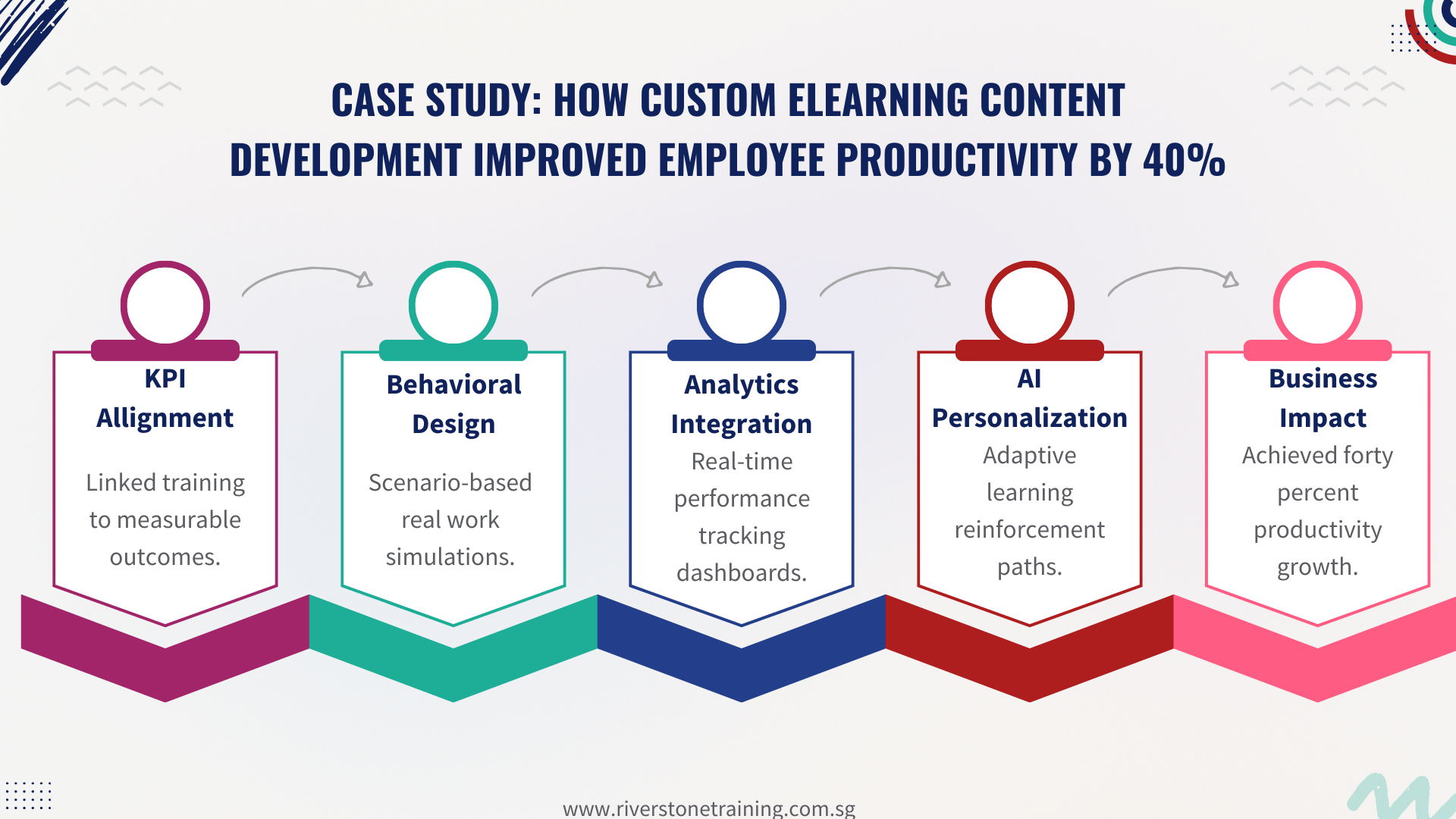
The company integrated a systematic structure that included strategic congruence, doesactic plan, technology combination, and quality control. The leadership did not concentrate on the creation of the content but instead considered Elearning Content development to be a holistic performance intervention.
With a direct mapping of learning aims to operational KPIs and a built-in applied simulative component of curriculum design, the organization developed an outcome-measurable route between training attendance and company performance.
What This Guide Will Contribute to the L&D Leaders
This case study describes how systematic planning, governance, and behavioral-based design have helped achieve a 40 percent productivity increment. It gives a real-life example that L&D leaders can use to make digital training a strategic performance accelerator.
1. Specific Learning Objectives (SMART-Based)
Training to Business KPI
The company started by stating clear goals based on operational measures. Examples of key performance indicators were the rate of order accuracy, the speed of processing orders, the speed of resolving customer service, and productivity of labor-hours. The development modules of the Elearning Contents were connected to a particular measurable improvement objective.
Correlation of Objectives with Measurable Outcomes
Instead of imprecise objectives like, improve understanding, objectives were formulated in terms of behavioral consequences, like, reduce shipment documentation errors by 20% in three months. This transparency brought accountability and enabled the leadership to follow direct influence.
2. Persona Analysis Audience/Learner
Proficiency, Occupation, Online fluent
Having 1,200 employees and branches in several hubs, the capacity of the workforce was quite diverse. The competencies pathways needed by warehouse personnel, customer care department employees and supervisors were varied. Persona analysis helped in the design of differentiated modules through the larger Elearning Content development strategy.
Cultural and Regional factors
There were operational hubs that worked in various regional settings. Localization of the content scenarios was done to capture the practical work environments at the workplace with rigorously standardized procedures.
3. Training needs assessment (TNA)
Performance Gap Analysis
The evidence indicated with repetition of order mistakes, delayed shipment tracking and irregular use of the system. These results indicated the existence of fragmented knowledge transfer as the major productivity barrier.
This evidence-based diagnosis did not allow the organization to build generic training but did influence specific interventions of Elearning Content development.
Stakeholder Interviews
Supervisors and operations managers gave insight on the issue of behavior in case of high-pressure situations. The simulations were in the digital modules based on these insights.
The Training vs Compliance
The organization separated the groups of required compliance modules and performance training that were productivity-oriented. This segregation provided a focus on design in the strategy.
4. Clear Success Measures and ROI Measures
Completion Rates
During the time of monitoring completion rates were not regarded as the first indicators of success.
Knowledge Retention
Retention was assessed by periodically administering reinforcing quizzes.
Behaviour Change Metrics
Managers monitored the changes in the accuracy of the tasks and consistency of decision-making after the training.
Business Impact Tracking
In six months, the productivity (output/hours worked) had grown by 40 percent. Delays in shipments reduced by 22% and time taken to resolve customer service reduced by 35. These findings justified the ROI of the Elearning Content development project.
5. Efficient Instructional Design Framework
Agile Learning Design vs SAM vs ADDIE
The model used by the organization is built on Agile so that rapid iterations and the incorporation of feedback can be made during the rollout.
Adult Learning Principles
The modules took practical relevance and application over theoretical education.
Cognitive Load Management
The information was divided to avoid overburdening and enhanced absorption and retention.
6. Storyboarding and content Structuring
Logical Module Flow
The modules were developed based on basic ideas to practical simulations.
Retention Content Chunking
Every module was covering a certain competency cluster to keep the clarity.
Script development, Storyboard development
Storyboards were detailed and synched images and objectives with assessment apparatus across the Elearning Content development lifecycle.
7. Modular Design Microlearning
When to Use Microlearning
Microlearning was used to implement system updates and refresher compliance.
Designing Bite-Sized High-Impact Modules
Brief scenario-based modules enhanced participation and reduced the disruption of business time.
Mobile-First Learning
The modules were accessed via mobile devices by employees which allowed flexibility of shifts and locations.
8. The Elements of Engagement and Interactivity
Scenario-Based Learning
Scenarios simulating the differences in shipments and customer complaints were reproduced through interactive simulation. The staff members had been trained in solving problems within fake time limits.
Gamification
The use of progress tracking and performance scoring as motivators to participate in the process effectively.
Branches of Logic and Simulations
Branching paths enabled the employees to feel the effects of decisions, which enhanced situational judgment.
9. Multimedia Optimization
Video, Animation, Voiceovers
Videos were used to demonstrate proper execution of the processes.
Visual Priority and Interface Sanity
Clean interface minimized the errors of navigation and cognitive load.
Accessibility Standards
There was optimization of content to facilitate reader-friendly content and device compatibility to achieve an inclusive participation.
10. LMS Standards and SCORM/xAPI standards
Achieving a Smooth LMS implementation
The presence of the LMS allowed integrating with the current management system and autonomously tracking the indicators of participation and performance.
Ability to track data and analytics functionality
Training engagement was associated with KPI operational shifts through real-time dashboards, which strengthened strategic transparency.
11. Mobile Responsiveness and Testing of the device
Hybrid Workforce Contemplations
Both the employees in various hubs accessed modules without any form of interruption.
Offline Accessibility
Offline usage helped employees in warehousing facilities with low connectivity.
12. Artificial Intelligence and Customisation
Adaptive Learning Paths
High-room tracking made it possible to identify the gaps in the skills and focus on the reinforcement modules.
Intelligent Content Recommendations
The system suggested performance-based refresher modules that increased the long-term retention.
13. Adherence and Regulatory Conformity
Compliance training related to industry
Legal compliance was ensured through regulatory changes, which were added as separate modules.
Information Security and Privacy Concerns
The data of employees was securely protected with the help of LMS architecture.
14. Pilot Testing and Feedbacks
Sample Learner Beta Testing
A pilot was conducted with 200 employees that tested navigation flow and scenario realism and deployed it afterwards.
Iterative Improvement Process
Adjustments reflecting on the feedback enhanced the clarity of the content and interest.
15. Constant Updates and Upgrades
Quarterly Review Cycles
Refinements were made based on performance data quarterly.
Analytics-Driven Enhancements
These KPIs were analyzed operationally to make future changes in modules.
Keeping Content Relevant
With the development of the systems, new micro-modules ensured the agility of the workforce and kept the Elearning Content development program successful.
Mistakes in eLearning Development in Corporations
The organization also did not fall into a number of pitfalls. It did not cram too much theory on modules. Applied simulations were used as a priority of engagement. The KPI dashboards incorporated post training measurement. The content was tailored to the operational functions instead of basing on one-size-fits-all approach.
Such rigorous activities distinguished the program compared to past training programs.
Internal vs Outsourced Development Decisions
The capability of internal design should be compared by organizations to the level of needed performance transformation.
Budget Allocation: Budget allocations must be made prior to initiating activities of the project. Budget Allocation: It is important to have budget allocations before activities of the project are initiated.
Strategic alignment, the design of behavioral simulation and integration of analytics should be a priority in investments as opposed to superficial multimedia enhancements.
Performance Analysis: How to Decompose the 40% Productivity Growth
Although the headline outcome, which is a 40% productivity rise, is something that grabs the interest of the executives, a better strategic insight can be made into how that outcome was achieved. The fact that training was transferred online did not lead to improvement of the organization. The quantifiable benefits were achieved as a result of deliberate engineering choices that were instilled in the lifecycle of Elearning Content development.
Efficiency in Operations
The warehouse teams had an average of 78 shipments processed in one hour before implementation. In half a year since the initiation of the new digital ecosystem, the average increased to 109 shipments per labor hour. This growth was not a result of increased working hours but better sequencing of the tasks, reduced documentation mistakes and increased use of the system.
The online courses helped in understanding:
- Uponcoded order checking processes.
- Effective shipment coding practices.
- Shortcuts in the navigation of the system.
- Exceptional processes of escalation.
Since the Elearning Content development project was directly aimed at high-frequency error points, employees rectified inefficiencies, which accumulated across shifts in the past.
Quality Improvements and Reduction of errors
Shipment documentation errors were reduced by 28 per cent in the first quarter of implementation. In the past, mistakes had to be handled manually, dispatch schedules had to be delayed and customer complaints were triggered.
The training modules simulated through scenario-based simulations recreated actual documentation errors. Employees had practised in identifying discrepancies, in timed circumstances. This positive reinforcement enhanced consistency of procedures.
The outcome shows that the development of strategic Elearning Content enhances speed and accuracy, two essential logistical operation productivity drivers.
Leadership Alignment and Executive Sponsorship
One significant point of difference in this case study was executive intervention. Training was not a one-off HR project by the senior leadership. Alternatively, they set Elearning Content development as an inter-functional change strategy.
Executive KPI Integration
The COO needed monthly dashboards that would be related to training participation and operational measures. This openness made them accountable and strengthened the message that online learning was directly related to performance expectations.
Buy-in occurred naturally when the supervisors saw the improvement in accuracy of shipment dependent on the completion data of training.
Manager Reinforcement Mechanisms
The performance report that supervisors received included the information on which team members have attended the reinforcement modules and the correlation with the productivity measures in individuals. These were insights that were used by the managers in coaching sessions.
This combination of managerial control increased the effects of Elearning Content development, as it impacted on the daily operational conduct and not being abstract.
Cultural Change To Life-long Learning
Before the digital revolution, training used to be viewed as a mandatory task periodically. Once it was implemented, the employees started considering learning a continuous performance aid.
On-Demand Accessibility
Mobile-first design allowed the staff to have microlearning modules access between working cycles. Employees did not wait until the scheduled workshops, but instead, they went through the modules by themselves when faced with the complex tasks.
This transition between event based training to the continuous reinforcement was a fundamental cultural change that was made possible through the systematic Elearning Content development.
Increased Learner Autonomy
Adaptive paths enabled employees with high performance levels to skip the basic modules and concentrate on the complex situations. Such individualization enhanced interaction and avoided frustration.
Participation is voluntary when the employees see learning to be relevant and efficient.
Financial ROI Breakdown
In addition to the productivity benefit, the organization did a comprehensive financial impact analysis six months after the implementation.
Reduced Overtime Costs
The efficiency also enhanced the use of less time, thereby leading to fewer overtime hours in peak seasons. The savings in labor were estimated to be 18 per cent as of the high period which the company had experienced in the previous year.
Reduced Customer Compensation Costs
Customer compensation claims reduced by 24, as there were fewer delays in shipments and documentation mistakes. These direct savings also explained investment in Elearning Content development.
Faster Onboarding Cycles
New employees took six weeks before they could reach the minimum performance standards. Onboarding time decreased to four weeks with organized digital modules and applied simulations, which is a 33% decrease.
The expedited onboarding enhanced the agility of the workforce when the operations peaked during the seasonal levels.
Reinforcement Strategy
The organization implemented periodic micro-modules, focusing on prevalent error trends and instead of a single time-and-done it was deployed periodically. An example of this is when a five-minute refresher module was ordered automatically when data analytics have shown an increase in wrong freight classification.
This just-in-time intercessory model was necessary so that Elearning Content development acted as a corrective feedback mechanism.
Reduced Cognitive Overload
The traditional workshops could have bogged the employees in details of procedures. Microlearning divided the complex workflows into specific competencies, which allowed understanding it better and retaining it more easily.
Spaced repetition is the area of research that is supported by cognitive science as one of the drivers of long-term memory consolidations. The organization was successful in reinforcing accuracy in procedure through the inclusion of reinforcement cycles.
In-depth Interview: AI-Based Personalization and Predictive Analytics
Detection of Patterns in Performance
AI-based dashboards pointed to employees who deteriorated in assessment scores. Instead of the system being triggered to wait until an error occurred in operations, it activated specific modules of reinforcement.
This strategic model minimized risk and hampered degradation of performance.
Skill Gap Forecasting
The system forecasted the competencies that needed strengthening by comparing the shipment processing data in the hubs prior to seasonal demand surges.
This predictive functionality illustrates the extent of innovation in the development of Elearning Content that goes beyond the delivery of courses in a static form to a performance management that is intelligent.
Addressing First Implementation of challenges
There is no change that is achieved without challenge. The organization had a number of obstacles during roll out. There is a resistance to digital adoption.
Digital training was not embraced by some long-term employees. This was solved by leadership by:
- Offering orientation programs.
- Providing hotlines to help with technical support.
- Making early success stories eminent.
Resistance was minimized by gradual adoption coupled with visible improvement of performance.
Post Pilot Refinement of the Content
Pilot testing showed that there was confusion in the navigation in the branching simulations. Feedback loops enabled the instructional designers to make pathways simple and more transparent.
The iterative process solidified the idea of constant enhancement of the Elearning Content development model in the organization.
Long-term Sustainability Strategy
Six months of increment does not assure performance. The organization had a set of governance systems to sustain momentum.
KPI Review Monthly Meetings
Operational dashboards were looked at as well as learning analytics. This made digital training to be in tandem with the changing performance priorities.
Developed Learning Governance Committee
Future content updates and strategy direction were handled by a cross-functional team of HR, operations, IT and compliance executives.
Formal administration adopted the Elearning Content creation as an ongoing ability and not as a short-term project.
Comparison Before and After Change
In order to gain a full picture of the impact, it is handy to compare pre and post-implementation conditions.
Before Implementation
- Unequal training standards in the regions.
- Limited data visibility
- Paper-price performance tracking.
- Reactive problem-solving
- Poor participation in regular workshops.
After Implementation
- Canonical computer-based curriculum.
- Real-time KPI dashboards
- AI-driven reinforcement
- Future skill gap Analysis.
- Access to microlearning all the time.
Such change shows that the process of digital migration does not necessarily lead to improvement. Practical results are brought about by strategic Elearning Content development, which is in tandem with quantifiable outcomes.
Replicability Inter-industry
Even though this case study dwells on logistics, the organized system can be applied to any industry.
- Manufacturing
The applied simulations are capable of decreasing safety incidences and error of misconfiguration of equipment. - Financial Services
Scenario-based modules have the ability to enhance compliance compliance and lower regulatory risk. - Healthcare
Procedural accuracy and patient safety can be enhanced with the help of microlearning reinforcement.
The rule is no exception in the industry: productivity increases are in line with Elearning Content development that is in tune with the KPIs of operations and integrates behavioral practice.
Major Strategic Insights of L&D Leaders
The given transformation leaves actionable pieces of advice to learning leaders:
- Establish quantifiable business results prior to creation of content.
- Integrate simulation of scenarios that are related to actual operational challenges.
- Combine analytics dashboards and operation KPI tracking.
- Implement microlearning reinforced learning.
- Have executive support and governance control.
- Such principles transform online learning into performance generator instead of a mandatory task.
In addition to the quantitative benefits that were measurable and improved, the initiative also generated a set of qualitative benefits that strengthened the overall performance and internal organizational culture, especially by enhancing employee confidence and the overall ability to make complex and high-pressure decisions with clarity and calmness, which contributed to decreased hesitation and uncertainty in operational processes and indirectly to improved productivity, as the interdepartmental cooperation became more decisive and accountable and the overall organizational culture because the standardized deployment of digital modules harmonized the terminology, expectations of various procedures, and understanding of the workflow among the
Improved Employer Brand Image
The development of learning systems was indicated by modernization of the system, which enabled the investment in the employee development, enhancing the retention and recruitment positioning of the systems.
These soft benefits also certify the strategic significance of systematic Elearning Content development.
Future Workforce Planning Strategic Implications
The digital learning ecosystem offers scalable infrastructure since the organization is still expanding regionally. The growth in the workforce in the future will not need equal growth in training of the personnel. Rather, the update of the content modules and an AI-enhanced direction will handle the expansion effectively. This scalability sees to it that Elearning Content development facilitates long term competitive positioning.
Conclusion
This case study shows that the productivity increase of 40 percent can be attained, provided that Elearning Content development is treated as a strategic performance intervention, as opposed to a content digitization exercise.
In the alignment of learning objectives with quantifiable KPIs, the instructional design based on behavior, the inclusion of analytics dashboards, and the constant improvement, the organization turned digital training into a quantifiable business force.
This hierarchical framework is a viable roadmap to L&D leaders who want their companies to improve their work force sustainably. Elearning Content development becomes a formidable force in bringing about organizational change, as well as long-term competitive advantage, when it is dictated by organizational strategy, supported by the science of instruction and evaluated on the basis of organizational operations.