
Instructional Design & Learning Issues and Effectiveness in Elearning Content development? Complete Guide for Corporate Training & HR Leaders (2026)
Introduction to Elearning Content Development Issues
By 2026, corporate learning is not considered a marginal HR process or an administrative initiative due to compliance. It has become a strategic infrastructure that directly influences organizational strength, innovation ability and profitability in the long term. Since the concept of artificial intelligence, automation, and mobility of global workforce is changing the model of operations, organizations need to reskill employees at all times to stay competitive. Elearning Content development, in this environment, does not consist of the process of digitalizing the presentations or moving the classroom slides into the online modules. It concerns designing performance-based, structured learning environments, which can be quantified in increasing worker competence.
To the HR leaders and Chief Learning Officers, the pressure to show return on investment has been heightened. The executive teams require evidence that training programs would lead to productivity, increase in revenues, efficiency in operations and reduce risks. Training projects should result in not just the number of engagements or completion rates but an observable improvement in performance. Regulated strategically, Elearning Content development closes gaps in the skills, reinforced compliance models, shortened onboarding processes, and minimized expensive operational mistakes. A more performance-oriented engineering becomes the key, rather than creating the content, it is important to make sure that knowledge acquisition results in applied skill, behavioral change, and business impact.
This change demands that organizations solve enduring issues of instructional design that restrict the effectiveness of learning. These underlying problems make even the technologically advanced digital learning platforms unsuccessful in providing sustainable value.
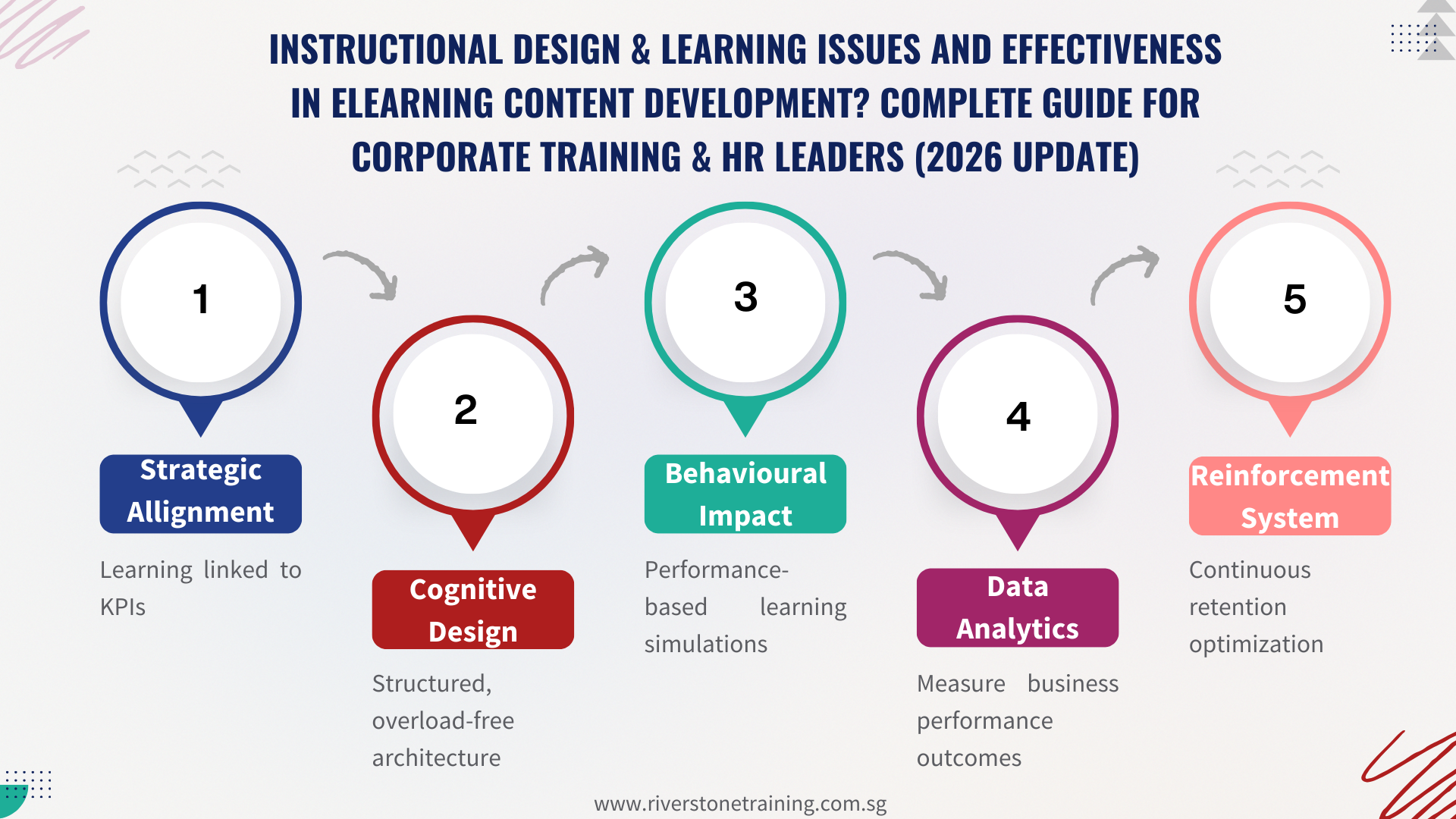
6 Major Problems on Instructional Designing and the Learning Effectiveness
1. Their Lack of Business Congruence
Lack of alignment between learning objectives and reality of business performance requirements is one of the greatest shortcomings of the corporate training strategy. Numerous programs are built based on generic competency models, industry templates or historic course libraries instead of operational gaps. Consequently, the employees are likely to fulfill courses, score highly in quizzes, and report positive feedbacks- but the productivity, quality, customer satisfaction, and profitability do not improve.
Successful Elearning Content development should start with a good performance analysis. Learning leaders should not pose the question of what content we should deliver but rather ask, what problem in performance are we solving. This difference is the main alteration of courses. Learning outcomes are supposed to be formulated in the form of observable and measurable behaviors that are directly related to the key performance indicators. Indicatively, instead of saying that employees will comprehend compliance regulations, the goals must say that the employees will correctly implement regulatory protocols in the working processes without errors of documentation records.
Digital learning is more of a performance intervention and not a repository of content when there is a clear alignment. The measurable outcomes that the stakeholders can follow are the decrease of the error rates, the increase of the customer conversion rates, or the speed up of the project completion schedules. Strategic alignment can be used to meet the needs of making sure that the Elearning Content development can help business sustainability but not to be a disjointed HR project.
2. The Weak Content Architecture and Cognitive Overload
One of the most underrated threats to the learning effectiveness is cognitive overload. In most online courses, students are presented with voluminous information, explanations, and complicated visuals not in any sequence. There is a limited capacity of working memory. On overloading, they get tired, lose interest and the retention levels decrease.
In the Elearning Content development, structure is significant than design. The content has to be divided in systematic modules that take logical development lines. Basic knowledge must come before practical situations. Ideas ought to be constructed in a progressive manner and not to seem detached.
The cognitive load theory proposes that learners remember information better in small bits that are facilitated by contextual examples. Spaced repetition reinforces memory consolidation whereas retrieval practice improves long-term memory. The absence of these mechanisms can result in insignificant long-lasting learning results even when the quality of multimedia presentations is high.
Companies that redesign their courses based on the principles of cognitive science find that there are higher retention rates, greater consistency in performance following the training, and lower costs to retrain.
3. Passive Learning and Minimal Interaction
The challenge in the digital learning programs is consistently the excessive use of passive content forms. Slide presentations translated into e-learning courses, taped lectures and reading materials are perhaps effective to create, but do little to spur applied thinking or behavior change.
The contemporary Elearning Content development focuses on the active involvement as an organizational necessity and not as an ornamentation. The interaction should be mental and not visual. Students are expected to be able to analyze situations, make decisions under trade-offs, contextual problems, and consequences.
The fundamentals of simulations and branching case studies (scenario-based) enable learners to be exposed to the multidimensional aspects of workplace issues. They do not just receive explanations of the policy but maneuver ethical dilemmas. They do not learn the principles of leadership by heart, but through practice, they engage in conflict resolution discussions. During the active participation, the neural pathways that are related to applied reasoning are strengthened, and the probability of a real-world transfer is high.
Learning becomes consumptive when the engagement is formulated by having purposeful convergence to the performance objectives.
4. Low Real-World Application and Transfer of Skill
The disconnect between the learning and the working life is one of the most frequent learning failures. Workers might be knowledgeable about the theories but they may not be able to use them in practice and when they are under pressure at work. This disparity lowers ROI and leaves leadership teams frustrated who seek to see an improvement.
High-impact Elearning Content development helps close this gap by integrating real job-related situations into the digital modules. The content must mirror real world processes, decision making and limitation that employees face in their day-to-day activities. The practice activities should be realistic and consist of simulating the complex nature of work, where the learners expect to process information, prioritize, and assess the outcomes.
As an illustration, there can be customer service education, which is simulated customer interaction, based on empathy, negotiation, and interpretation of policies. Compliance modules can also include actual regulatory documentation cases. There can be sales programs which mimic negotiation settings with dynamic objections.
Transfer design helps in guaranteeing that the learning investments generate behavioral change. Experience is converted into practicable ability, and the measures of performance are observable change.
5. Ineffective Assessment Models
Conventional evaluation methods are usually reserved to recall based tests which evaluate short term memory as opposed to applied competence. Although multiple-choice testing is simple to administer, it does not give much information about the preparedness to work in a complex environment.
Strong Elearning Content development consists of performance based evaluation models. There are better indicators of proficiency in the skills, which are provided in simulations, scenario analysis, applied projects, and peer-reviewed assignments. The evaluations must reflect the real world operation, quality of decisions and strategic thinking and not memorization.
In addition to course-based assessment, organisations should be able to tie learning involvement in the long-term business performance. The reduction in errors, better retention of customers, accelerated onboarding schedule, and higher productivity are more indicative of impact.
The end of evaluation should not be at completion of the course. Urgent measurement confirms that behavioral change is maintained after a certain period and that learning interventions need improvement.
6. Absence of Reenforcement and Retention Strategy
Without reinforcement, there is no way that learning will not decay. Studies have always shown that new knowledge obtained reduces quickly when not re-read or put into practice. A lot of organizations develop training as a single intervention approach as opposed to a continuous developmental ecosystem.
Sustainable Elearning Content development incorporates reinforcement strategy in the overall learning structure. Microlearning recapitulations that are administered at key times will reinforce the basic concepts. Nudges on performance remind employees of the best practice when undertaking key workflows. Social reinforcement is offered by coaching and peer collaboration forums.
Spaced repetition and retrieval exercises help in improving neural consolidation.. Reinforcement would then turn single occurrences of learning into permanent behavioral patterns. Organizations that have embraced reinforcement ecosystems have reinforcement retention, less compliance risk, and long-term performance improvements.
The Learning Effectiveness and instructional Design in elearning content development
In case strategic alignment is the purpose of digital learning, instructional design is the determiner of the success. Companies tend to spend more money on high-resolution videos, advanced animation and enhanced learning management systems and ignore the need to ensure cognitive effectiveness. The lack of instructional sophistication cannot be made up by visual sophistication.
According to the intersection of behavioral science, cognitive psychology, and business strategy, true excellence in the Elearning Content development will be achieved.
Behavioral Change: Design
The mainstream corporate learning focused on the delivery of information. Definitions were read, policies were reviewed, and quizzes that were aimed at assessing recall were taken by employees. Memorized knowledge is however not a sure way of operational competence.
The development of high-impact Elearning Contents should start with the identification of the behavioral shifts. The question that designers pose is what the employees should do differently after training. Digital modules are designed based on real decision points as opposed to the theoretical explanations.
Simulations of branches, case studies within context, and interactive decision trees recreates complexity at the workplace. Learners are punished on the decisions they make, which makes them accountable and critical thinkers. Organizations enhance applied competence by emphasizing on performing and not memorizing.
Behavior-based design provides confidence and eliminates variability in performance. The reasoning abilities of employees are applied to real-life situations, and not the abstract comprehension.
Architecture Engineering
The human cognitive ability is limited. Good Elearning Content development takes into consideration these limitations and designs content in this way.
In modularized systems, overload is minimized. Retrieval practice improves the memory. Consolidation is improved in case of delayed reinforcement. Sequential scaffolding advances the students of the basic knowledge to practical mastery.
Retention is not accidental. It is developed in a consciously designed sequencing and strengthening processes. Companies that incorporate the concepts of cognitive science in digital learning have a more uniform performance in the long-term and decline in knowledge is lower.
Intentional Interaction and Implemented Interactivity
The level of interactivity should serve the learning goals and not to disturb them. Gamification, animation and multimedia features are worthwhile only when they are in tandem with behavioral results.
In the strategic Elearning Content development, human interaction mechanisms are used to recreate actual working conditions. Performance appraisal discussions can be re-created using leadership modules. Regulatory noncompliance can be shown in the compliance courses and must be addressed through remedial measures. Sales programs can play out negotiation dynamics with changing responses in clients.
Learning becomes experiential when it is reflected in the workplace pressure. Performance rehearsal allows employees to train with increased safety and confidence in psychologically safe settings.
Measuring Real Impact of Learning
Superficial measures like completion rates and satisfaction surveys do not give much information on impact on organisations. Strong performing companies use long-term behavioral and business KPIs to assess the development of Elearning Content.
The analysis that can be undertaken after the training can be productivity, quality audit, customer feedback, and manager performance. In case behavior changes are not observed, content is shaped. The digital learning process should continue to be in line with changing strategic priorities through continuous iteration.
Evidence based appraisal converts training to a cost centre to a quantifiable investment. Leadership has a clear view as to the contribution of capability-building initiatives to profitability and risk mitigation.
Elearning Content Development Strategic Governance
Outside mechanisms of instructional design, the sustainable achievement of Elearning Content development must be a sustained governance structure that facilitates consistency, scalability and strategic governance. Most organizations have invested in quality learning programs but do not have a centralized model of governance to regulate standards, updates, and alignment to other departments.
The absence of governance makes digital learning ecosystems fragmented. Courses are commissioned in independent departments whose messages are considered to be inconsistent, redundant, and with overlapping objectives. This decentralization is a setback to efficiency and performance tracking.
Strategic governance also puts in place standardized development models, branding conformity policies, compliance validation policies, and KPI alignment policies. It makes sure all learning initiatives, whether they are departmental or not, are in line with enterprise-wide ability objectives.
An Elearning Content development strategy is well governed and involves:
- Easy to follow instruction standards.
- Specific content refresh rates.
- Version control mechanisms
- Data reporting protocols
- Dashboard of performance at the executive level.
Governance helps to convert digital learning in individual projects to an integrated enterprise capability system.
The use of Data Analytics in Ongoing Optimization
Advanced learning analytics is one of the most potent facilitators of current Elearning Content development. In the past, the completion rates and learner satisfaction surveys were used as the main means of evaluating training programs. These measures are very useful but they do not reflect the actual performance impact.
Organizations utilize integrated analytics in the year 2026, which monitor behavioral patterns in the digital learning platforms. Heat maps are used to identify the modules that cause confusion. The drop-off analytics identify the points of disengagement. Scenario results point to the flaws of decision-making.
Learning leaders are provided with actionable intelligence when these insights are linked to the operational KPIs, i.e., the sales performance, the compliance accuracy, or the production efficiency. It is possible to modify content by use of evidence and not guesswork.
Speaking of which, assuming that analytics reveal that learners constantly have difficulties with regulatory decision simulations, proactive implementation of reinforcement modules may be allowed. In case onboarding cohorts are less productive than expected to ramp-up, it is possible to recalibrate scenario difficulty.
This is due to continuous optimization that sees Elearning Content development keeping up with organizational requirements. It is made a dynamic system instead of a dead library.
Workforce Performance System Integration
Integration with the wider talent management infrastructure is the other important aspect of advanced Elearning Content development. There should be no learning without performance reviews, succession plans, or competency mapping frameworks.
With the digital platforms being connected to the performance management systems, gaps in skills can be identified on-the-fly. Managers are able to implement specific learning interventions in accordance to each development plan. The employees understand the way of growth and the opportunity of promotion.
This is an enhanced accountability. Studying is no longer an optional extravagance- it gets integrated into career advancement systems. The reference list of skills acquisition in the performance appraisals confirms the relationship between taking part in learning and career growth.
Organizations who combine Elearning Content development with talent analytics record better retention rates and effective leadership pipeline development.
Workforce and Global Workforce
Scalability is becoming a decisive force in digital learning strategy as businesses become global. Elearning Content development should support multilingual labor force, cultural diversity, regulatory difference, and dispersed operation models.
- Scalability all over the world needs:
- Localization systems of language adaptation.
- Contextualization of Case studies and scenarios.
- Localized compliance modification.
Mobile-first development of various infrastructure environments
What works in one location might need some contextual modification in a different location. The contexts of training in leadership have to expose cultural communication norms. The compliance modules should be in tandem with the local regulatory frameworks.
Scalable architecture allows world-wide businesses to operate with equal standards in the capabilities without infringing on the geographical peculiarities.
Augmented Instructional Design Processes with AI
It is not only that artificial intelligence is changing the experience of learners, but it is also changing the development workflow in Elearning Content development teams. AI-based applications can help draft scripts, create voiceovers, offer suggestions on visual content, and tag content.
The technologies reduce production time lines and ensure that production quality remains consistent. Nevertheless, AI should supplement and not substitute human teaching skills.
Strategic instructional designers decipher business needs, implement the principles of behavioral science, and arrange performance-based experiences. AI is not a replacement of strategic thinking but rather a complement to it.
When implemented in an organization in a responsible manner in the Elearning Content development workflows, organizations that implement AI in their workflows experience a quicker deployment cycle yet retain the cognitive integrity as well as business alignment.
Risk Introduction Risk Mitigation Structured Learning Design
Losses and breaches of compliance, operations, and safety are associated with high financial and reputational risks. Powerful Elearning Content development serves as a risk preventive measure.
Simulated scenarios provide the employees with high-risk decision-making exercises in virtual safe settings. Branching ethical dilemmas that represent actual regulatory pressures may be included in compliance training. Training in the form of safety modules can be designed to mimic the situation that endangers the safety of individuals, and the compliance with the procedures can be strengthened without any physical exposure.
Entering risk awareness into instruction architecture helps organizations lessen the frequency of incidents and make their regulation defensible. Due diligence in regulatory audits is evidenced by training records, performance analytics and mechanisms of reinforcements.
Learning, therefore, is not only a growth engine, but also a safety measure.
Micro learning Ecosystems and Performance support
Although previous sections touched upon the strategies of reinforcement, the development of microlearning should be considered. Contemporary Elearning Content development is based on microlearning not only as supplemental content but also as a constant performance support system.
Microlearning units are a calculatedly introduced point of workflow. Organizations do not expect employees to memorize complicated procedures but place searchable micro-units in digital dashboard.
For instance:
- The sales representatives get access to tips on negotiation prior to meeting the clients.
- Safety measures are examined by health workers before operations.
- Quality checklists are used by manufacturing supervisors when auditing the production.
This just-in-time structure increases trust and lessens intellectual tension. Microlearning moves towards reinforcement, to operational augmentation.
Microlearning systems, with the support of analytics, change according to the usage trends and the detected skill deficits, contributing to the overall effectiveness of the Elearning Content development.
Accessibility and Human-Centered Design
Human-centered design is essential even in the era of advanced technologies. The development of Elearning Content should be focused on the aspects of accessibility, usability, and psychological inclusiveness.
Accessible design includes:
- Clear navigation pathways
- Readable font and graphical contrast.
- Sounds and closed capturing.
- Assistive technologies compatibility.
Inclusivity is not limited with technical compliance. The content should be such that it shows different points of view, not cultural bias, and it should also be representative of the different workforce demographics.
It is also important to have psychological safety. Students have to be free to discuss situations, commit mistakes, and get feedback without embarrassment. Learning environments that are safe allow experimentation and more engagement.
Human centered design enhances levels of trust, participation and effectiveness in the long run.
Leadership Engagement and Cultural Strengthening
The culture of learning is one of the factors that determine the effectiveness of Elearning Content development programs. When leadership makes training optional, the employees will respond to the same.
Managers and senior executives should be exemplary in learning participation. Online coursework, reinforcement talks at team building sessions, and the social support of ability building programs strengthen organization commitment.
When leaders incorporate learning goals in performance discussions, employees understand that skill improvement has a bearing on career progression. The instructional design is enhanced by cultural reinforcement.
Conclusion
Elearning Content development is a strategic discipline, which brings together business alignment; cognitive science, behavioral engineering and performance measurement into a unified capability-building system in 2026. It is no longer enough to create aesthetically attractive online modules. Education programs should be designed in a manner that facilitates quantifiable transformation.
Organizations can make digital learning a performance accelerator by resolving the most important instructional design problems the alignment, cognitive structure, engagement, application, assessment, and reinforcement.
With the right strategic focus and instructional accuracy, Elearning Content development can be a multiplier of productivity, a compliance control, and a sustainable competitive advantage. The future of business success is not creating more content, rather it is creating smart learning environments that directly influence the ability of the workforce and the output of the organization.