
Financial Modeling Training Programs for Investment Banking and Private Equity
Comprehensive Financial Modeling Programs
Financial modeling has become a necessity rather than an option in the competitive corporate finance environment, which determines the performance and reputation of investment experts. In the case of investment bankers and private equities, financial modeling is the basis of valuation, structuring a deal, and investment decision-making. With the increasingly complex and data-driven nature of transactions, there is a definite demand of highly specific and practical and advanced training programs that will prepare professionals in the field of finance with the means to analyze, predict, and make deals successfully.
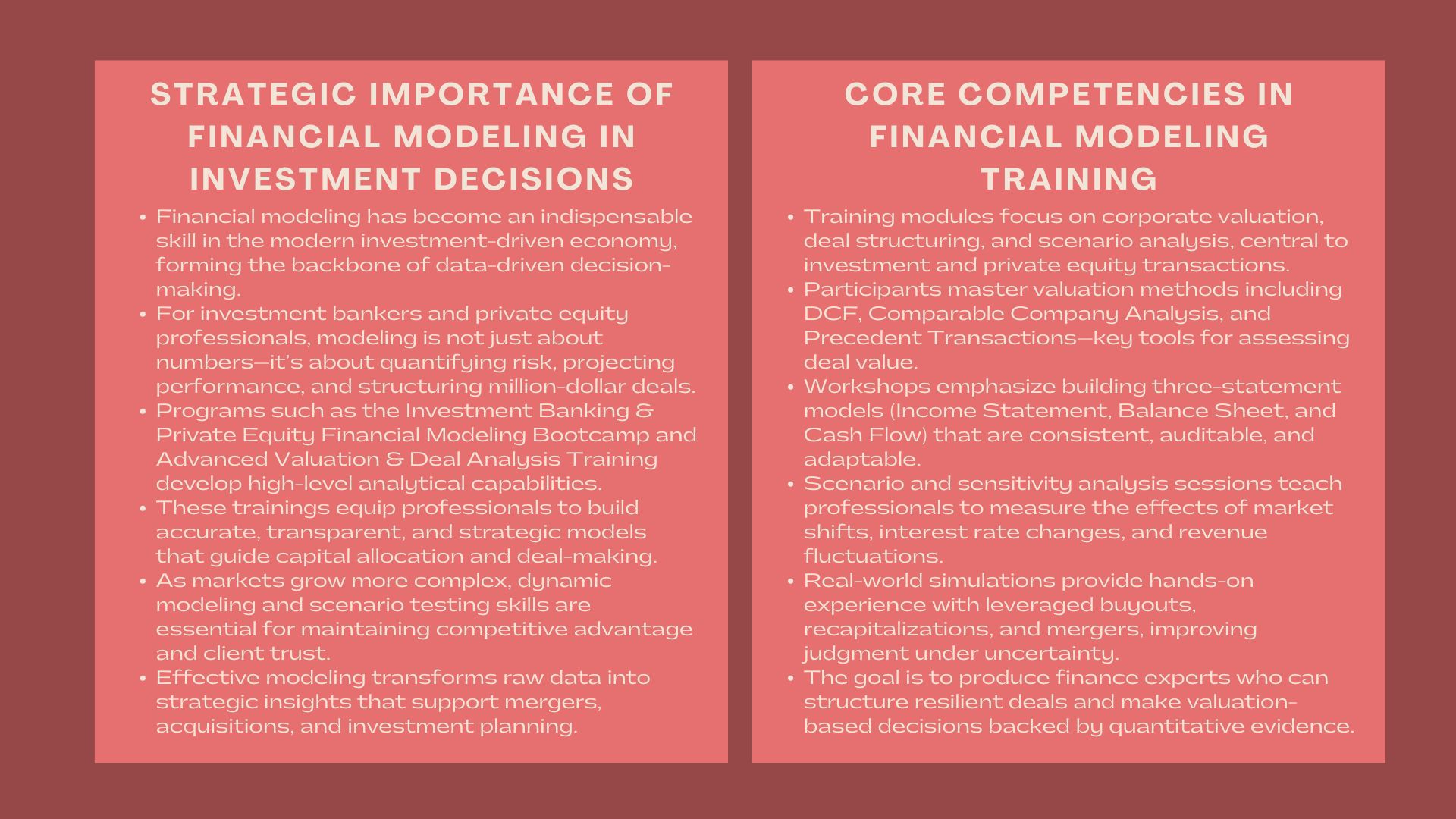
Finance-specific courses such as investment banking and private equity financial modeling bootcamp and advanced valuation modeling and deal analysis training can be used by finance professionals who want to enhance their analytical and strategic skills. These events fill the cavity between theory and practical implementation, providing the participants with the capability to model deals, risks, and make informed investment decisions both accurately and precisely.
Establishing the Excellence of Financial Modeling.
Comprehending the Foundational Principles.
The Investment decision-making is supported by financial modeling. It entails the conversion of financial data into coordinated forecasts and analysis which underlies strategic recommendations. The students of such training programs get to know how to build full-colored models that combine income statements, balance sheets, and cash flow statements without having logic and analytical sense.
It does not only deal with spreadsheet mechanics, but more with financial interpretation, how numbers indicate the performance, potential, and risk exposure of a company. This method assists the participants to acquire technical and conceptual know-how required in strategic financial analysis.
It is the Static Models and Dynamic Decision Tools.
The use of the traditional and usual static financial models has been surpassed by the dynamic and scenario-driven tools simulating the uncertainties in the real-world. In contemporary training courses, the participants are taught how to develop models that automatically adapt to the evolving assumptions like interest rates, inflation, market demand and capital structure.
Development of flexible models allows the profession in finance to sample a variety of outcomes and offer the data-oriented recommendation to management or investors that help in making high-stakes decisions.
Rationality (Value) of Structured Training of Investment Professionals.
Hands-On, Practical Learning
Investment banking and private equity financial modeling bootcamp provides an applied model where the participants develop models by constructing them separately, through case studies. These case exercises will include such situations as mergers and acquisitions (M&A), leveraged buyouts (LBOs), initial public offering (IPO), and capital budgeting.
The steps are followed from the collection of financial data all the way to the development of valuation models and the scenario analysis. The outcome is the overall knowledge of how raw data can be converted to actionable insights that can be used to execute deals.
Bridging Valuation and Strategy
While financial modeling is a technical skill, its true value lies in how it supports strategic decisions. The advanced valuation modeling and deal analysis training teaches professionals to interpret results in context—linking model outputs with real-world investment considerations such as growth prospects, market positioning, and risk-adjusted returns.
Being able to relate financial indicators to strategic thinking allows the participants to be able to view investment opportunities as a whole and effectively communicate what they have learned to the stakeholders.
Critical Focus Areas of Financial Modeling Training.
Corporate Valuation Techniques.
The fundamental component of any financial modeling program is valuation. Some of the approaches that participants examine include Discounted Cash Flow (DCF) analysis, Comparable Company Analysis and Precedent Transaction Analysis. They are taught to determine intrinsic value, critical value drivers and use sensitivity analysis to determine the extent to which minor assumptions change could affect the results of a deal.
There is also a foregrounding of market data and peer benchmark integration in the workshops to have a validation of valuation results and consistency with industry standards.
Deal Structuring and Leveraged Buyout (LBO).
LBO models are quite essential in enabling the individuals in the field of private equity to identify the viability of debt-based acquisitions. The training sessions take the participants through the procedure of building a complete LBO model- the estimation of multiples of entry and exit, forecasting schedules of debt, and the assessment of returns to investors.
Using real world case study, learners are able to understand how to recognize value creating opportunities, financing levels, and building deals that balance between risk and profit.
Scenario and Sensitivity Analysis.
Due to uncertainty in financial markets, scenario and sensitivity analysis has now become a fundamental constituent of modeling. Participants are taught the skills of determining the best-case, base-case, and worst-case scenarios to determine the possible outcomes of investing.
With the help of such tools as data tables, scenario managers, and probability-weighted models, professionals can give decision-makers more detailed risk-adjusted data.
Beyond Investment Banking and Private Equity Applications.
In the case of Investment Banking Professionals.
In investment banking, the models are applied in the advice of valuation, pricing of deals, and structuring of transactions. A set of training programs is offered on how to model transactions that are complex e.g. mergers, acquisitions and raising of capital. The subjects also enable the participants to be exposed to the more sophisticated accounting of transactions such as purchase price allocation, goodwill impairment, and synergy realization.
Through such skills, investment bankers are better placed to handle the execution of deal, offer correct valuations, and offer client-oriented advisory services.
In the case of Private Equity Professionals.
Financial models are applied by the professionals of the private equity to identify and analyze investment opportunities. The training on the advanced valuation modeling and deal analysis puts special emphasis on LBO modeling, portfolio management, and exit analysis. The participants become capable of testing the conditions of returning, defining the value drivers, and predicting the effects of the improvement of operations.
They also get to know how to apply post-investment monitoring in the form of financial dashboards to monitor performance indicators in order to make proactive decisions during the investment lifecycle.
Application of Technology and Automation in Financial Modeling.
The Change to Intelligent Modeling.
Automation is an emerging trend in modern finance teams with the aim of enhancing efficiency and accuracy. Workshops expose participants to the techniques of Excel automation, VBA scripting and add in features which are used to simplify repetitive modeling processes.
Moreover, through the application of visualization applications such as Power BI, analysts can construct interactive dashboard and turn the non-interactive models into interactive communication tool, which enhances the transparency of decision-making.
The Analytics and Data Model Integrity.
Accurate training focuses on data-based modeling – the combination of huge data quantities, industry standards and economic signals into the financial outcomes. This enhances accuracy in addition to allowing the participants to spot the new patterns that might affect the investment performance.
The participants will also be taught the model audit techniques that will guarantee integrity, traceability and adherence to the corporate governance standards.
Professional and Institutional Benefits.
Personal Professional Development.
In case of the professionals in the field of finance, financial modeling is a key to the advancement of the career. Graduates of the investment banking and private equity financial modeling bootcamp gain a competitive edge by developing skills that are directly applicable to high-stakes deal environments.
Analytical confidence also improves the skill to build and understand complex models, and therefore, allows professionals to have more strategic discussions with their clients, investors, and the management.
Organizational Benefits
The companies which invest in systematic training of financial models acquire more analytical groups which can help them in complex transactions with accuracy. The improved modeling facilities enhance good quality of decision making, less exposure to risks and the internal reporting structures.
Companies, which promote life-long learning, also develop a culture of analytical superiority and fiscal responsibility leading to even greater capital allocation and higher ROI.
Maintaining Financial Competence in the Long Run.
The constant learning and specialization.
The financial sector is dynamic and the valuation procedures, assumptions in the market and regulatory requirements keep changing. Training programs make the participants embrace the culture of lifelong learning. Advanced workshops, case-based learning and refresher modules keep the professionals informed about the most current trends in the field of valuation, technology and financial analytics.
Strategic Perspective: Developing a Strategy.
In addition to technical modeling, the participants are also taught to think as a strategic advisor. This involves the knowledge on how the financial results impact the corporate strategy, the investor relations and the value creation over the long term. Incorporating both analytical insight and strategic vision, the contribution of finance professionals may be taken to a new level, the level of a leader.
Conclusion
In current finance world where there is a high rate of change, analytical accuracy, as well as modeling skills cannot be afforded to investment bankers, and other professionals in the field of private equity. The investment banking and private equity financial modeling bootcamp and the advanced valuation modeling and deal analysis training are only some of the programs that can offer that all-encompassing, practical experience of being able to go through the complicated deals with confidence.
Through technical expertise, strategic knowledge, and practical practice, these training programs enable finance professionals to provide more powerful valuations, intelligent deal analysis, and more effective investment decisions that lead to success in the long term.