Structuring Customer Experience Workshops for Healthcare and Corporate Teams
Introduction to Certified Customer Experience Workshop Training
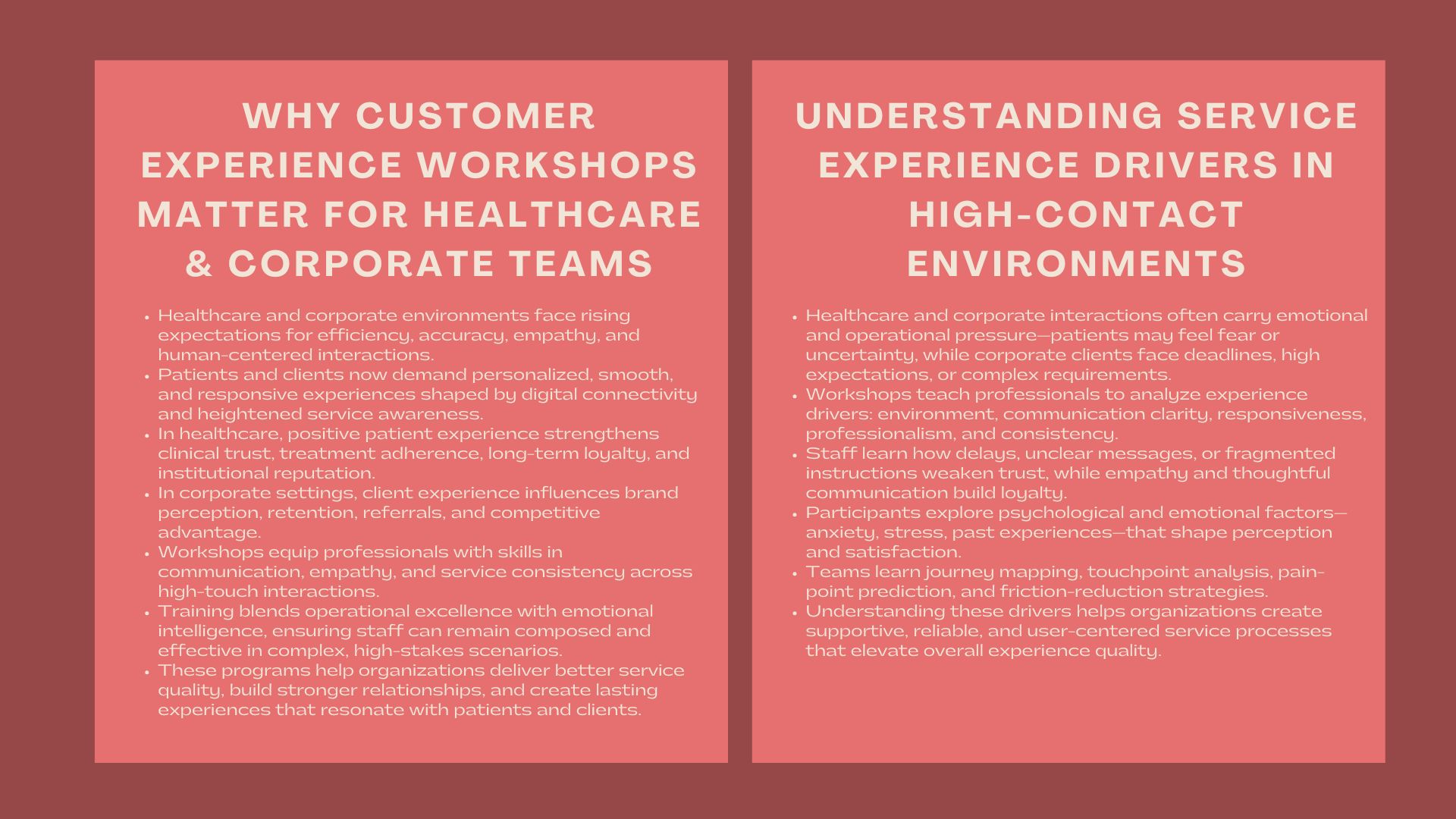
The healthcare facilities and business corporations today exist in the rapidly changing environments, where the demand towards the quality of provided services, as well as their interactions with clients, is growing at unprecedented rates. Demands of patients, clients, and customers are now characterized by a certain level of efficiency, accuracy, as well as empathetic, smooth, and individualized interactions. This emerging trend is indicative of overall social transformations, such as the expansive spread of digital connectivity, increased sensitivity toward service quality, and increased enthusiasm when it comes to experiences that are personal, responsive, and human oriented.
In the case of healthcare providers, clinical trust and treatment adherence as well as long-term patient loyalty directly rely on the positive patient experience. When a patient understands and supports them, better chances are getting the expected treatment plans, follow-ups, and making others aware of the positive experience they go through which further improves the reputation of the institution.
On the same note, in the corporate setting, client interaction is very critical in influencing brand perception, aiding in client retention, and in ensuring an organization retains a competitive advantage among other businesses in the same market settings. Such companies place the emphasis on superior customer experience and usually experience quantifiable customer satisfaction, referral rate, and customer growth to an organization.
With rising demands of customer satisfaction at the service end, organizations are finding it important to consider customer experience training programs to be structured to provide employees with knowledge, skills, and behavioral competencies to facilitate excellent interactions at all high touch points. Not only do these workshops discuss operational efficiency, they also concentrate on the emotional and relational side of service offering, equipping the participants with the means of staying composed and moving forward into complicated, customer experience design and service excellence workshop high-stakes situations.
Be it as a combined customer experience design and service excellence training and development experience, or that of patient and client satisfaction that is designed to meet the needs of specific healthcare organizations and consumer-related teams, these initiatives enable professionals to improve the quality of their services, build stronger relationships and offer lasting experience that appeals to their consumers.
Enhancing Service Excellence Capabilities Across Healthcare and Corporate Settings
Understanding Experience Drivers in High-Contact Service Environments
Service interactions in healthcare settings as well as corporate settings are often characterized by sensitive and high-impact interactions that influence the perceptions of clients towards the safety, trust, and value. The patient can find themselves in a state of apprehension or skepticism or defenselessness particularly where he or she is not aware of the medical procedures or medical outcomes.
In the same way, corporate clients can be those who have demanded services with a strict deadline, high demands, complex requirements where even a single slip can affect satisfaction, maintaining, or brand loyalty. Such emotional and situational processes are very vital in influencing the way people perceive the standard of service they have received and therefore, it is necessary that professionals be aware of the determinants that lead to experience outcomes.
Customer experience workshops assist the attendants analyze these experience drivers at depth levels. Employees get to understand the impact of the environmental condition, communicative nature, responsiveness, clarity of information, and consistency of operations in terms of overall judgement of service quality. The respondents rely on real life scenarios like how poor timeliness in responding, disjointed instructions, lack of professionalism, or poor explanation of the message may destroy trust where careful and understanding interaction positively impacts satisfaction and loyalty.
Organized learning programs also enable those to gain awareness of psychological and emotional aspects which affect the expectation of the clients. Through learning to identify the role of anxiety, stress or past experiences in perception, professionals are able to act in the context to which they can be sensitive to the body of anxiety, stress or past experiences they have had, therefore making every interaction unlike the other non-functional and meaningless.
This knowledge can inform the practices of healthcare providers to ensure that patients do not suffer as triggered by the knowledge, that enhance good compliance to treatment procedures, and that promote holistic care. In the case of an organizational team, it helps in directing the patient and client satisfaction training for healthcare and corporate staff strategies of managing relationships with clients, solving problems, and delivering services that promote credibility and brand value to the organization.
In addition, knowing about these experience drivers would help organizations to create service processes that could preemptive favorable experiences. The teams are able to direction-find the patient and/or customer journey, establish the key touchpoints, predict pain points, and apply friction-reduction strategies. This understanding empowers the institutions to build environments that appear accommodating, receptive and congenial to service excellence ideals, which forms a platform of long term progress in service delivery channels.
Building Empathy-Based Skills for Patient and Client-Centered Interactions
Sympathy has been well established as the most important service trendsetter. The stakes in healthcare are especially high, because discomfort, fear, or uncertainty of patients usually can affect their capacity to interact with care. In order to form trust, enforce compliance to treatment plans and facilitate positive experiences, demonstration of compassion, active listening and emotional intelligence is necessary. In business contexts, customers also demand care, dignity, and sincere empathy to their needs especially through the elaborate service request or troubleshooting.
Customer experience workshops are oriented towards the development of empathetic based skills that enable the professionals to relate with clients and patients in an authentic manner. The participants are also conditioned to understand the significance of non-verbal behaviors, identify emotional conditions, and act in clarity and sensitivity. They discuss ways to organize conversations that can legitimize worries, convey information in the most effective ways, as well as alleviate doubts. This could be incorporated into healthcare-oriented patient satisfaction schemes such as procedure explanation protocol, dealing with anxieties, or overcoming awkward discussions on prognosis, or treatment choices. It may also include active listening, dealing with client expectations and providing constructive solutions in high intensity engagements in corporate programs.
The issue of emotional intelligence as part of service recovery is also highlighted during workshops. It trains staff on how to maneuver through the situations that may lead to dissatisfaction, uneasiness or confrontation so that the interaction is achieved with patience, professionalism and calmness. With the help of scenario-based exercises, the participants become sure of their ability to de-escalate tension, address the concerns efficiently, and, in the end, leave the clients/patients in a state of respect and satisfaction. By sacrificing technology to enhance human feeling, an organisation can reinforce long term relationships and improve the quality of service in general thus making the experience to be not only efficient but also humanistic.
Core Components of Customer Experience Workshop Development
Designing Sustainable Experience Frameworks for Service-Driven Organizations
The customer experience workshop is well-organized starting with the development of structures that would help in designing, delivering, and assessing the interaction through service. These frameworks make consistency in standards of service delivery across departments, roles and touchpoints creating a stable and predictable client experience. The participants investigate the methodologies of mapping the customer journey, modeling communication, service flow analysis, and touchpoint optimization and know how to convert all this knowledge into applicable guidelines that can be applied in everyday life.
Such structures in the healthcare field may revolve around improving patient intake, minimizing the procedural misunderstanding, improving patient comfort, and enabling the smooth flow of care across the multidisciplinary teams. At the corporate levels, they could entail the creation of predictable, precise, and opportune interactions that are consistent with brand values and the customer expectations. Significantly, these systems are flexible to both physical and online systems of service delivery, and therefore, the experiences of the clients are seamless in whichever manner they approach the organization.
It is also in the framework development that there is an inclusion of mechanisms of measuring quality of experience. The participants are trained on how to decode satisfied measurements, feedback analysis, and how to change operations processes so as to meet client expectations. Through installing these evaluation systems, organizations establish viable frameworks on a sustainable continuous improvement, strengthen the culture of excellence and accountability.
Developing Communication Mastery for Engaging and Responsive Interactions
All successful service interaction deals with effective communication. Workshops impart to participants the methods of giving information in a clear, accurate and empathetic manner that will minimize chances of misinterpretation and will make clients less cautious. Experts are taught how to design discussions and give appropriate explanations as well as controlling expectations in various situations.
In the medical geographical context, communication skill is essential in explaining the medical procedures, addressing the issues of patients, and taking people through complicated treatment regimens. Learning how to communicate is of value to corporate employees in terms of presenting briefs to the client, negotiating with them, explaining the processes and solving problems. Training focuses on the adaptation of communication in different settings, such as the use of digital correspondence, the workplace under pressure, cross-cultural relations, as well as teamwork in various functions.
The ability to enhance communication also helps the professionals to be better equipped in developing trust, minimising friction as well as increasing general client satisfaction. The competencies are needed in organizations that want to continue with the high level of services and guarantee the positive experiences throughout the points of interaction.
Implementing Customer Experience Training Across Healthcare and Corporate Teams
Tailoring Experience Training to Sector-Specific Operational Realities
The nature of operational reality in both healthcare and corporate industries are two quite distinct entities, and training programs should be crafted as much as possible to suit the situation. Any healthcare setting is extremely emotionally charged, requires regulatory adherence, and has complicated care trajectories, with the interdisciplinary coordination. Corporate cultures are focused on efficiency, professionalism, brand loyalty and addressing the needs of a client.
Healthcare team-based workshops concentrate on the communication with patients in a patient-centered manner, emotional sensitivity, precise care pathway, and collaboration by some disciplines. Programs that are corporate-oriented emphasize strategies of getting into contact with clients, brand-centered messages, service recovery methods, and responsiveness in operations. Tailoring training would mean that the participants will go through relevant and practical learning that is role specific and can be applied instantly in the work situation enhancing the chances of long-term effects.
Simulations and realistic case scenarios are also a part of sector specific training which enables participants to train in the situations which resemble their daily difficulty. Such a practical method reinforces the connection between learning at the workplace and the performance in the workshop, as well as the confidence and competency.
Strengthening Team Integration and Service Consistency Across Departments
Customers demand high-quality customer experiences, and for this purpose, it is not just the personal workplace skills that are needed but also effective cooperation in the departments. Internal alignment makes everything provide a value to the larger service journey. This is coordination of administrative personnel, nurses, physicians, and technicians as well as care coordinators in healthcare. On the corporate level, it necessitates a smooth communication between the sales, operation, support and management teams.
Workshops introduce the participants to value themselves as part of the service ecosystem, interdependencies, and they are taught to behave collaboratively to increase service continuity. Methods of information sharing, coordination of tasks and post-regular communication are highlighted to minimize errors, poor communication and tension.
Organizations can integrate high quality in the day-to-day activities by inculcating a culture of collective accountability towards service excellence. The combined teams create the smoother client and patient experiences by creating experiences that seem to be cohesive, professional, and considerate throughout the touchpoints.
Promoting Cross-Functional Collaboration for Seamless Service Delivery
To provide unprecedented customer experience, one needs more than just the personal ability, but one needs effective interdepartmental cooperation as well. Internal alignment will take into consideration the fact that every interaction will add value to the larger service journey. This also entails collaboration between the administrative personnel and nurses, physicians, technicians and care coordinators in the health sector. It should allow smooth communication between the sales, operations, support and management teams in the corporate environment.
These workshops can educate participants to recognize the value of their participation in the service ecosystem and the value of interdependencies, as well as teach them the ability to engage in collaborative behavior to ensure the service continuity. Methods of information sharing, coordination of tasks, and regular communication are highlighted in an attempt to minimize mistakes, miscommunication, and friction.
With the culture of collective responsibility on service excellence, an organization would be able to instill high-quality standards in day-to-day functioning. Teams that are integrated offer easier client and patient experiences, providing them with opportunities to have interactive and responsive experiences throughout all touchpoints.
Conclusion
Customer experience workshops Current investment is highly important in healthcare and corporate companies that want to promote the degree of service as well as customer satisfaction and develop trust in the clients and patients. Under systematic training professionals gain knowledge of the behavioral, communication, and operational skills required to provide interactions that would be responsive, steady and empathetic as expected by the modern standards.
Detailed customer experience design and service excellence workshops for healthcare and corporate teams provide teams with its frameworks of process improvement, touchpoint management, and consistency of service provision. In the meantime, patient and client satisfaction training by itself is patient-specific, and cultivates interpersonal competencies that are vital to negotiating sensitive, high-stakes or intricate interactions. With the focus on education in structured customer experience, organizations develop the cultures in which client and patient needs become central, contributing to the operational excellence and successful relationships in the long run.